

Vinit Pratap Singh
Department of Plant Pathology, Sardar Vallabhbhai Patel University of Agriculture and Technology, Meerut-250 110, Uttar Pradesh, India
Seweta Srivastava
Regional Plant Quarantine Station, Kolkata-700 097, West Bengal, India
Swapnil Kumar Shrivastava
Department of Biotechnology, Sardar Bhagwan Singh Post Graduate Institute of Biomedical Sciences and Research, Dehradun-248 001, Uttarakhand, India
H.B. Singh
Department of Mycology and Plant Pathology, Institute of Agricultural Sciences, Banaras Hindu University, Varanasi-221 005, Uttar Pradesh, India
Plant Pathology Journal
Year: 2012 | Volume: 11 | Issue: 2 | Page No.: 73-76


ABSTRACT
Trichoderma spp. are also known as effective bio-control agents against soil-borne pathogens of several important crops. Integration of chemicals and bio-control agents has been the subject of research during recent years. The potential value of bio-pesticides for the control of important plant pathogens requires investigation due to the general requirement for very low pesticide residues in foodstuffs and concerns over the increasing development of resistance to the different classes of chemicals. The aim of the present study was to check the compatibility of different insecticides viz., Decis (deltamethrin 2.8% EC), Ekalux EC 25 (quinalphos 25% EC), Fenval 20% EC (fenvalerate 20% EC), Hilcron 36 SL (monocrotophos 36 SL), Hildan 35 EC (endosulfan 35 EC), Hilmida (imidacloprid 17.8 SL), Marshal 25 E (carbosulfan 25% EC), Rogor 30% EC (dimethoate 30% EC), Rocket 44 EC (profenofos 40%+cypermethrin 4%) with V15 strain of Trichoderma harzianum Rifai. Mycelial growth of V15 strain of Trichoderma harzianum was calculated in the presence of above mentioned insecticides by using Potato Dextrose Broth (PDB) medium and SP3 medium separately. Hilmida (imidacloprid 17.8 SL) was found to be most compatible with V15 strain of Trichoderma harzianum in both the liquid media as it shows nil percentage reduction of mycelium. It was concluded that conclude that Decis (deltamethrin 2.8% EC), Hilcron 36 SL (monocrotophos 36 SL), Hilmida (imidacloprid 17.8 SL) and Rogor 30% EC (dimethoate 30% EC) are compatible insecticides with biocontrol agent (Trichoderma harzianum) while some insecticides viz., Ekalux EC 25 (Quinalphos 25% EC), marshal 25 E (carbosulfan 25% EC) and rocket 44 EC (profenofos 40%+cypermethrin 4%) inhibits the growth of Trichoderma spp.
PDF Abstract XML References Citation
Article History
Received: April 06, 2012;
Accepted: June 18, 2012;
Published: August 15, 2012
How to cite this article
Vinit Pratap Singh, Seweta Srivastava, Swapnil Kumar Shrivastava and H.B. Singh, 2012. Compatibility of Different Insecticides with Trichoderma harzianum Under in vitro Condition. Plant Pathology Journal, 11: 73-76.
DOI: 10.3923/ppj.2012.73.76
URL: https://scialert.net/abstract/?doi=ppj.2012.73.76
DOI: 10.3923/ppj.2012.73.76
URL: https://scialert.net/abstract/?doi=ppj.2012.73.76
INTRODUCTION
Trichoderma spp. are fungi that occur worldwide. Recent, studies show that these fungal parasites are able to produce antibiotics against plant pathogens. In addition, certain strains of Trichoderma spp. can induce systemic and localized resistance to several plant pathogens. Some strains may also enhance plant growth and development (Ha, 2010).
Biological control is an alternative to the use of chemical pesticides. Biological fungicides may act to suppress the population of the pathogenic organism through competition with pathogenic organisms, stimulate plant growth which may allow plants to quickly outgrow any pathogen effects, or damage the pathogen by means of toxins produced (Cook, 2000; Gilreath, 2002). Trichoderma spp. has received the most attention for control of soil borne pathogens. Trichoderma harzianum is a fungal biocontrol agent that attacks a range of phytopathogenic fungi. It can be used either alone or in combination with other Trichoderma species in biological control of several plant diseases (Papavizas, 1985; Chet, 1987; Samuels, 1996).
Although use of biocontrol agents could reduce chemical application to a limited extent, it is less reliable and less efficient (Monte, 2001). Integrated Pest Management (IPM) is an approach involving the use of biological, physical and chemical measures to manage pest and pathogen populations in a cost-effective ecological way. Within these complex plant protection strategies, one may need to combine biocontrol agents with chemicals to achieve the target (Kredics et al., 2003). The combined use of biocontrol agents and chemical pesticides has attracted much attention as a way to obtain synergistic or additive effects in the control of soil-borne pathogens (Locke et al., 1985).
The objective of the present study was to check the compatibility of different insecticides viz., Decis (Deltamethrin 2.8% EC), Ekalux 25% EC (Quinolphos 25% EC), Fenval 20% EC (Fenvalerate 20% EC), Hilcron 36% SL (Monocrotophos 36% SL), Hildan 35% EC (Endosulfan 35% EC), Hilmida (Imidacloprid 17.8% SL), Marshal 25% EC (Carbosulfan 25% EC), Rogor 30% EC (Dimethoate 30% EC), Rocket 44% EC (Profenofos 40%+ Cypermetrin 4%) with V15 strain of Trichoderma harzianum Rifai.
MATERIALS AND METHODS
Whole experiment was carried out in the year 2007 in the laboratory of Division of Plant Pathology, National Botanical Research Institute, Lucknow, Uttar Pradesh, India.
Estimation of compatibility of Trichoderma harzianum with insecticides: V15 strain of Trichoderma harzianum Rifai. was studied with nine insecticides viz. Decis (Deltamethrin 2.8% EC), Ekalux 25% EC ( Quinolphos 25% EC), Fenval 20% EC (Fenvalerate 20% EC), Hilcron 36% SL (Monocrotophos 36% SL), Hildan 35% EC (Endosulfan 35% EC), Hilmida (Imidacloprid 17.8% SL), Marshal 25% EC (Carbosulfan 25% EC), Rogor 30% EC (Dimethoate 30% EC), Rocket 44% EC (Profenofos 40%+ Cypermetrin 4%). Mycelial growth of V15 strain of Trichoderma harzianum was calculated in the presence of above mentioned insecticides by using Potato Dextrose Broth (PDB) Medium and SP3 Medium separately. Both recommended dose and double amount of recommended dose of insecticides were used separately in PDB and SP3 medium for the mycelial growth of V15 strain of Trichoderma harzianum. Take 10 mL PDB and 10 ml SP3 medium in 19 conical flasks, respectively. Add recommended dose (100 μL) of insecticides in 9 conical flasks of PDB medium and 9 conical flasks of SP3 medium aseptically. Similarly, add double amount of recommended dose (200 μL) of insecticides in 9 conical flasks of PDB medium and 9 conical flasks of SP3 medium. One flask of 10 mL PDB and 1 flask of 10 mL SP3 medium used as control without any insecticide.
Cut 6 mm discs of seven days old culture of V15 strain of Trichoderma harzianum Rifai. by the sterilized cork borer and put a single disc in each conical flask containing PDB and SP3 medium with the help of inoculating needle under aseptic condition. Then all the flasks are kept on shaker for a week. After that harvesting and weighing of fungal growth was done.
Calculation for the percent reduction of the mycelial growth of the Trichoderma harzianum: The percent reduction of fungal growth was calculated by using the following formula (Vincent, 1947).
 |
Where:
| C | = | Control |
| T | = | Treatment |
RESULTS
After the completion of the experiment, it was found that four insecticides out of nine viz. Decis (Deltamethrin 2.8% EC), Hilcron 36% SL (Monocrotophos 36% SL), Hilmida (Imidacloprid 17.8% SL) and Rogor 30% EC (Dimethoate 30% EC) are compatible insecticides with biocontrol agent (Trichoderma harzianum).
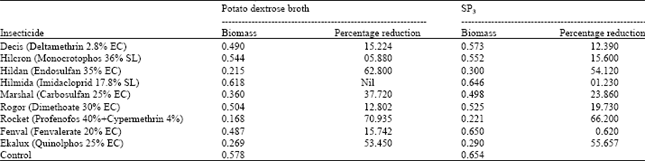
As the data revealed in Table 1 shows that at 100 μL concentration of insecticides used, the conclusion come according to the recorded data that in liquid media i.e., in Potato Dextrose Broth (PDB), Decis (Deltamethrin 2.8% EC), Fenval 20% EC (Fenvalerate 20% EC), Hilcron 36% SL (Monocrotophos 36% SL), Hilmida (Imidacloprid 17.8% SL) and Rogor 30% EC (Dimethoate 30% EC) are compatible with V15 strain of Trichoderma harzianum Rifai. in which Hilmida (Imidacloprid 17.8% SL) is most compatible by showing no percent reduction of Trichoderma harzianum. Marshal 25% EC (Carbosulfan 25% EC) shows medium compatibility because percentage reduction of mycelium is 37.720%. While Ekalux 25% EC (Quinolphos 25% EC), Hildan 35% EC (Endosulfan 35% EC) and Rocket 44% EC (Profenofos 40%+Cypermetrin 4%) are found to be incompatible with V15 strain of Trichoderma harzianum as they had shown more than 50% of percentage reduction of mycelial growth of the fungus. At the same concentration of insecticides in SP3 medium it was concluded that Decis (Deltamethrin 2.8% EC), Fenval 20% EC (Fenvalerate 20% EC), Hilcron 36% SL (Monocrotophos 36% SL), Hilmida (Imidacloprid 17.8% SL), Marshal 25% EC (Carbosulfan 25% EC) and Rogor 30% EC (Dimethoate 30% EC) are found to be compatible with V15 strain of Trichoderma harzianum.
| Table 1: | Mycelial growth and percentage reduction of V15 strains of Trichoderma harzianum in the presence of recommended dose (100 μL) of different insecticides in potato dextrose broth medium and SP3 medium |
 | |
| EC: Emulsifiable concentrate, SL: Soluble concentrate | |
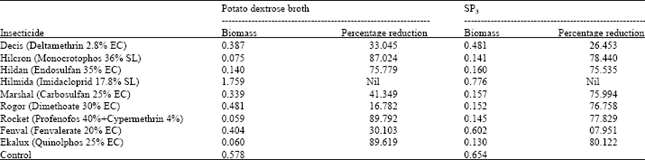
| Table 2: | Mycelial growth and percentage reduction of V15 strains of Trichoderma harzianum in the presence of double amount of recommended dose (200 μL) of different insecticides in potato dextrose broth medium and SP3 medium |
 | |
| EC: Emulsifiable concentrate, SL: Soluble concentrate | |
While Ekalux 25% EC (Quinolphos 25% EC), Hildan 35% EC (Endosulfan 35% EC), and Rocket 44% EC (Profenofos 40%+Cypermetrin 4%) are found to be incompatible with V15 strain of Trichoderma harzianum as they had shown more than 50% of percentage reduction of mycelial growth of the fungus.
According to the data presented in Table 2, at 200 μL concentration of insecticides in Potato Dextrose Broth (PDB) only Hilmida (Imidacloprid 17.8% SL) and Rogor 30% EC (Dimethoate 30% EC) are compatible with V15 strain of Trichoderma harzianum. Hilmida (Imidacloprid 17.8% SL) are most compatible because it shows nil percentage reduction of mycelium. Rest of the insecticides viz. Decis (Deltamethrin 2.8% EC), Ekalux 25% EC (Quinolphos 25% EC), Fenval 20% EC (Fenvalerate 20% EC), Hilcron 36% SL (Monocrotophos 36% SL), Hildan 35% EC (Endosulfan 35% EC), Marshal 25% EC (Carbosulfan 25% EC) and Rocket 44% EC (Profenofos 40%+Cypermetrin 4%) are found to be incompatible with V15 strain of Trichoderma harzianum. At the same concentration (200 μL) of insecticides in SP3 medium it was concluded that Decis (Deltamethrin 2.8% EC), Fenval 20% EC (Fenvalerate 20% EC) and Hilmida (Imidacloprid 17.8% SL) had shown less percentage reduction in mycelial growth so it is compatible with V15 strain of Trichoderma harzianum. Rest of the insecticides viz. Ekalux 25% EC (Quinolphos 25% EC), Hilcron 36% SL (Monocrotophos 36% SL), Hildan 35% EC (Endosulfan 35% EC), Marshal 25% EC (Carbosulfan 25% EC), Rogor 30% EC (Dimethoate 30% EC) and Rocket 44% EC (Profenofos 40%+Cypermetrin 4%) are found to be incompatible with V15 strain of Trichoderma harzianum in SP3 medium.
After dual culture on control as well as insecticides amended media I came to conclude that Decis (Deltamethrin 2.8% EC), Hilcron 36% SL (Monocrotophos 36% SL), Hilmida (Imidacloprid 17.8% SL) and Rogor 30% EC (Dimethoate 30% EC) are compatible insecticides with biocontrol agent (Trichoderma harzianum) as they have the same biocontrol activity on pathogen in comparison to control. It means that when these chemicals and biofungicides are applied in the same field there is no any adverse effect occurs on the growth of Trichoderma harzianum due to these chemicals. While some insecticides viz., Ekalux 25% EC ( Quinolphos 25% EC), Marshal 25% EC (Carbosulfan 25% EC) and Rocket 44% EC (Profenofos 40% + Cypermetrin 4%) inhibits the growth of Trichoderma spp. So, it was concluded that in presence of biocontrol agent these insecticides are not used.
DISCUSSION
The superiority of chemicals over bio-control agents in terms of effective and quick disease control was already confirmed but ill effects of chemicals on human health and environment are a major setback to application of chemical pesticides in long run (Sharma, 2011). Sterk et al. (2002) found that the two neonicotinoids viz., imidacloprid and thimethoxam, alone were very toxic and even may harmful for the beneficial macro-organisms also. Massive pesticide used in the traditional plant protection has affected the biological environment, human life and sustainable agricultural development. Biological control characterized by safety, economy and non-polluting, provides sustainable agriculture with new opportunity and technological bases and solves many problems in the implementation of sustainable agriculture (Haowen et al., 2004). Madhavi et al. (2008) were reported that both the species i.e., Trichoderma harzianum and Trichodrema viride showed high compatibility with imidacloprid (0.025%). Jegathambigai et al. (2010) were observed that Trichoderma harzianum was superior in producing spores in all the liquid substrates. In terms of the insecticides tested, quinalphos and dicofol exhibited toxicity (quinalphos more so), even at the low concentration of 10 ppm. Endosulfan, fenpropathrin and propargite were less toxic which indicated the compatibility of these insecticides with T. harzianum (Sarkar et al. 2010). Bhai and Thomas (2010) reported that percent mycelial inhibition of Trichoderma harzianum was 55.84% in the presence of Quinalphos. The duration of active disease control can be extended by using chemical and biological control agents together in integrated management system.
CONCLUSION
From the above experiments it was concluded that if the formulations made by the recommended dose of insecticides with the bio-control agent Trichoderma harzianum and used for the management of various plant pests show promising effect than the chemicals alone. It is cost effective and environment friendly also.
REFERENCES
- Bhai, R.S. and J. Thomas, 2010. Compatibility of trichoderma harzianum (Rifai.) with fungicides, insecticides and fertilizers. Indian Phytopathol., 63: 145-148.
Direct Link - Cook, R.J., 2000. Advances in plant health management in 20th century. Annu. Rev. Phytopathol., 38: 95-116.
CrossRefDirect Link - Ha, T.N., 2010. Using Trichoderma species for biological control of plant pathogens in vietnam. J. ISSAAS, 16: 17-21.
Direct Link - Jegathambigai, V., R.S.W. Wijeratnam and R.L.C. Wijesundera, 2010. Effect of Trichoderma sp. on Sclerotium rolfsii, the causative agent of collar rot on Zamioculcas zamiifolia and an on farm method to mass produce Trichoderma species. Plant Pathol. J., 9: 47-55.
CrossRefDirect Link - Kredics, L., Z. Antal, L. Manczinger, A. Szekeres, F. Kevei and E. Nagy, 2003. Influence of environmental parameters on Trichoderma strains with biocontrol potential. Food Technol. Biotechnol., 41: 37-42.
Direct Link - Madhavi, M., C. Kumar, P. Chandra, D. R. Reddy and T.V.K. Singh, 2008. Compatibility of mutant isolates of Trichoderma spp. with agrochemicals. J. Biol. Control, 22: 51-55.
Direct Link - Monte, E., 2001. Understanding Trichoderma: Between biotechnology and microbial ecology. Int. Microbiol., 4: 1-4.
PubMedDirect Link - Papavizas, G.C., 1985. Trichoderma and Gliocladium: Biology, ecology and potential for biocontrol. Annu. Rev. Phytopathol., 23: 23-54.
CrossRefDirect Link - Sarkar, S., P. Naratayanan, A. Divakaran, A. Balamurugan and R. Premkumar, 2010. The in vitro effect of certain fungicides, insecticides, and biopesticides on mycelial growth in the biocontrol fungus Trichoderma harzianum. Turk J. Biol., 34: 399-403.
Direct Link - Sharma, P., 2011. Evaluation of disease control and plant growth promotion potential of biocontrol agents on Pisum sativum and comparison of their activity with popular chemical control agent-carbendazim. J. Toxicol. Environ. Health Sci., 3: 127-138.
Direct Link - Sterk, G., F. Heuts, N. Merck and J. Bock, 2002. Sensitivity of non-target arthropods and beneficial fungal species to chemical and biological plant protection products: Results of laboratory and semi-field trials. roceedings of the 1st International Symposium on Biological Control of Arthropods, January 14-18, 2002, Honolulu, Hawaii, USA., pp: 306-313.
- Vincent, J.M., 1947. Distortion of fungal hyphae in the presence of certain inhibitors. Nature, 159: 850-850.
PubMedDirect Link