

Muhammd Afzal
Department of Agri. Entomology, University of Agriculture, Faisalabad, Pakistan
Tasneem Ahmad
Department of Agri. Entomology, University of Agriculture, Faisalabad, Pakistan
Mazhar Hussain
Department of Agri. Entomology, University of Agriculture, Faisalabad, Pakistan
Abu Bakar Muhammad Raza
Department of Agri. Entomology, University of Agriculture, Faisalabad, Pakistan
Journal of Biological Sciences
Year: 2001 | Volume: 1 | Issue: 3 | Page No.: 95-96


ABSTRACT
Investigations on the toxic effect of different doses of Dimecron 100 SCW (phosphamidon) on cotton variety FH-682 on thrips Thrips tabaci Lind. were carried out under natural field conditions at Faisalabad. Different doses of Dimecron 100 SCW (phosphamidon) under trial were 150, 200, 250, 300 and 400 ml/acre. Trials were laid-out in Randomized Complete Block Design having six treatments including control having five repeats each. The spray material was prepared on vol./vol. basis and sprayed on the crop by using Solo-Knapsack Sprayer at fortnight interval. The data were recorded early in the morning 24, 48, 72 hours and 7 days after each spray. Data were recorded from 20 randomly selected plants from upper middle and lower portion on per leaf basis. Crop was sprayed 3 times during the growth period. The efficacy of different doses was considered to be an indirect reflection of thrips population. Dose of 400 ml was found to be the most effective followed by all other dosages in descending order.
PDF Abstract XML References Citation
How to cite this article
Muhammd Afzal, Tasneem Ahmad, Mazhar Hussain and Abu Bakar Muhammad Raza, 2001. The Comparative Efficacy of Different Doses of Dimecron 100 Scw (Phosphamidon) Against the Cotton Thrips Thrips tabaci Lind. On FH-682 Cotton. Journal of Biological Sciences, 1: 95-96.
DOI: 10.3923/jbs.2001.95.96
URL: https://scialert.net/abstract/?doi=jbs.2001.95.96
DOI: 10.3923/jbs.2001.95.96
URL: https://scialert.net/abstract/?doi=jbs.2001.95.96
INTRODUCTION
Cotton plays a pivotal role in the economy of the Pakistan. FH-682 is one of the most recent releases of cotton. This variety, along with other insect pest complexes, damaged by cotton thrips, Thrips tabaci Lind., which desap it and may, sometimes, result in a leaf/flower and/ or a boll drop of the attacked crop. Such a situation, ultimately results in a low production of the seed-cotton. As, the use of some systemic insecticides, in such a situation, is the only quick answer to the above pest problem, a continouous sorting out of the most efficient ones of them as well as different doses is a permanent hobby of the entomologists engaged on the toxicological-side. Dimecron 100 SCW (phosphamidon), being such a material, was, hence, choosen to be tried against the cotton thrips for the present project.
Sidhu and Dhawan (1979), concluded that monocrotophos at 0.5 Kg toxicant/ha gave the best control of Thrips tabaci, followed by endosulfan and quinalphos. Mundiwale et al. (1983), reported that fenvalerate, methamidophos, methomyl and phosalone, alone and all of them, except fenvalerate, in a combination with DDT gave an effective control of the sucking insect pests of cotton, including cotton thrips, Thrips tabaci. Patel et al. (1984), reported that vamidothion was found to be the most effective against Amrasca devastans and Thrips tabaci. Ahmed and Baig (1987), reported that combination of deltamethrin and monocrotophos applied at 18.5 g(a.i)/ha and 0.3% (a.i.), respectively was effective against cotton thrips. Zafar (1987), reported that three pyrethroids (Arcker, Karate and Baythroid) and one of (Gusathion-M) alone and a combination of (Pyrethriod+O-P) in the form of Polytrin-C gave significant control of cotton thrips on Au-52. Dhawan et al. (1988), found that monocrotophos at 100 g(a.i.)/ha was as effective as dimethoate at 188 g(a.i.)/ha for controlling Amrasca devastans, Bemisia tabaci and Thrips tabaci on cotton. Yousuf (1989), described the efficacy of 4 insecticides, viz., Pay off plus 22.5 EC, Challenge 313 EC, Boom 425 EC and Commando 340 EC and reported that Boom 425 EC was the most effective against Thrips tabaci. Rizwan (1993), reported that Tamaron 600SL once, followed with two sprays of Baythroid TM 525EC and one of Baythroid 50SL was found to be the most effective against cotton thrips as well as other sucking insect pests of cotton. The main aim of the present efforts was not only to compare the efficacy of different doses of Dimecron 100 SCW against the cotton thrips, but also workout the comparative performance of their spray applications in the field.
MATERIALS AND METHODS
The trials were, laid-out at Ayub Agricultural Research Institute (AARI), Faisalabad, in a Randomized Complete Block Design during 1998. There were six treatments including a control and 5 different doses of Dimecron 100 SCW (phosphamidon), viz., 150, 200, 250, 300 and 400 ml (a.i.)/acre, having five repeats each. The spray materials were sprayed over to the crop (FH-682 cotton) at a interval of fortnight, starting from the economic threshold level of thrips. The various observations on the population of thrips during the trials were kept on being taken continuously throughout the test season. The data on the population of the pest from each plot were recorded early in the morning, a day before and one, two, three and seven days after the application of the insecticide from 20 plants selected at random. For this purpose, one leaf each from the upper portion of the first, from the middle portion of the second and from the lower portion of the third plant, were observed for the thrips population, till a count of 20 plants were completed. The population data were, however, finally presented in the form of mean values separately for each repeat of the various treatments. The significance of the difference in mean population of the pest was, however, sorted out through the Duncan’s Multiple Range Test after Steel and Torrie (1980).
RESULTS AND DISCUSSION
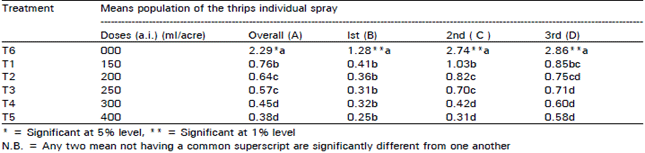
An overall perusal of the data, (Table 1) on the mean values for the population of thrips on FH-682 cotton, from one treatment to another, reveals a highly significant variation in the incidence of the pest after each spray as well as in that of their overall estimate. The mean values of the overall as well as individual population of cotton thrips (Table 1) where 150 to 400 ml (a.i.)/acre of Dimecron 100 SCW were applied to the crop were found to be very significantly lower to that, kept as a check where no insecticide was applied.
| Table 1: | A multiple comparison of the mean values for the population of cotton thrips (leaf–1), after three different sprayus and that of their overall mean population on FH-682, cotton, treated with different doses of Dimecron 100 SCW |
 | |
| Table 2: | A correlation matrix between the mean population of the cotton thrips (leaf–1), after three different sprays and that of their overall mean population on FH-682, cotton, treated with different doses of Dimecron 100 SCW |
 | |
The lower mean values in the treatments where 150 to 400 ml (a.i.)/acre, compared with those in T6, where no insecticide was applied, would, in all cases, reflect on their killing potential against the cotton thrips. Thus a significant variation in the population of cotton thrips where 150 to 400 ml (a.i.)/acre of phosphamidon, was applied would suggest that all of the test doses had a different toxicity effect. On numerical basis, however, a lower mean values for cotton thrips in T5 which involved a spray at 400 ml (a.i.)/acre, would suggest this dose, to be the most toxic for the pest. The comparison of the nature of changes in the population of thrips, after different individual sprays with that of their overall population estimate, would suggest there to be only one trend, in them. To confirm such a situation, the correlation of change, between the individual sprays as well as that of their overall estimates being discussed, calculated and presented through Table 2. A critical review of the correlation matrix of Table 2, reveals only one pattern of changes in the population of the cotton thrips, depending upon their significance of this relationship. Thus, the effect of different doses of Dimecron 100 SCW on cotton thrips after first, second and that of the third spray were found to be positively correlated to those on their overall population of cotton thrips per spray.
A comparison of theses findings with those of others, like Sidhu and Dhawan (1979), Mundiwale et al. (1983), Patel et al. (1984), Ahmed and Baig (1987), Zafar (1987), Yousuf (1989), Rizwan (1993) and Wahla et al.(1997), etc., in the past, is not possible in absolute terms, because of the difference in the various insecticides(s)/crop variety, combinations employed by them in their projects compared with those used in the present trials. As such, the present efforts, can be considered, to be a new addition to the previous information on the present lines, at least within this country.
Thus, to wind up, it may be concluded, on the basis of above discussion that:
| i. | The effectiveness of different doses of Dimecron 100 SCW (phosphamidon), except of course within the first spray, against the cotton thrips on FH-382, cotton, varies |
| ii. | By and large, a dose of Dimecron 100 SCW at 400 ml (a.i.)/acre, was found to be the most efficient against the cotton thrips |
| iii. | The changes in the overall population of the cotton thrips/toxicity of different doses of Dimecron 100 SCW tested, were correlated positively to those of the individual pest-population/insecticide toxicity deal |
REFERENCES
- Steel, R.G.D. and J.H. Torrie, 1980. Principles and Procedures of Statistics: A Biometrical Approch. 2nd Edn., McGraw-Hill, New York City, ISBN: 9780070609266, Pages: 633.
Direct Link - Dhawan, A.K., G.S. Simwat and A.S. Sidhu, 1988. Field evaluation of monocrotophos for the control of sucking pests on cotton. Pesticides, 22: 25-28.
Direct Link - Mundiwale, S.K., U.B. Men, V.S. Govindwar and M.N. Borle, 1983. Efficacy of five insecticides alone and in combination with DDT against cotton pests. Indian J. Entomol., 45: 282-285.
Direct Link - Patel, B.K., N.B. Rote and N.W. Mehta, 1984. Comparative efficacy of some insecticides against sucking pests of hybrid-4 cotton. Indian J. Plant Protect., 12: 139-141.
Direct Link