

Meher Fatima
Institute of Marine Science, University of Karachi, Karachi 75270, Pakistan
Journal of Biological Sciences
Year: 2001 | Volume: 1 | Issue: 3 | Page No.: 171-172


ABSTRACT
Length -weight relationship and length frequency distribution of two commercially important species of prawns: Penaeus japonicus and Parapenaeopsis sculptilus was studied.Samples were taken during May and June 2000 from Korangi Fish harbour,Karachi. Both species showed negative allometric growth of weight ( b <3.0). Recruits (8-10cm)of Pp.sculptilus were dominant in June, Largest size class consisted of females. Pp.sculptilus attained greater length (> 16cm) and weight(>34g) than P.japonicus .
PDF Abstract XML References Citation
How to cite this article
Meher Fatima, 2001. Study on Length-frequency and Length-weight Relationship
Of Penaeus japonicus and Parapenaeopsis sculptilus. Journal of Biological Sciences, 1: 171-172.
DOI: 10.3923/jbs.2001.171.172
URL: https://scialert.net/abstract/?doi=jbs.2001.171.172
DOI: 10.3923/jbs.2001.171.172
URL: https://scialert.net/abstract/?doi=jbs.2001.171.172
INTRODUCTION
Knowledge regarding length-weight relationships, growth and population dynamics of marine animals is required for their effective management. This information is, however, not available for several commercially important species. Information on length- weight relationship of shrimps occurring in coastal waters of Pakistan is also scanty. Previous work on shrimps of Pakistan waters include a report by Tirmizi and Tahera (1989) mentioning briefly the length-weight relationship of Penaeus indicus, Metapenaeas affinis and Parapenaeopsis stylifera and that of Ayub (1998) who reported length-weight relationship of P. merguiensis, P. penicillatus, M. affinis and P. stylifera. No such information was available on Penaeus japonicus and Parapenaeopsis sculptilus. The present study provides some information about length-weight relationship and size frequency distibution of P. japonicus and P. sculptilus.
MATERIALS AND METHODS
Samples of penaied prawns were obtained from Korangi fish harbour on 15th May and 2nd June 2000 The shrimps were brought to the laboratory, their individual measurements were taken and correspcnding total weight (w) and meat weight (MWT) (after removing head') in grams were obtained for each specimen. Length-weight relationship of Penaeus japonicus and P. sculptilus was calculated by regression analysis using least square method.
Result and Discussion
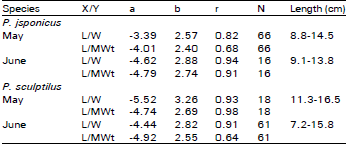
The parameters a and b of the length- weight relationships of P. japonicus and P. sculptilus are given in Table 1. An exponential relationship was found between total length and total weight of P. japonicus and P. sculptilus, values of b ranged from 2.40 to 2.88 for P. japonicus and 2.55 to 3.26 for P. sculptilus (Fig. 1a). In summer (May- June) P. japonicus showed anisometric growth with weights increasing at a relatively slower rate (b<3) than length, similar value of b for the same species was recorded in June 1999 also (Fatima, 2000). P. sculptilus indicated a faster growth rate (b>3) of total weight in May, but in June negative allometry (b<3) was observed. Growth of meat weight remained at a slower rate than length in both species. Correlation coefficient (r) showed stronger relationship (r = 0.9) with total weights than meat weight (Fig. 1b).
Length-frequency histograms for P. japonicus and P. sculptilus during summer are shown in Fig. 2.
| Table 1: | Length-weight relationship for two species of prawns obtained in summer, 2000 from Korangi. Parameters: a. coefficient of regression, b = slope,r = correlation coefficient. N = number of shrimps |
 | |
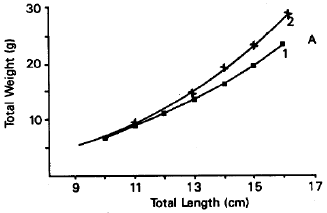 | |
| Fig. 1a: | Length frequency histograms based on samples obtained in May, 1 June, 2 |
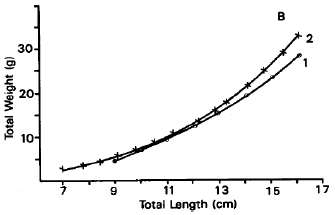 | |
| Fig. 1b: | Length-weight relationship of P. sculptilus during May, 1 June, 2 |
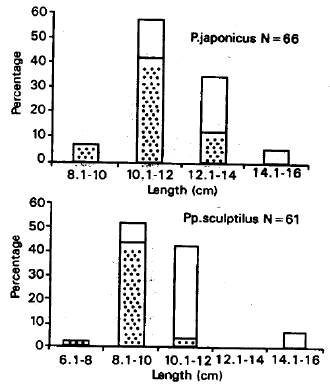 | |
| Fig. 2: | Length frequency histograms based on samples obtained in May, June 2000. Spotted area denotes males, clear area denotes females |
P. japonicus population showed dominance of size class 10-11.9 cm, in which males were numerous. Largest size class, (14.1-16 cm) consisting of females was only 3% of the total. P. sculptilus population showed predominance of recruits i.e., size class of 8.0-10 cm length which consisted of 84% males. Recruitment in P. sculptilus is obvious in summer, previous study of Tirmizi and Tahera (1989) also supports it, they noted 10.2 cm size as the dominant modal group in summer. Recruitment of two other species of prawns, P. merguensis and P. penicillatus also occurs in May (Ayub and Ahmed, 1992).
Results of present study indicates that growth rate of shrimps P. japonicus and P. sculptilus is almost similar, though P. sculptilus grows upto larger size and heavier weight. Their growth rate and population structure indicate occurrence of recruitment and abscence of breeding in summer. Previous work of Ayub and Ahmed (1992) and Fatima (2000) also supports this opinion that for the sake of protection of breeding prawns, it is better to shift closed season of fishing from summer to fall.
ACKNOWLEDGMENT
I am thankful to Dr. Sohail Barkati, Professor, Deptt. of Zoology for reading the manuscript critically.