

Khalid Abdullah
Entomology Section, Agriculture Research Section, Mingora, Swat 19130
Masood K. Khattak
Department of Entomology, Faculty of Agriculture, Gomal University, Dera Ismail Khan 29050, Pakistan
Wahid Munir
Department of Entomology, Faculty of Agriculture, Gomal University, Dera Ismail Khan 29050, Pakistan
Journal of Biological Sciences
Year: 2001 | Volume: 1 | Issue: 3 | Page No.: 155-157


ABSTRACT
In lab bioassay experiment, field collected medium to large sized (3rd, 4th and 5th instar) larvae were tested to the three concentrations (low 11.25 ppm, medium 22.50 ppm and high 33.75 ppm) of Deltaphos. In all sets of experiments untreated check gave significantly lower mortality than all the concentrations of insecticides. In topical treatment experiment, higher (33.75 ppm) and medium (22.50 ppm) concentrations resulted in higher mortality of test insects than lower concentration (11.35 ppm). Similarly results were obtained in stomach poisoning experiment; however, contact poisoning experiment gave an equal mortality percentage (60 percent) in all concentration tested. Deltaphos 10+350 EC proved as an active insecticide.
PDF Abstract XML References Citation
How to cite this article
Khalid Abdullah, Masood K. Khattak and Wahid Munir, 2001. Laboratory Bioassay of Three Doses of Deltamethrin +Triazophos (Deltaphos
10+350 EC)
on Field Collected Medium to Large Sized Helicoverpa Sp. Larvae
Infesting Gram Pods. Journal of Biological Sciences, 1: 155-157.
DOI: 10.3923/jbs.2001.155.157
URL: https://scialert.net/abstract/?doi=jbs.2001.155.157
DOI: 10.3923/jbs.2001.155.157
URL: https://scialert.net/abstract/?doi=jbs.2001.155.157
INTRODUCTION
Helicovrpa sp., a polyphagous hexapod, takes a heavy toll from the agricultural important crops. Cotton, vegetables, tobacco, corn and gram are the important crops being damaged by this insect (Saleem and Yunus, 1982; Bilapate et al. 1992). Since lots of pesticide is used to manage this insect on many host plants, therefore, it is getting resistant to many commonly used groups of insecticides. Development of resistant in Helicoverpa sp. is being reported by many authors in Pakistan and other parts of the world (Ahmad and McCaffery, 1988). It has also been observed that a malfunctioning of spray equipment, improper spray particle size and uneven pesticide coverage usually misleadingly added to the resistant phenomena and resulted into un-necessary up gradation of dosage etc. So, keeping in view the various aspects, it is very important to evaluate every single factor very carefully before making any recommendation. Present studies have been designed to appraise the efficacy of Deltaphos 10+350EC against field collected Helicovrpa sp. larvae in the laboratory. Bhalani and Parsana (1986) Singh et al. (1987) Sharma et al. (1989) Gupta et al. (1990) and many others have proved deltamethrin a best insecticide among the tested chemicals at different parts of the world (Lohar and Jumo, 1995).
MATERIALS AND METHODS
For this experiment three concentration of Deltaphos 10+350 EC were prepared by dissolving 1.25 ml, 2.50 ml and 3.75 ml of formulated insecticide in 500 ml distilled water. These concentrations were used in different Bioassay (Table 1). For these experiments, gram pod borer Helicoverpa armigera larvae were collected from an un-sprayed gram field during March 1997. Healthy and active larvae of third, fourth and fifth instar were separated and placed individually in petri dishes to avoid cannibalism. The field collected larvae were used in different experiment the same day. A series of three experiments was conducted to find the action of insecticide, through cuticle (topical application), stomach (feeding experiment) and contact (contact poisoning). After the completion of each experiment each larva was observed under dissecting microscope by probing with a blunt-end needle. The larva was declared alive if it moved any of its appendages otherwise considered dead. All experiments were conducted in the Laboratory at the room temperature (21°C). The data were converted into percent mortality and chi-square test of homogeneity was applied to see the critical difference of each treatment with un-treated check.
| Table 1: | Detail of concentration of field solutions used in laboratory bioassay |
 | |
Topical Treatment Experiment: For this experiment, ten (10) active Helicoverpa sp. larvae were treated with each concentration of insecticide and a control group was treated with distilled water only following the procedure (Marco et al., 1998). A drop (≈1 μl) of each of (insecticide) concentration or distilled water was carefully placed with the help of fine glass rod on the dorsal surface of thoracic segments. The glass rod was rinsed three-times before using any concentration of the insecticide. Individual larva was placed very carefully in 4-inch petri dishes. Each larva was observed after 24 and 36 hours of treatment under the dissecting microscope and mortality recorded. The data thus collected were subjected to statistical analysis following the procedure described earlier.
Stomach Poisoning Experiment: This experiment was designed to find out the effect of stomach poison of the insecticide on the medium-large sized (3rd, 4th and 5th instar) Helicoverpa armigera larvae. For this purpose fresh gram leaves were collected from field, never sprayed during the growing season and washed with distilled water to remove dust; excessive water from the leaves was air-dried. The leaves were dipped in respective concentrations of insecticide for ≈ 30 seconds and then aerated for about a minute and offered for feeding to field collected Helicoverpa armigera larvae. Ten larvae were tested for each concentration and the control group of larvae was fed the leaves washed by distilled water. Each larva was held singly in a 4-inch petri dish and observed after 24 hour under the microscope. The data was converted to percentage and appropriate statistical procedures were applied as described earlier.
Contact Poisoning Experiment: The experiment was designed to evaluate the contact poisoning effect of insecticide (Deltaphos 10+350 EC). Each concentration was filled in 10-ml test tube, held for 30 seconds and drained out. Test tubes were dried to have fine coating of insecticide on their inner walls. One field collected Helicoverpa armigera. larva was placed in each test tube, allowing the insect to come in contact with the insecticide film lined inside the test tube. The test tubes were held horizontally for 24 hours in the laboratory at prevailing room temperature (21°C) and observed for dead and live larvae thereafter. The data were analyzed according to the procedure described already.
RESULTS AND DISCUSSION
Topical Treatment Experiment: Percent mortality of Heliothis sp. and chi square values is given in Table 2. Data show a proportional relationship between insecticide concentrations and mortality after 24 hours. I.e. 50 percent for the low concentration (11.25 ppm), 80 percent in medium concentration (22.50 ppm) and 90 percent in high concentration sz(33.75 ppm), while untreated check had only 20 percent mortality. All mortality by different concentrations of insecticide proved to significantly different from untreated check. It is obvious by the findings that the medium (recommended) or higher dose of Deltaphos 10+350 EC, when applied to the larvae of H. armigera causes more than 50 percent mortality.
| Table 2: | Effect of different levels of Deltaphos 10+350EC when topically applied on gram pod borer larvae and their respective chi-square value. |
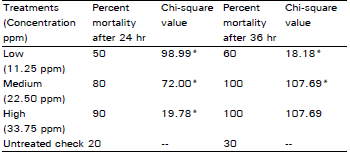 | |
| *: Significant Each value is a mean of three replications. | |
Same experiment was repeated and mortality was recorded after 36 hours. Data show all the concentrations of Deltaphos 10+350EC resulted in significantly higher mortality than untreated check after 36 (Table 2). However, after 36 hours, Medium (22.50 ppm) and Higher (33.75 ppm) concentration gave 100 percent mortality followed by Low (11.25 ppm) concentration. Whereas untreated had only 30 percent mortality of gram pod borer larvae. In the field conditions insecticides with contact action are largely chosen for the management of lepidoptrous insects as they are well exposed to the spray particles. The results of the present study also proved the topical activity of Deltaphos. Bhalani and Parsana 1986; Gupta et al. 1990 and Lohar and Jumo 1995 also in conformity with the findings and stated that Triazophos is an active insecticide for the management of Heliothis sp., on gram and other vegetables as well.
Stomach Poisoning Experiment: Results of stomach poisoning experiment showed that all levels of the insecticide had killed significantly more larvae than the check as 30 percent and 50 percent kill at low, medium and high dose, respectively, were statistically different to that of 10 percent kill in the control (Table 3).
Leaves treated with (11.25 ppm) when fed, killed 30 percent larvae of H. armigera, while mortality of the test insects reached to 50 percent at medium (22.50 ppm) and high (33.75 ppm) doses. Results proved that insecticide if used at recommended or higher (not recommended) doses killed gram pod borer larvae through stomach poisoning action.
Singh et al. (1987), Sharma et al. (1989) and Lohar and Jumo 1995 tested different pyrethroids against the Heliothis sp. attacking gram in the field and found Triazophos as an effective insecticide. Similar findings were obtained in the present studies. It can be extrapolated that the pest population unable to be hit directly by an insecticide during field spray would die when fed on sprayed crop. This gives an extra edge to the insecticide and increases the efficacy.
| Table 3: | Effect of different levels of Deltaphos 10+350EC when used as stomach poison against gram pod borer larvae and their respective chi-square value. |
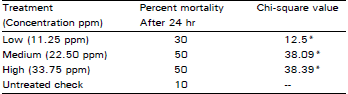 | |
| *: Significant Each value is a mean of 3 replications. | |
| Table 4: | Effect of contact application of Deltaphos 10+350EC at different levels to gram pod borer larvae and their respective chi-square values. |
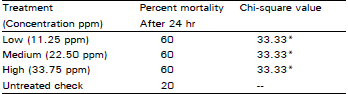 | |
| *: Significant Each value is a mean of 3 replications. | |
Contact Poisoning Experiment: Data regarding the contact poisoning experiment showed a significantly higher mortality of Helicoverpa armigera in all concentrations of the insecticide than an un-treated check. Where only 20 percent mortality was recorded (Table 4). It was also observed that all the three concentrations (low, medium and high) did show similar mortality rate i.e. 60%.
Results indicated that the activity of the insecticide at all concentrations through contact could kill about 40 percent (adjusted) of the insect population. The activity shown by the product has importance for the full fed larvae near to pupation. Sharma et al. (1989); Bhalani and Parsana (1986); Lohar and Jumo (1995); Singh et al. (1987) conducted the experiments and evaluated different insecticides for the control of Helicoverpa sp. and proved that deltamethrin is one of the best synthetic pyrethroid insecticide among the tested ones. Our results are also showing a significant activity of the Deltaphos against Helicoverpa sp. It is clear from the results that Deltaphos 10+350EC has varying degree of affectivity to its various modes of action, but it is an active insecticide for the control of Helicoverpa armigera through its all modes of actions. Although its activity is more through topical application than stomach or contact actions can be concluded that if Deltaphos 10+350EC applied at a proper time, concentration and with a suitable equipment it would check the pest below ETL. However, care should be taken for the management of resistance development in the pest (like consecutive usage of similar group of poison for a longer period of time).
REFERENCES
- Ahmad, M. and A.R. McCaffery, 1988. Resistance to insecticides in a Thailand strain of Heliothis armigera (Hubner)(Lepidoptera: Noctuidae). J. Econ. Entomol., 81: 45-48.
CrossRefDirect Link - Marco, V., G. Perez-Farinos and P. Castanera, 1998. Effects of hexaflumuron on transovarial, ovicidal, and progeny development of Aubeonymus mariaefranciscae (Coleoptera: Curculionidae). Environ. Entomol., 27: 812-816.
CrossRefDirect Link