

Hafeez Ullah
NWFP Agricultural University, Peshawar
Gulzar Ahmad
Agricultural Research Institute, Tarnab, Peshawar, Pakistan
Zar Quresh
Agricultural Research Institute, Tarnab, Peshawar, Pakistan
Journal of Biological Sciences
Year: 2001 | Volume: 1 | Issue: 3 | Page No.: 132-133


ABSTRACT
There was no significant effect of different weed control methods on the number of days to emergence of sunflower. Maximum plant height (175.33 cm), Head Diameter (18.75 cm), thousand kernel weight (69.83 g), achene yield (2274.99 kg/ha) and oil yield (946.59 kg/ha) were obtained by manual weed control plots while minimum plant height (159.5 cm), Head Diameter (16.26 cm), thousand achene weight (61.68 g), and achene yield (1547.49 kg/ha) were exhibited by treatments where no weeding was done. Maximum weeds (331.83 gm/m2) were recorded in plots where no weeding had taken place while minimum weeds (139.66 gm/m2) were recorded in the treatments where manual weed control had been practiced.
PDF Abstract XML References Citation
How to cite this article
Hafeez Ullah, Gulzar Ahmad and Zar Quresh, 2001. Effect of Weed Control Treatments on the Performance of Sunflower. Journal of Biological Sciences, 1: 132-133.
DOI: 10.3923/jbs.2001.132.133
URL: https://scialert.net/abstract/?doi=jbs.2001.132.133
DOI: 10.3923/jbs.2001.132.133
URL: https://scialert.net/abstract/?doi=jbs.2001.132.133
INTRODUCTION
The sunflower (Helianthus annuus L.) belongs to the family composite. It is said to be of American origin (Heiser, 1976). It has a tap root system which grows as deep as 3 m. Sunflower grows 1.5 m tall. The stem is circular, 3-6 cm in diameter with rough hairs. The leaves are large, hairy, ovate and petiolate. Sunflower produces a disc shaped head called the “Capitulum” on top of the stem. The head commonly varies from 10-30 cm in diameter (Heiser, 1976). The capitulum is heliotropic until most of the flowers are fertilized, after which it generally remains fixed facing the east. The flowers are normally cross-pollinated mainly by honeybees. Seed colour varies from black to white. The seeds are usually 10-25 mm long with 8-15 mm width and 3.0-7.5 mm thick. One thousand seeds weigh 50-100 g or more. Sunflower is a Temperate Zone crop, but it is adaptable to a wide range of climatic conditions. It is grown on all types of the soils provided they are well drained. Acidic and saline soils are not desirable, though it can tolerate a pH range from 6.5-8.0 (Hatam and Abbasi, 1994).
In Pakistan, sunflower can be grown throughout the country on irrigated as well as rainfed areas, but its production is too low to meet or even narrow down the gape between requirements and production of edible oil of the country. In 1997-98 sunflower was grown on 98459 hectares in Pakistan, which produced 129693 tones of seeds. Its yield is 1300 kg/ha (Anonymous, 1998) which is very low as compared to other agriculturally advanced countries. Sunflower yields in Argentina, Turkey, France, USSR are 1435, 1535, 2595 and 1439 kg/ha respectively (FAO, 1989). Pakistan imported edible oil worth Rs. 43.0 billion during the fiscal year 1998-99 (Pakistan Oilseed Development Board). If due attention is given to sunflower crop, the gape between production and consumption can be narrowed down considerably.
It is generally agreed that appropriate sowing methods and weed control treatments are necessary for obtaining good yield of this crop.
Subbaiah et al. (1995) reported excellent control of all types of weeds with manual weeding, where as different chemicals gave moderate to good control. Solunkhe et al. (1990) reported good weed control with hand weeding and hoeing, 3 and 6 weeks after sowing. El Naggar (1991) stated that weed weight was lowest with hand hoeing. Legha et al. (1992) obtained reduced weed dry weight and maximum grain yield with manual weeding. Bially and Samie (1997) reported maximum head diameter and highest grain yield from hand weeded plots.
Keeping in mind the above facts, the present project was under taken to investigate the response of sunflower hybrid SF-177 to different weed control treatments for higher yield in Peshawar valley.
MATERIALS AND METHODS
The effects of different weed control methods on the performance of sunflower were investigated at Agriculture Research Institute Tarnab Peshawar, during spring 1999. Sunflower hybrid SF-177 was sown on April 13, 1999.
The experiment was laid out in RCB design having four replications. The sub plots size was 3×5 m2. Each treatment had four rows, five meter long and 75 cm apart. Plant to plant distance was kept about 20-25 cm.
Recorded data were analyzed statistically according to RCB design and Least Significant Difference (LSD) test was applied to detect whether the effects of different treatments were significant or not.
RESULTS AND DISCUSSION
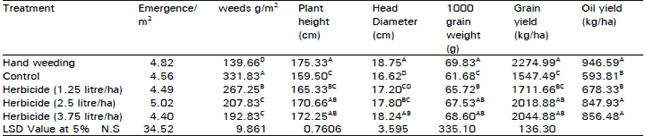
Results presented in Table 1 revealed that emergence/m2 of sunflower was not significantly affected by different weed control treatments. The possible reason could be that the chemical was selective in nature for sunflower.
Fresh weight of weeds per m2 after 45 days of emergence was significantly affected by weed control treatments. Maximum fresh weight of weeds was recorded in the control plots while minimum fresh weight of weeds was observed in the hand weeded plots. The possible reason could be that most of the weeds that came under the blow of kudal were eliminated irrespective of any selectivity like in case of chemical treatments. Both the highest levels of 2.5 and 3.75 lit./ha of stomp had similar effect on the fresh weight of weeds with the possible reason that some of the weeds might have been adversely affected per unit area and therefore, as compared to control less fresh weight of weeds was observed. These observations are supported by El Naggar (1991) who reported that weed weight was lowest with hand hoeing.
Plant height was significantly affected by different weed control treatments. Maximum plant height was recorded in plots where hand weeding was carried out. The minimum plant height was recorded in the control treatment. The possible reason could be that hand weeding eliminated most of the weeds and the plant met its requirements easily from the soil. These results are in agreement with Fleck et al. (1989).
Head Diameter was significantly affected by weed control treatments. The maximum head diameter was produced in the plots where hand weeding was carried out, while the minimum was produced in the control plots.
| Table 1: | Results of different weed control treatments on the performance of Sunflower. |
 | |
The possible reason could be that hand weeding cleared the plots from all type of weeds and therefore, plants had not to compete for nutrients and moisture. These results were also confirmed by Legha et al. (1992) and Bially and Samie (1997).
Thousand grains weight was significantly affected by different weed control treatments. Maximum grain weight was recorded in plots where hand weeding was carried out and lighter grains were produced by those plots where no weeding was carried out. Hand weeding eliminated most of the weeds, hence balance nutrition was available to the plants and bigger grains were produced. These results are similar to those reported by Legha et al. (1992) who obtained maximum 1000 grain weight with mechanical weeding.
Grain yield of sunflower was significantly affected by the different weed control treatments. The maximum grain yield of 2274.99 kg/ha was recorded in those plots where hand weeding was done and minimum yield was recorded in those plots where no weeding was carried out. Hand weeding removed all types of weeds and loosened the soil and in this way the crop availed better environment for high production. These results are similar to those reported by Bially and Samie (1997) who found that highest grain yield was obtained in plots, which were hand weeded.
Oil yield per hectare was significantly affected by different weed control treatments. Maximum Oil yield of 946.59 kg/ha was given by the plots where hand weeding had been practiced while minimum oil yield was recorded in the control plots. These results are in agreement with Girijesh and Patil (1989) who reported that hand weeding provided the highest sunflower oil yield.
REFERENCES
- Fleck, N.G., I.P. Mengarda and J.J.O. Pinto, 1989. Weed interference in sunflower. Competition in space. Pesquisa Agropecuaria Brasileira, 24: 1131-1137.
Direct Link - Solunkhe, U.V., D.K. Shelke and R.H. Bhosle, 1990. Integrated weed management in sunflower during rabi season in Marathwada. J. Maharashtra Agric. Univ., 15: 367-367.
Direct Link - Subbaiah, H., H.V. Nanjappa and B.K. Ramachandrappa, 1995. Chemical weed control studies under sole and intercropping systems in groundnut (Arachis hypogaea L.). Mysore J. Agric. Sci., 29: 320-326.
Direct Link