

Munawar Khan
Agricultural Research Station, Serai Naurang, Bannu, NWFP, Pakistan
Khalid Nawab
Agricultural Research Station, Serai Naurang, Bannu, NWFP, Pakistan
Aminullah Khan
Agricultural Research Station, Serai Naurang, Bannu, NWFP, Pakistan
Muhammad Safdar Baloch
Agricultural Research Station, Serai Naurang, Bannu, NWFP, Pakistan
Journal of Biological Sciences
Year: 2001 | Volume: 1 | Issue: 3 | Page No.: 117-119


ABSTRACT
Investigations were carried out on fifteen divergent genotypes. Results revealed that the cultivar M 22-24 was superior in various yield supporting parameters and produced maximum grain yield per plant. Correlation coefficient between grain yield and its contributing variables showed that grain yield was positively and significantly correlated with number of branches, pods per plant and total biomass per plant. A non-significant positive association of grain yield was observed with days to 50% flowering, days to maturity and pod length. Number of branches, number of pods and dry total biomass were found best among the yield components in mungbean.
PDF Abstract XML References Citation
How to cite this article
Munawar Khan, Khalid Nawab, Aminullah Khan and Muhammad Safdar Baloch, 2001. Genetic Variability and Correlation Studies in Mungbean. Journal of Biological Sciences, 1: 117-119.
DOI: 10.3923/jbs.2001.117.119
URL: https://scialert.net/abstract/?doi=jbs.2001.117.119
DOI: 10.3923/jbs.2001.117.119
URL: https://scialert.net/abstract/?doi=jbs.2001.117.119
INTRODUCTION
Mungbean (Vigna radiata L.) occupies an important position due to its high seed protein content (22 to 24%) and ability to restore the soil fertility through symbiotic nitrogen fixation (Malik, 1994). It is rich in essential amino acids specially lysine, which is deficient in most of the cereal grains. In Pakistan two crops of mungbean can successfully be grown as a kharif and spring mung in a year. Being a drought tolerant crop, it is mostly grown in rainfed areas of the country where yield level is very low. Another important reason of its lower productivity is lack of cultivars with high yield potentials, resistance to biotic and abiotic stresses. Improvement programme in mungbean for long time has mainly been confined to simple selection from the local material commonly grown by the farmers. Because of self pollination, which is a rule, hybridization is rather difficult mainly due to its complex and delicate floral structure and very precise micro condition required for pollen dehiscence and fertilization. Thus the crop has been facing problems of low genetic variations and consequently hampering the improvement programme to a great extent. Present studies were designed to know the genetic variability and influence of various plant parameters on the grain yield of mungbean.
MATERIALS AND METHODS
The study was undertaken at Agricultural Research Station Serai Naurang (Bannu). The experiment was laid out in a Randomized Complete Block Design with four replications, having a plot size of 7.2 m2. Each treatment comprised of six rows, four meter long and 30 cm apart. Plant to plant distance was 10 cm. Fertilizer NPK at 20-50-0 kg/ha was applied at the time of sowing. The data were subjected to analysis of variance techniques (Steel and Torrie, 1980) and DMRT (Duncan, 1955) was used to compare the treatment means. Correlation between grain yield and other yield contributing variables were worked out using computer package MSTATC.
RESULTS AND DISCUSSION
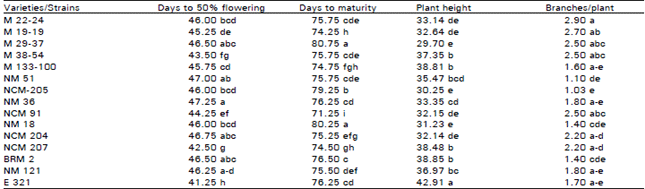
Days to 50% flowering: Data given in Table 1 indicated significant difference among varieties. Variety E-321 took minimum days to flowering, followed by NCM-207 and M 38-54. The cultivar NM-36 was designated as late flowering genotype. The time to flower appearance depends upon available nutrients, temperature and genetic make up of the plant (Naidu et al., 1991).
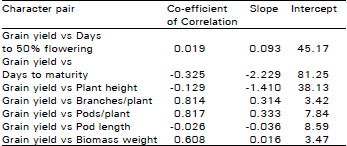
Data presented in Table 3 manifested that days to 50% flowering had non-significantly positive correlation with grain yield which indicated that early flowering cultivar gives lower yield and late flowering cultivar might be helpful in yield improvement (Reddy et al., 1991).
Days to maturity: Table 1 revealed that all the genotypes were determinate in maturity. Comparison between varietal means further exhibited that cultivar NCM-91 was early maturing among the varieties. It was followed by cultivars M 19-19, NCM-207, M 133-100 and NCM-204 as for as days to maturity is concerned. Cultivars M 29-37 and NM-18 were found late maturing. Maturity of a crop depends upon photoperiod of genotypes, temperature and slightly on the available moisture to the plant. This is also a varietal dependant character which is influenced by genetic make up of a cultivar and its environment (Reddy et al., 1991).
Correlation studies between grain yield and number of days taken to maturity given in Table 3 indicated a negatively non-significant association between these two characters, which means that increase in days to maturity will decrease the final grain yield in mungbean. These findings were not supported by Saleem (1982) who observed positive association of grain yield with days to maturity. The difference in results might be due to different genetic make up of cultivars.
Plant height (cm): All the genotypes behaved differently in attaining the height of plants (Table 1). Variety E-321 produced tallest plants, followed by cultivar BRM-2, M 133-100, NCM-207 and M 38-54 with at par plant height. Short stature plants were observed in cultivar M 29-37 which was statistically at par with NCM-205 and NM-18. Plant height, being a genetically controlled character, varied in various cultivars (Miah and Bhadra, 1989).
Correlation studies presented in Table 3 manifested that plant height had negative and non-significant relationship with grain yield which indicated that plant height is inversely proportional to grain yield i.e with the increase in height of plant, the yield will decrease and vice versa. These results also revealed that medium and short stature plants should be emphasized, while selecting the single plant for grain yield improvement. Saleem (1982) reported a negative relationship between these two characters.
Aslam et al. (1992) showed a positive association between the pair of characters under discussion. This difference might be due to different climatic conditions and genotypic variations of cultivars.
| Table 1: | Days to 50% flowering, days to maturity, plant height (cm) and branches/plant as affected by divergent genotypes of mungbean |
 | |
| Means followed by different letters are significant at 5% level of probability | |
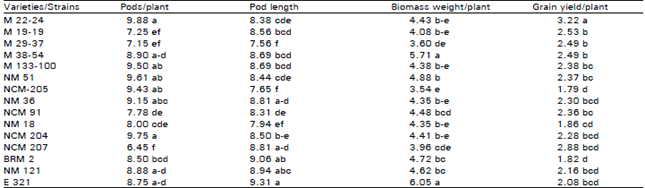
| Table 2: | Pods/plant, pod length (cm), biomass weight/plant (g) and grain yield/plant (g) as affected by divergent genotypes of mungbean |
 | |
| Means followed by different letters are significant at 5% level of probability | |
| Table 3: | Correlation of grain yield with its contributing parameters in mungbean |
 | |
Branches per plant: A thorough probe into the mean data given in Table 1 indicated that variety M 22-24 surpassed all the cultivars by producing maximum branches/plant. Cultivar NCM-205 produced the minimum branches/plant, followed by cultivar NM-51. Reddy et al. (1991) observed that various genotypes of mungbean produced different number of branches per plant.
Correlation studies between grain yield and number of branches given in Table 3 indicated that a highly significantly positive association exists between these two characters, which means that number of branches are directly proportional to grain yield in mungbean i.e any increase in number of branches would definitely enhance the grain yield in mungbean. The results of present study are in conformity with those obtained by Reddy et al. (1991).
Pods per plant: Analysis of mean values revealed that there exist a highly significant variation in number of pods per plant (Table 2). The cultivar M 22-24 produced maximum pods per plant as against cultivar NCM-207 which produced minimum pods/plant. Like number of branches, the pods are also considered as the most important yield component and are directly concerned with final yield in pulse crops. As the pods are produced by the branches, hence they are positively correlated with branches per plant. This is evident from Table 2 where cultivar M 22-24 produced maximum branches per plant and maximum pods were also recorded in the same cultivar. The differences in pod production by various cultivars of mungbean were also reported by Miah and Bhadra (1989) and Reddy et al. (1991).
Correlation results given in Table 3 indicated that number of pods/plant and grain yield were highly significantly and positively correlated with each other. This strong relationship between these two characters revealed that pod number is most important component and directly proportional to crop yield. Increase in number of pods per plant will also increase the grain yield and vice versa.
Pod length (cm): Pod length is an important yield parameter in food legume crops. Results given in Table 2 revealed that pod length was significantly affected by varieties. Data further exhibited that cultivar E-321 produced pods with maximum length as against minimum pod length found in cultivar M 29-37. The cultivars showing the tallest plants also produced the lengthy pod. Similarly the short stature cultivars produced the pods with minimum length. This indicated that plant height is positively correlated with pod length. Miah and Bhadra (1989) and Naidu et al. (1991) observed a significant difference in the mean value of pod length due to various genotypes of mungbean.
A non-significantly positive relationship between pod length and grain yield was observed which indicated that any increase in pod length will slightly increase the grain yield of mungbean (Table 3). These results are in accordance with the findings of Reddy et al. (1991) who also reported a positive association between pod length and grain yield in mungbean.
Biomass weight per plant (g): Plant biomass produced by cultivars differed significantly.
The cultivar E-321 showed maximum plant weight, while cultivar NCM-205 produced lightest plants (Table 2). These results are in accordance with Reddy et al. (1991) and Naidu et al. (1991).
Correlation estimates presented in Table 3 indicated a significant positive association between dry matter yield and grain yield which indicated that increase in biomass of plant would increase the grain yield. In other words the healthy plants of mungbean will produce more yield as compared to weak and thin plants. This strong relationship exhibited that improvement in plant type would be beneficial for a breeder in enhancing grain yield of mungbean. Similar results of relationship between this pair of characters were reported by Miah and Bhadra (1989) and Reddy et al. (1991).
Grain yield per plant (g): Grain yield depends upon the variety, availability of plant nutrients, crop management and its supporting variables either in negative or positive direction. Various genotypes significantly affected the grain yield and all the varieties behaved differently as for as grain production is concerned. Contemplation of mean values given in Table 2 further demonstrated that cultivar M 22-24 proved its superiority by producing maximum grain yield per plant. Cultivar NCM-205 was found poor with lowest grain yield per plant. It was however at par with BRM-2 and NCM-207 in respect of grain yield production. These findings are in agreement with Miah and Bhadra (1989) and Reddy et al. (1991).
In present studies the cultivar M 22-24 produced the maximum yield. This superiority of M 22-24 in grain yield production was actually due to yield contributing traits like days to flowering, plant height, number of branches per plant, number of pods per plant, pod length etc. All these traits were positively correlated with yield. In aforesaid discussion it can be concluded that cultivar M 22-24 is the best for general cultivation followed by M 19-19. Further correlation studies indicated that during single plant selection, emphasis should be given on the characters like days to 50% flowering, plant height, number of branches, number of pods, pods length, seeds per pod, 1000-seed weight and total biomass weight of plant as a selection criteria for mungbean improvement programme.
REFERENCES
- Steel, R.G.D. and J.H. Torrie, 1980. Principles and Procedures of Statistics: A Biometrical Approch. 2nd Edn., McGraw-Hill, New York City, ISBN: 9780070609266, Pages: 633.
Direct Link - Saleem, S.A., 1982. Variation and correlations among agronomic characters in a collection of beans (Vicia faba L.). J. Agric. Sci., 99: 541-545.
CrossRefDirect Link