

Muhammad R. Khan
Department of Biological Sciences, Quaid-I-Azam University, Islamabad
Afsari S. Qureshi
Department of Biological Sciences, Quaid-I-Azam University, Islamabad
Journal of Biological Sciences
Year: 2001 | Volume: 1 | Issue: 3 | Page No.: 108-110


ABSTRACT
Seeds of three chickpea genotypes having different seed coat colours viz; Noor 91 (white), Punjab 91 (brown) and C 141 (black) were treated at 40, 50 and 60 Kr separately and with gibberellic acid (GA3). Three genotypes responded differentially for path analysis and correlation coefficient studies for various traits. Plant height, number of primary and secondary branches had negative path coefficient in Noor 91 and Punjab 91 while, these were positive in C141. Pods per plant were positively contributed in the three varieties while biological yield in Noor 91 and Punjab 91. 100-seed weight and maturity days had positive direct effect on grain yield in Noor 91 and C141 while, these were negative in Punjab 91. The genotypic correlations in most of the characters were higher than the corresponding phenotypic correlations. Pods per plant had positive and highly significant correlation with grain yield in three genotypes. Number of primary branches was positively and significantly associated with grain yield in Punjab 91 and C141. Seeds per pod, harvest index were highly significantly correlated while; biological yield was significantly associated with grain yield in Noor 91 and Punjab 91. Plant height and 100-seed weight had significant and positive correlation with grain yield in Punjab 91.
PDF Abstract XML References Citation
How to cite this article
Muhammad R. Khan and Afsari S. Qureshi, 2001. Path Coefficient and Correlation Analysis Studies on the Variation Induced by Gamma Irradiation in M1 Generation of Chickpea (Cicer arietinum L.). Journal of Biological Sciences, 1: 108-110.
DOI: 10.3923/jbs.2001.108.110
URL: https://scialert.net/abstract/?doi=jbs.2001.108.110
DOI: 10.3923/jbs.2001.108.110
URL: https://scialert.net/abstract/?doi=jbs.2001.108.110
INTRODUCTION
The identification of plants with suitable combination of characters from a population with genetic variability is dependent upon the knowledge of breeder on that population. Path coefficient analysis measures the direct and indirect effect for one variable upon other and permits the separation of the correlation coefficient into components of direct and indirect effect (Dewey and Lu, 1959). Path coefficient studies provide an opportunity to study the magnitude and direction of association of yield with its direct and indirect components and also among various components. To accumulate optimum combination of yield contributing characters in a single genotype, it is essential to know the implications of the inter relationship of various characters. Using path coefficient analysis, it is easy to determine which yield component is influencing the yield substantially. Having this information, selection can then be based on that criterion thus making possible great progress in a particular genotype through selection in limited time. Dewey and Lu (1959) demonstrated the validity of path analysis in effective plant selection that results in selection of desirable genotypes.
MATERIALS AND METHODS
Dry seeds were exposed to gamma irradiation at doses of 40, 50 and 60 Kr to 1000 seeds for each treatment in three genotypes at Nuclear Institute for Food and Agriculture (NIFA), Peshawar. A part of the irradiated seeds after one hour of soaking under continuous aeration seeds were subjected to 0.5 mM aqueous solution of gibberellic acid for 16 hours with constant shaking. Non irradiated seeds soaked in water were kept as control in the case. After treatment seeds were washed in running tap water and then were dried on blotting paper. Treated along with control seeds were sown in split plot design with three replications at Barani Agriculture Research Institute (BARI) Chakwal in 1995 to raise the M1 generation. Data on 20 consecutive plants from the middle row was appropriately recorded for various characters.
Phenotypic and genotypic correlation coefficient were calculated using the procedure described by Kwon and Torrie (1964) as under:
rp = Mij / (Mii) ( Mjj)
Where:| rp | = | The estimate of phenotypic correlation coefficient. |
| Mij | = | The mean product of varieties for ith and jth traits. |
| Mii & Mjj | = | Variety mean squares for ith and jth traits, respectively. |
| And rg | = | cov. gij / (var. gi) (var. gj) |
Where:
| rg | = | The estimate of genotypic correlation coefficient. |
cov. gij; var. gi and var. gj are the estimate of lines are varieties components of covariance for ijth traits, variance of ith trait and jth trait, respectively.
Path coefficient was studied according to the method prescribed by Dewey and Lu (1959), by solving simultaneous equations, using genotypic correlations where seed yield per plant was kept as a resultant variable and other contributing characters as casual variables.
RESULTS AND DISCUSSION
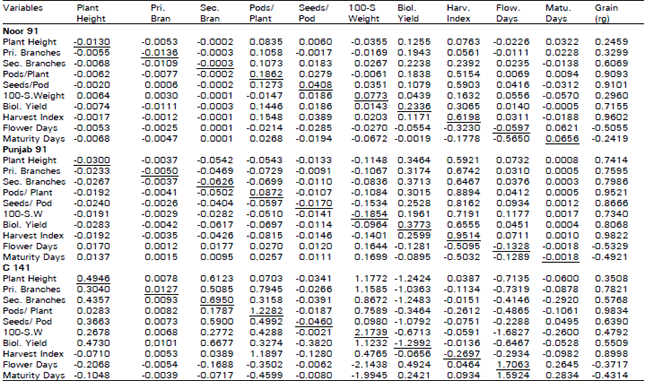
Path Coefficient Analysis: A critical examination of the data (Table 1) showed that in M1 generation of variety Noor 91, pods per plant, seeds per pod, 100-seed weight, biological yield, harvest index and days to maturity had direct positive effect on grain yield per plant. Harvest index had maximum genetic correlation and direct contribution to grain yield. Ghafoor et al. (1990) has also found a positive direct effect of harvest index and biological yield on grain yield. Pods per plant, seeds per pod and biological yield also sufficiently indirectly contributed through harvest index to grain yield.
However, the remaining characters plant height, primary branches, secondary branches and days to 50% flowering had negative direct effect on grain yield per plant. Malik et al. (1987b) also reported negative direct effect of days to flowering on grain yield.
In case of Punjab 91 genotype, harvest index had maximum direct contribution to grain yield followed by biological yield, however, the rest of all the characters had negative direct effect on grain yield (Table 1).
| Table 1: | Direct (under line) and indirect effect matrix (non-dependent variable is grain yield). The last column shows genotype correlation of independent variables with grain yield in M1 generation of three chickpea genotypes |
 | |
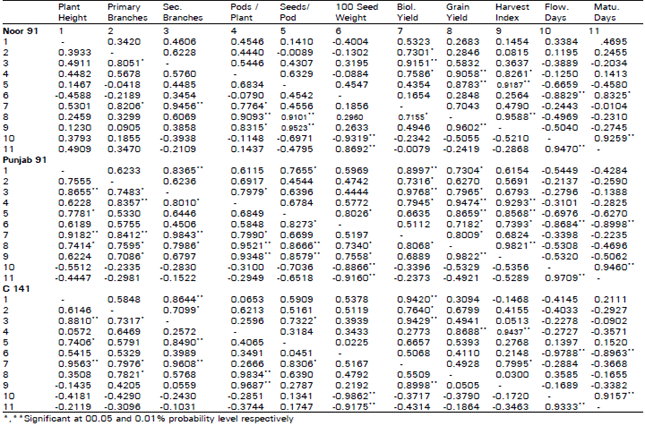
| Table 2: | Estimates of phenotypic (upper diagonal) and genotypic (lower diagonal) correlation between pairs of characters in M1 generation of three chickpea genotypes |
 | |
Harvest index and biological yield also had the highest genetic correlation with seed yield. Highly positive direct estimate for biological yield and harvest index were reported by Malik et al. (1987b) and Ghafoor et al. (1990) in mungbean and mashbean, respectively. Rest of the characters except days to flowering and maturity had the positive genetic correlation with grain yield, which was mainly contributed indirectly through the harvest index.
The contribution of different characters to grain yield in variety C141 of M1 generation, revealed that 100-seed weight had maximum direct positive effect on grain yield followed by days to flowering and pods per plant (Table 1). However biological yield had strong negative direct effect on grain yield per plant. Harvest index and seeds per pod also had negative direct contribution to grain yield. Pods per plant had the maximum genetic correlation, which was mainly due to the indirect positive effect of the 100-seed weight on seed yield. Seeds per pod, biological yield, harvest index, days to flowering and maturity in most of the traits had negative indirect effect, while the other characters had positive indirect contribution to grain yield.
Correlation Coefficient Studies: The results regarding genotypic and phenotypic correlation coefficients for M1 population (Table 2) revealed that the genotypic coefficients were higher than the phenotypic ones for most of the characters. The findings of Hussain et al. (1991) and Bakhsh et al. (1991) are in agreement with present results. Higher magnitude of genotypic coefficients than that of phenotypic coefficients indicated the masking effect of environment (Asawa et al., 1981).
In M1 generation of three varieties, the correlation of yield was positive with all characters except days to flowering and maturity where association was negative. In Noor 91, the genotypic correlation was highly significant for pods per plant, seeds per pod and harvest index while a significant correlation was observed for biological yield. Majid et al. (1982) also recorded highest correlation value between seed yield and pods per plant. Malik et al. (1988) observed that seed yield was positively and significantly correlated with pods per plant and biological yield. Positive and significant association of seed yield have been reported for pods per plant in chickpea (Yaqoob et al., 1990), seeds per pod (Singh, 1988). The correlation between yield and other traits like plant height, primary branches, secondary branches and 100-seed weight was positive but non-significant. Ghafoor et al. (1990) also recorded positive correlation with these characters.
Genotypic correlation in the case of variety Punjab 91, was highly significant for pods per plant, seeds per pod and harvest index. Malik et al. (1987a) also reported positive and significant association between yield and pods per plant. While, a significant association between yield and other characters like plant height, primary branches, secondary branches, 100-seed weight and biological yield was observed. Positive and significant correlation between seed yield and all these traits except biological yield has been observed by Khan et al. (1983) in chickpea, while in Vigna radiata by Malik et al. (1987b).
However, in variety C141, highly significant correlation was observed for seed yield with pods per plant and harvest index while a significant association was recorded for primary branches. Whereas, the remaining characters like plant height, secondary branches, seeds per pod, 100-seed weight and biological yield were positively and non-significantly associated with grain yield.
From this study it can be concluded that although most of the characters had positive correlation with seed yield. But when we consider path analysis then a more clearer picture for the selection of better genotypes is established. In genotype Noor 91 according to this study, most emphasis should given to harvest index along with pods per plant, seeds per pod and biological yield for the selection of better genotypes. Harvest index and biological yield in genotype Punjab 91 while in C141, harvest index and pods per plant and 100-seed weight could be approved as important criterion in the improvement of these genotypes.
REFERENCES
- Dewey, D.R. and K.H. Lu, 1959. A correlation and path-coefficient analysis of components of crested wheatgrass seed production. Agron. J., 51: 515-518.
CrossRefDirect Link - Kwon, S.H. and J.H. Torrie, 1964. Heritability of and interrelationships among traits of two soybean populations. Crop Sci., 4: 196-198.
Direct Link