

Rahmat Ullah Khan
Arid Zone Research Institute, PARC, Ratta Kulachi, D.I. Khan, Pakistan
Abdul Ahad
Arid Zone Research Institute, PARC, Ratta Kulachi, D.I. Khan, Pakistan
Abur Rashid
Arid Zone Research Institute, PARC, Ratta Kulachi, D.I. Khan, Pakistan
Ahmad Khan
Arid Zone Research Institute, PARC, Ratta Kulachi, D.I. Khan, Pakistan
Journal of Biological Sciences
Year: 2001 | Volume: 1 | Issue: 3 | Page No.: 103-104


ABSTRACT
A field trial was conducted to determine the optimum row spacing for chickpea crop for its better plant development to obtain maximum seed yield under the rainfed condition of Dera Ismail Khan. All the row spacing influenced the seed yield but use of narrow spacing of 30 produced significantly maximum yield of 2994, 2392 kg/ha whereas lowest yield 1834 and 1441 kg/ha obtained by wider spacing of 70 cm both the year respectively. The said treatment also produced the greatest 1000 seed weight.
PDF Abstract XML References Citation
How to cite this article
Rahmat Ullah Khan, Abdul Ahad, Abur Rashid and Ahmad Khan, 2001. Chickpea Production as Influenced by Row Spacing under Rainfed Conditions of Dera Ismail Khan. Journal of Biological Sciences, 1: 103-104.
DOI: 10.3923/jbs.2001.103.104
URL: https://scialert.net/abstract/?doi=jbs.2001.103.104
DOI: 10.3923/jbs.2001.103.104
URL: https://scialert.net/abstract/?doi=jbs.2001.103.104
INTRODUCTION
Chickpea or Gram (Cicer arietinum L.), is the most important winter pulse crop grown in Pakistan. It is grown an area of 1.10 m ha with an annual production of 0.60 mt (Anonymous, 1997). As the crop is a complex phenomena, and is the outcome of several inter related factors. The main reasons for low yield of chickpea are either due to lack of knowledge on optimum management practices or non-availability of high yielding chickpea varieties. Among these factors, planting geometry is an important factor in which row spacing plays an important role in plant development. Guzoresk (1957) reported that chickpea drilled in 15 and 45 cm apart rows at seed rates of 20, 35, 55 and 65 kg ha–1, higher yield was obtained from highest seed rate, drilled in 15 cm apart rows than that drilled in 45 cm apart rows. Arnon (1972) concluded that chickpea is normally sown a 90 to 110 kg ha–1 in rows 30 and 35 cm apart.
Pondleton and Martwing (1973) concluded that in southern USA the soybean yield does not shown any yield increase when planted in narrow rows. However, in Albama, the soybean yield increased progressively as row width decreased from 1 to 0.25 m on soybean planted after July 1 (Rogers and Thurlow, 1971). Similar findings were reported by Costa et al. (1980).
In Israel, Saxena (1979) concluded that yield increased with increase in plant population upto 50 plants/m2 for irrigated chickpea. For unirrigated chickpea, the optimum plant population was 23 plants/m2. He further observed that a 52% increase in yield was obtained when the population levels of winter chickpea was doubled by reducing the row spacing to 30 cm from usual 60 cm. Therefore the present study was undertaken to determine the optimum row spacing for chickpea crop for its better plant development to obtain maximum seed yield under the rainfed condition of Dera Ismail Khan.
MATERIALS AND METHODS
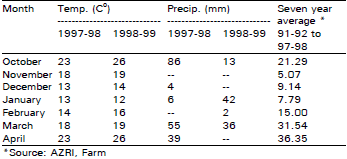
The field experiments were conducted at the research station of Arid Zone Research Institute, D.I.Khan during 1997-98 and 1998-99. Prior to seeding, soil samples were taken from the experimental sites for analysis. Results of the physical and chemical analysis of the soils are presented in Table 1. A basal dose of fertilizer at 20-50-0 NPK kg ha–1 was broadcasted and incorporated into the soil, at planting time. Three row spacing i.e. 30, 50 and 70 cm in chickpea cv. NIFA-88, were evaluated. Planting was done with a single row drill during first weak of November and 2nd week of October both the years respectively. The experiment was laid out in a Randomized Complete Block Design (RCBD) with four replications maintaining a plot size of 1.8×5m (6 rows/plot). Meteorological data are reported in Table 2.
Data on plant height, branches per plant, pods per plant, days to maturity, seed weight, and seed yield was recorded in each plot. Data were analyzed using the analysis of variance (ANOVA) (Steel and Torrie, 1980).
| Table 1: | Chemical and physical status of the soil, where field trials were conducted |
 | |
| Table 2: | Mean monthly temperature (C°) and monthly precipitation at D.I. Khan |
 | |
Results and Discussion
During 1997-98, seed yield ranged from 1834 to 2994 kg/ha and significantly affected by row spacing but 30 cm row spacing appeared the best which gave maximum seed yield of 2994 kgha–1 followed by 50 cm row spacing with seed yield of 2433 kgha–1 but the wider row spacing of 70 cm produced the lowest seed yield of 1834 kg/ha. Branches per plant and maturity did not differ significantly except plant height and pods per plant. The wider spacing plants beard more number of pods which probably may not developed the seed in all pods which ultimately affected the yield. Although row spacing did not influence the 1000 seed weight but generally the narrow row spacing of 30 cm appeared with heavier seed weight as compared to an other treatments (Table 3).
During 1998-99 test, seed yield ranged from 1441 to 2392 kgha–1. Similarly to 1997-98, the narrow spacing of 30 cm significantly gave maximum yield followed by 1668 and 1441 kgha–1 by 50 cm and 70 cm row spacing. Yield did not differ significantly between 50 and 70 cm row spacing but the wider spacing of 70 cm produced the lowest seed yield.
| Table 3: | Effect of spacing on seed yield of chickpea 1997-98 |
 | |
| Table 4: | Effect of spacing on seed yield of chickpea 1998-99 |
 | |
The heaviest 1000 seed weight was obtained by narrow spacing of 30 cm whereas all the other parameter did not differ significantly (Table 4). It has been observed from both year of study that narrow row spacing may have better chances for plant stand and development for obtaining higher yield under rainfed condition. An experiments were conducted on different row spacing i.e 15, 30 and 45 cm in rapeseed for weed control and found narrow row of 15 to 30 cm spacing the best treatments for reducing weeds and their biomass and seed yield as compared to wider spacing of 45 cm (Khan and Muendel, 1999).
The yield differences during both the year may be the result of weather and precipitations occurred during growing seasons both the year respectively (Table 2).
REFERENCES
- Costa, J.A., E.S. Oplinger and J.W. Pendleton, 1980. Response of soybean cultivars to planting patterns. Agron. J., 72: 153-156.
CrossRef - Steel, R.G.D. and J.H. Torrie, 1980. Principles and Procedures of Statistics: A Biometrical Approach. 2nd Edn., McGraw Hill, New York, United States, ISBN-13: 9780070609266, Pages: 633.
Direct Link