

Wartono
Department of Mathematics, State Islamic University of Sultan Syarif Kasim Riau, 28293 Pekanbaru, Indonesia
M. Soleh
Department of Mathematics, State Islamic University of Sultan Syarif Kasim Riau, 28293 Pekanbaru, Indonesia
I. Suryani
Department of Mathematics, State Islamic University of Sultan Syarif Kasim Riau, 28293 Pekanbaru, Indonesia
Zulakmal
Department of Mathematics, Faculty of Mathematics and Natural Sciences, Universitas Andalas, Kampus Unand Limau Manis, 25163 Padang, Indonesia
Muhafzan
Department of Mathematics, Faculty of Mathematics and Natural Sciences, Universitas Andalas, Kampus Unand Limau Manis, 25163 Padang, Indonesia
LiveDNA: 62.20729
Asian Journal of Scientific Research
Year: 2018 | Volume: 11 | Issue: 3 | Page No.: 409-414


ABSTRACT
Background and Objective: The Chebyshev-Halley is an third order iterative method that be used to find the roots of a nonlinear equation. This study is presented a new variant of Chebyshev-Halley’s method without second derivative with two parameters. Methodology: In order to avoid the second derivative, it is approximated by using an equality of two methods, namely, use of a circle of curvature that has the same tangent line and to equate to the Potra-Ptak’s method. Results: The results show that the method requires two evaluation of functions and one its first derivative per iteration with the efficiency index equal to 4⅓ ≈ 1.5874. The convergence analysis shows that the proposed method has the fourth-order convergence for θ = 1 and β = 1 and requires three evaluation of functions per iteration. Conclusion: The final results show that the proposed methods has better performance as compared some other kind of methods. A numerical simulation is presented to show the performance of the proposed method by using several functions.
PDF Abstract XML References Citation
Article History
Received: February 10, 2018;
Accepted: April 26, 2018;
Published: June 15, 2018
Copyright: © 2018. This is an open access article distributed under the terms of the Creative Commons Attribution License , which permits unrestricted use, distribution and reproduction in any medium, provided the original author and source are credited.
How to cite this article
Wartono, M. Soleh, I. Suryani, Zulakmal and Muhafzan, 2018. A New Variant of Chebyshev-Halley’s Method Without Second Derivative with Convergence of Optimal Order. Asian Journal of Scientific Research, 11: 409-414.
DOI: 10.3923/ajsr.2018.409.414
URL: https://scialert.net/abstract/?doi=ajsr.2018.409.414
DOI: 10.3923/ajsr.2018.409.414
URL: https://scialert.net/abstract/?doi=ajsr.2018.409.414
INTRODUCTION
The problems of determining the roots of a nonlinear equation constitutes one of the very important problem in numerical analysis. It is well-known that the following Newton’ss method, i.e:
 | (1) |
constitutes as classical iterative method that can be used to find a simple root of a nonlinear equation f(x) = 0, where f : D ⊂ ℜ→ ℜ is a scalar function. As Ostrowski1 is stated that this method is quadratically convergent with efficiency indexes equal to 
In order to improve the local order of convergence, many modification of the method have been proposed. A family of iterative method with third order-convergence has been reported by Amat et al.2 and Hernandez and Salanova3 as follows:
 | (2) |
Where:
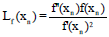 | (3) |
The Eq. 2 is known as Chebyshev-Halley’s method for some β. In particularly, the Eq. 2 becomes the Chebyshev’s method if β = 0, Halley’s method if β = 1/2 and super Halley’s method if β = 1, according to Gutierrez and Hernandez4.
Note that the Eq. 2 requires a second derivative of f. It is evident that the Eq. 2 can not be used in the cases in which the second derivative of f is not exist. Recently, some modification of Eq. 2 have been studied to avoid the second derivative by using several approximation such as Taylor’s series expansion5-8, finite different quotient9-11, cubic polynomial12, quadratic function13, linear combination14 and hyperbola15.
Motivated by the recent study, in this paper is presented a new variant of the classical Chebyshev-Halley’s method that contain two real parameters using a new approximation to avoid the second derivative o f f in Eq. 2. It is shown that for θ = 1, this new method constitutes a generalization of several previous methods that be proposed in Ostrowski1, Chun16, Potra and Ptak’s17 and Sharma18. In the end of this study, a numerical simulation is presented for comparing several methods.
NEW METHOD
To derive this method, let us consider the Chebyshev-Halley’s method in Eq. 2 in the following form:
 | (4) |
The iteration scheme of Eq. 4 has the third order of convergence and contains a second derivative function. In order to avoid the second derivative, f (xn) is approximated by using an equality of two methods.
To derive an approximation for f (xn) in Eq. 4, firstly use a circle of curvature that has a same tangent line at (xn, yn) of the curve y = f(x) that given by:
 | (5) |
The circle of curvature in Eq. 5 that throughout at intersection at point (xn+1, 0) is:
 | (6) |
Let f(xn) = yn , f '(xn) = yn and f ''(xn) = y"n, then (6) can be written as:
 | (7) |
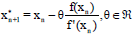
Where:
 | (8) |
By substituting (8) into (7), one have:
 | (9) |
Furthermore, consider the following Potra-Ptak’ss method17:
 | (10) |
where yn is a Newton’ss method that defined by (8):
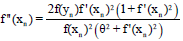
Based on Eq. 9 and 10, one get a new expression of f''(xn) that given by:
 | (11) |
By subtituting Eq. 11 into Eq. 4, one obtained a new two-parameters family of Chebyshev-Halley’s method which free of second derivative, that is:
 | (12) |
The Eq. 12 is a variant of Chebyshev-Halley’s method with two parameters θ and β that requires three evaluation of functions f(xn), f '(xn) and f(yn).
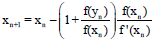
One can see that for θ = 1 and β∈ℜ, the family of Eq. 12 constitutes a generalization of Chebyshev-Halley’s method. For β →±∞, one get the Newton’ss method as defined by Eq. 1. For β = 0, one get the Potra-Ptak’ss method17:
 |
For β = ½, one get the Newton’s-Steffensen’s method18:
 |
For β =1, one get the Ostrowski’s method1:
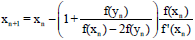 |
For β = -1/2, one get the Chun’s method16:
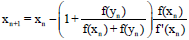 |
Furthermore, it will be shown that this new method has the fourth-order convergence.
Theorem: Let α ∈ D be a simple root of a differentiable function f : D ⊂ ℜ → ℜ. If the initial value x0 is sufficiently close
to α, then the method defined by Eq. 12 has fourth order convergence for θ = 1 and β =1 with error:
 | (13) |
Proof: Let α is the root of nonlinear equation f(x) = 0. If en = xn-α and  , then the expansion of Taylor’s series for f(xn) and f '(xn) around α is given by:
 | (14) |
and:
 | (15) |
because:
 | (16) |
Using the Eq. 14 and 15, one get  as follows:
 | (17) |
Furthermore, using the Eq. 17 and xn = α + en, one get:
 | (18) |
and using the expansion of Taylor’s series around α, f(yn) can be written as:
 | (19) |
By using the Eq. 16 and 19, one get:
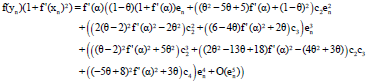 | (20) |
 | (21) |
and:
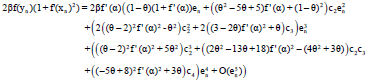 | (22) |
Furthermore, by using the Eq. 20-22 and en = xn-α, the Eq. 12 becomes:
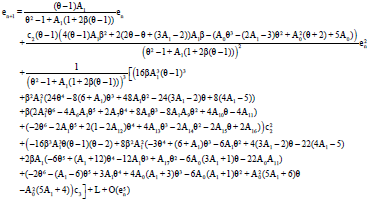 | (23) |
Where:
| A0 | = | f(α)2 |
| A1 | = | 1+f(α)2 |
| A2 | = | 4 f(α)2-1 |
| A3 | = | f(α)6+22f(α)4+f(α)2+6 |
| A4 | = | -f(α)6-4f(α)4+7f(α)2+2 |
| A5 | = | f(α)2 (7f(α)4+27f(α)2+4) |
| A6 | = | f(α)4 (5f(α)4+15f(α)2+2) |
| A7 | = | f(α)2 (2f(α)4+7f(α)2-2) |
| A8 | = | 7f(α)4+24f(α)2+5 |
Using the Eq. 23 and by taking θ = 1, one get:
 | (24) |
Because the Eq. 12 requires three evaluation of functions, it becomes an optimal iterative method when it has fourth order of convergence19. So, based on the Eq. 24, one can see that the order of convergence of Eq. 24 will increase quartically by taking β = 1 and it can be written as:
 | (25) |
The Eq. 25 has fourth-order convergence and it requires three evaluation of functions with an efficiency index equal to  ≈ 1.5874.
NUMERICAL EXAMPLE
In this section is presented a numerical example to illustrate efficiency of the proposed method by using several test functions. The zeros approximation α of the test functions was displayed 20th decimal places.
It is compared the performance of Eq. 12 both of β ≠ 1 (VCH3) and β = 1 (VCH4) with Newton’ss method (N2)20, classical Chebyshev-Halley’s method with β = 1/2 (CH3)3,4, Potra-Ptak’ss method (PP3)17. All computations are performed by using Maple 13.0 with 850 digits floating point arithmetics for the following several test functions:
| • | f1(x) | =xe‾x -0.1, α = 0.11183255915896296483 |
| • | f2(x) | =ex-4x2, α = 4.30658472822069929833 |
| • | f3(x) | =cos(x)-1, α = 0,73908513321516064165 |
| • | f4(x) | =(x-1)3-1, α = 2.00000000000000000000 |
| • | f5(x) | =x3+4x2-10, α = 1.36523003414096845760 |
| • | f6(x) | = -cos(x+1)+x3+1, α = -1.000000000 00000000000 -cos(x+1)+x3+1, α = -1.000000000 00000000000 |
| • | f7(x) | = -x , α = 1.00000000000000000000 -x , α = 1.00000000000000000000 |
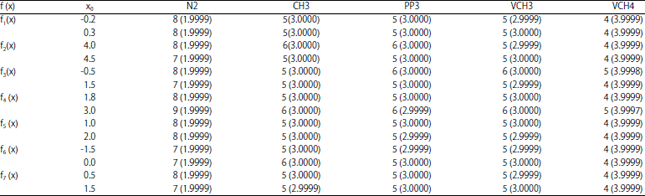
Table 1 shows the number of iteration (IT) that satisfies stopping criteria:
 | (26) |
where, e = 10-95 and all computation order of convergence (COC) in the parentheses by using the following formula:
 | (27) |
Based on the Table 1, one can see that order of convergence of the proposed method is three for β ≠1 and four for β = 1.
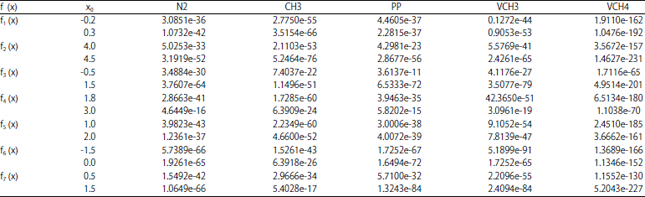
The accuracy of the new method and several other methods by using the same total number of functional evaluation as comparison are presented at Table 2. Based on the Table 2, one can see that accuracy of the proposed method for β = 1 is better than other methods.
| Table 1: | Number of iteration (IT) and COC |
 | |
| Table 2: | Absolute value of function |f (xn+1)| under same total number of functional evaluation (TNFE) with TNFE = 12 |
 | |
CONCLUSION
This research work have developed a new fourth-order convergence method for solving nonlinear equation that free from second derivative. The method requires two evaluation of functions and one its first derivative per iteration with the efficiency index equal to  ≈1.5874. The numerical results show that the proposed method has better performance as compared with the other methods. Therefore, the results of this study provide a new contribution in computational science area.
SIGNIFICANCE STATEMENT
This study discovers a new variant of Chebyshev-Halley’s method as an alternative method to find the roots of the nonlinear equation. The results of this study can help the researchers in computational science and engineering area.
REFERENCES
- Amat, S., S. Busquier and J.M. Gutierrez, 2003. Geometric constructions of iterative functions to solve nonlinear equations. J. Comput. Applied Math., 157: 197-205.
CrossRefDirect Link - Hernandez, M.A. and M.A. Salanova, 1993. A family of Chebyshev-Halley type methods. Int. J. Comput. Math., 47: 59-63.
CrossRefDirect Link - Gutierrez, J.M. and M.A. Hernandez, 1997. A family of Chebyshev-Halley type methods in banach spaces. Bull. Aust. Math. Soc., 55: 113-130.
CrossRefDirect Link - Kanwar, V. and S.K. Tomar, 2007. Modified families of multi-point iterative methods for solving nonlinear equations. Numer. Algorithms, 44: 381-389.
CrossRefDirect Link - Li, Y., P. Zhang and Y. Li, 2010. Some new variants of Chebyshev-Halley methods free from second derivative. Int. J. Nonlinear Sci., 9: 201-206.
Direct Link - Nedzhibov, G.H., V.I. Hasanov and M.G. Petkov, 2006. On some families of multi-point iterative methods for solving nonlinear equations. Numer. Algorithms, 42: 127-136.
CrossRefDirect Link - Wartono, M. Soleh, I. Suryani and Muhafzan, 2016. Chebyshev-Halley's method without second derivative of eight-order convergence. Global J. Pure Applied Math., 12: 2987-2997.
Direct Link - Chun, C.B., 2007. Certain improvements of Chebyshev-Halley methods with accelerated fourth-order convergence. Applied Math. Comput., 189: 597-601.
CrossRefDirect Link - Kou, J., Y. Li and X. Wang, 2007. Fourth-order iterative methods free from second derivative. Applied Math. Comput., 184: 880-885.
CrossRefDirect Link - Chun, C., 2007. Some variants of Chebyshev-Halley methods free from second derivative. Applied Math. Comput., 191: 193-198.
CrossRefDirect Link - Chun, C., 2007. Some second-derivative-free variants of Chebyshev-Halley methods. Applied Math. Comput., 191: 410-414.
CrossRefDirect Link - Grau-Sanchez, M. and J.M. Gutierrez, 2010. Some variants of the Chebyshev-Halley family of methods with fifth order of convergence. Int. J. Comput. Math., 87: 818-833.
CrossRefDirect Link - Xiaojian, Z., 2008. Modified Chebyshev-Halley methods free from second derivative. Applied Math. Comput., 203: 824-827.
CrossRefDirect Link - Chun, C., 2008. A simply constructed third-order modifications of Newton's method. J. Comput. Applied Math., 219: 81-89.
CrossRefDirect Link - Sharma, J.R., 2005. A composite third order Newton-Steffensen method for solving nonlinear equations. Applied Math. Comput., 169: 242-246.
CrossRefDirect Link - Kung, H.T. and J.F. Traub, 1974. Optimal order of one-point and multipoint iteration. J. Assoc. Comput. Mach., 21: 643-651.
CrossRefDirect Link