

G.R. Huang
Department of Food Science, College of Life Sciences, China Jiliang University, Xiasha High Education Area, 310018, Hangzhou, Zhejiang Province, People’s Republic of China
Z.Y. Ren
Department of Food Science, College of Life Sciences, China Jiliang University, Xiasha High Education Area, 310018, Hangzhou, Zhejiang Province, People’s Republic of China
J.X. Jiang
Department of Food Science, College of Life Sciences, China Jiliang University, Xiasha High Education Area, 310018, Hangzhou, Zhejiang Province, People’s Republic of China
American Journal of Food Technology
Year: 2014 | Volume: 9 | Issue: 1 | Page No.: 49-55


ABSTRACT
Iron is one of the most popular trace elements in body and plays very important role in metabolism or construction of body. Organic iron from various sources for curing iron-deficiency anemia was one of the hot research items in recent years. The aim of this study was optimize the enzymatic hydrolysis conditions for preparing iron peptides from shrimp processing byproducts. Factorial experiments and response surface methodology were applied to optimize the enzymatic hydrolysis parameters. The iron binding capacity was used for evaluating indicator. The results showed that trypsin hydrolysate of shrimp processing byproducts had the highest iron binding ability and the three significant factors were enzyme concentration, pH and hydrolysis time, respectively. The optimum trypsin hydrolysis conditions were pH 8.2, enzyme concentration of 500 U mL-1 and hydrolysis time of 2 h, respectively. The highest iron binding ability of trypsin hydrolysate was obtained to be 6.75 μg mg-1 at these optimum conditions. Trypsin was effective for producing iron binding peptides from shrimp processing byproducts.
PDF Abstract XML References Citation
Article History
Received: September 07, 2013;
Accepted: January 03, 2014;
Published: March 04, 2014
How to cite this article
G.R. Huang, Z.Y. Ren and J.X. Jiang, 2014. Optimization of Hydrolysis Conditions for Iron Binding Peptides Production
from Shrimp Processing Byproducts. American Journal of Food Technology, 9: 49-55.
DOI: 10.3923/ajft.2014.49.55
URL: https://scialert.net/abstract/?doi=ajft.2014.49.55
DOI: 10.3923/ajft.2014.49.55
URL: https://scialert.net/abstract/?doi=ajft.2014.49.55
INTRODUCTION
Iron is one of the most popular trace elements in body and plays very important role in metabolism or construction of body, such as oxygen transportation of hemoglobin in blood. Iron deficiency in body will cause iron-deficiency anemia which is one of the most deficiency diseases and more than two billion people suffer from ion-deficiency anemia every year all over the world (Wu et al., 2002).
Shrimp is one of the most favorite marine products and it enriches in nutrition, such as high levels of protein, minerals, vitamins and other bioactive molecules. Except for consumption as freshness, most of the shrimp are processed to shrimp products, such as frozen shrimp. However, the discards which include mainly heads and shells, will occupy 35-45% during shrimp processing (Meyers, 1986; Begum et al., 2006). These shrimp processing byproducts will be gotten rancidness easily and is difficult to transport because of high contents of moisture, protein and fat. Therefore, these shrimp processing byproducts should be treated rapidly and direct discards will be pollution to environment. Now, most of them are used for production of animal feed or chitin (Daum et al., 2007; Cavalheiro et al., 2007). Other high valued products from shrimp processing byproducts are also reported in recent years, such as shrimp carotenoids (Sachindra et al., 2007), chitosan (Weska et al., 2007), shrimp sauce (Kim et al., 2003, 2005) and bioactive peptides, such as antimicrobial peptide (Destoumieux-Garzon et al., 2001), antioxidant peptide (De Rosenzweig Pasquel and Babbitt, 1991; Seymour et al., 1996; Zhao et al., 2011) and ACE inhibiting peptide (Cheung and Li-Chan, 2010). Mineral binding peptides, including calcium, zinc and iron, had been reported from chickpea protein (Torres-Fuentes et al., 2012), oyster protein (Chen et al., 2013), sesame protein (Wang et al., 2012), soy protein (Bao et al., 2007) and casein protein (Wang et al., 2011). However, the shrimp processing byproducts was rarely used for producing mineral binding peptides by enzymatic hydrolysis (Huang et al., 2011). In this study, the enzymatic hydrolysis conditions were optimized for producing iron-binding peptides from shrimp processing byproducts.
MATERIALS AND METHODS
Materials and chemicals: The shrimp processing byproducts as frozen status were delivered from Hangzhou Beijiping Aquatic Co. Ltd., Zhejiang province, China. The samples were thawed at 4°C for 24 h and then were rinsed three times with distilled water and dried at 65°C under vacuum for 24 h. The dried samples were smashed into fine powder and passed through 150 mesh (0.1 mm) sieve then stored in sealed container at 4°C. Flavourzyme (1500 U mg-1) was purchased from Novo (Novozymes, Denmark). Pepsin (1200 U g-1), compound protease (120 U mg-1), neutral protease (200 U mg-1) and alacalase (100 U mg-1) were purchased from Shanghai biological Co. Ltd., China. Trypsin (2500 U mg-1) and chelating resin were purchased from Sinopharm Chemical Reagent Co. Ltd., China. Chemicals and solvents were of analytical and HPLC grade.
Preparation of enzymatic hydrolysates: The shrimp processing byproducts fine powder was suspended in buffer solution at 5% (w/v) mixture and then the mixture was hydrolyzed at optimum temperature shown in Table 1 for 5 h with enzyme concentration of 1000 U mL-1. The hydrolysis reaction was terminated by boiling the hydrolysates for 10 min in order to inactivate the enzyme. The hydrolysates were then centrifuged at 8000 g for 10 min to remove insoluble substrates and the supernatant was stored at -20°C till analysis.
Factorial experiments: For the chosen optimum protease, factor experiments were chosen to judge the significance of five hydrolysis factors, including pH, temperature, time, enzyme concentration and substrate concentration. A five-factor-two-level factorial experiment was designed and total 8 experiments were conducted shown in Table 2. After hydrolysis, the protein content and iron binding capacity were determined.
| Table 1: | Enzymatic hydrolysis conditions of six chosen proteases for producing iron binding peptides from shrimp processing byproducts |
 | |
| *tris-HCl means Tris (hydroxymethyl) aminomethane-HCl | |
| Table 2: | Iron binding capacity at various trypsin hydrolysis conditions designed by factorial experiments |
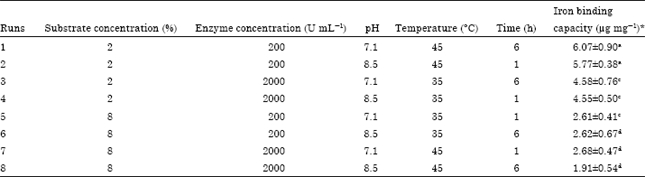 | |
| *The values are Means±SD of triplicate measurements. Values with different letters in the same row are significantly different (p<0.05) | |
| Table 3: | Experimental design used in response surface methodology studies by using three independent variables with six center points showing observed iron binding capacity |
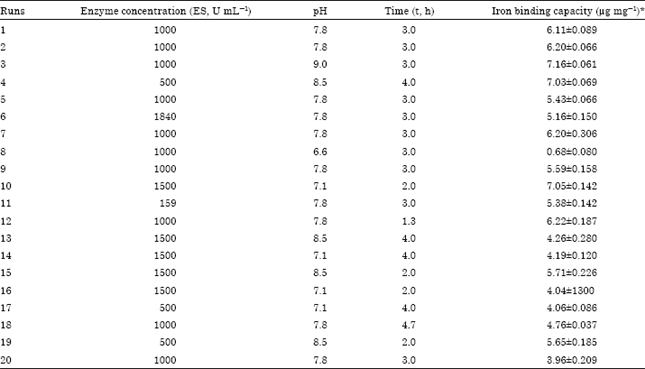 | |
| *Values are Means±SD of triplicate measurements | |
Response surface methodology experiments: The trypsin hydrolysis parameters of shrimp processing byproducts were optimized using Response Surface Methodology (RSM) for producing iron binding peptides. The Central Composite Design (CCD) was employed in this regard. The pH (pH), trypsin concentration (ES) and time of hydrolysis (t) were chosen for independent variables and the ranges of which, given in Table 3, were determined according to the results of factorial experiments. The CCD composed by 20 experiments was carried out. The iron binding capacity was selected as the response for the combination of the independent variables given in Table 3. They are the average of three sets of parallel data. Experimental runs were randomized to minimize the effects of unexpected variability in the observed responses. The behavior of the system was explained by the following quadratic Eq. 1:
 | (1) |
where, Y is the iron binding capacity (μg mg-1); β0 is a constant term; βi, βii, βij are the linear, quadratic and cross-product regression coefficients and xi, xj are levels of the independent variables. The model evaluated the effect of each independent variable on a response. Analysis of the experimental design and calculation of predicted data were carried out using Design Expert Software to estimate the response of the independent variables. Subsequently, three additional confirmation experiments were conducted to verify the validity of the statistical experimental strategies.
Determination of protein content and iron binding capacity: The hydrolysates were diluted with distilled water and then appropriate amount of macroporous resin (Amberlite IRC-748I sodium form) was added to demineralize in order to exclude the interference of divalent iron. The hydrolysate was mixed with equal volume of 200 mM phosphate buffer (pH8.0). After the addition of 30 mM FeSO4•7H2O (including 0.1 M L-ascorbic acid), the solution was stirred at room temperature for 1 h and the mixture was centrifuged at 8000 g for 10 min to remove precipitates. The iron content in the supernatant was determined using a chromomeric method with orthophenanthroline reagent (Krishna Murti et al., 1970). The absorbance at 510 nm was determined after adding 2.75 mL distilled water, 1.0 mL acetate buffer solution (pH 4.5) and 0.25 mL orthophenanthroline reagent to the sample (1.0 mL). Also the Ethylene Diamine Tetraacetic Acid (EDTA) was used as a positive control. The protein content was determined using a chromomeric method with Folin-phenol (Lowry et al., 1951) using bovine serum albumin as a standard. The iron binding capacity was expressed as equivalent EDTA quantity (μg) per unit of protein (mg).
Statistical analysis: Statistical analysis was conducted by Design Expert software and data was expressed as Mean±Standard deviation of three experiments. The Least Significant Difference (LSD) with a confidence interval of 95% was used to compare the means.
RESULTS AND DISCUSSION
Choice of hydrolysis enzyme: Six kinds of proteases, including alcalase, pepsin, trypsin, neutral protease, compound protease and flavourzyme, were used to hydrolysis shrimp processing byproducts for producing iron binding hydrolysates. The results were shown in Fig. 1. Trypsin was the best effective enzyme for producing hydrolysate with high iron binding capacity of 1.28 μg mg-1. The iron binding capacity of hydrolysates with pepsin and flavourzyme were slightly lower than that of hydrolysate with trypsin. Trypsin was one of endo peptidases and hydrolyzed the peptide bonds of lysine or arginine in protein. Trypsin was also always used to hydrolyze marine protein for producing biological activity peptides, such as antioxidant peptides from the marine rotifer, Brachionus rotundiformis (Je et al., 2007) and antioxidant peptides from tuna backbone protein (Byun et al., 2009). Therefore, trypsin was chosen to optimize hydrolysis conditions for producing iron binding peptides from shrimp processing byproducts in the next experiments.
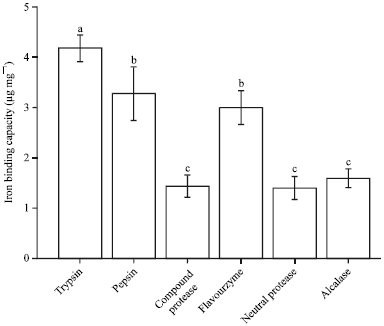 |
| Fig. 1: | Iron binding abilities of shrimp heads and shells hydrolysates by six proteases. The values are Mean±SD of triplicate measurements. Values with different letters are significantly different (p<0.05) |
Factorial experiments: Factorial experiments were usually used to choose significant factors from multitude factors by experiments as little as possible. During enzymatic hydrolysis of protein, the pH, temperature, time, enzyme concentration and substrate concentration were frequently affected the peptide molecular distribution of hydrolysates which influenced the biological activity of hydrolysates. Therefore, these five factors were chosen to determine their effects on iron binding capacity of hydrolysates during trypsin hydrolysis with five-factor-two-level experiments. The iron binding capacities of trypsin hydrolysates were ranging from 1.91 to 6.07 μg mg-1 at various hydrolysis conditions (Table 2). At lower substrate concentration and enzyme concentration, the hydrolysates had higher iron binding capacity of 6.07 or 5.77 μg mg-1. The results showed that pH, hydrolysis time and enzyme concentration were the significant factors for producing iron binging peptides (Table 2). The relationship index (R2) between these factors and iron binding capacity were 0.9664, 0.9598 and 0.8987, respectively. Therefore, pH, hydrolysis time and enzyme concentration were optimized during trypsin hydrolysis in the next experiments by response surface methodology.
Response surface methodology: Response surface methodology was an effective statistical technique for process parameters optimization in the shortest time and the least cost when many factors and interactions had effect on response (Kongo-Dia-Moukala and Zhang, 2011). RSM was used in this section to optimize the trypsin hydrolysis conditions for producing high iron binding capacity hydrolysate from shrimp processing byproduct. Based on preliminary experiments, the center points of trypsin hydrolysis were chosen at pH 7.8, time of 3 h and enzyme concentration of 1000 U mL-1. The other two factors were fixed at substrate concentration of 5% and temperature of 37°C. The results were given in Table 3. The iron binding capacities of trypsin hydrolysates in 20 runs of RSM experiments were ranging from 0.68 to 7.16 μg mg-1 at various hydrolysis conditions (Table 3). The iron binding capacity at six central points was much closed and the average value of 5.915 μg mg-1. A full factorial CCD was performed to study the combined effects of these three factors on the iron binding capacity of shrimp processing hydrolysate.
| Table 4: | Regression analysis results using response surface methodology for optimizing trypsin hydrolysis conditions |
 | |
A second-order polynomial regression model was selected to predict iron binding capacity responses. All terms with a statistical significance below 5% probability level were listed in Table 4, leading to the models shown in Eq. 2:
 | (2) |
The Model “Prob>F” value of 0.1485 meant that the reliability of predicted model was about 85%. The model could be used to predict the effects of these three factors on iron binding capacity of hydrolysates. The optimal conditions were extracted by Design Expert software with its optimization menus: pH = 8.2, ES = 500 U mL-1, t = 2 h. To confirm the validity of the statistical experimental strategies, three additional confirmed experiments were conducted. The measured iron binding capacity of 6.73 μg mg-1 was much close to the predicted values of 6.75 μg mg-1 using RSM. These results are obviously in close agreement with the model prediction and confirm the predictability of the model for the enzymolysis of the shrimp processing byproduct in the experimental condition used.
CONCLUSION
Among the six commercial proteases, trypsin was best choice for producing iron binding peptides from shrimp processing byproducts and pepsin or flavourzyme was the next choice. The enzyme concentration, pH and hydrolysis time affected significantly on iron binding capacity of hydrolysates by factorial experiments. The optimum of hydrolysis conditions by response surface methodology showed that the best choices were pH 8.2, enzyme concentration of 500 U mL-1 and hydrolysis time of 2 h. At these optimum hydrolysis conditions, the highest iron binding capacity of 6.73 μg mg-1 was obtained which was much closed to the predicted value by the quadratic model.
REFERENCES
- Bao, X.L., M. Song, J. Zhang, Y. Chen and S.T. Guo, 2007. Calcium-binding ability of soy protein hydrolysates. Chin. Chem. Lett., 18: 1115-1118.
CrossRefDirect Link - Begum, S., K. Ikejima, H. Ara and M.Z. Islam, 2006. Alternative processing option from shrimp processing biowaste in khulna district-Southwestern Bangladesh. J. Applied Sci., 6: 1307-1313.
CrossRefDirect Link - Byun, H.G., J.K. Lee, H.G. Park, J.K. Jeon and S.K. Kim, 2009. Antioxidant peptides isolated from the marine rotifer, Brachionus rotundiformis. Process Biochem., 44: 842-846.
CrossRefDirect Link - Cavalheiro, J.M.O., E.O. de Souza and P.S. Bora, 2007. Utilization of shrimp industry waste in the formulation of tilapia (Oreochromis niloticus Linnaeus) feed. Bioresour. Technol., 98: 602-606.
CrossRefDirect Link - Chen, D., Z. Liu, W. Huang, Y. Zhao, S. Dong and M. Zeng, 2013. Purification and characterisation of a zinc-binding peptide from oyster protein hydrolysate. J. Funct. Foods, 5: 689-697.
CrossRefDirect Link - Daum, G., H. Stober, K. Veltrup, F. Meinhardt and B. Bisping, 2007. Biotechnological process for chitin recovery out of shrimp waste. J. Biotechnol., 131: s188-s188.
CrossRef - Destoumieux-Garzon, D., D. Saulnier, J. Garnier, C. Jouffrey, P. Bulet and E. Bachere, 2001. Crustacean immunity. Antifungal peptides are generated from the C terminus of shrimp hemocyanin in response to microbial challenge. J. Biological Chem., 276: 47070-47077.
CrossRefDirect Link - Huang, G., Z. Ren and J. Jiang, 2011. Separation of iron-binding peptides from shrimp processing by-products hydrolysates. Food Bioprocess Technol., 4: 1527-1532.
CrossRefDirect Link - Cheung, I.W.Y. and E.C.Y. Li-Chan, 2010. Angiotensin-I-converting enzyme inhibitory activity and bitterness of enzymatically-produced hydrolysates of shrimp (Pandalopsis dispar) processing byproducts investigated by Taguchi design. Food Chem., 122: 1003-1012.
CrossRefDirect Link - Je, J.Y., Z.J. Qian, H.G. Byun and S.K. Kim, 2007. Purification and characterization of an antioxidant peptide obtained from tuna backbone protein by enzymatic hydrolysis. Process Biochem., 42: 840-846.
CrossRefDirect Link - Kim, J.S., F. Shahidi and M.S. Heu, 2003. Characteristics of salt-fermented sauces from shrimp processing byproducts. J. Agric. Food Chem., 51: 784-792.
CrossRef - Kim, J.S., F. Shahidi and M.S. Heu, 2005. Tenderization of meat by salt-fermented sauce from shrimp processing by-products. Food Chem., 93: 243-249.
CrossRefDirect Link - Kongo-Dia-Moukala, J.U. and H. Zhang, 2011. Defatted corn protein extraction: Optimization by response surface methodology and functional properties. Am. J. Food Technol., 6: 870-881.
CrossRefDirect Link - Krishna Murti, G.S.R., A.V. Moharir and V.A.K. Sarma, 1970. Spectrophotometric determination of iron with orthophenanthroline. Microchem. J., 15: 585-589.
CrossRef - Lowry, O.H., N.J. Rosebrough, A.L. Farr and R.J. Randall, 1951. Protein measurement with the folin phenol reagent. J. Biol. Chem., 193: 265-275.
CrossRefPubMedDirect Link - De Rosenzweig Pasquel, L.J. and J.K. Babbitt, 1991. Isolation and partial characterization of a natural antioxidant from shrimp (Pandalus jordani). J. Food Sci., 56: 143-145.
CrossRef - Sachindra, N.M., N. Bhaskar, G.S. Siddegowda, A.D. Sathisha and P.V. Suresh, 2007. Recovery of carotenoids from ensilaged shrimp waste. Bioresour. Technol., 98: 1642-1646.
CrossRef - Seymour, T.A., S.J. Li and M.T. Morrissey, 1996. Characterization of a natural antioxidant from shrimp shell waste. J. Agric. Food Chem., 44: 682-685.
CrossRefDirect Link - Torres-Fuentes, C., M. Alaiz and J. Vioque, 2012. Iron-chelating activity of chickpea protein hydrolysate peptides. Food Chem., 134: 1585-1588.
CrossRefDirect Link - Wang, C., B. Li and J. Ao, 2012. Separation and identification of zinc-chelating peptides from sesame protein hydrolysate using IMAC-Zn2+ and LC-MS/MS. Food Chem., 134: 1231-1238.
CrossRefDirect Link - Wang, X., J. Zhou, P.S. Tong and X.Y. Mao, 2011. Zinc-binding capacity of yak casein hydrolysate and the zinc-releasing characteristics of casein hydrolysate-zinc complexes. J. Dairy Sci., 94: 2731-2740.
CrossRef - Weska, R.F., J.M. Moura, L.M. Batista, J. Rizzi and L.A.A. Pinto, 2007. Optimization of deacetylation in the production of chitosan from shrimp wastes: Use of response surface methodology. J. Food Eng., 80: 749-753.
CrossRefDirect Link - Wu, A.C., L. Lesperance and H. Bernstein, 2002. Screening for iron deficiency. Pediatr. Rev., 23: 171-177.
Direct Link - Zhao, J., G.R. Huang, M.N. Zhang, W.W. Chen and J.X. Jiang, 2011. Amino acid composition, molecular weight distribution and antioxidant stability of shrimp processing byproduct hydrolysate. Am. J. Food Technol., 6: 904-913.
CrossRefDirect Link