

M. Ayub
Department of Agronomy, University of Agriculture, Faisalabad-38040, Pakistan
M.S. Sharar
Department of Agronomy, University of Agriculture, Faisalabad-38040, Pakistan
A. Tanveer
Department of Agronomy, University of Agriculture, Faisalabad-38040, Pakistan
M. Khaliq
Department of Agronomy, University of Agriculture, Faisalabad-38040, Pakistan
Journal of Biological Sciences
Year: 2001 | Volume: 1 | Issue: 3 | Page No.: 92-94





ABSTRACT
Response of wheat (Triticum aestivum L.) cultivar Inqulab-91 to nitrogen application of 120 kg ha -1 at different growth stages (full at sowing, full at tillering, half at sowing and half at tillering, half at sowing and half at flowering, half at tillering and half at flowering and 1/3 at sowing, 1/3 at tillering and 1/3 at flowering) was studied under field conditions during 1993-94. Grain yield and various yield components like plant height, total number of tillers m -2, fertile tillers m -2, number of grains per spike, 1000-grain weight and harvest index were affected significantly by nitrogen application at different growth stages. Maximum grain yield of 84.31 q ha -1 was obtained where nitrogen was applied in three equal splits (1/3 at sowing, 1/3 at tillering and 1/3 at flowering) and it was followed by full at tillering and full at sowing which yielded 80.47 q ha -1 and 80.07 q ha -1, respectively. The nitrogen in three equal splits (1/3 at sowing, 1/3 at tillering and 1/3 at flowering) should be applied for getting higher grain yield of wheat in Faisalabad conditions.
PDF Abstract XML References Citation
How to cite this article
M. Ayub, M.S. Sharar, A. Tanveer and M. Khaliq, 2001. Growth and Yield Response of Wheat (Triticum aestivum L.) to Nitrogen Application at Different Growth Stages. Journal of Biological Sciences, 1: 92-94.
DOI: 10.3923/jbs.2001.92.94
URL: https://scialert.net/abstract/?doi=jbs.2001.92.94
DOI: 10.3923/jbs.2001.92.94
URL: https://scialert.net/abstract/?doi=jbs.2001.92.94
INTRODUCTION
Wheat (Triticum aestivum L.) is a major food grain crop and due to its dietary value holds superiority over other food grains not only in Pakistan but also in the world. It plays an important role in the agricultural economy of Pakistan. The average grain yield of wheat (2238 kg ha–1) in Pakistan is much lower as compared to other wheat producing countries (Anonymous, 1998).
Balanced use of fertilizer and agronomic measures are needed to raise production of this crop. Fertilizers are also not being used efficiently. Among the nutrients applied, nitrogen is being used more extensively than the phosphatic or potash fertilizers (Anonymous, 1992) and it is an essential constituent of proteins and is also present in chlorophyll, nucleotides, hormones, vitamins and enzymes. The application of adequate amount of nitrogen at proper time has a great bearing on productivity of wheat (Zebarth and Sheard, 1992). Nitrogen application at different growth stages has been recommended by various research workers to obtain the optimum grain yield of wheat i.e., full at sowing (Iqbal, 1982), full at sowing or tillering (Holliday, 1960) and split application at sowing, tillering and heading (Sarkar et al., 1990). Mossedaq and Smith (1994) reported that nitrogen application increased the grain yields of wheat cultivars due to increased kernel number per unit area. The kernel number response was associated for increased numbers of spikes produced per unit area, increased kernel number per spike or both. They further reported that greatest response occurred when the final increment of nitrogen was applied just prior to stem elongation. Jan and Khan (2000) reported that spike population and number of grains per spike increased with increase in nitrogen levels but grain weight remained unaffected by the application of nitrogen. Split dose of nitrogen application at sowing and vegetative stage or at vegetative and boot stage increased number of productive tillers per unit area. Generally 50 kg N ha–1applied at boot stage increased grain weight, while number of grains per spike showed no response to split application at any growth stage. Whereas, Ayoub et al. (1994) stated that split nitrogen application had a little effect on yield, but decreased lodging and spikes population, while grain weight increased. The objective of this study was to understand the response of yield components to nitrogen application of 120 kg ha–1at different growth stages.
MATERIALS AND METHODS
The study was conducted at the Post-graduate Agricultural Research Station (PARS), University of Agriculture, Faisalabad, during the year 1993-94. The experiment was laid out in randomized complete block design with four replications and measuring a net plot size of 3.0 x 6.0 m2. Nitrogen fertilizer in the form of urea at the rate of 120 kg ha–1 was applied at different growth stages (full at sowing, full at tillering, full at flowering, half at sowing and half at flowering, half at tillering and half at flowering, 1/3 at sowing, 1/3 at tillering and 1/3 at flowering). Phosphorus and Potassium each at the rate of 60 kg ha–1 were applied at sowing in the form of diammonium phosphate and sulphate of potash, respectively. Crop was planted on November 9, 1993 and harvested in the last week of April, 1994. All other agronomic practices were normal and uniform for all other treatments. Plant height (cm), total number of tillers per unit area (m2), fertile tillers per unit area (m2), number of grains per spike, 1000-grain weight (g), grain yield ha–1 and harvest index (%) were recorded using standard procedures. The data were analyzed statistically by using Fisher’s analysis of variance technique and differences among treatment means were compared by using the least significant difference (LSD) test at 5%probability level (Steel and Torrie, 1984).
RESULTS AND DISCUSSION
Nitrogen application significantly influenced the plant height (Table 1). Maximum plant height was obtained where nitrogen was applied in splits (1/3 at sowing, 1/3 at tillering and 1/3 at flowering) as against the minimum of 79.65 cm of control. Control did not differ significantly from application of nitrogen full at flowering and half at tillering and half at flowering. All other timings of nitrogen application did not differ significantly from one another. Haq (1991) and Nuttal and Malhi (1991) had also reported that time of nitrogen application significantly influenced the plant height of wheat.
Total number of tillers per unit area was affected significantly by time of nitrogen application.
| Table 1: | Effect of nitrogen application on grain yield and yield components of wheat at different growth stages. |
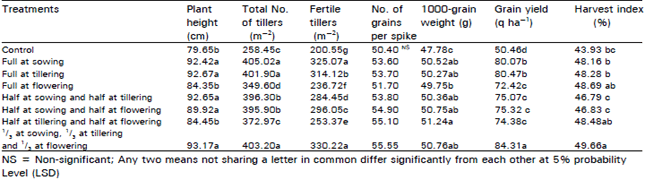 | |
The maximum total tillers were obtained in plots fertilized with full dose of nitrogen at sowing and it was statistically similar to treatments where full dose of nitrogen was applied at tillering and in three equal splits i.e. 1/3 at sowing, 1/3 at tillering and 1/3 at flowering (Table 1). The application of nitrogen in two equal splits i.e. half at sowing and half at tillering or at flowering produced statistically similar total number of tillers m–2. The minimum number of total tillers m–2 was recorded in plots where no nitrogen was applied. The reason for obtaining more number of total tillers per unit area in treatment 2 (full N at sowing) may be attributed to more availability of N at this stage. Significant effects of split application of N on total tillers have been reported by other researchers (Al-Mulla et al., 1991, Miceli et al., 1992, Ijaz, 1994).
Fertile tillers per unit area were also affected significantly by the time of nitrogen application. Application of nitrogen in three equal installments at sowing, tillering and flowering gave the maximum fertile tillers m–2, which were statistically similar to full nitrogen application at sowing. Control gave significantly the minimum fertile tillers (Table 1). The higher number of fertile tillers m–2 in plots applied with split application of nitrogen (1/3 at sowing, 1/3 at tillering and 1/3 at flowering) was attributed to more effective and efficient utilization of the applied nitrogen coinciding with the stages of requirement of crop towards tillering. These results confirm the findings of other workers (Sandhu et al., 1978; Siddique, 1986; Mossedaq and Smith, 1994; Ijaz, 1994). But these results are contradictory to those of Haq (1991). These contradictory results might have been due to differences in nitrogen dose, its application time and fertility status.
Grains per spike were not affected significantly by the time of nitrogen application. Application of nitrogen in three equal splits i.e.1/3 at sowing, 1/3 at tillering and 1/3 at flowering produced the maximum grains per spike whereas, the minimum grains per spike were recorded in control plots (Table 1). These results do not agree with those of Haq (1991), Ijaz (1994), Mossedaq and Smith (1994) and Jan and Khan (2000). They observed significant effects of nitrogen application on grain number per spike. These contradictory results might have been due to varying response of varieties to nitrogen application or differences in genetic make up of the varieties.
The application of nitrogen significantly influenced the 1000-grain weight. Nitrogen applied half at tillering and half at flowering gave the maximum 1000-grain weight and did not differ significantly from all other treatment except full nitrogen application at flowering and control. Significantly the minimum 1000-grain weight was given by control (Table 1). Similarly Haq (1991), Mossedaq and Smith (1994), Ijaz (1994) and Jan and Khan (2000) had also reported significant effect of nitrogen application at different growth stages on 1000-grain weight of wheat.
Grain yield was significantly affected by the time of nitrogen application. Nitrogen application in three equal splits at sowing, tillering and flowering produced significantly higher grain yield than all other treatments and it was followed by nitrogen application full at sowing and full at tillering having average grain yields of 80.07 and 80.47 q ha–1, respectively. The minimum grain yield was recorded from control plots. The higher grain yield by nitrogen application in three equal splits was mainly due to higher 1000-grain weight, number of grains per spike and fertile tillers m–2. Nitrogen applied full at flowering or in two equal splits at different growth stages i.e. half at sowing and half at tillering or half at flowering produced statistically the same grain yield. These results are supported by Haq (1991), Khan and Makhdum (1988) and Mossedaq and Smith (1994). These results are contradictory to those of Ijaz (1994). He applied nitrogen in 2, 3, 4 and 5 equal splits and observed non-significant differences for grain yield among the nitrogen treatments but all these nitrogen treatments gave significantly higher grain yield over control. These contradictory results might have been due to the variation in fertility status of soil or time differences of nitrogen application.
Harvest index was affected significantly by the time of nitrogen application. The application of nitrogen in three equal splits at sowing, tillering and flowering gave the maximum harvest index value but it was statistically similar to nitrogen application half at tillering, half at flowering and full at flowering. The minimum harvest index value was recorded from control plots (Table 1) and it was statistically similar to all other treatments except to nitrogen application in three equal splits i.e. 1/3at sowing, 1/3 at tillering and 1/3at flowering. These results are contradictory to those of Haq (1991) and Zebarth and Sheard (1992). These contradictory results might have been due to differences in genetic make up of the variety and the environments under which it was grown. For getting higher grain yield of wheat the nitrogen fertilizer should be applied in three equal splits i.e.1/3at sowing, 1/3at tillering and 1/3 at flowering.
REFERENCES
- Ayoub, M., S. Guertin, S.L. Lussier and D.L. Smith, 1994. Timing and level of nitrogen fertility effects on spring wheat yield in Eastern Canada. Crop Sci., 34: 748-756.
CrossRefDirect Link - Mossedaq, F. and D.H. Smith, 1994. Timing nitrogen application to enhance spring wheat yields in a Mediterranean climate. Agron. J., 86: 221-226.
CrossRefDirect Link - Jan, M.T. and S. Khan, 2000. Response of wheat yield components to type of N-fertilizer, their levels and application time. Pak. J. Biol. Sci., 3: 1227-1230.
CrossRefDirect Link - Khan, M.S. and M.I. Makhdum, 1988. Optimum time of NP application to wheat under irrigated conditions. Pak. J. Agric. Res., 9: 6-10.
Direct Link - Miceli, F., M. Martin and G. Zerbi, 1992. Yield, quality and nitrogen efficiency in winter wheat fertilized with increasing N levels at different times. J. Agron. Crop Sci., 168: 337-344.
CrossRefDirect Link - Nuttal, W.F. and S.S. Malhi, 1991. The effect of time and rate of N application on the yield and N uptake of wheat, barley, flax and four cultivars of rapeseed. Can. J. Soil Sci., 71: 227-238.
CrossRefDirect Link - Sarkar, A.K.D., M.M. Hoque and M.A. Shaheed, 1990. Effect of split application of nitrogen on wheat yield. Rachis, 9: 17-18.
Direct Link - Zebarth, B.J. and R.W. Sheard, 1992. Yield and protein response of hard red winter wheat to rate of nitrogen fertilization and previous legume crop. Crop Can. J. Plant Sci., 72: 21-25.
CrossRefDirect Link