

Rahmat Ullah Khan
Arid Zone Research Institute, Pakistan Agricultural Research Council,Ratta Kulachi, D.I. Khan, Pakistan
Abdul Ahad
Arid Zone Research Institute, Pakistan Agricultural Research Council,Ratta Kulachi, D.I. Khan, Pakistan
Abdur Rashid
Arid Zone Research Institute, Pakistan Agricultural Research Council,Ratta Kulachi, D.I. Khan, Pakistan
M. Amin
Arid Zone Research Institute, Pakistan Agricultural Research Council,Ratta Kulachi, D.I. Khan, Pakistan
Journal of Biological Sciences
Year: 2001 | Volume: 1 | Issue: 3 | Page No.: 90-91





ABSTRACT
During 1997 to 98, the fertilizer level applied at the ratio of 1/3 as a basal + 2/3 at 30 days after planting significantly increased the yield and seed weight over other treatments whereas during 1998 to 99, all the splie applied treatments gave higher yield over full basal dose applied at planting, although, no significant difference appeared among them but generally the fertilizer applied in the ratio of ½ as a basal + ½ after 30 days of planting appeared the best. However response towards seed yield of both the above treatments may be the result of rainfall distribution at growing stage of the crop during both the years respectively.
PDF Abstract XML References Citation
How to cite this article
Rahmat Ullah Khan, Abdul Ahad, Abdur Rashid and M. Amin, 2001. Techniques of N:P Application on Wheat Yield under the Rainfed
Condition of Dera Ismail Khan. Journal of Biological Sciences, 1: 90-91.
DOI: 10.3923/jbs.2001.90.91
URL: https://scialert.net/abstract/?doi=jbs.2001.90.91
DOI: 10.3923/jbs.2001.90.91
URL: https://scialert.net/abstract/?doi=jbs.2001.90.91
INTRODUCTION
Seed yield per acre is major important in the production of wheat like any other field crop. Yield depends upon the characteristics of the variety and the agronomic practices under which it is sown. In this regard, the chemical fertilizer plays a pivotal role in increasing yield and improving the quality of crop. But it is becoming less attractive for the farmers due to its increasing cost unless its efficiency use is increased through appropriate application techniques. Abdullah et al. (1976) found that split application of N resulted in increased yields and efficient use of applied nitrogen. Dubey (1993) found an increased nitrogen use efficiency when applied in split doses. Increase in grain yield of wheat have been reported with fertilizer applied at 20+40 NP kg/ha (Khan et al., 1997). Rehman (1984) reported that the contribution of fertilizer towards increased yield varied from 30 to 47%. The application of various doses of nitrogen fertilizer has been reported to increase the growth and yield of wheat crop (Nazir et al., 1988). Application of balance fertilizer is very important in achieving true potential from varieties evolved for cultivation. Many wheat trials under different agro-climatic conditions have indicated that N:P when 1:1 or 3:2 resulted in better returns (Anonymous, 1986) than previously recommended 2:1 NP.
Sato et al. (1993) gave their findings that split application was better than other indigenous techniques. Kim et al. (1995) reported enhanced nitrogen efficiency when split application of N was practiced.
The fertility of the soil is always accomplished by nutrients, their proper method and in time application. In Pakistan, the ratio of NPK fertilizer application is very wide (Ahmad and Jalil, 1992) and quite different doses are required for different areas.
MATERIALS AND METHODS
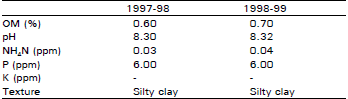
Field trials ware established under rainfed conditions at Arid Zone Research Farm, Dera Ismail Khan during 1997 to 98 and 1998 to 99, growing seasons to determine the effect of different combination of nitrogen and phosphorus on wheat cv. Inqilab-91 applied at different techniques. The physicochemical characteristics of the experimental sites is summarized in Table 1, while monthly precipitation data in Table 2. The sites were disked twice to a depth of 10 cm prior to seeding. The recommended rate of fertilizer 60 to 40 NP kg ha–1 was applied at 4 different ratios.
All the fertilizer was applied in the form of urea and diammonium Phosphate respectively with a single row drill. The trials were arranged in a Randomized Complete Block Design with three replications and Plot size of 1.8×5 meters. Wheat variety Inqilab-91 was planted at 2 to 3 cm depth using Single row drill with 30 cm apart using, seed rate of 100 kg ha–1 on October 11 and 27 in 1997 to 98 and 1998 to 99 respectively. The middle four rows were harvested, dried and threshed manually (Table 3).
The data were analyzed statistically using the analysis of variance technique and L.S.D. at 0.05 for comparing treatment means described by Steel and Torrie (1980).
| Table 1: | Soil chemical and physical status of trial sites used in study |
 | |
| Table 2: | Meteorological data of the trial sites used in study |
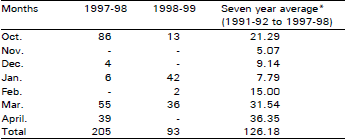 | |
| * Mean monthly and long-term average precipitation(mm). | |
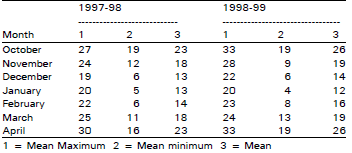
| Table 3: | Monthly mean temperature (°C) |
 | |
RESULTS AND DISCUSSION
The data in respect of yield component and seed yield is presented in Table 4 and 5.
| Table 4: | Effect of various techniques of fertilizer application on seed yield of wheat, 1997-98 |
 | |
| Table 5: | Effect of various techniques of fertilizer application method on seed yield of wheat, 1998-99 |
 | |
| N.S : Non significant | |
| Figure followed by the similar word do not differ significantly | |
| 1 | = | Applied whole as basal dose |
| 2 | = | Applied 2/3 basal+1/3 at 30 days |
| 3 | = | Applied 1/3 basal+2/3 at 30 days |
| 4 | = | Applied ½ basal+½ at 30 days |
During 1997 to 98 all the fertilizer treatments applied in different ratios significantly influenced the seed yield positively as compared to the fertilizer applied at once at the time of planting.
Seed yield ranged from 2243 to 2821 kg ha–1 but the best response occurred with the ratio of NP applied 1/3 at time of planting and 2/3 after 30 days which produced significantly maximum yield over first treatment (Control) as well as other treatments. Beyond the said fertilizer combination, seed yield reduced. Greatest 1000 seed weight also obtained by the said treatment whereas, plant height, grains per spike and maturity did not differ significantly but generally spike length slightly increased (Table 4). This positive response on crop towards yield at later stage may have been the result of rainfall received during the month of March (Table 2, 3).
Ahmad et al. (1988) obtained a decrease in fertilizer use efficiency by increasing soil moisture depletion from 40 to 75 percent in wheat. Malik and Hassan (1990) illustrated that with increase in rainfall, fertilizer use efficiency increased in wheat crop.
During trial conducted in 1998-99 the seed yield ranged from 2423 to 2970 kg ha–1 but all the split applied fertilizer treatments significantly gave higher seed yield over full basal dose (60-40- NP) kg ha–1 applied at planting. But the best response occurred with the ratio of NP applied ½ at the time of planting and ½ after 30 days which produced maximum yield (2970 kg ha–1) as compared to the fertilizer whole rate applied at planting time, yield 2423 kg ha–1. Although the said application gave higher yield over other treatment but was non significant to rate applied 2/3 at planting and 1/3 after 30 days as well as 1/3 at planting and 2/3 after 30 days . The said treatment also appeared slightly with increase spike length, grains/spike and heavier seed weight over full basal dose applied at planting (Table 5). This effect might be the result of proper rainfall distribution at critical stage of crop growth in January to March (Table 2).
It is also obtained high yield of wheat crop with optimum moisture and fertilizer application. Annandale et al. (1984) pointed out that well fertilizer wheat utilize more water than wheat grown on poorly fertilized plots.
REFERENCES
- Annandale, J.G., P.S. Hammes and P.C. Nel, 1984. Effect of soil fertility on the vegetative growth, yield and water use of wheat (Triticum aestivum L.). South Afr. J. Plant Soil, 1: 96-97.
CrossRefDirect Link - Steel, R.G.D. and J.H. Torrie, 1980. Principles and Procedures of Statistics: A Biometrical Approach. 2nd Edn., McGraw Hill, New York, United States, ISBN-13: 9780070609266, Pages: 633.
Direct Link