

Sultan Mahmood Leghari
Department of Fresh Water Biology & Fisheries, University of Sindh, Jamshoro-76080, Sindh, Pakistan
M.A. Sahito
Department of Botany, University of Sindh, Jamshoro, Sindh, Pakistan
Z.A. Nizamani
Department of Botany, University of Sindh, Jamshoro, Sindh, Pakistan
M.A. Baryar
Department of Geology, University of Sindh, Jamshoro, Sindh, Pakistan
Journal of Biological Sciences
Year: 2001 | Volume: 1 | Issue: 3 | Page No.: 173-174





ABSTRACT
In the present study rare fossil spores of algae fungi and bryophytes are described. They are represented by Botryococcus braunii Kuetz., Brateacoccus sp. cf. B. grandis Bischoff et Bold, Braeteacoccus minor (Chodat) Petrova, Geminella sp. cf. G. minor (Naegeli) Heering, Multicellaesporities elongatus (Shefy & Dilcher ,1971) var. perforatus Leghari et al. var. nov. and Riccia sp. cf. R. rosea Volk et Perold. These spores are indicative of paralic swamp vegetation associated with the deltoid region.
PDF Abstract XML References Citation
How to cite this article
Sultan Mahmood Leghari, M.A. Sahito, Z.A. Nizamani and M.A. Baryar, 2001. Rare Fossil Algal, Fungal and Riccia Spores Isolated from Sonda
Coal Deposits, District, Thatta, Sindh, Pakistan. Journal of Biological Sciences, 1: 173-174.
DOI: 10.3923/jbs.2001.173.174
URL: https://scialert.net/abstract/?doi=jbs.2001.173.174
DOI: 10.3923/jbs.2001.173.174
URL: https://scialert.net/abstract/?doi=jbs.2001.173.174
INTRODUCTION
Microfossil analysis of coal provides important information about the past flora of the region and their phylogenetical relationships. The occurence of coal in the lower Palaeocene sequence of Sindh is known since very long (Blanford, 1879). The coal seam are present in Bara Formation mid-paleocene Ranikot group (Shah, 1977). Nizamani (1982), Leghari and Nizamani (1985) and Nizamani et al. (1991) reported some algal and fungal spores during their palynological investigations of Lakhra coal field area. Later Sahito et al. (1986, 1988) described algal genera lyngbya, Myxococcoides and Oscillatoria (Cyanophyta.), Cephalia, Chaetomorpha, Coelastrum, Genecularia, Stichococcus, Ulothrix and Zygnema (Chlorophyta.) and Pinnularia (Bacillariophyta). Sahito and Nizamani (1989) described some fungal genera Dicellaesporites, Multicellaesporites, Pluricellaesporites (Dematiaceae) and Lacrimasporonites. (Basidomycetes.) microfossils from Sonda coal field. In the present study some unreported forms of fossil spores of algae, fungi and Riccia are described, which were perhaps overlooked because of their rare occurrence.
The Sonda coal field (district, Thatta) is almost 60 km south west of the Kotri on the National Highway (Lat. 68°. 15N. long 25°E). The samples were obtained from the exploratory bore holes No.1 and 2 drilled in the area from the depth of 681, 722, 782, 790, 806 and 830 feet. The samples were macerated according to the method of Schultz (1928) and the slides were prepared following the standard technique of Kisser (1935).
RESULTS
The description of rare algal, fungal and Riccia spores isolated from Sonda coal is as follow:
Botryococcus braunii Kuetz. Prescott, 1962:232. (Fig. A) The colonies are spherical in shape, vary in size depending upon the daughter colonies which remain attached to one another. Cells spherical to ovoid or wedge shaped, cells ±3-6 x 6-12 μm in diameter.
Bracteacoccus sp. cf. B. grandis Bischoff et Bold, 1963:48. Watanabe 1979:90. (Fig. B). Colony spherical, ±18-20 μm in diameter, with aerietal discoid cells with granules. Cell wall thin, ±0.8-1.5 μm in thickness, protrusion ±1.5-3 μm in thickness.
Bracteacoccus minor (Chodat) Petrova, 1931. Desortova, 1974:111; Watanabe, 1979:90. (Fig. C). Vegetative cells ±18-22 μm in diameter, cells granulated, cell-wall thin ±0.8 μm in thickness. Cell with Plate like granules, ±0.8-1.2 μm diameter.
Geminella sp. cf. G. minor (Naegeli) Heering, 1914. Ramanathan (1964) :65-66 (Fig. D). Filament uniseriate with sheath ±18 μm broad and ±144-200 μm long. Cells cylindrical joined within wide gelatinous, homogenous sheath. Cells ± 4-10 μm broad and 2-4 times long.
Multicellaesporites elongatus (Shefy & Dilcher, 1971) var. perforatus Leghari et al., var. nov. (Fig. E). Pharagmospore ±3.5-8×44 μm in diameter, uniseriate composed of 12 cells are regular oblong tapering on both ends. Cells ±3-5 x 5-8 μm in diameter. Cell wall ±0.5-0.7 μm thick, septa ±0.5-1 μm thick and perforated, perforation ±0.6-0.8 μm.
Latin diagnosis: Phragemospores 3.5-8×44 μm in diameter, septate, thick and perforated septa.
Riccia sp. cf. R. rosea Volk et Perold, 1986:181 (Fig. F). Spores ±100-128 μm in diameter, dark brown in colour semitransparent, subglobular to globular, outline crenate or bluntly papillose, ornamentation regularly reticulate on all faces, well defined rounded aerole, each aerolae ±10-18 μm in diameter.
Botrycoccus braunii and Geminella sp. cf. G. minor are cosmopolitan colonial and filamentous plankton found in brackish and fresh water of ponds and pools (Prescott, 1962). While Bractaecoccus sp. cf. B. grandis and Bracteacoccus minor are unicellular green algae forming extensive growth of green crust of algae on damp surface on the humid soil of the alpine and tundra soil covered by Riccia species, mosses, fern, grasses, dead basal leaves and other vegetation; (Desortova, 1974; Watanabe, 1979). Riccia sp. cf. R. rosea grow in light and partial shade and often grow mixed with other Riccia species. Raccia is some-times found growing on the rotten roots of the grasses and other vegetation, but it prefers sandy soil (Volk and Perold, 1986).
It could therefore be concluded that the paleoclimatic conditions at the place of deposition were warm, humid and carbonaceous material is the product of mixed vegetation (Sahito and Nizamani, 1989; Venkatachala and Rawat, 1973).
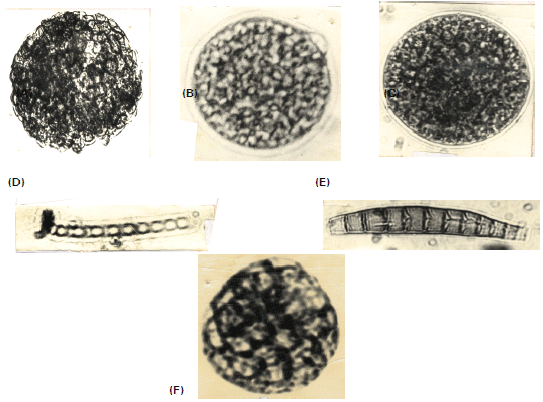 |
| Plate 1. Figures (A) Botryococcus braunii Kuetz X 400 (B) Bracteacoccus sp. cf. B. grandis Bischoff et Bold X 400 (C) Bracteacoccus minor (Chodat) Petrova X 400 (D) Gminella sp. cf. G. minor (Naegeli) Heering X 400 (E) Multicellaesporites elongatus var. perforatus Leghari et al. var. nov (F) Riccia sp. cf. R. rosea. Volk et Perold X 400 |
The spores of Algae, Fungi and Riccia described indicate that the coal was formed in paralic swamp vegetation in the deltoid region.
ACKNOWLEDGEMENT
We appreciate the critical comments and suggestions recommended by Prof. Dr. Mustafa Shameel and Prof. Dr. M. Nizamuddin, Department of Botany , Karachi University, Karachi.
REFERENCES
- Sahito, M.A., Z.A. Nizamani and S.M. Leghari, 1988. Some algal microfossils isolated from Sonda coal deposits, Thatta district, Sind, Pakistan. Pak. J. Bot., 20: 305-309.
Direct Link - Sahito, M.A. and Z.A. Nizamani, 1989. Fossil fungal remains isolated from Sanda coal deposits. Sarhad J. Agric., 5: 497-502.
Direct Link - Shefy, M.V. and D.L. Dilcher, 1971. Morphology and taxonomy of fungal spores. Palaeontographica Abteilung B, 133: 34-51.
Direct Link - Venkatachala, B.S. and M.S. Rawat, 1973. Palynology of the tertiary sediments in the Cauvery Basin. 2. Oligocene-miocene palynoflora from the subsurface. Palaeobotanist, 20: 238-263.
Direct Link - Volk, O.H. and S.M. Perold, 1986. Studies in the genus Riccia (Marchantiales) from Southern Africa. 5. R. rosea, a new species. Bothalia, 16: 181-185.
Direct Link