

Quddusi B. Kazmi
Marine Reference Collection and Resource Centre, University of Karachi, Karachi-75270, Pakistan
Feroz A. Siddiqui
Marine Reference Collection and Resource Centre, University of Karachi, Karachi-75270, Pakistan
Journal of Biological Sciences
Year: 2001 | Volume: 1 | Issue: 3 | Page No.: 166-168





ABSTRACT
Little work has been done on the Tanaidacean Crustaceans of the Pakistani coast. The genus Pagurapseudes lives in empty gastropod shells and looks like a small hermit crab. The species is new to science and the genus new to the area. This is the tenth species of the genus from the Indian Ocean. It has been fully described and illustrated.
PDF Abstract XML References Citation
How to cite this article
Quddusi B. Kazmi and Feroz A. Siddiqui, 2001. Pagurapseudes setulosa, a new species of Apseudomorpha
(Crustacea, Tanaidacea) from Pakistan. Journal of Biological Sciences, 1: 166-168.
DOI: 10.3923/jbs.2001.166.168
URL: https://scialert.net/abstract/?doi=jbs.2001.166.168
DOI: 10.3923/jbs.2001.166.168
URL: https://scialert.net/abstract/?doi=jbs.2001.166.168
INTRODUCTION
Pagurapseudine apseudomorphan tanaidaceans are far from being wholy known. There are 18 species distributed in 3 genera (Gutu, 1997). To our knowledge this is the third report on tanaidaceans from Pakistani coast of northern Arabian Sea (Indian Ocean). The first one is by Bacescu (1978) when he collected specimens by "Thalassa" Cruise and established a new genus Pakistanapseudes; the second is by Kazmi and Siddiqui (1992) on Leptochelia. Besides these several kalliapseudids from north western Indian Ocean are reported upon by Bacescu (1980). From the south western part of the Indian Ocean, (Tanzanian coast Mozambique channel and Madagascar), several papers were published by Bacescu (1975, 1976a, b, 1987), Pasternak (1986) and Gutu (1988, 1989, 1991, 1996a, b).
In the present paper one species, perhaps belonging to Pagurapseudes genus is described. It seems to be new to science as it does not fit in the key given for the genus Pagurapseudes by Gutu (1997); another kalliapseudid (probably from genus Hemikalliapseudes) and one unidentified genus of Tanapseudidae are observed in the plankton and will be reported in another paper.
| Suborder Apseudomorpha Sieg, 1980 |
| Family Pagurapseudidae Lang, 1970 |
| Subfamily Pagurapseudinae Lang, 1970 |
| Genus Pagurapseudes Whitelegge, 1901 |
| Pagurapseudes setulosa sp. nov. (Fig. 1-2, Pl.1). |
Material: 3 specimens: 1 m (holotype), TL: 2.63 mm, CL: 0.55 mm, Bulleji, Karachi, dt: 10.04.97; 2 ff paratypes, TL: 2.6-3.5mm (abdomen curved), CL: 0.55-0.70 mm, Bulleji, Karachi, dt: 23.06.1997. All from empty gastropod shells.
Description of type material: Body (Fig. 1A, Pl.1) is 5 times longer than the maximum width; dorsolaterally with small plumose setae on entire length of body. Carapace, as wide as long, rostrum serrated (Fig. 1A) with tuberculiform prominenses (Fig. 1A") on the side up to each eye projection, each eye lobe with visual element. Epistome single lobed with a thick seta exceeding rostral length.
Pereon with six free smooth pereonites, 3 times longer than broad, granules present on the margins. Pereonites four and five almost equal and slightly longer than any of the others, but shorter than their width.
Pleon formed of five free short pleonites and pleotelson which measures as much as three pleonites and has a medio-distal tubercle, latero-distally armed with unequal setules on each side (Fig. 1B).
Antennule (Fig. 1C) with the peduncle much longer than the carapace the first article, with small thick and plumose setae on both the sides; second article being 2 times shorter than the first with several long plumose setae; third thinner than the second; fourth article (Fig. 1C') short, with two flagella, inner flagellum with long article, ended with 3 simple unequal apical setae, outer flagellum formed of three articles, each of them shorter than the inner flagellum; all having setae, those of 1st article very long, and those on apical article are five or four in number with two aesthetascs.
Antenna (Fig. 1D) with the peduncle formed of four articles, the first one being very developed with rough outer margin and one long plumose seta distolaterally, inner margin with setae; second article small, third and fourth narrow, subequal, setose at disto-lateral angle. Flagellum (Fig. 1D') formed of two thin and subequal segments, second with three long setae.
Mandible (Fig. 1E) with three-articulated palp, the first article short, non-setose; the second and third article equal both heavily setose (setae short and long). Pars molaris (Fig. 1E') moderately developed with rugged surface, pars incisive and lacinia mobilis of the left mandible with two rough denticles, setiferous lobe with four setae, one terminally ramified (Fig. 1E), on the outer edge many tuberculiform-spiniform elements present.
Labium (Fig. 1F) with five spines on the outer side and many long hairs on rostral edge, palpus oval, terminally narrowed and truncated with simple setae on its side and two spiniform setae apically.
Maxillule (Fig. 1G) with palpus present, bisegmented, having four terminal setae. Inner endite with 5 spines. Outer endite with 10 spines on terminal edge and one simple subterminal seta and fixed with spines on inner and fine hairs on outer edges.
Maxilla (Fig. 1H) with well developed lobes, having on the rostral margin dense setae and spines of different forms and sizes as illustrated.
Maxilliped (Fig. 1I) with a well developed basis, bearing several denticles on outer edges, and long setae on inner side; palp four segmented: the first article of palpus short, with denticles on outer edge, second article slightly longer with long plumose setae, some very robust; third article broadens apically with long setae and tuberculiform-spiniform formations; fourth article short and oval with setae and spine.
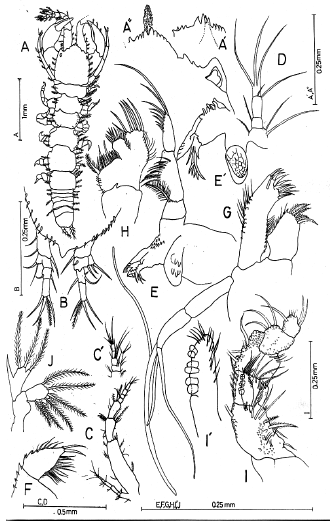 | |
| Fig. 1: | Pagurapseudes setulosa sp. nov. (male holotype, CL. 0.55mm); A. Entire specimen in dorsal view; A'. Rostrum and epistome; A". Rostrum and eye lobe; B. Telson and uropods; C. Antennae; C'. Antennular flagellum; D. Antennal flagellum; E. Mandible; E'. Mandible, pars incisive, lacina mobilis and setiferous lobe; F. Labium; G. Maxillula; H. Maxilla; I. Maxilliped; I'. Same, endite; J. Pleopod |
Endite (Fig. 1I) relatively small with three long plumose setae and four spines on the rostral edge; on the inner side 6 couplers in pairs.
Chelipeds (Fig. 2A,B) slightly unequal, the larger size of the left one (Fig. 2A) being caused by the elongation of the carpus, propodus and fingers basis short and wide with spines, and single plumose seta, single segment exopod present. (Fig. 2A'), merus with spines and left one more setose; carpus long with few spines and setae; propodus well developed, longer than carpus; finger broad, triangular and short. Dactylus curved in both chelipeds; The finger of propodus and dactylus dentate and setose on inner margins and ending in claws.
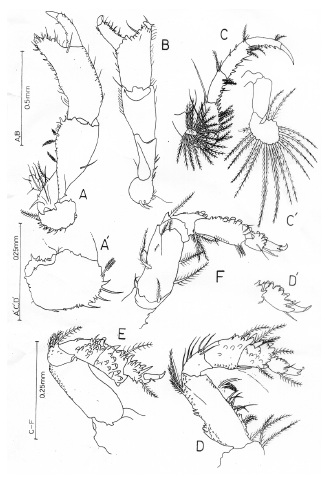 | |
| Fig. 2: | Pagurapseudes setulosa sp. nov. (male holotype, CL. 0.55mm); A. Left cheliped; A'. Same, exopod; B. Right cheliped; C. Second pereopod; C'. Second pereopod exopod; D. Third pereopod; D'. Third propodus and dactylus; E. Fourth pereopod; F. Seventh pereopod |
Pereopod II (Fig. 2C) with basis not wider than next articles, exopod (Fig. 2C') very big, three articulated, the last segment wide, lamellate, with fifteen long plumose setae all around; ischium short, with long simple seta on outer margin and short setae on inner margin; merus cylindrical, long with three long inwardly spines on outer side and eight shorter outwardly curved spines and plumose setae on inner side; carpus slightly curved, smaller than the merus, armed with five spines on inner margin; propodus slightly curved and equal to dactylus (without claw), with six spines on inner margin; dactylus narrower than propodus, armed with five spines and having a strong narrow simple claw.
Pereopod III (Fig. 2D) has a well developed basis with thick setae and spines; ischium short with long plumose setae at the disto-sternal end; merus much longer than ischium, has sternal and dorsal spines, a very thick seta on inner disto-lateral angle as well as formation of sucker type; carpus short with setae, tubercles and sucker spines; propodus has spines and suckers, with two very strong spines behind the dactylus, one having a seta with characteristic morphology (Fig. 2D'); dactylus thick and curved with a robust claw.
Pereopod IV (Fig. 2E) shorter and thinly setose than pereopod III, but the basic structure is the same.
Pereopod VII (Fig. 2F) shorter than the previous ones; carpus long with no less than 15 suckers; propodus short with three suckers and a spike like spine on inner disto-lateral angle; dactylus together with the claw much longer than the propodus.
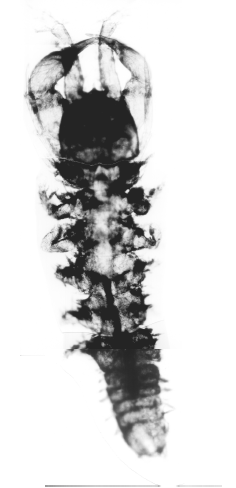 | |
| Pl. 1: | Pagurapseudes setulosa sp. nov,Freshly killed specimen, (CL. 0.55 mm) |
Pleopod (Fig. 1J) four pairs on the first four pleonites, biramous, with short ramii fourth reduced, each of the remaining three having a single article and unequal number of setae. Uropods (Fig. 1B) moderately long with two ramii, exopod thin, with one segment, endopod consists of three unequal articles as illustrated.
Colour: Dark chocholate brown (Pl. 1).
Remarks: The specimens are placed in the genus Pagurapseudes but can also be identified with the help of key of Gutu (1996a) as belonging to the genus Macrolabrum (Bacescu, 1976a) on the basis of presence of a distinct epistome. But the number of four articles on antennal peduncle (which is five in Macrolabrum) and a smaller epistome does not allow us to include the species within the genus Macrolabrum. It can be turned out a third and new genus. The genus Macrolabrum consists of five species (Gutu, 1997) and the genus Pagurapseudes has nine species. The species is similar to P. spinipes in having a single segmented modified exopod on the chelipeds. The spine on the propodus of third leg behind the dactylus is simple but with characteristic morphology, which does not resemble to any of two species of Pagurapseudes where this exists i.e P. razvani (Gutu, 1997) and P. pangtiruthuli (Gutu, 1991). The main feature of the P. setulosa sp.nov which distinguishes it from other species in the genus are the setules from the lateral side of pleotelson (Gutu, personal communication, QBK).
Etymology: Named after the setules on the pleotelson.
ACKNOWLEDGMENTS
The first author is most grateful to Dr. Modest Gutu "Grigore Antipa" National Museum of Natural History of Romania for reviewing various versions of the manuscript, for his valuable comments which have greatly improved the quality of final manuscript and sending relevant literature. The financial assistance was available through Faculty Grant 1998-99.
REFERENCES
- Bacescu, M., 1980. Contribution to the knowledge of some Kalliapseudidae (Crustacea, Tanaidacea) from the N.W. of the Indian Ocean. Trav. Mus. Hist. Nat. Grigore Antipa, 22: 359-379.
Direct Link - Gutu, M., 1988. Description of three new species of Tanaidacea (Crustacea) from the Tanzanian coasts. Trav. Mus. Natl. Hist. Nat. Grigore Antipa, 40: 179-209.
Direct Link - Gutu, M., 1991. The description of a new genus and of two new species of Tanaidacea (Crustacea) from western Indian Ocean. Trav. Mus. Natl. Hist. Nat. Grigore Antipa, 31: 355-364.
Direct Link - Gutu, M., 1996. The synoptic table and key to super specific taxa of recent Apseudomorpha. (Crustacea, Tanaidacea). Trav. Mus. Natl. Hist. Nat. Grigore Antipa, 36: 135-146.
Direct Link - Gutu, M., 1989. Tanaidacea (Crustacea) collected by the Benthedi French Expedition (1977) in South-Western Indian Ocean. I. Trav. Mus. Hist. Nat., 30: 135-160.
Direct Link