

Shad K. Khalil
Department of Agronomy, NWFP Agriculture University, Peshawar, Pakistan
John G. Mexal
Department of Agronomy and Horticulture, New Mexico State University, Las Cruces NM USA
Leigh W. Murray
Department of Experimental Statistics, New Mexico State University, Las Cruces NM USA
Journal of Biological Sciences
Year: 2001 | Volume: 1 | Issue: 3 | Page No.: 105-107





ABSTRACT
Seed priming have been used successfully in an attempt to improve germination and seedling establishment of many vegetables and field crops. The objective of this research was to study the effect of polyethylene glycol (PEG) 8000 concentrations and seed treatment durations on soybean seed germination. Three experiments were conducted: In experiment 1, the seeds were treated for 1, 2, or 7 days. The osmotic potentials of the PEG solutions were 0, -0.1, -0.2, -0.4, -0.5, -0.7, and -1.1 MPa including control. In control the seeds were treated with water for the above duration. In experiment 2, the seeds were treated for 24, 48 or 72 hours The osmotic potentials of the PEG solutions was 0, -0.3, -0.5, -0.9 and -1.5 MPa including control. The control was not treated with water or PEG. In experiment 3, the seeds were separated into small and large seed and was treated with PEG solution having osmotic potentials of -0.5, -1.1 and -1.8 MPa for 0 (control), 24, and 48 hours. The control was not treated with water or PEG. PEG solution having osmotic potentials (-1.1 and -1.8 MPa) improved germination compared to control (no PEG treatment). Seed treatment durations longer than 48 hours was deleterious and reduced the germination. Seed size has no effect on germination.
PDF Abstract XML References Citation
How to cite this article
Shad K. Khalil, John G. Mexal and Leigh W. Murray, 2001. Germination of Soybean Seed Primed in Aerated Solution of Polyethylene Glycol (8000). Journal of Biological Sciences, 1: 105-107.
DOI: 10.3923/jbs.2001.105.107
URL: https://scialert.net/abstract/?doi=jbs.2001.105.107
DOI: 10.3923/jbs.2001.105.107
URL: https://scialert.net/abstract/?doi=jbs.2001.105.107
INTRODUCTION
Poor germination and low seed viability are among the serious problems in the production of soybean. Several methods have been used to precondition seeds in an attempt to improve germination and seedling establishment of many vegetables and field crops. These include alternate wetting and drying, pre-germination and controlled hydration by means of an osmoticum such as polyethylene glycol (PEG). This method of controlled hydration is called priming or osmoconditioning (Khan et al., 1990).
Seed priming is a pre-sowing, controlled hydration treatment in which quiescent seeds are exposed to an external water potential sufficiently low to prevent radicle protrusion and yet stimulate physiological and biochemical activities (Bradford, 1986; Khan, 1992).
Primed seeds can have improved germination rate and uniformity, particularly under adverse seed bed conditions such as low temperature (Pill and Savage, 1988; Stoffella et al., 1988), matric stress (Akers et al., 1987; Frett and Pill, 1989), salinity (Pill et al., 1991; Wiebe and Muhyaddin, 1987) and heat (Wurr and Fellows, 1984).
Seed size is another important factor affecting germination and stand establishment of most of the plant species specially soybean (Armstrong et al., 1988a).
Most of the seed priming work has been done on vegetables and other field crops with little work on soybean seed priming. Therefore, this research was conducted to study the effect of PEG 8000 concentrations and seed treatment durations on germination of soybean using seed of different sizes.
MATERIALS AND METHODS
The osmotic potentials of PEG 8000 solutions were determined according to Michel (1983). Seeds were primed in aerated solution of PEG using an aquarium pump. Distilled water was added every day so that moisture content of the solution would not drop from a constant level. After priming, the seeds were rinsed with tap water for about two minutes.
Experiment 1: The seeds harvested from January 16 planted soybean were primed in an aerated solution of PEG 8000 in flasks for 1, 2 and 7 days using 0, 50, 100, 150, 200, 250 and 300 g PEG per kg distilled water. The osmotic potentials of the PEG solutions were 0, -0.1, -0.2, -0.4, -0.5, -0.7 and -1.1 MPa respectively. The control was seed aerated with distilled water for 1, 2 and 7 days. The primed seeds were germinated in an incubator having 3 shelves (blocking factor) on August 22, 1991 at 24± 2 °C. Twenty seeds were sown in each petri dish measuring 14 cm in diameter and replicated three times. The petri dishes were filled with sand and wetted with distilled water. Germination counts were made daily until the 14th day. Thereafter no additional germination occurred. The experimental design was a Randomized Complete Block Design with 7x3 factorial (7 PEG concentrations, 3 treatment durations). The data were analyzed according to Snedecor and Cochran (1989) using analysis of variance techniques and LSD test was applied when F-values were significant.
Experiment 2: It was observed from the experiment 1 that lower PEG concentrations and longer seed treatment durations resulted in poor germination. Therefore, this experiment was designed to use higher concentrations and shorter seed treatment duration. Seeds were primed for 24, 48 and 72 hours using 0, 120, 200, 280 and 360 g PEG per kg water. The water potentials of the PEG solutions was 0, -0.3, -0.5, -0.9 and -1.5 MPa respectively. The control was dry untreated seed. The primed and unprimed (control) seeds were germinated in an incubator in petri dishes filled with sand as in experiment 1, sown on September 12, 1991. The experimental design was the same as that of experiment 1, again with 3 blocks. Germination counts and statistical analysis were done as in experiment 1.
Experiment 3: It was observed from the experiment 2 that lower PEG concentrations of 120 g PEG per kg water and longer seed treatment duration of 72 hours resulted in poor germination. Seed size is another factor which in most cases affect the germination. Therefore, higher concentrations, shorter seed treatment durations and seed of different sizes were used in this experiment. Seeds were separated into small and large sizes by passing the seed through screens according to Armstrong et al. (1988b)
Seeds were primed for 0 (control), 24 and 48 hours using 200, 300 and 400 g PEG per kg water. The water potentials of the PEG solutions was -0.5, -1.1 and -1.8 MPa respectively. The control was dry untreated seed. The primed and unprimed (control) seeds were germinated in an incubator in petri dishes filled with sand as in experiment 1, sown on September 26, 1991. The experimental design was randomized complete block design with 2x3x3 factorial (2 seed sizes, 3 PEG concentrations, 3 treatment durations) with 3 blocks. Germination counts were made as in experiment 1. Statistical analysis of the data were done according to Snedecor and Cochran (1989) using analysis of variance techniques and LSD test was applied when F-values were significant.
RESULTS
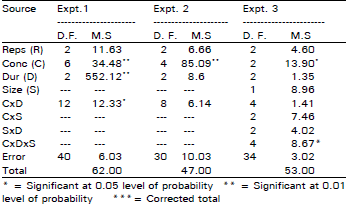
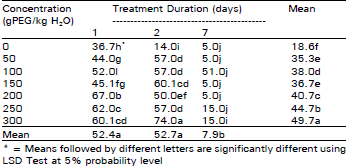
Experiment 1: Concentration (C), seed treatment duration (D) and CxD interaction significantly affected germination (Table 1). Seed treated with aerated distilled water for 7 days was deleterious and resulted in lowest germination (Table 2). However, this reduction decreased when seed was treated for 2 or 1 day. Treating seed with PEG for 7 days also reduced germination at all of the PEG concentrations. Seed germination increased with increasing PEG 8000 concentration. Maximum germination was recorded from seed treated with 300 g PEG for 2 days.
| Table 1: | Analysis of variance of germination of soybean as affected by PEG 8000 concentration, seed treatment duration and seed size |
 | |
| Table 2: | Germination (%) of soybean as affected by PEG 8000 concentration, seed treatment duration |
 | |
| Table 3: | Germination (%) of soybean as affected by PEG 8000 concentration, seed treatment duration |
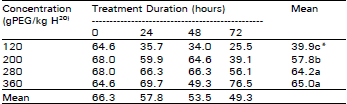 | |
Experiment 2: Concentration (C) significantly affected germination (Table 1), whereas seed treatment duration (D) and CxD interaction effects were not significant. Germination increased with increasing PEG concentration (Table 3). However, germination was poorer than the control for seed treated with 120-200 g PEG and statistically equal to the control at 280 g PEG. Maximum germination (71.4%) was recorded for seed that received 360 g PEG per kg water.
Experiment 3: Concentration (C) and CxDxS (seed size) significantly affected germination (Table 1), whereas seed treatment duration (D), seed size (S), CxD and CxS interaction effects were not significant. Germination increased with increasing PEG concentration up to 300 g PEG per kg water (Table 4). Maximum germination (76.5%) was recorded for seed that received 300 g PEG per kg water. Thereafter, no increase was observed. Germination was higher in case of 300 and 400 g PEG per kg water than control (non treated seed). Seed treatment for 48 hours particularly improved the germination of small size seed. However, this increase was slight and statistically non significant.
DISCUSSION
Higher concentrations resulted in higher germination than lower concentrations in all experiments. PEG concentration of 300 g PEG per kg water improved the germination over seed treated with distilled water (Table 2).
| Table 4: | Germination (%) of soybean as affected by PEG 8000 concentration, seed treatment duration and seed size. |
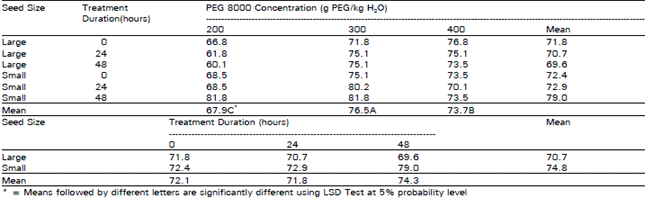 | |
However, in experiment 2 & experiment 3, only the higher concentration improved the germination over the control in this case dry seed (Table 3, 4). These results confirm the findings of Madakadze et al. (1993), Odell et al. (1992), Parera and Cantliffe (1992), Parera and Cantliffe (1993), Murray et al. (1992), Hardegree and Emmerich (1992), Carpenter (1989) and Simak et al. (1984) who reported improvement in the germination of the PEG treated seed than non treated seeds. However, it contradicts with Murray (1990), Carpenter (1990), Sundstrom and Edwards (1989), Dearman et al. (1987), Hallgren (1987, 1990) and Bussell and Gray (1976) who observed no improvement in germination due to PEG. This may be due to the fact that response to the PEG treatment is species dependent.
Seed treatment durations longer than 48 hours drastically decreased the germination, indicating that overpriming is detrimental (Table 2). This idea is supported by Murray (1989) who concluded that overpriming may cause oxygen deficiency and the build up of inhibitors.
Small seed improved germination compared with large seed. However, this improvement was non significant and needs further research in order to confirm the findings of this experiment. It can be concluded from these experiments that higher concentrations improved the germination more than lower concentrations and control. Seed treatment longer than 48 hours decreased germination and may have detrimental effect.
REFERENCES
- Akers, S.W., G.A. Bekowitz and J. Rabin, 1987. Germination of parsley seed primed in aerated solutions of polyethylene glycol. HortScience, 22: 250-258.
Direct Link - Bradford, K.J., 1986. Manipulation of seed water relations via osmotic priming to improve germination under stress conditions. HortScience, 21: 1105-1112.
Direct Link - Bussell, W.T. and D. Gray, 1976. Effects of pre-sowing seed treatments and temperatures on tomato seed germination and seedling emergence. Scientia Hortic., 5: 101-109.
CrossRefDirect Link - Khan, A.A., 1992. Preplant Physiological Seed Conditioning. In: Horticultural Reviews, Volume 13, Janick, J. (Ed.). John Wiley and Sons, Oxford, UK., pp: 131-181.
CrossRef - Michel, B.E., 1983. Evaluation of the water potentials of solutions of polyethylene glycol 8000 both in the absence and presence of other solutes. Plant Physiol., 72: 66-70.
Direct Link - Odell, G.B., D.J. Cantliffe, H.H. Bryan and P.J. Stofella, 1992. Stand establishment and yield responses to improved direct-seeding methods of tomatoes. HortScience, 27: 1185-1188.
Direct Link - Parera, C.A. and D.J. Cantliffe, 1992. Priming leek seed for improved germination and emergence at high temperature. HortScience, 27: 1077-1079.
Direct Link - Snedecor, G.W. and W.G. Cochran, 1989. Statistical Methods. 8th Edn., Iowa State University Press, Ames, Iowa, USA, ISBN-13: 978-0813815619, Pages: 524.
Direct Link - Sundstrom, F.J. and R.L. Edwards, 1989. Pepper seed respiration, germination and seedling development following seed priming. Hortic. Sci., 24: 343-345.
Direct Link - Wiebe, H.J. and T. Muhyaddin, 1987. Improvement of emergence by osmotic seed treatments in soil of high salinity. Acta Horticulturae, 198: 91-100.
CrossRefDirect Link - Pill, W.G., J.J. Frett and D.C. Morneau, 1991. Germination and seedling emergence of primed tomato and asparagus seeds under adverse conditions. HortScience, 26: 1160-1162.
Direct Link - Carpenter, W.J., 1990. Priming dusty miller seeds: Role of aeration, temperature and relative humidity. HortScience, 25: 299-302.
Direct Link - Dearman, J., R.L.K. Drew and P.A. Brocklehurst, 1987. Effect of osmotic priming, rinsing and storage on the germination and emergence of carrot seed. Ann. Applied Biol., 111: 723-727.
CrossRefDirect Link - Frett, J.J. and W.G. Pill, 1989. Germination characteristics of osmotically primed and stored Impatiens seeds. Scientia Hortic., 40: 171-179.
CrossRefDirect Link - Hardegree, S.P. and W.E. Emmerich, 1992. Effect of matric-priming duration and priming water potential on germination of four grasses. J. Exp. Bot., 43: 233-238.
CrossRefDirect Link - Madakadze, R., E.M. Chirco and A.A. Khan, 1993. Seed germination of three flower species following matriconditioning under various environments. J. Am. Soc. Hortic. Sci., 118: 330-334.
Direct Link - Pill, W.G. and W.E. Finch-Savage, 1988. Effects of combining priming and plant growth regulator treatments on the synchronisation of carrot seed germination. Ann. Applied Biol., 133: 383-389.
CrossRefDirect Link - Stoffella, P.J., A. Pardossi and F. Tognoni, 1988. Temperature and seed treatment effects on taproot growth of young bell peppers. Adv. Hortic. Sci., 2: 8-10.
Direct Link - Wurr, D.C.E. and J.R. Fellows, 1984. The effects of grading and priming seeds of crisp lettuce cv. Saladin, on germination at high temperature, seed vigour and crop uniformity. Ann. Applied Biol., 105: 345-352.
CrossRefDirect Link - Parera, C.A., P. Qiao and D.J. Cantliffe, 1993. Enhanced celery germination at stress temperature via solid matrix priming. HortScience, 28: 20-22.
Direct Link - Murray, G.A., 1990. Priming sweet corn seed to improve emergence under cool conditions. HortScience, 25: 231-231.
Direct Link - Murray, G.A., J.B. Swensen and G. Beaver, 1992. Emergence of spring-and summer-planted onions following osmotic priming. HortScience, 27: 409-410.
Direct Link - Armstrong, J.E., C.C. Baskin and J.C. Delouche, 1988. Effects of mechanically sizing soybean seed on seed quality. J. Seed Technol., 12: 54-58.
Direct Link