

Mohammed Arafa
Department of Civil Engineering, The Islamic University of Gaza, P.O. Box 108, Palestine
Mamoun Alqedra
Department of Civil Engineering, The Islamic University of Gaza, P.O. Box 108, Palestine
Journal of Artificial Intelligence
Year: 2011 | Volume: 4 | Issue: 1 | Page No.: 63-75





ABSTRACT
Early stage cost estimate plays a significant role in any initial construction project decisions, despite the project scope has not yet been finalized and still very limited information regarding the detailed design is available during these early stages. This study aimed at developing an efficient model to estimate the cost of building construction projects at early stages using artificial neural networks. A database of 71 building projects is collected from the construction industry of the Gaza Strip. Several significant parameters were identified for the structural skeleton cost of the project and yet can be obtained from available engineering drawings and data at the pre-design stage of the project. The input layer of the Artificial Neural Networks (ANN) model comprised seven parameters, namely: ground floor area, typical floor area, number of storeys, number of columns, type of footing, number of elevators and number of rooms. The developed ANN model had one hidden layer with seven neurons. One neuron representing the early cost estimate of buildings formed the output layer of the ANN model. The results obtained from the trained models indicated that neural networks reasonably succeeded in predicting the early stage cost estimation of buildings using basic information of the projects and without the need for a more detailed design. The performed sensitivity analysis showed that the ground floor area, number of storeys, type of foundation and number of elevators in the buildings are the most effective parameters influencing the early estimates of building cost.
PDF Abstract XML References Citation
Article History
Received: July 17, 2010;
Accepted: August 24, 2010;
Published: February 01, 2011
How to cite this article
Mohammed Arafa and Mamoun Alqedra, 2011. Early Stage Cost Estimation of Buildings Construction Projects using Artificial Neural Networks. Journal of Artificial Intelligence, 4: 63-75.
DOI: 10.3923/jai.2011.63.75
URL: https://scialert.net/abstract/?doi=jai.2011.63.75
DOI: 10.3923/jai.2011.63.75
URL: https://scialert.net/abstract/?doi=jai.2011.63.75
INTRODUCTION
Early stage (as called pre-design) cost estimation is a crucial element of any construction project. The accurate estimation of the early cost will support the project managers in decision-making process. It allows the managers to choose adequate alternatives and to avoid misjudging of solutions. The cost of a construction project is impacted significantly by the decisions taken at the design phase. At this stage, designers use several cost estimation methods and intuitive judgments through their experience and data from other projects. There are several methods and techniques for cost estimation at different phases of a project, including; traditional detailed breakdown cost estimation; simplified breakdown cost estimation; cost estimation per activity; cost estimation based on cost functions; index number estimate; expert systems (Zhang and Fuh, 1998; Pettang et al., 1997; Wilmot and Mei, 2005; Min-Yuan et al., 2009; Ozgan and Demirci, 2008; Cheng et al., 2010).
Comparative cost estimating and regression models assume a linear relationship between the final cost and the basic design variables of the project (Gunaydin and Dogan, 2004). The linear relationship in linear regression imposes a functional relationship which may not always be appropriate. Also, the assumption of a specific mathematical model limits its capability to fit the data on which it is estimated. The current developments in computer and software technology facilitate emerging novel approaches for cost estimates.
Artificial neural networks method has a potential to be the most appropriate technique for early stage cost estimation. This is because neural networks, unlike linear regression, are able to model interdependencies between input data which will inevitably occur when considering the significant variables on the construction; such as number of storeys, floor area and number of lifts. Neural networks can deal more readily with non-linear relationships. Also, neural networks would handle more effectively incomplete data sets. This is a very important advantage of neural networks as at the early stage of any project, complete data sets are not always available (Harding et al., 1999; Rafiq et al., 2001; Orlando et al., 2009; Solaimani, 2009).
The current experience indicates that the design of a building and the selected materials play a significant influence on the cost. The cost estimation of a building comprises several parameters; among them are type of the skeleton system, area of the building, number of typical floors, the walls length, doors and windows, the mechanical system, quality of finishes, etc. These parameters and others are different for projects based on the use and function of the building (Pettang et al., 1997; Gunaydin and Dogan, 2004).
The objective of the current study is to construct, train and test an Artificial Neural Network (ANN) model to estimate the cost of the structural system of the buildings at early stage (pre-design stage). This study was curried to deal with medium size construction projects in the Gaza strip, Palestine. These projects represent public and private buildings which constructed till 2008. Tower buildings, mosques and hospitals are not covered in this study due to the insufficient number of available similar projects. The projects documents and data were collected from consultancy offices, contractors and local governments in the Gaza Strip, Palestine.
RESEARCH SIGNIFICANCE
Project owners and construction project managers need a way to focus and prioritize their efforts to control project costs, when their efforts can have maximal impact on the total cost of the project. In the earliest phases of planning and design, only the most basic and functional decisions about the project have been made and the data available for predicting project costs is ambiguous and highly subject to change. Under these conditions, traditional methods for predicting the cost, such as cost build-up, unit cost and expert system estimating, become inaccurate or impossible to implement. Stakeholders responsible for controlling project costs are in need for an alternative technique to the traditional cost-based prediction methods to help them predict the costs of their projects using the limited available data in the early phases of the project.
ARTIFICIAL NEURAL NETWORKS IN COST ESTIMATION
There are a good number of researchers who apply neural network approach in various fields of engineering prediction and optimization. However, the authors believe that the researches and studies on utilizing neural networks to estimate the cost of construction projects at various stages of the work are very limited (Gunaydin and Dogan, 2004; Harding et al., 1999; Adeli and Wu, 1998; Sonmez, 2004).
Kim et al. (2005) applied hybrid models of ANN and Genetic Algorithms (GA) to estimate the preliminary cost of residential buildings. Data used for training and performance evaluation were for residential buildings constructed from 1997 to 2000 in Seoul, Korea. They first optimized the parameters of the back-propagation algorithm using genetic algorithms and then obtained a set of trained weights for the ANN model using GA. The results of the research revealed that optimizing each parameter of back-propagation networks using GA is most effective in estimating the preliminary costs of residential buildings. They concluded that GA may help estimators to overcome the problem of the lack of adequate rules for determining the parameters of ANN.
Gunaydin and Dogan (2004) developed an ANN model to estimate the cost of a square meter of the structural system of buildings in early phases of design processes. They collected cost and design data from 30 projects of 4 to 8 storey residential buildings in Turkey. The trained ANN model was capable of providing accurate estimates of at least 93% of building cost per square meter. The input layer of the trained ANN model comprised eight parameters available at the early design stage.
Sonmez (2004) developed conceptual cost models for continuing care retirement community projects with regression analysis and neural networks. The results obtained from the models were compared for closeness of fit and prediction performance. He indicated that while regression analysis requires a decision about the class of relations to be used in modelling, neural networks was able to identify the relations between variables and the project cost. It was also shown that by using regression analysis and neural network techniques simultaneously, a satisfactory conceptual cost model (which fits the data adequately and has a reasonable prediction performance) can be achieved.
Emsley et al. (2002) trained neural network cost models using a database of data nearly 300 building projects, the data collected included final account sums. The model was capable of evaluating the total cost of the construction. They also used linear regression techniques as a benchmark for evaluation of the neural network models. The results showed the ability of neural networks to model the nonlinearity in the data. The trained ANN model obtained gave a mean absolute percentage error of 16.6%.
The above researches and many other reviewed by the authors indicated that the application of artificial neural networks to estimate the early cost of construction projects is a promising area and more studies should be carried out in this field.
DESIGN OF ARTIFICIAL NEURAL NETWORK MODEL
Network architecture for back-propagation: A multi-layered feed forward neural network architecture was used to develop the early cost estimate model of building construction. A typical feed forward ANN commonly consists of input layer, one or more hidden layers and output layer. Each layer has a number of neurons (nodes or perceptions). Each neuron in one layer is connected to every neuron on the next layer. Hence information is constantly fed forward from one layer to the next and this explains why these networks are called feed-forward networks. It should be mentioned also that there is no connection among nodes in the same layer (Hagan et al., 1996).
There are several techniques available to train a neural network; among them is back-propagation technique. Back-propagation is generally known to be the most powerful and widely used for ANN applications (Hagan et al., 1996; Setyawati et al., 2002; Ashour and Alqedra, 2005). In back-propagation, to achieve the desired outputs the weights, which represent the connection strength between nodes and biases are adjusted using a number of training inputs and the corresponding target values. The network error, which is the difference between the calculated and expected target, sets. This network error is then back propagated from the output layer to update the network weights and biases. This adjusting mechanism of weights and biases is repeatedly performed until the network error reaches at a certain level of accuracy.
Data collection and identification of design variables: The project documents of a large number of buildings were collected form engineering consulting firms, contracting companies and the owners of the buildings (either governmental or non-governmental organizations). A data sheet was designed and used to extract the significant information from each project, which could influence the process of early estimation. An analysis of the obtained data was carried out to identify those key parameters that have significant impact on the total cost of buildings. It is assumed in this study that at least the initial versions of architectural drawings of the building (not necessarily the final version of the drawings) are available in addition of the accessibility to information of similar adjacent buildings.
In construction industry of the Gaza Strip, the structural skeleton commonly includes the structural skeleton (foundation, columns, ground beams, beams, slab, shear, elevator walls, etc) and the masonry works. While the finishes works comprises the remaining activities, such as plastering, painting, tiling, doors and windows, electrical and mechanical works, water and sanitary works, etc. Based on this analysis and the literature review, 7-key parameters (i.e., design variables of the building) were identified to evaluate the early cost of the structural system, as shown in Table 1.
These parameters were the design variables that derived the cost of the structural skeleton of the buildings under study. They defined the main characteristics of the buildings and cost of material required for them. The areas of the ground typical floors have a strong and direct impact on the total cost of the building. The ground floor and typical floor areas will reflect type and thickness of the slabs, beam sizes and their costs. Number of storeys together with ground and typical floor area represent the total area of the building which in turn has a direct linear relation to the total cost of the building. Number of storeys influences directly the vertical section area of the structural frame and consequently the cost of beams. Ground, typical floor areas and number of storeys have a direct effect on type, width and depth foundation system.
In this study, three types of foundation systems were involved, namely; isolated, isolated and combined and finally raft or piles. The foundation type parameter represents the amount and cost of the required reinforced concrete. Some information about soil properties of the construction site should be available and consequently the foundation system of the building would approximately be estimated. This information can be obtained from the soil investigation report of the construction site, or in case such report is not ready yet, the foundation systems of similar adjacent buildings would provide significant data about the foundation system of the building under estimation.
| Table 1: | Key parameters for early cost estimates of buildings and their ranges |
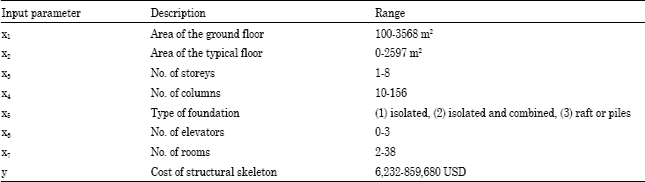 | |
The architectural drawings usually propose the initial layout of the required columns of the building. This initial layout of columns would usually remain unchanged by the structural engineer or minor changes could be suggested. Therefore, it is a good idea to utilize this available parameter in the early cost estimation process. The number of columns has direct influence on column and beam dimensions and slab thickness. The number of elevators also has a significant influence on the skeleton structural cost through the required amount of reinforced concrete. The masonry works is considered as part of the structural skeleton system in the Gaza Strip construction industry. Therefore, the number of rooms (i.e., number of masonry partitions) per building has a significant influence on the cost of the structural skeleton of the building. These design parameters agree very well with most of the key parameters defined by Gunaydin and Dogan (2004) for the building construction in Turkey. Five parameters out of seven of Gunaydin and Dogan (2004) study are similar in natural with those defined in the current paper; the difference in other parameters was attributed to the nature of the construction industry in Turkey and the Gaza Strip.
Data analysis and pre-processing: An initial selection criterion was applied on the collected data in order to ensure dealing with data of similar nature. Several selection conditions were subjected to collected projects, namely; project implementation period less than a year; project has to be completely finished and currently in use; construction year not later than the year 2002; project was implemented under full time engineering supervision of a consulting firm. The application of the above conditions ended up with 92 projects, which can be used as a training data for the ANN model.
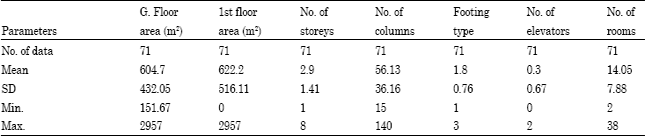
The 92 projects data were then statistically analyzed to investigate the reliability of these data to be training examples for the proposed ANN model. The frequency distributions of the data based on several criteria were performed. Type of building, area of ground floor, area of typical floor, number of storeys, number of columns, number of rooms, type of footings and number of elevators were utilized to perform the frequency distribution of the data. Table 2 presents the mean, standard deviation, minimum and maximum values of each parameter. The frequency distributions of the collected data based on these parameters are presented in Fig. 1-8.
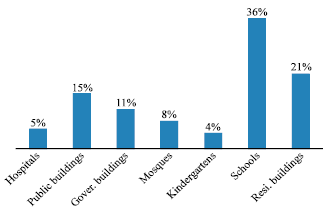
Figure 1 shows the classification of the 92 project data based on type of building. The highest and lowest distribution percentage is for the schools and kindergartens, respectively. It was decided to exclude the data for the mosques and hospitals (12 projects) because their frequencies were very low and the structural system is different than other types. The remaining 71 project data were passed on for the next step of the frequency analysis based on the rest of the parameters.
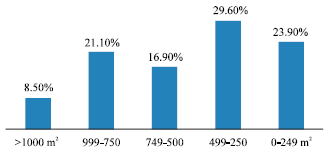
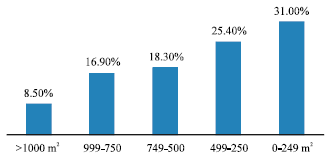
An acceptable distribution of the data representing the ground floor area, typical floor area, number of storeys, type of footings and number of rooms per building was found as shown in Fig. 2-6.
| Table 2: | Statistical properties of the input parameters |
 | |
 | |
| Fig. 1: | The frequency of the data collected |
 | |
| Fig. 2: | Area of the ground floor |
 | |
| Fig. 3: | Area of the first floor |
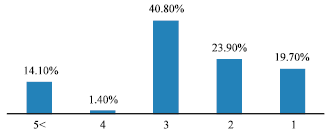 | |
| Fig. 4: | No. of storeys |
Figure 7 indicates that about 70% of collected buildings have columns with less than 30 and up to 60 columns. The remaining 30% of the buildings is distributed as follows: 7% have 61 to 90 columns, 14.1% have 91 to 120 columns and 8.5% more than 120 columns. While 77.5% of the buildings do not have elevators, 22.5% of them have one or two elevators. Although, the distribution of the results on the entire ranges is not uniform, it was decided to use these data for the training of the ANN model as one of the advantages of neural networks is the capability of dealing with incomplete and noisy data.
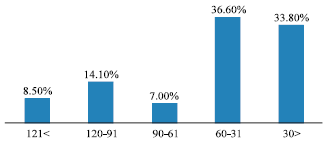 | |
| Fig. 5: | No. of columns |
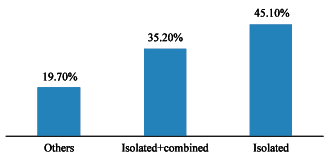 | |
| Fig. 6: | Type of footing |
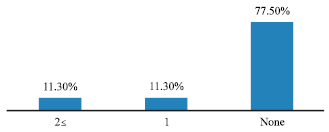 | |
| Fig. 7: | No. of elevators |
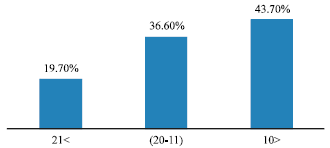 | |
| Fig. 8: | No. of rooms |
Building phase of ANN model: The ANN toolbox available in MATLAB Version 2009b, (MATLAB, 2009) was used for constructing the current ANN cost estimation model. Alqedra and Ashour (2005) indicated that ANN algorithms in MATLAB can be implemented and used to model large-scale problems. In the present study, the non-linear tan-sigmoid transformation function was utilized in the hidden layers and a linear transformation function was employed in the output layer. The upper and lower bounds of the returned value of the tan-sigmoid function is ranged between + 1 and – 1 respectively. Therefore, it was recommended to normalise the input and target in the training database in order to obtain better efficiency of the training process. Equation 1 presents the formula applied for normalizing the training sets so that they fall in the interval [-1, 1].
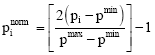 | (1) |
where, pinorm and pi represent the normalised and original data set and pmax and pmin are the upper and higher range of the data under normalisation, respectively.
Training phase of ANN model: The identification of the optimum neural network architecture of the current problem comprises defining the number of neurons (nodes) in the input and output layers, number of hidden layers and the number of neurons in each hidden layer. The number of neurons in the input layer equals the number of the key parameters obtained from the analysis of collected projects. Therefore, the input layer had 7 neurons, namely; area of the ground floor, area of the typical floor, number of storeys, number of columns, type of foundation, number of elevators and number of rooms. The output layer contained one neuron which is the total cost of structural skeleton. Since there is no specific rule to determine the optimum number of hidden layers and the number of neurons in each layer, a trial and error technique was performed to achieve an adequate number of hidden layers and number of neurons in each layer [3, 14, 15]. A neural network of (7x7x7) was found to be the optimum architecture for the current problem, as shown in Fig. 9.
One of the challenges facing training phase is to obtain a trained model which ensure generalization of the neural network (Hagan et al.,1996). Over-fitting is a common problem that could occur during training process. Shi (2002) indicated that training data evenly distributed over the entire space successfully allows the neural network to achieve the target behavior.
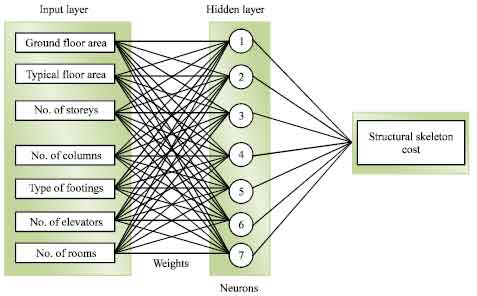 | |
| Fig. 9: | Structure of the ANN Model |
One of the effective methods to ensure generalization of ANN models is early stopping criteria. In this study, the available training data were divided into three sets, namely; training, validation and test sets. The training set is utilized to modify the network weights and biases in order to minimize the network error. The error on the validation set is monitored during the training process. When the network begins to over-fit the data, the error on the validation set will typically begin to rise. When the validation set error increases for a specified number of epochs, the training is stopped. Additional stopping criteria were also applied to ensure over-fitting was minimal. A reasonable level (neither very high nor very tight) of performance error function was adopted. The use of very high value of target error would deprave the ANN model from converging to a well trained model. While the application of very tight target error causes the ANN model to over-fit the training data and consequently loses generalization of the ANN.
The test set is used as a further check for the generalization of the ANN, but do not have any effect on the training. In the present work, training data set comprises 35 data entries and the remaining data entries (36) are equally divided between the validation and testing sets. The dividing process was carried out randomly between the three sets and each dataset has been statistically examined to ensure that it covers the range of input parameters.
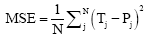
A performance function of mean square sum of errors (MSE) was used to monitor the neural network performance, Eq. 2 shows the relation applied to calculate SSE.
 | (2) |
where, N is total number of training set, Tj and Pj are target and actual output of a data set, respectively. The mean square error is a good overall measure of the successfulness performance of a training run (Al-Tabtabai et al., 1999; Yang et al., 2008).
The training process using multi-layer feed forward neural networks calculates the error between the structural skeleton cost predicted by the output layer and the actual cost. This error then was back-propagated from the output layer to the input layer in which the connected weights and biases were modified. This process is repeated until one of the stopping criteria is satisfied.
Figure 10 shows the performance error curve obtained during the training process of the ANN model. It indicates a reduction in the mean squared error from 1.33 to 0.0014. The actual cost of the 71 projects is compared with the corresponding values predicted from the trained neural network as shown in Fig. 11.
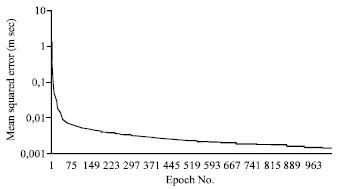 | |
| Fig. 10: | Learning curve of the training process |
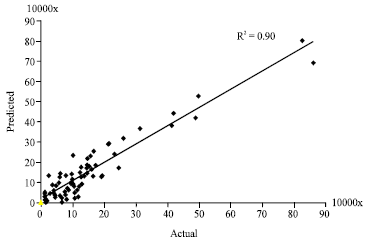 | |
| Fig. 11: | A comparison between the actual cost of the trained set and the corresponding ANN predicted values |
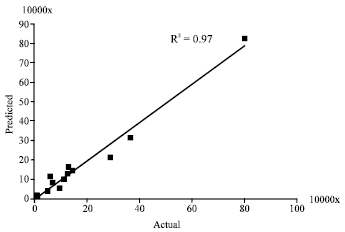 | |
| Fig. 12: | A comparison between the actual cost of the test set and the corresponding ANN Predicted values |
A perfect agreement between the actual and predicted values draws a 45-degree line, which means that the actual cost values equal the predicted ones (Fig. 11) indicates a reasonable concentration of the predicted values around the 45° degree line. The coefficient of determination between the actual and the predicted cost values was 90%.
Testing phase of ANN model: The testing phase of the ANN model building ensures that the developed ANN model was successfully trained and generalisation is adequately achieved. As mentioned above, the training data is divided into three sets; training, validation and testing sets. The input parameters of the testing set was used to subject the proposed ANN model to a new set of data, which were not previously known to the network. A comparison between the actual cost values of the testing set and those obtained from the ANN model is shown in Fig. 12. The mean, standard deviation and coefficient of determination (R2) of the ratio between the actual and predicted cost Cp/CA are 0.960, 0.420 and 97%, respectively.
The influence of the input parameters on the performance of the trained ANN model was evaluated using sensitivity analysis. This study would comment on the significance of each parameter to the network and whether any change in the size of the network is necessary. The sensitivity analysis was carried out by varying one parameter at a time and the corresponding change in the cost as a percentage was reported.
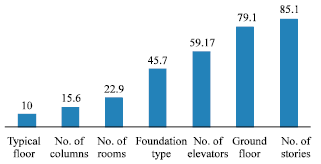 | |
| Fig. 13: | Sensitivity measures of the input parameters on the output of the NN model |
The sensitivity analysis results of each input parameter are presented in Fig. 13. Figure 13 shows that the ground floor area, number of storeys, number of elevators and type of foundation have significant to very significant influence on the output of the network which is the structural skeleton cost of the building. Typical floor area, number of rooms and number of columns showed small to very small influence on the output.
This finding agrees well with the results obtained by Gunaydin and Dogan (2004). They showed that the ratio of the typical floor area to the total area of the building and the number of storeys were the most effective design parameters. They also found that the total area of the building had a very small effect on the output. This seems reasonable because the total area of the building is represented by the ratios of the ground floor area and the typical floor area to the total area of the building and the number of storeys. Therefore, the trainer of the network considered this parameter as a dependant parameter represented by other parameters.. This finding is also observed in this study as the typical floor area had very little influence on the output. Although, the ranges of ground floor areas and the typical floor areas in the current study are different, most of the collected projects had similar ground and typical floor areas, as shown in Fig. 2 and 3. This made the typical floor area parameter a dependant variable represented by of the number of storeys and the ground floor area parameters (i.e., the total area). Thus, the typical floor area of the building had insignificant effect on the output.
It does not necessarily mean that small-effect parameters should be excluded from the model, these parameters could enhance the learning capability of the model to achieve the best output prediction. This finding also agrees with the results obtained by Gunaydin and Dogan (2004). It can also be concluded that identifying the significance of each parameter on the structural skeleton cost of the building defines which parameters one can and cannot scarify in order to obtain a reasonable estimation of the building cost. Therefore, trained neural networks are very useful in obtaining information on the significance of the key parameters of the problem under consideration.
CONCLUSIONS
A neural network was developed to predict the early stage cost of the buildings. A large number of data was initially collected from the industry comprising schools, public building, governmental and non-governmental buildings, kindergartens and residential buildings. A pre-processing was carried out and a 71 project data was kept for the training process of the ANN model.
The analysis of the training data revealed that there are 7 key parameters influencing the cost of the buildings, namely: ground floor area, typical floor area, number of storeys, number of columns, type of footing, number of elevators and number of rooms. The developed ANN model had one hidden layer with seven neurons. One neuron representing the early cost estimate of buildings formed the output layer of the ANN model. The actual cost values of the training set are compared with the corresponding ones which predicted from the trained neural network. The comparison indicated a reasonable concentration of the predicted values around the 45° degree line. The coefficient of determination between the actual and the predicted cost values was 90%. Also, a comparison between the actual cost values of the testing set and those obtained from the ANN model showed that the mean, standard deviation and coefficient of determination (R2) of the ratio between the actual and predicted cost Cp/CA are 0.960, 0.420 and 97%, respectively.
A sensitivity analysis was carried out to study the influence of each input parameter on the performance of the ANN model to predict the cost of buildings. The performed sensitivity analysis showed that the ground floor area, number of storeys, type of foundation and number of elevators in the buildings are the most effective parameters influencing the cost estimates of buildings. The remaining parameters had small effect on the estimated value but it is believed that their existence could be important to enhance the ability of the model to learn and generalize the results.
Finally, It can be concluded that the trained models of neural networks reasonably succeeds in predicting the cost estimation of buildings at early stages by just using the basic and fundamental information of the projects without the need for a more detailed design. It is recommended that more reliable project data to be collected and added to the training set in order to improve the predictions and widen the ranges the current ANN model work through.
ACKNOWLEDGMENT
Authors would like to express their gratitude for the final-year students of the Civil Engineering Department, the Islamic university of Gaza; A. Hamad, A. Afifi, D. Abu Asi, M. Skaik, M. Abu Meri and M. Al Halool for collecting the projects data from the industry of the Gaza Strip in their preliminary study to build ANN model as a part of their final graduation project under the supervision of the authors and made them available for the authors.
REFERENCES
- Adeli, H. and M. Wu, 1998. Regularization neural network for construction cost stimation. J. Construction Eng. Manage., 124: 18-24.
CrossRef - Alqedra, M.A. and A.F. Ashour, 2005. Prediction of shear capacity of single anchors located near a concrete edge using neural networks. Comput. Struct., 83: 2495-2502.
CrossRef - Al-Tabtabai, H., P.A. Alex and M. Tantash, 1999. Preliminary cost estimation of highway construction using neural networks. Construct. Eng., 41: 19-24.
Direct Link - Ashour, A.F. and M.A. Alqedra, 2005. Concrete breakout strength of single anchors in tension using neural networks. Adv. Eng. Software, 36: 87-97.
CrossRef - Emsley, M.W., D.J. Lowe, A.R. Duff, A. Harding and A. Hickson, 2002. Data modelling and the application of a neural network approach to the prediction of total construction costs. Construct. Manage. Econo., 20: 465-472.
CrossRef - Gunaydin, M.H. and S.Z. Dogan, 2004. A neural network approach for early cost estimation of structural systems of buildings. Int. J. Project Manage., 22: 595-602.
CrossRef - Harding, A., D. Lowe, M. Emsley, A. Hickson and R. Duff, 1999. The role of neural networks in early stage cost estimation in the 21st century. Proceedings of the Construction and Building Research (COBRA), (CBR`99), RICS Research Foundation, Department of Building Engineering, UMIST, UK., pp: 161-168.
Direct Link - Kim, G.H., D.S. Seo and K.I. Kang, 2005. Hybrid models of neural networks and genetic algorithms for predicting preliminary cost estimates. J. Comput. Civil Eng., 19: 208-211.
CrossRef - Orlando, D., R. Nibaldo and A.C. Luiz, 2009. Neural networks for cost estimation of shell and tube heat exchangers. Expert Syst. Appl., 36: 7435-7440.
CrossRef - Pettang, C., L. Mbumbia and A. Foudjet, 1997. Estimating building materials cost in urban housing construction projects, based on matrix calculation. Construct. Build. Mater., 11: 47-55.
CrossRef - Rafiq, M.Y., G. Bugmann and D.J. Esterbrook, 2001. Neural network design for engineering applications. Comput. Struct., 79: 1541-1552.
CrossRef - Min-Yuan C., T. Hsing-Chih and H. Wen-Shan, 2009. Web-based conceptual cost estimates for construction projects using evolutionary fuzzy neural inference model. Automation Construction, 18: 164-172.
CrossRef - Cheng, M.Y., H.C. Tsai and E. Sudjono, 2010. Conceptual cost estimates using evolutionary fuzzy hybrid neural network for projects in construction industry. Expert Syst. Appl., 37: 4224-4231.
CrossRef - Ozgan, E. and R. Demirci, 2008. Neural networks based modelling of traffic accidents in interurban rural highways, duzce sampling. J. Applied Sci., 8: 146-151.
CrossRefDirect Link - Shi, J.J., 2002. Clustering technique for evaluating and validating neural network performance. J. Comput. Civil Eng., 16: 152-155.
CrossRef - Solaimani, K., 2009. A study of rainfall forecasting models based on artificial neural network. Asian J. Applied Sci., 2: 486-498.
CrossRefDirect Link - Sonmez, R., 2004. Conceptual cost estimation of building projects with regression analysis and neural networks. Can. J. Civil Eng., 31: 77-683.
CrossRef - Wilmot, C.G. and B. Mei, 2005. Neural network modeling of highway construction costs. J. Construction Eng. Manage., 131: 765-771.
CrossRef - Yang, K.H., A.F. Ashour, J.K. Song and E.T. Lee, 2008. Neural network modelling of RC deep beam shear strength. Struct. Build., 161: 29-39.
Direct Link - Zhang, Y.F. and J.Y.H. Fuh, 1998. A neural network approach for early cost estimation of packaging products. Comput. Ind. Eng., 34: 433-450.
CrossRef
muna saad Reply
researching in thesis in construction management
Bilisuma Reply
I REALY APPRECIATE THE PAPER VERY WELL! I am very happy if i would get the model that used for an input .
Sincerly