

Zhang Xiaoren
School of Economics and Management, Beihang University, Beijing, China
Chen Xiangdong
School of Economics and Management, Beihang University, Beijing, China
Ding Ling
School of Economics and Management, Beihang University, Beijing, China
Information Technology Journal
Year: 2013 | Volume: 12 | Issue: 12 | Page No.: 2350-2357





ABSTRACT
With the rapid development of modern information technology, more and more Self-service Technologies (SSTs) have emerged and won more and more customers increasingly. But some types of SSTs are not accepted by the customers. This study firstly divided SSTs into financial and specialty classes based on the product function. Then, a technology acceptance model was proposed on the basis of analysis of SSTs adoption behavior. Finally, the data were collected from users of automated teller machines and automated boarding machines in china through site interview and processed by structural equation modeling analysis method. The study found that both perceived risk and perceived security have significant impact on users’ adoption of financial SSTs while perceived ease of use and perceived enjoyment positively affect specialty SSTs adoption behavior and the effects of perceived usefulness and the self-efficacy on customers were alike.
PDF Abstract XML References Citation
Article History
Received: May 18, 2013;
Accepted: June 24, 2013;
Published: August 02, 2013
How to cite this article
Zhang Xiaoren, Chen Xiangdong and Ding Ling, 2013. Comparative Study of Self-service Technology Adoption based on Product Function. Information Technology Journal, 12: 2350-2357.
DOI: 10.3923/itj.2013.2350.2357
URL: https://scialert.net/abstract/?doi=itj.2013.2350.2357
DOI: 10.3923/itj.2013.2350.2357
URL: https://scialert.net/abstract/?doi=itj.2013.2350.2357
INTRODUCTION
With the development of modern information technology, a variety of Self-service Technologies (SSTs) such as banking self-service equipment, commercial self-vending machines, airline reservation systems, self-parking system, online banking and online shopping have emerged. These self-service technologies have created more value for customers and met their particular needs.
According to the survey organized by the author, the current usage of SSTs varies considerably in China. Automated teller machines, online banking and ticket vending machines are achieving better returns while some applications of the self-service technologies have not been accepted by customers yet.
As is known to all, customers and the technology providers are focusing on the product function. And self-service technologies aim to provide invisible and standardized services. Therefore, the adoption behaviors of customers affected by the product function of self-service technologies are worthy of further study. However, there are no studies on exploring customers’ adoption behaviors of SSTs based on product function in this field. In this study, the theory of consumer and value engineering were used to compare the role of various factors in SSTs adoption behaviors based on the product function. The deployment suggestions of various types of SSTs were also proposed.
The term “Self-Service Technologies” (SSTs) was first used by Meuter et al. (2000). They defined them as “technological interfaces that enable employees to provide customers with services directly and independently”. In subsequent researches, the term and its definition has gained wide acceptance among other researchers (Curran and Meuter, 2005; Lee and Allaway, 2002; Forbes, 2008; Bobbit and Dabholkar, 2001).
A better classification was needed with a growing number of researches in SSTs. Meuter et al. (2000) divided SSTs into two dimensions: interface (telephone voice response; online; interactive kiosks) and purpose (customer service, transactions). Curran and Meuter (2005) utilized adoption factor models to test different SSTs and reported that the influence of tested adoption factors varied with the types of SSTs which confirmed the need for the classification of SSTs by interface and purpose. Forbes (2008) provided an alternative classification, in which he divided SSTs into two groups: internet and non-internet SSTs and suggested that marketers needed to understand the numerous differences between these two types. By researching consumers’ view about SSTs, Cunningham et al. (2008) offered a different perspective and 11 classified dimensions including physical product component were tested.
In the study, of value engineering, function is defined as a property that the object can meet some demands of the users. The product functions are the users’ essential demands for products. The real purpose of customers was the product's function rather than the product itself (Luthje and Herstatt, 2004). Different types of user groups need different functions, so product function is a critical factor in customer-oriented innovation. The rational cognition and principle of the product functions were the first motivation of consumers when they choose a product or service (Hippel, 1988). With the excellent product functions, services tend to be customers’ priority as the product functions provide users with convenience, pleasure and good work sense. The demand for product function was the essence for the consumers to buy products and the competition of product functions was the core of innovation competition (Levitt, 1980).
Based on the research above, the SSTs were classified as financial and specialty according to the product functions. Financial SSTs refer to the technologies related to financial transactions such as automatic teller machines, online banking, telephone banking, etc. The main features of financial SSTs include transfers, withdraw and payment. Specialty SSTs refer to technologies that focus on providing special services such as ACD, self-check-in machine, distance learning and information kiosk.
HYPOTHESES AND RESEARCH MODEL
The personal decision made by regular users to choose a certain kind of product or service was called adoption (Kotler and Keller, 2006). Self-service technologies make customers to be exposed to technology media in the service delivery process inevitably. Therefore, the customers’ attitude to the use of technology will affect their adoption behaviors. The attitudes and behaviors of users affected the use of SSTs and in return impact on the intention of the users had received wide attractions among researchers (Dabholkar and Bagozzi, 2002).
Perceived usefulness: The degree that a person values by using a particular system to enhance his or her job performance was defined as Perceived Usefulness (PU) (Davis, 1989). It could be measured by increase in productivity, improvement in job performance, enhancement of job effectiveness as well as usefulness in the job. According to the previous studies in different countries, perceived usefulness was an important predictor for SSTs adoption (Wang et al., 2003; Pikkarainen et al., 2004; Guriting and Ndubisi, 2006; Rigopoulos and Askounis, 2007; Amin, 2007). On the basis of these arguments the following hypothesis was formulated:
| • | H1: Perceived usefulness has positive effects on customers’ attitude to SSTs |
Perceived ease of use: Perceived ease of use (PEOU) was described as the degree that a person believes how difficult to use a particular system (Davis, 1989). A number of studies showed that PEOU is one of the determinant factors of systems application, particularly in the internet banking and ATM (Curran and Meuter, 2005; Park and Chen, 2007). According to the above arguments, the following hypotheses are concluded in the study:
| • | H2: Perceived ease of use has positive effects on customers’ attitude to SSTs |
| • | H3: Perceived ease of use has positive influence on perceived usefulness |
Perceived enjoyment: The intrinsic motivation, such as fun and enjoyment, was the determinant factor for the customers’ tendency of using the technologies (Dabholkar, 1996). Perceived Enjoyment (PE) is the feeling of joy and pleasure which emerges immediately from using the technology, especially the computer and internet (Teo, 2001). Igbaria et al. (1996) explained that perceived enjoyment was an intrinsic motivation and users might be motivated to use new technology if they were able to obtain intrinsic psychological rewards. In addition, PE had a positive relationship with internet usage (Teo, 2001). Based on the considered outlines above, it can be proposed that:
| • | H4: Perceived enjoyment has positive effects on SSTs’ adoption behavior |
Self-efficacy: Self-Efficacy (SE) refers to an individual’s perceptions of his or her ability to use technology in the accomplishment of a task. Individuals often preferred to avoid a new technology or were less likely to use it which they considered too complex to use and they were unable to control it in all probability (Igbaria and Iivari, 1995). Therefore, when an individual has more confidence in his or her ability to use SSTs, he/she will be more likely to use SSTs. Users’ beliefs regarding information technology acceptance was mainly determined by self-efficacy according to many empirical studies (Bagozzi et al., 1992; Wang et al., 2003). Based on the above discussion, the following proposition is obtained:
| • | H5: Self-efficacy will affect SSTs adoption behavior positively |
Technology readiness: People’s propensity to embrace and use new technologies for accomplishing goals in life and work was called Technology Readiness (TR) (Parasuraman, 2000). People have positive and negative feelings towards technology due to the components of TR. The mechanism that TR affects satisfaction and behavioral intention was empirically tested by Lin et al. (2005). Van Riel et al. (2006) challenged the importance of TR. He made an explanation on SST adoption behavior and found that there was no significant difference between the TR of adopters and non-adopters on self-service. Hypothesis was therefore formulated:
| • | H6: Technology readiness has positively effects on customer attitude to SSTs |
Perceived risk: The variable risk is examined mainly in the fields such as e-commerce and on-line shopping. Risks of internet shopping were tested in various shopping contexts like airplane tickets buying (Cunningham et al., 2004) and internet shopping (Liebermann and Stashevsky, 2002). The Perceived Risk (PR) in purchasing air-tickets online has been studied by Cases (2002). His discovery is similar to previous research which found that payment and privacy security appeared as a main risk factor in internet shopping settings. On the basis of these arguments, hypothesis was formulated as follows:
| • | H7: There is a negative correlation between perceived risk and SSTs adoption behavior |
Security and privacy: There are still a group of users who are reluctant to accept the self-service technologies because of security and privacy issues. The possibility that the third parties acquired the personal information without customers’ permission was called Security and Privacy (SP) (Lee and Allaway, 2002). The level of risk gets higher if there is no sufficient security and privacy guaranteed by the service providers especially the banks. Therefore, a lack of security and privacy becomes a barrier in adopting SSTs. It can be concluded that:
| • | H8: Security and privacy issues have negative effects on customers’ attitude towards SSTs |
Facilities condition: Facilities Condition (FC) means to the important external environment which helps customers to overcome obstacles and deficiencies in information technology utilization. According to the definition, an easily understandable condition of facilities can help the customers master the skills and accept the technology even if he or she is unskilled and unprofessional. Convenient and good conditions can help customers get access to much needed services timely and enhance the usefulness of technology which makes customers feel joyful.
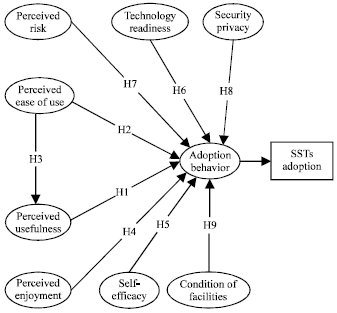 | |
| Fig. 1: | Research model of the impact factor of SSTs adoption |
Conditional facilities include the available technical support services for customers which are used to eliminate their risk perception. Therefore, the following hypothesis can be proposed:
| • | H9: SSTs conditional facilities have positive effects on customers’ attitude towards SSTs |
Research model: According to reasonable action theory, the Technology Acceptance Model (TAM) was developed by Davis (1986) to explain people's technology adoption behavior and the model was widely used in later SST studies (Curran and Meuter, 2005; Dabholkar, 1996; Dabholkar and Bagozzi, 2002; Ndubisi and Jantan, 2003). Beliefs have a direct impact on behavior intentions, suggested by TAM (especially the revised TAM) (Davis, 1989). Therefore, according to TAM, the above exploration and analysis of literatures, the model of study structure is expressed as Fig. 1.
METHODS AND DATA COLLECTION
The objects for this study are the customers who ever used self-service technologies. To ensure the comparability of the sample, the Automated Teller Machines (ATM) of commercial banks and airline Automated Boarding Machines (ABM) with better operation are chosen as objects to study the key factors that affect different types of SSTs. In this study, all the customers have used the self-services at ATM and ABM.
The previous researches have been adopted to ensure the reliability of the questionnaires. The scale used to measure Attitude to SSTs was based on the scales used by Bobbit and Dabholkar (2001). The items used by Davis (1989) to measure Ease of use and Perceived usefulness were adapted to the context of the study. The scale for Perceived risk was based on the scale used by Cunningham et al. (2004) and the scale for Perceived enjoyment was based on the scale used by Igbaria et al. (1996). The items used by Van Riel et al. (2006) were used to measure the impact of Technology readiness. The scales used for Security and Facilities condition were based on the scale used in Lee and Allaway (2002), as well as the items by Wang et al. (2003) to measure Self-efficacy towards the SSTs. Question items relating to latent construct were measured by a five-point Likert-type scale (1) Absolutely disagree, (2) Disagree, (3) Neither agree nor disagree, (4) Agree and (5) Absolutely agree. A 28-item questionnaires containing relation to users’ acceptance and behavior was designed.
Site survey was utilized in this study as a method to collect data. Survey respondents were chosen at the airport terminal in Beijing. From March 2011 to May 2011, 180 respondents were interviewed and of which 168 were valid questionnaires. And there were 47.8% male and 52.2% female respondents.
DATA ANALYSIS
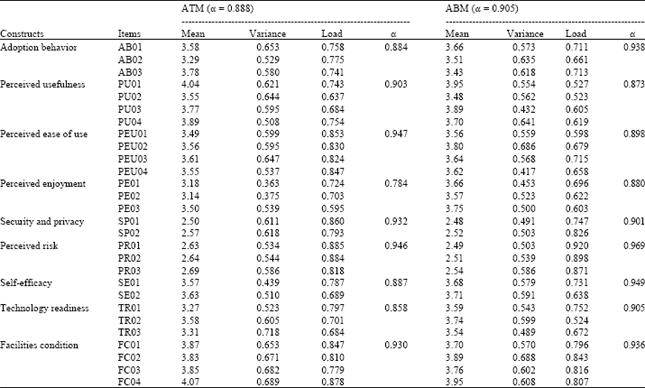
The data was processed by using the SPSS 18.0. The two questionnaires KMO coefficients were 0.888 and 0.905, respectively which indicated that the survey data are highly relevant to the use of factor analysis. In this study, confirmatory factor analysis was utilized to assess the convergent validity. Table 1 shows the descriptive statistics and factor loading of each single item. The factor loading ranges from 0.595-0.885 and 0.523-0.92. Over 0.5 means the measurement items were valid. All α coefficients of the latent variable in the study ranged from 0.784-0.947 and 0.873-0.969, are greater than 0.75. All α coefficients of the questionnaires are higher than 0.85 which means that good internal consistency was guaranteed in the model.
When the correlation between the two constructs was too strong (|R|>0.85) or too weak (|R|<0.10), the discriminated validity of theoretical measurement model could be tested (Kline, 1998). The Average Variance Extraction (AVE) values of the latent variable and the correlation coefficient matrix are all between 0.1 and 0.854, as showed in Table 2 and 3 and each value is greater than the criteria of correlation coefficient. Therefore, the measurement model has a good discriminate validity.
| Table 1: | Construct reliability and validity of measurement scales of ATM and ABM |
 | |
| ATM: Automated teller machines, ABM: Automated boarding machines | |
| Table 2: | AVE of latent variable and the correlation coefficient matrix of automated teller machines |
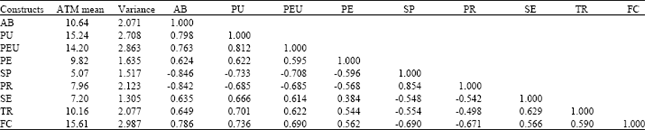 | |
| ABM: Automated boarding machines, ATM: Automated teller machines, AB: Adoption behavior, PU: Perceived usefulness, PEOU: Perceived ease of use, PE: Perceived enjoyment, SP: Security and privacy, PR: Perceived risk, SE: Self-efficacy, TR: Technology readiness, FC: Facilities condition | |
| Table 3: | AVE of latent variable and the correlation coefficient matrix of automated boarding machines |
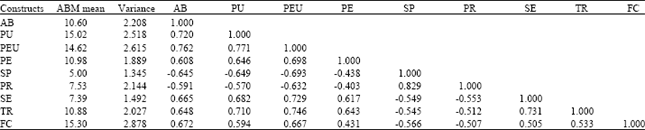 | |
| ABM: Automated boarding machines, ATM: Automated teller machines, AB: Adoption behavior, PU: Perceived usefulness, PEOU: Perceived ease of use, PE: Perceived enjoyment, SP: Security and privacy, PR: Perceived risk, SE: Self-efficacy, TR: Technology readiness, FC: Facilities condition | |
HYPOTHESIS TESTING AND DISCUSSION
In this study, AMOS 18.0 was used to create the covariance-based Structural Equation Model (SEM). Measurement model validation results show that the R2 of ATM and ABM are 0.478 and 0.637 which indicates 47.8 and 63.7% of the behavior of adoption can be explained by the latent variables and the results of two measurement models are both acceptable. The main parameters of the structural model for the ATM and ABM are as follows: the CMIN/DF is 4.3, GFI 0.555, NFI 0.717, CFI 0.766, RMSEA 0.14; and the CMIN/DF is 4.4, GFI 0.559, NFI 0.721, CFI 0.768 and RMSEA 0.143. It can be concluded that the observed data fit the hypothesized model.
The standardized path coefficients of the proposed research model are shown in Fig. 2. The 9 hypotheses are all supported by the empirical assessment of the structural model.
As the analysis results of SEM showed, perceived usefulness, perceived ease of use, perceived enjoyment, self-efficacy, facilities conditions and technical readiness of ATM and ABM significantly and positively affect the behaviors of adoption like H1, H2, H3, H4, H5, H6, H9. Perceived risk, security and privacy have a negative effect on the adoption behavior such as H7, H8. The greater the perceived risk is, the weaker the usage intention of ATM and ABM will be. And the results are corresponded with the research findings of Davis, Meuter, Dabholkar, etc.
The observed variable path coefficient shows that the ATM’s perceived risk, technology readiness and security are significantly larger than the coefficient of ABM’s and ATM’s perceived enjoyment, perceived ease of use and self-efficacy are significantly less than ABM’s. The path coefficients of facilities conditions between two types of SSTs are approximative. It can be concluded that perceived risk and security have significant influences on the intention of adoption behaviors of financial SSTs. As for the specialty SSTs, customers are more concerned about perceived enjoyment and perceived ease of use. Perceived usefulness and facility conditions on ATM and ABM clearly have the same impacts on the behavior of adoption.
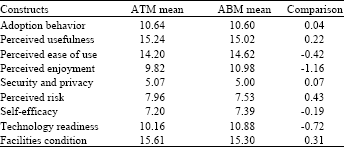
To compare the customer’s adoption behavior under two types of SSTs, this study combines the mean score differences with analyzing observed variables. As it can be seen from Table 4, the average perceived usefulness ATM is 0.22 larger than that of ABM. Therefore it can be concluded that customers consider ATM as a more useful technology which can help them avoid queuing and provide more services that meet their more demands while ABM is a relatively simple technology only for check-in and less useful than ATM.
ABM is usually installed at the airport terminal, simple to use and its check-in queue is not very long. Therefore, the deployment of ABM is not as significant as ATM in enhancing users’ efficiency.
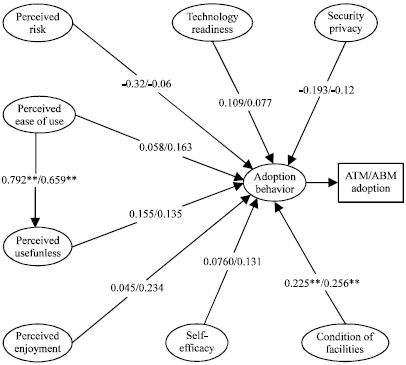 | |
| Fig. 2: | AMOS Analysis results of the research model of automated teller machines and automated boarding machines, **path is significant at p<0.01 |
| Table 4: | Comparison of observed variables between ATM and ABM |
 | |
| ATM: Automated teller machines, ABM: Automated boarding machines | |
The mean score of perceived enjoyment variable of ABM is greater than that of ATM and its path coefficient is almost 3 times greater than ATM’s. It can be seen that the customers pay more attention to ABM.
The average self-efficacy and technical readiness of ATM are 0.19 and 0.72 less than ABM, showing that ATM is a relatively complex functional technology and customers can not acquaint themselves with it well. But ABM is relatively simple (only for check-in) and the customers perceived lower ease than ATM.
Perceived risks and security differences lead to the average scores of two types of SSTs as 0.43 and 0.07, respectively. Furthermore, the ATM’s path coefficient is several times of ABM’s which reflects that the customers consider ATM to be much more risks than ABM in the safety fields especially on the issue of potential risks. Most customers gave a positive respond during the survey process.
THEORETICAL AND MANAGERIAL IMPLICATIONS
The study creatively divided SSTs into financial and specialty SSTs based on product function. Better applications of SSTs were chosen in China to verify the different factors and effects of adoption behaviors in the technology acceptance model, observing variables and the average score of scale. The study expanded the research scope of SSTs and made a theoretical contribution to the current social and economic environment of China.
ATM, as a financial self-service technology, is related to accounting and cash transaction and its internal function is very complex. The research results show that the perceived risks and security are relatively high, so the customers are worried about their potential loss in self-service. Thus, the innovation of financial self-service technologies should be focused on the security features and safety control mechanism which aimed to reduce the probability of security incidents.
The study found that perceived ease of use and perceived enjoyment have more significant impacts on ABM than ATM. Therefore, for the technology that is to be substitutable, the customers care more about the enjoyment and ease within services than services themselves. The goal of innovation is to improve customers’ feeling and satisfaction by providing more personalized, friendly functions.
The study shows that the innovation diffusion of SSTs need a requirement of strengthening their basic functions so that customers can feel the enhancements of usefulness, real conveniences and performance. The self-efficacy and technology readiness for adoption effects of ATM are relatively significant and the customers generally have a psychological fear of complex technology. Therefore, the design of complex SSTs should be simplified in introducing and adopting standard modular technology. If customers are familiar with the technical performance or the principles, the level of their adoption will be improved. As ATM needs high technology capacity, service providers should make an explanation of the technology to eliminate the anxiety of customers and improve the customer's willingness to use.
The research results show that the facility conditions significantly affect the adoption behavior of SSTs, technology providers should focus on providing operation instructions for customers. However, for the specialty SSTs deployed in particular place, the good conditions of facilities will not contribute to their usage. Therefore, these SSTs should make a good balance between costs and benefits instead of achieving a wide range of technology applications by simple and blind investment.
FUTURE RESEARCH PROSPECTS
There are some inevitable shortcomings in the study. Future research can ameliorate these deficiencies and make these findings to be more generally significant.
ATM and ABM are based on “site” SSTs while the others such as online banking and online shopping are based on the “media” SSTs. Influencing factors and their results tend to be different. Therefore, the conclusions of this study needs to be verified to spread these technologies.
Sample of the study is chosen at the airport terminal, taking into account the socio-economical environment of China. The interviewed customer groups relatively have higher education, income and social status. The customer’s perceived usefulness, perceived risk, self-efficacy, technology readiness and other factors had a different impact on the adoption behavior compared with other customer groups and the specific impact of these relations needs further exploration.
REFERENCES
- Amin, H., 2007. Internet banking adoption among young intellectuals. J. Internet Bank. Commerce, 12: 1-13.
Direct Link - Bobbit, L.M. and P.A. Dabholkar, 2001. Integrating attitudinal theories to understand and predict use of technology-based self-service: The Internet as an illustration. Int. J. Serv. Ind. Manage., 12: 423-450.
CrossRefDirect Link - Bagozzi, R.P., F.D. Davis and P.R. Warshaw, 1992. Development and test of a theory of technological learning and usage. Hum. Relations, 45: 659-686.
CrossRefDirect Link - Cases, A.S., 2002. Perceived risk and risk-reduction strategies in Internet shopping. Int. Rev. Retail Distrib. Consum. Res., 12: 375-394.
CrossRefDirect Link - Cunningham, L.F., J. Gerlach and M.D. Harper, 2004. Assessing perceived risk of consumers in internet airline reservations services. J. Air Transp., 9: 21-35.
Direct Link - Cunningham, L.F., C.E. Young and J.H. Gerlach, 2008. Consumer views of self-service technologies. Serv. Ind. J., 28: 719-732.
CrossRefDirect Link - Curran, J.M. and M.L. Meuter, 2005. Self-service technology adoption: Comparing three technologies. J. Serv. Market., 19: 103-113.
CrossRef - Dabholkar, P.A., 1996. Consumer evaluations of new technology-based self-service options: An investigation of alternative models of service quality. Int. J. Res. Market., 13: 29-51.
CrossRefDirect Link - Dabholkar, P.A. and R.P. Bagozzi, 2002. An attitudinal model of technology-based self-service: Moderating effects of consumer traits and situational factors. J. Acad. Market. Sci., 30: 184-201.
CrossRefDirect Link - Davis, F.D., 1989. Perceived usefulness, perceived ease of use and user acceptance of information technology. MIS Q., 13: 319-340.
CrossRefDirect Link - Forbes, L.P., 2008. When something goes wrong and no one is around: Non-internet self-service technology failure and recovery. J. Serv. Market., 22: 316-327.
CrossRefDirect Link - Guriting, P. and N.O. Ndubisi, 2006. Borneo Online banking: Evaluating consumer perceptions and behavioral intention. Manage. Res. News, 29: 6-15.
CrossRefDirect Link - Igbaria, M. and J. Iivari, 1995. The effects of self-efficacy on computer usage. Omega, 23: 587-605.
CrossRef - Igbaria, M., S. Parasuraman and J.J. Baroudi, 1996. A motivational model of microcomputer usage. J. Manage. Inform. Syst., 13: 127-143.
CrossRefDirect Link - Kline, R.B., 1998. Software review: Software programs for structural equation modeling: Amos, EQS and LISREL. J. Psychoeducational Assess., 16: 343-364.
CrossRefDirect Link - Lee, J. and A. Allaway, 2002. Effects of personal control on adoption of self-service technology innovations. J. Servic. Market., 16: 553-572.
CrossRefDirect Link - Levitt, T., 1980. Marketing success through differentiation-of anything. Harvard Bus. Rev., 58: 83-91.
Direct Link - Liebermann, Y. and S. Stashevsky, 2002. Perceived risks as barriers to internet and e-commerce usage. Qual. Market Res. Int. J., 5: 291-300.
Direct Link - Van Riel, A., V. Liljander, F. Gillberg and J. Gummerus, 2006. Technology readiness and the evaluation and adoption of self-service technologies. J. Retail. Consum. Serv., 13: 177-191.
Direct Link - Luthje, C. and C. Herstatt, 2004. The lead user method: An outline of empirical findings and issues for future research. RD Manage., 34: 553-568.
Direct Link - Meuter, M.L., A.l. Ostrom, R.I. Roundtree and M.J. Bitner, 2000. Self-service technologies: Understanding customer satisfaction with technology-based service encounters. J. Market., 64: 50-64.
CrossRef - Ndubisi, N.O. and M. Jantan, 2003. Evaluating IS usage in Malaysian small and medium-sized firms using the technology acceptance model. Logist. Inform. Manage., 16: 440-450.
CrossRef - Parasuraman, A., 2000. Technology Readiness Index (TRI): A multiple-item scale to measure readiness to embrace new technologies. J. Serv. Res., 2: 307-320.
Direct Link - Park, Y. and J.V. Chen, 2007. Acceptance and adoption of the innovation use of smartphone. Ind. Manage. Data Syst., 107: 1349-1365.
CrossRefDirect Link - Pikkarainen, T., K. Pikkarainen, H. Karjaluoto and S. Pahnila, 2004. Consumer acceptance of online banking: An extension of the technology acceptance model. Internet Res., 14: 224-235.
CrossRefDirect Link - Rigopoulos, G. and D. Askounis, 2007. TAM framework to evaluate users perception towards online electronic payments. J. Internet Bank. Commer., 12: 1-6.
Direct Link - Teo, T.S.H., 2001. Demographic and motivation variables associated with internet usage Activities. Internet Res., 11: 125-137.
CrossRefDirect Link - Wang, Y.S., Y.M. Wang, H.H. Lin and T.I. Tang, 2003. Determinants of user acceptance of Internet banking: An empirical study. Int. J. Service Ind. Manage., 14: 501-519.
CrossRefDirect Link