

A.A. Abd El-Mageed
Flora and Phyto-Taxonomy Research Department, Horticulture Research Institute, Agricultural Research Center, Egypt
A.K. Osman
Department of Botany, Faculty of Science (Qena), South Valley University, Egypt
A.Q. Tawfik
Department of Botany, Faculty of Science (Qena), South Valley University, Egypt
H.A. Mohammed
Flora and Phyto-Taxonomy Research Department, Horticulture Research Institute, Agricultural Research Center, Egypt
Research Journal of Phytochemistry
Year: 2011 | Volume: 5 | Issue: 2 | Page No.: 115-122


ABSTRACT
We have evaluated the medicinal properties of Eucalyptus essential oils that are highly flammable and contains compounds which are natural disinfectants and pest deterrents. The essential oils isolated by hydrodistillation from the leaves of four Eucalyptus species growing in Egypt were analyzed by GC/MS for their chemical compositions. The major components identified in E. citridora Hook oil were 3-hexen-1-ol, cis-geraniol, citronellol acetate, 5-hepten-1-ol, 2,6-dimethyl and citronellal; in E. camaldulensis Dehn. were megastigma-3,7(Z),9-triene, dihydrocarveol acetate, cis-nerolidol, kauran-18-al,17-(acetyloxy)-,(4.β.)- and (-)-spathulenol; in E. gomphocephala Dc. were dihydrocarveol acetate, p-cymene and citral (isomer 1) cis-, trans-.; and the major components of E. resinfera Sm. were eucalyptol, (-)-spathulenol, α-terpineol acetate and trans-nerolidol. The findings demonstrated that there are broad differences in the chemical components for the investigated Eucalyptus species.
PDF Abstract XML References Citation
Article History
Received: February 11, 2011;
Accepted: May 11, 2011;
Published: July 02, 2011
How to cite this article
A.A. Abd El-Mageed, A.K. Osman, A.Q. Tawfik and H.A. Mohammed, 2011. Chemical Composition of the Essential Oils of four Eucalyptus Species (Myrtaceae) from Egypt. Research Journal of Phytochemistry, 5: 115-122.
DOI: 10.3923/rjphyto.2011.115.122
URL: https://scialert.net/abstract/?doi=rjphyto.2011.115.122
DOI: 10.3923/rjphyto.2011.115.122
URL: https://scialert.net/abstract/?doi=rjphyto.2011.115.122
INTRODUCTION
Essential oils are the odorous, volatile products of the secondary metabolism of an aromatic plant which are often concentrated in a particular organ of the plant such as leaves, stems, bark or fruit (Prasad et al., 2011; Monfared and Ghorbanli, 2010; Okiei et al., 2009; Okoh et al., 2007). Essential oils and their components are widely used in medicine as constituents of different medicinal products, in the food industry as flavoring additives and also in cosmetic as fragrances (Cowan, 1999; Dadji et al., 2011; Ogunlesi et al., 2009; Patra, 2011).
Family Myrtaceae comprises 3800 species distributed in 140 genera occurring along tropical and subtropical regions of the world, mainly Australia and central and South Americas (Mabberley, 1997). Eucalyptus L'Hér, is a large genus of this family that includes some 900 species and subspecies (Brooker and Kleinig, 2004). This family represents an important source of antimicrobial essential oils (Sartorelli et al., 2007; Musyimi and Ogur, 2008). Although most of the plants are native to Australia, numerous species have been introduced to other parts of the world, including Egypt, as economic and ornamental trees in the forest, where the plants have become source of important fast-growing hardwood trees (Dassanajake, 1981) and Eucalyptus oils (Assareh et al., 2007).
The essential oils of Eucalyptus species leaves have been underwent to several studies as antibacterial, antioxidant, antihyperglycemic and antifungal studies (Ghalem and Ali, 2008; Bendaoud et al., 2009; El-Ghorab et al., 2003; Oyedeji et al., 1999a; Ogunwande et al., 2003; Gray and Flat, 2001; Su et al., 2006; Akin-Osanaiye et al., 2007).
The Eucalyptus essential oils could be grouped into three types (medicinal, industrial and perfumery) on the basis of their chemical constituents (Oyedeji et al., 1999b). Consequently, Eucalyptus oil composition has been extensively investigated due to their numerous uses in the pharmaceutical and cosmetics industries (Ahmad et al., 2005). Also, the Eucalyptus oil is a complex mixture of a variety of monoterpenes and sesquiterpenes, aromatic phenols, oxides, ethers, alcohols, esters, aldehydes and ketons; however, the exact composition and proportion of which varies with species (Brooker and Kleinig, 2006).
There are many studies about the composition of essential oil of other Eucalyptus species. For example, the essential oils obtained by steam distillation from the leaves of nine Eucalyptus species of Moroccan origin (E. cinerea, E. baueriana, E. smithii, E. bridgesiana, E. microtheca, E. foecunda, E. pulverulenta, E. propinqua and E. erythrocorys) have been analyzed using GC and GC-MS. A total of 83 constituents were identified. All the species investigated were found to possess an oil rich in 1,8-cineole (>68%) (Zrira et al., 2004). Moreover, in five species (E. cinerea F. Muell., E. baueriana F. Muell., E. smithii R. T. Baker, E. bridgesiana R.T. Baker and E. microtheca F. Muell.), the 1,8-cineole content exceeded 80% (Elaissi et al., 2011). Furthermore, the essential oil of E. camaldulensis, especially from the leaves, has been widely studied. Thus the first two main components were spathulenol and p-cymene detected in trees from Morocco (Zrira and Benjilali, 1996), 1,8-cineole and β-pinene from Mozambique (Pagula et al., 2000), p-cymene and spathulenol from Jerusalem (Chalchat et al., 2001) and 1,8-cineole and limonene from Burundi (Dethier et al., 1994).
Previous studies on the composition of leaf volatile oil of E. citriodora have been reported from the plants collected in Morocco (Zrira et al., 1992), Madagascar (De Medici et al., 1992), Burundi (Dethier et al., 1994) and Australia (Boland et al., 1991). Therefore, in this study the essential oil of leaves of E. citridora Hook., E. camaldulensis Dehn., E. gomphocephala DC. and E. resinfera Sm. collected from Egypt were investigated for their chemical composition and content of the essential oils.
MATERIALS AND METHODS
Plant materials: Fresh leaves of four adapted Eucalyptus species were collected in February 2009 from Zoological garden in Giza-Egypt. These species represent the more dominant cultivated plants for ornamentals, medicinal importance and street trees in Egypt. The plant samples were identified in the Flora and Phyto-Taxonomy Researches Department. The herbarial specimens were deposited in the QNA Herbarium (Proposed abbreviation). The plant samples were washed, air-dried for two weeks under laboratory shade prior to the extraction of the oil samples.
Isolation of the volatile oils: The air-dried plant samples were powdered and subjected to hydro-distillation for 3 h using a Clevenger-type apparatus. One hundred gram of the dried samples of each of the plant powdered materials was placed in a round-bottomed flask and 1 L of distilled water was added. After 3 h of steam distillation, the oil layers had separated from the water layers and were collected and anhydrous sodium sulfate was added to remove the water. Yields of the essential oils were determined and the oils were stored in tightly closed dark-colored glass bottle and preserved in refrigerator until use for analysis (Denny, 1991).
Gas chromatography-Mass spectrometry (GC-MS): GC/MS analysis was performed in center lab of Horticulture Research Institute with Shimadzu GC/MS-QP-5000 a system. Column HP5, 30 m, 0.25 mm, 0.5 μm film thickness; Helium was used as carrier gas at flow rate of 1.7 mL min-1; Injector temperature 120°C, detector temperature 210°C; temperature program 50°C (for 1 min) then gradually increasing 190°C at a rate of 3°C m-1. The split ratio was 2:7 and 0.2 μL of sample was injected the mass range was 40-350 m z-1.
RESULTS AND DISCUSSION
As shown in this Table 1, the highest value (2.50 mL) of oil yield was obtained with the dry leaves of E. camaldulensis, while the lowest value (1.40 mL) was resulted from E. resinifera. Oil odor of E. citriodora and E. gomphocephala was characteristic perfume, while it was perfume for E. camaldulensis and E. resinifera. Oil color was found to be pale yellow to yellow colors.
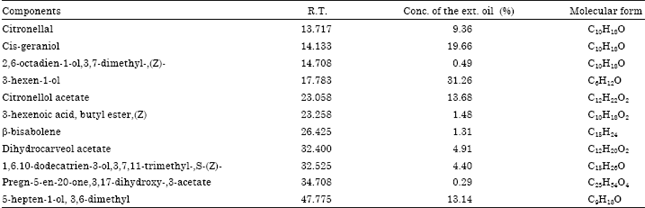
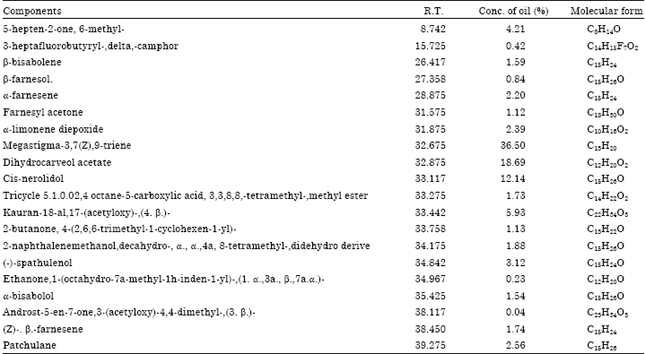
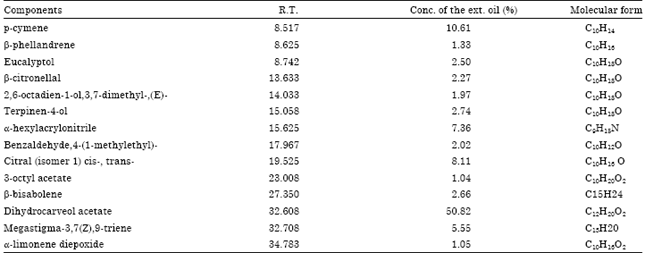
The essential oils were analyzed by gas chromatography/mass spectrometry (GC/MS) and the chemical compositions with their percentage and retention times are present in Table 2-5 of four species under study.
In this respect, Table 2 revealed the major components of the leaf essential oil extracted from E. citriodora. The volatile oils of E. citriodora leaves were fractionated into 11 peaks as revealed by GC/MS. The major components of volatile oil in E. citriodora species were 3-hexen-1-ol (31.26%), cis-geraniol (19.66%), citronellol acetate (13.68%), 5-hepten-1-ol, 2,6-dimethyl (13.14%) and citronellal (9.36 %). Six compounds were found as a minor components (Su et al., 2006; Vahirua-Lechat et al., 2007; Low et al., 1974).
Table 3 revealed the major components of the leaf essential oil extracted from E. camaldulensis. The volatile oils of E. camaldulensis leaves were fractionated into 20 peaks as revealed by GC/MS. The major components of volatile oil in E. camaldulensis species were (4. β.)-(5.93%) and (-)-spathulenol (3.12%). Fifteen compounds were found as a minor components. It was found that these results contradicted with some of the previous results, in the research of Pagula et al. (2000), 1,8-cineole and β-pinene were the major components detected in trees from Mozambique.
| Table 1: | The mean essential oils yields (mL 100 g-1 of dry leaves powder), odors and colors from Eucalyptus investigated species |
 | |
| Table 2: | Chemical composition of the essential oil isolated from leaves of E. citriodora |
 | |
| Table 3: | Chemical composition of the essential oil isolated from leaves of E. camaldulensis |
 | |
| Table 4: | Chemical composition of the essential oil isolated from leaves of E. gomphocephala |
 | |
Akin et al. (2010) mentioned that the major constituents of the essential oil from E. camaldulensis were ethanone (25.36%), eucalyptol (13.73%), β-caryophyllene (11.55%) and carvacrol (9.05%). Also Basak and Candan (2010) reported that the major components of leaf oils of E. camaldulensis were, p-cymene (68.43 %), 1,8-cineole (13.92%), 1-(S)-α-pinene (3.45%) and R-(+)-limonene (2.84%). Difference in the chemical composition of the extracted oils may be due to one of the following reasons:
| • | Nutrients of different soils and their accumulation in the leaves may result in different metabolism and production of different bio-products and different volatile oils |
| • | The change in genes through generations and hybridizations, naturally and induced, may result in production of a variety of volatile oils compared to a nectars or those of different habitat |
| • | Acclimation of species to the environment in which it is growing in the past |
| • | Differences may be due different ecotypes of the species |
| Table 5: | Chemical composition of the essential oil isolated from leaves of E. resinifera |
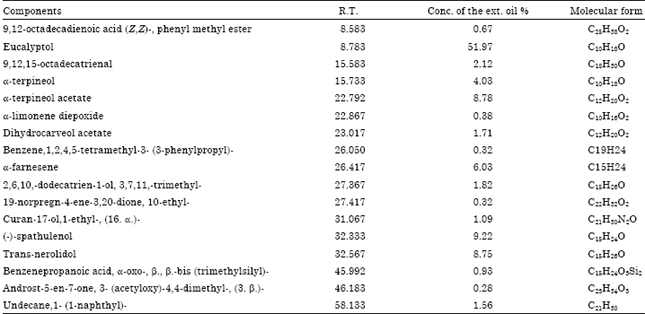 | |
| Conc. of the ext. oil (%) = concentration of the extracted oil (%); R.T. = Retention time (m) | |
Table 4 revealed the major components of the leaf essential oil extracted from E. gomphocephala. The volatile oils of E. gomphocephala leaves were fractionated into fourteen peaks as revealed by GC/MS. The major components of volatile oil in E. gomphocephala species were dihydrocarveol acetate (50.82%), p-cymene (10.61%) and citral (isomer 1) cis-, trans-(8.11%). Eleven compounds were found as minor components. There are no results reports in the chemical composition of the essential oils of E. gomphocephala. In this study, we will find reports for the first time of the analysis of leaf essential oil of this species which growing in Egypt.
Table 5 revealed the major components of the leaf essential oil extracted from E. resinfera. The volatile oils of E. resinfera leaves were fractionated into 17 peaks as revealed by GC/MS. The major components of volatile oil in E. resinfera were eucalyptol (51.97%), (-)-spathulenol (9.22%), α-terpineol acetate (8.78%) and trans-nerolidol (8.75 %). Thirteen Compounds were found as minor components. It was found that these results were agree with findings of Pino et al. (2002). The oil of E. resinifera was found to contain 1,8-cineole as the major constituent.
The reason of this variation may be attributed to that the chemical compositions of essential oils depends on climatic, seasonal and geographic conditions, harvest period and isolation technique.
Correlations between the constituents of Eucalyptus species and their taxonomic relationship, both within the genus and as a part of the Myrtaceae family, have been attempted. Hegnauer, for example, has addressed the issue in his Chemotaxonomie der Pflanzen series (Hegnauer, 1969, 1990). As in natural stands, the oil yields of plantations vary greatly. Factors which affect these yields include: seed provenance and species, soil and nutrient properties, water supply, weather, weeds, pests and diseases (Milthorpe et al., 1994).
The reason of variation between the chemical compositions of oils may be attributed to that the chemical composition of essential oils depends on climatic, seasonal and geographic conditions, harvest period and isolation technique. E. citriodora oil, like citronella oil, has a lemon-like odor and contains citronellal as the principal constituent (Ford et al., 1988). The concept of chemical variants (also called chemical forms or chemo-types) has been based on the existence of discontinuities in the chemical composition of certain eucalyptus oils. However, the development of more sensitive analytical methods, such as capillary GC, has indicated that in some of those cases previously considered to be examples of qualitative variation, the variation was only quantitative, as in E. dives (Hellyer et al., 1969).
CONCLUSIONS
In this study, we extracted the essential oils from leaves of the four species of Eucalyptus trees of E. citriodora, E. camaldulensis, E. gomphocephala and E. resinifera using a hydrodistillation method. A diverse range of yield and chemical composition has been demonstrated by the kind of volatile oils isolated from Eucalyptus species. The yield and chemical compositions of these species have been described above. Such broad differences and the pharmacological profiles provide a stimulus to further research and it is likely that more new compounds will be isolated from an increasing number of Eucalyptus species in the future. The ease of cultivation and rapid growth of eucalyptus makes it, potentially, a very valuable natural resource for the commercial production of pharmaceuticals, over and above the present production of eucalyptus oil for medicinal purposes. It is likely that in the years ahead Eucalyptus metabolites other than the volatile constituents will form part of the armory of drugs available to the physician for the treatment or prevention of human diseases.
ACKNOWLEDGMENT
The authors offer their regards and blessings to all of those who supported them in any respect during the completion of the research.
REFERENCES
- Ahmad, N.R., M.A. Hanif and U. Rashid, 2005. Chemical compositional and intra provenance variation for content of essential oil in Eucalyptus crebra. Asian J. Plant Sci., 4: 519-523.
CrossRefDirect Link - Akin, M., A. Aktumsek and A. Nostro, 2010. Antibacterial activity and composition of the essential oils of Eucalyptus camaldulensis Dehn. and Myrtus communis L. growing in Northern cyprus. Afr. J. Biotechnol., 9: 531-535.
Direct Link - Akin-Osanaiye, B.C., A.S. Agbaji and M.A. Dakare, 2007. Antimicrobial activity of oils and extracts of Cymbopogon citratus (Lemon Grass), Eucalyptus citriodora and Eucalyptus camaldulensis. J. Med. Sci., 7: 694-697.
CrossRefDirect Link - Basak, S.S. and F. Candan, 2010. Chemical composition and in vitro antioxidant and antidiabetic activities of Eucalyptus camaldulensis. Essential oil. J. Iran. Chem. Soc., 7: 216-226.
Direct Link - Bendaoud, H., J. Bouajila, A. Rhouma, A. Savagnac and M. Romdhane, 2009. GC/MS analysis and antimicrobial and antioxidant activities of essential oil of Eucalyptus radiata. J. Sci. Food Agric., 89: 1292-1297.
CrossRefDirect Link - Cowan, M.M., 1999. Plant products as antimicrobial agents. Clin. Microbiol. Rev., 12: 564-582.
CrossRefPubMedDirect Link - De Medici, D., S. Pieretti, G. Salvatore, M. Nicoletti and P. Rasoanaivo, 1992. Chemical analysis of essential oil of Malagasy medicinal plants by gas chromatography and NMR spectrometry. Flavour Fragrance J., 7: 275-281.
CrossRef - El-Ghorab, A.H., K.F. El-Massry, F. Marx and H.M. Fadel, 2003. Antioxidant activity of Egyptian Eucalyptus camaldulensis var. brevirostrisleaf extracts. Food/Nahrung, 47: 41-45.
CrossRefDirect Link - Dadji, G.A.F., J.L. Tamesse and F.F. Boyom, 2011. Adulticidal effects of essential oils extracts from Capsicum annuum (Solanaceae) Piper nigrum (Piperaceae) and Zingiber officinale (Zingiberaceae) on Anopheles gambiae (Diptera-Culicidea), vector of malaria. J. Entomol., 8: 152-163.
CrossRefDirect Link - Gray, A.M. and P.R. Flat, 2001. Antihyperglycemic actions of Eucalyptus globulus (Eucalyptus) are associated with pancreatic and extrapancreatic effects in mice. J. Nutr, 128: 2319-2323.
PubMed - Hellyer, R.O., E.V. Lassak, H.H.G. McKern and J.L. Willis, 1969. Chemical variation within Eucalyptus dives. Phytochemistry, 8: 1513-1514.
CrossRef - Low, D., B.D. Rawal, W.J. Griffin, 1974. Antibacterial action of the essential oils of some Australian Myrtaceae with special references to the activity of chromatographic fractions of oil of Eucalyptus citriodora. Planta Med., 26: 184-185.
PubMed - Milthorpe, P.L., J.M. Hillan and H.I. Nicol, 1994. The effect of time of harvest, fertilizer and irrigation on dry matter and oil production of blue mallee. Ind. Crops Prods., 3: 165-173.
CrossRef - Monfared, A. and M. Ghorbanli, 2010. Composition of the Essential oils of Salvia leriifolia Benth. growing wild in around of two mine in Iran. Res. J. Phytochem., 4: 13-17.
CrossRef - Musyimi, D.M. and J.A. Ogur, 2008. Comparative assessment of antifungal activity of extracts from Eucalyptus globules and Eucalyptus citriodora. Res. J. Phytochem., 2: 35-43.
CrossRefDirect Link - Ogunlesi, M., W. Okiei, E.A.S. Osibote and C. Muotoh, 2009. Antimicrobial activity of the essential oil and the fractional samples obtained from the leaves and seeds of Phyllanthus amarus (Euphorbiaceae). Res. J. Phytochem., 3: 77-84.
CrossRefDirect Link - Ogunwande, I.A., N.O. Olawore, K.A. Adeleke, W.A. Konig, 2003. Chemical composition of the essential oils from the leaves of three Eucalyptus species growing in Nigeria. J. Essent. Oil Res., 15: 297-301.
Direct Link - Okiei, W., M. Ogunlesi, E. Ofor and E.A.S. Osibote, 2009. Analysis of essential oil constituents in hydro-distillates of Calotropis procera (Ait.) R. Br. Res. J. Phytochem., 3: 44-53.
CrossRefDirect Link - Okoh, O.O., A.A. Sadimenko and A.J. Afolayan, 2007. The effects of age on the yield and composition of the essential oils of Calendula officinalis. J. Applied Sci., 7: 3806-3810.
CrossRefDirect Link - Oyedeji, A.O., O.N. Olawore, O. Ekundayo and W.A. Koenig, 1999. Volatile leaf oil constituent of three Eucalyptus species from Nigeria. Flavor Fragr. J., 14: 241-244.
CrossRef - Pagula, F.P., K.H.C. Baser and M. Kurkcuoglu, 2000. Essential oil composition of Eucalyptus camaldulensis Dehn. from Mozambique. J. Essent. Oil. Res., 12: 333-335.
Direct Link - Patra, A.K., 2011. Effects of essential oils on rumen fermentation, microbial ecology and ruminant production. Asian J. Anim. Vet. Adv., 6: 416-428.
CrossRefDirect Link - Pino, J.A., R. Marbot, R. Quert, H. Garcia, 2002. Study of essential oils of Eucalyptus resinifera Smith, E. tereticornis Smith and Corymbia maculata (Hook.) K. D. Hill & L. A. S. Johnson, grown in cuba. Flav. Frag. J., 17: 1-4.
CrossRef - Prasad, K., K. Moulekhi and G. Bisht, 2011. Chemical composition of the essential oil of Pavetta indica L. leaves. Res. J. Phytochem., 5: 66-69.
Direct Link - Sartorelli, P., A.D. Marquioreto, A. Amaral-Baroli, M.E.L. Lima and P.R.H. Moreno, 2007. Chemical composition and antimicrobial activity of the essential oils from two species of Eucalyptus. Phytother. Res., 21: 231-233.
CrossRefDirect Link - Su, Y.C., C.L. Ho, E.I.C. Wang and S.T. Chang, 2006. Antifungal activities and chemical compositions of essential oils from leaves of four eucalypts. Taiwan J. For. Sci., 21: 49-61.
Direct Link - Oyedeji, A.O., O. Ekundayo, O.N. Olawoye, B.A. Adeniyi and W.A. Koenig, 1999. Antimicrobial activity of the essential oils of five Eucalyptus species growing in Nigeria. Fitoterapia, 70: 526-528.
CrossRefDirect Link