

Neha Behar
School of Studies in Biotechnology, Pt. Ravi Shankar Shukla University, Raipur, Chhattisgarh, India
K.L. Tiwari
Department of Biotechnology, Guru Ghasidas Central University, Bilaspur, Chhattisgarh, India
S.K. Jadhav
School of Studies in Biotechnology, Pt. Ravi Shankar Shukla University, Raipur, Chhattisgarh, India
Research Journal of Medicinal Plants
Year: 2013 | Volume: 7 | Issue: 2 | Page No.: 113-118


ABSTRACT
The traditional system of medicine involves the use of different plant extracts or the bioactive constituents for treating various ailments. It is important to establish and compare the phytochemical profiles of lesser known medicinal plant (C. caesia) with the well-known species of the genus (C. longa) for phytochemical similarities or dissimilarity for further drug formulations in this unexplored plant. Thus, this study was conducted which involved soxhlet extraction from leaves and rhizome of both the plant using methanol and chloroform solvents, phytochemical testing for identification of secondary metabolites and thin layer chromatography profiling for presence of curcuminoids. In Curcuma longa, the methanolic extract of rhizome yielded 39.8% while in Curcuma caesia, yield was 6.4%. In Curcuma caesia alkaloids and tannins were found in addition to other metabolites while they were absent in Curcuma longa. In TLC profiling, the rhizome of both the Curcuma species showed presence of curcuminoids while in leaves only methanolic extract in C. longa showed distinctable bands for curcuminoids and in C. caesia, leaves showed only presence of curcumin while dis-methoxycurcumin and bis-demethoxycurcumin was found absent. Presence of medicinally important bioactive compounds in Curcuma caesia depicts that it has great potential for becoming a future drug.
PDF Abstract XML References Citation
Article History
Received: January 14, 2013;
Accepted: May 10, 2013;
Published: July 02, 2013
How to cite this article
Neha Behar, K.L. Tiwari and S.K. Jadhav, 2013. Comparative Phytochemical Screening of Bioactive Compounds in Curcuma
caesia Roxb. and Curcuma longa. Research Journal of Medicinal Plants, 7: 113-118.
URL: https://scialert.net/abstract/?doi=rjmp.2013.113.118
URL: https://scialert.net/abstract/?doi=rjmp.2013.113.118
INTRODUCTION
Plant synthesizes variety of compounds that are produced by various metabolic pathways. These can be broadly distinguished into primary and secondary metabolites. The primary metabolites (carbohydrates, proteins, nucleotides etc.) are essential for growth and development and required for the survival of the plant while secondary metabolites are required for specific functions (resistance against pests, diseases and herbivores or attraction of pollinators) that plays important role in the survival of the plant in its ecosystem. Although about 100,000 plant secondary metabolites are already known, only a small percentage of all plants species have been studied to some extent for the presence of secondary metabolites (Verpoorte et al., 2000). These compounds can be considered as backbone of many of modern pharmaceuticals as the medicinal plants contains specific metabolites which produce a definite physiological action on the human body. The some of the important bioactive compounds present in plants are alkaloids, flavonoids, tannins, glycosides, steroids, saponins, resins and phenolic. The phytochemical study based on ethno-pharmacological information is an effective approach for discovering new drugs from medicinal plants (Duraipandiyan et al., 2006). The genus Curcuma belongs to family Zingiberaceae. This family constitutes rhizomatous and aromatic plants characterized by the presence of volatile oils and oleoresins (Joy et al., 1998). Curcuma caesia Roxb. (Black turmeric) and Curcuma longa L. (turmeric) belongs to same genus but they show marked differences in the colour of their rhizomes, leaves and flowers. Black Turmeric is an important and lesser known medicinal plants used as folklore medicine for the treatment of wounds, cold, cough inflammation, leucoderma, tumors, piles, bronchitis, pneumonia, asthma and rheumatic pains etc. While several studies have also authenticated the use of Curcuma longa as anti-inflammatory, anti-microbial, anti-infertility, anticancer, anti-diabetic, antioxidant, hypolipidemic, anti-venom, anti hepato-toxic, nephron-protective, anticoagulant etc. and also has shown to possess anti-HIV activity and anti-alzheimer. It is important to establish the secondary metabolite profiles of Curcuma caesia and compare it with the well-known species of the genus (C. longa) for phytochemical similarities or dissimilarity for further drug formulations in this unexplored plant. Thus, this study was conducted which involved soxhlet extraction with methanol and chloroform from leaves and rhizome of both the plants, conducting phytochemical tests for identification of secondary metabolites and thin layer chromatography profiling for presence of curcuminoids. Although, such study have already been conducted earlier but the work involving isolation of phytochemicals from both leaves and rhizome of the plants in different type of solvents and the comparison of important secondary metabolites between the two Curcuma species and their TLC profile holds relevance.
MATERIALS AND METHODS
Rhizome and leaves of Curcuma caesia Roxb. and C. longa were collected from the plants sown in the shade house of School of Sciences in Biotechnology, Pt. Ravi Shankar Shukla University. Fully grown rhizomes were harvested at the end of growing period in the month of October and leaves in the September as after that leaves dries and droops off.
Extraction: Fresh rhizomes and leaves were thoroughly washed, cleaned, sliced and dried in the sun for one week and again dried at 60°C in a hot air oven for 6 hours. Dried rhizomes and leaves were cut in small pieces and powdered by electronic mill. About 20 g of sample were taken into a thimble and placed in a soxhlet apparatus with 250 mL of solvents and extracted for 6 h. The solvents used were Methanol (B.P-65°C) and Chloroform (B.P-61°C). After completion of extraction, the extract was cooled, concentrated and dried in water bath and hot air oven and % yield of crude extract from soxhlet was calculated.
Phytochemical tests: The tests were done to find the presence of the active chemical constituents such as alkaloids, glycosides, steroids, flavonoids, saponins, tannin, phenol and resins by the following procedure:
Alkaloid
Wagner’s test: To the 1 mL extract, 2 mL of Wagner reagent (picric acid) was added. The samples were then observed for the presence of reddish colour precipitation.
Cardiac glycoside
Kellar-killani test: To the 1 mL extract, 2 mL of glacial acetic acid and 1-2 drops of 2% ferric chloride was added and then this whole was transferred in another test tube containing 2 mL of concentrated sulphuric acid and observed for a reddish brown coloration at the junction of two layers.
Steroids
Salkowaski reaction: To the extract, 2 mL of chloroform was added and concentrated sulphuric acid was added carefully from the sides of test-tube and red colour in the lower chloroform layer was observed for the presence of steroids.
Flavonoid: To the 1 mL of the filtrate 2 mL of dilute sodium hydroxide is added and golden yellow colour was then observed for the presence of flavonoids.
Tannins: To the extract, few drops of 1% of lead acetate solution was added and looked for yellow precipitate for the presence of tannins.
Phenol: To the crude extract 2 mL of 2% ferric chloride solution was added and black coloration was observed for the presence of phenol.
Saponin: The crude extract was mixed with 5 mL of distilled water and shaken vigorously, stable foam indicates the presence of saponins in the extracts.
Resins: To the crude extract acetone was added and whole solution was poured in the distilled water, turbidity indicates the presence of resins in the extracts.
Thin layer chromatography: Separation of curcuminoids by Thin Layer Chromatography (TLC) was done using TLC plate coated with silica, using chloroform and methanol (95:5) as mobile phase. After development plates were removed and dried and spots were visualized in Ultraviolet light and Retardation Factor values were calculated. The standard curcumin (Himedia) was also subjected to TLC along with the screening samples as co-chromatography. The yellow colored spots developed was calculated with reference to their RF values and tallied with that of the standard curcumin.
Statistical analysis: A completely randomized design with 3 replicates was used for the TLC experiment and mean with standard error was calculated.
RESULTS AND DISCUSSION
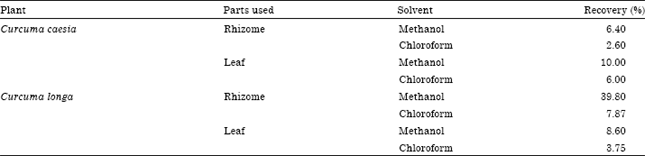
The knowledge of the phytochemical constituents of plants is valuable for authentication of folkloric remedies and is the first step towards studying the medicinal property of the plant. The therapeutic value of Curcuma longa has been well recognized in different systems of traditional medicine for the treatment of various diseases which is attributed due to presence of several phytoconstituents and has been authenticated by many authors, similarly Curcuma caesia has also been used in our traditional Ayurveda system of medicine for inflammation and asthma and by various tribal dwelling in different parts of the country for curing ailments, but it needs to be authenticated by scientific studies. Solvent with opposite polarity (chloroform and methanol) were used for extraction from leaves and rhizome of Curcuma caesia and C. longa. After concentrating each extract, total yield of crude extract was calculated. In Curcuma longa, the methanolic extract of rhizome yielded 39.8% while in Curcuma caesia, yield was 6.4% (Table 1). The choice of solvents for extraction is very important to get optimum yield of the desired products. Various phytochemical tests were performed for different secondary metabolites. In Curcuma caesia alkaloids and tannins were found in addition to other metabolites while they were absent in Curcuma longa (Table 2).
| Table 1: | % recovery of the crude extract from the soxhlet in various solvents from different parts of the plants |
 | |
| Table 2: | Comparative account of Phytochemical tests for different secondary metabolites in the two curcuma species |
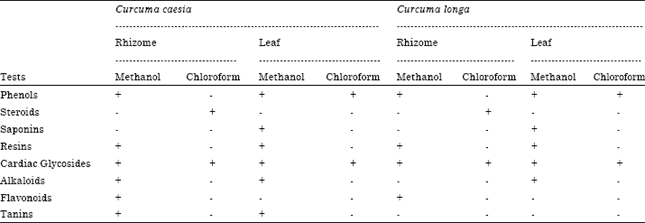 | |
| +: Presence and -: Absence of metabolites in the extract | |
Paliwal et al. (2011) also reported the presence of alkaloids, steroids, phenolics and tannins as the major constituent in successive extracts of rhizome in Curcuma caesia. Curcuminoids (curcumin, de-methoxycurcumin, bis-demethoxycurcumin), volatile oil components from rhizomes and leaves of Curcuma species are very important biologically. In fact, the relative proportion of the different curcuminoids plays a considerable role in optimum bioprotective activity of turmeric (Sasikumar, 2005). Thin-layer Chromatography (TLC) is regularly used for the identification, separation, quantification or semi-quantitative purposes of natural pigments, including curcuminoids, due to many advantageous properties associated with the technique, namely low cost in operation, ease in sample preparation and the availability of several detection systems (Cserhati et al., 2005). Many authors have also stated that the developed TLC method can be a very useful technique for quality control of Curcuma rhizomes (Rohman, 2012). The thin layer chromatography of the extracted curcuminoids was done using chloroform and methanol (95: 5) as mobile phase and RF values were calculated (Table 3). The Retardation Factor (RF) value of standard (Himedia) was 0.95, 0.85 and 0.54 for Curcumin, demethoxycurcumin and bisdemethoxycurcumin respectively. In all the solvents RF values of extracts of rhizome matched with the standard irrespective of the Curcuma species while in leaves only methanolic extract in C. longa showed distinctable bands for curcuminoids while in C. caesia, leaves showed only presence of curcumin (Fig. 1). Revathy et al. (2011) also reported that chloroform: methanol at 95:5 ratios showed better resolution of RF as 0.75, 0.55 and 0.27 for curcumin, de-methoxycurcumin and bis-demethoxycurcumin, respectively.
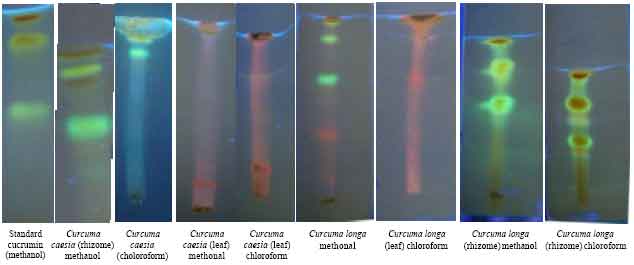 | |
| Fig. 1: | TLC profiling of extracts of rhizome and leaf in chloroform and methanol (95:5) as mobile phase |
| Table 3: | RF values (Mean±S.E) for curcuminoids in different extracts of the plants |
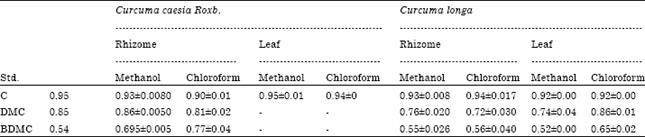 | |
| C: Curcumin, DMC: De-methoxycurcumin, BDMC: bis-demethoxycurcumin | |
TLC analysis of Curcuma caesia rhizome was also done by Sarangthem and Haokip (2010) and they also reported RF values of the three compounds as 0.42, 0.14 and 0.08 in crude extract while in standard RF values were 0.39, 0.18, 0.06 in chloroform and methanol (95:5) as mobile phase.
CONCLUSION
Phytochemical screening of both the Curcuma species revealed that the preliminary phytochemical characterization of the bioactive compounds and its TLC profiling has form the basis that Curcuma caesia holds great promise for becoming a future drug.
REFERENCES
- Rohman, A., 2012. Analysis of curcuminoids in food and pharmaceutical products. Int. Food Res. J., 19: 59-66.
Direct Link - Cserhati, T., E. Forgacs, Z. Deyl and I. Miksik, 2005. Chromatography in authenticity and traceability tests of vegetable oils and dairy products: A review. Biomed. Chromatogr., 19: 183-190.
PubMedDirect Link - Duraipandiyan, V., M. Ayyanar and S. Ignacimuthu, 2006. Antimicrobial activity of some ethnomedicinal plants used by Paliyar tribe from Tamil Nadu, India. BMC Complementary Altern. Med., Vol. 6.
CrossRefDirect Link - Paliwal, P., S.S. Pancholi and R.K. Patel, 2011. Pharmacognostic parameters for evaluation of the rhizomes of Curcuma caesia. J. Adv. Pharm. Technol. Res., 2: 56-61.
CrossRefDirect Link - Revathy, S., S. Elumalai, M. Benny and B. Antony, 2011. Isolation, purification and identification of curcuminoids from turmeric (Curcuma longa L.) by column chromatography. J. Exp. Sci., 2: 21-25.
Direct Link - Sarangthem, K. and M.J. Haokip, 2010. Bioactive component in Curcuma caesia Roxb. grown in Manipur. Bioscan, 5: 113-115.
Direct Link - Sasikumar, B., 2005. Genetic resources of Curcuma: Diversity, characterization and utilization. Plant Genet. Resour., 3: 230-251.
CrossRefDirect Link - Verpoorte, R., R. van der Heijden and J. Memelink, 2000. Engineering the plant cell factory for secondary metabolite production. Transgenic Res., 9: 323-343.
CrossRefDirect Link