

Bassey Udom
Department of Crop and Soil Science, University of Port Harcourt, Rivers State, Nigeria
LiveDNA: 234.14849
ORCID: 0000-0003-3830-5873
Joy Oluchi John
Department of Crop and Soil Science, University of Port Harcourt, Rivers State, Nigeria
Journal of Applied Sciences
Year: 2019 | Volume: 19 | Issue: 4 | Page No.: 360-365


ABSTRACT
Background and Objective: Information concerning moisture properties of soil on account of their direct relation with changes of soil matrix can be obtained by evaluating the Atterberg limits of the soil. The study was carried out to evaluate the influence of five annual applications of poultry manure and spent mushroom substrates on plastic limit and susceptibility of the soil to deformation during cultivation. Materials and Methods: The study was conducted in an experimental plots where different rates of poultry manure and spent mushroom substrates have been applied for 5 years. The treatments were: Control, 5 t ha–1 poultry manure (PM5), 10 t ha–1 poultry manure (PM10), 5 t ha–1 spent mushroom substrate (SMS5), 10 t ha–1 spent mushroom substrate (SMS10) and 5 t ha–1 poultry manure+5 t ha–1 spent mushroom substrate (PM5+SMS5). Results: Results showed that plastic limit, liquid limit and plasticity index varied significantly (p<0.05) due to treatments. Plastic limit was highest (16.65%) in SMS5, followed by PM10 with mean value of 12.48%. Liquid limit showed the highest value of 30.0% in PM10 soil. Saturation water content was significantly (p<0.05) higher in Pm5+SMS5 with corresponding increase in mean weight diameter of aggregates and total porosity. Conclusion: Results revealed that spent mushroom substrate increased optimum cultivation water content while poultry manure increased the susceptibility of soil to deformation during cultivation. Combination of poultry manure and spent mushroom substrates increase stability of aggregates and reduced plastic index.
PDF Abstract XML References Citation
Article History
Received: January 14, 2019;
Accepted: February 20, 2019;
Published: April 22, 2019
Copyright: © 2019. This is an open access article distributed under the terms of the Creative Commons Attribution License , which permits unrestricted use, distribution and reproduction in any medium, provided the original author and source are credited.
How to cite this article
Bassey Udom and Joy Oluchi John, 2019. Plastic Limits and Aggregates of Soil after Five Annual Applications of Poultry Manure and Spent Mushroom Substrate. Journal of Applied Sciences, 19: 360-365.
DOI: 10.3923/jas.2019.360.365
URL: https://scialert.net/abstract/?doi=jas.2019.360.365
DOI: 10.3923/jas.2019.360.365
URL: https://scialert.net/abstract/?doi=jas.2019.360.365
INTRODUCTION
Atterberg limits (plastic limit and liquid limit) have been found to be useful especially in fine-textured soils because it describes the behavior of soil at various moisture contents which may have significant effects on soil properties and tillage operations. Atterberg limits represent the water content where the consistency of a fine-grained soil is transformed from plastic state (plastic limit PL) to a liquid state (liquid limit LL) and from a semi-solid state (shrinkage limit SL) to a plastic state as well as the water content at which different fine-grained soils have an approximately equal undrained shear strength1,2. Although manures have been shown to improve soil properties in many environments, little is known about its effect on Atterberg limits in sandy loam soils3. As the moisture content of the soil increases, the behavior of the soil changes from one state to another. Plastic limit and liquid limit suggest a method of evaluating and defining these changes at various moisture contents4.
The behavior of a soil at optimum cultivated moisture content can be influenced by the application of manure, its dynamic properties such as bulk density and water content at different potentials, as well as inherent properties of the soil5,6. These investigations would lead to understanding of interaction processes on the particle-to-particle scale, mechanisms for aggregation, strengthening and microstructural stability of different soils. It can be used to evaluate the effects of water content, texture, mineralogy, concentration of salts, organic matter content and soil fertility management on these processes7-9. However, the geotechnical properties and field behavior of soil could differ considerably from soils of the same particle size distribution and plasticity characteristics, of the soil due to manure application and consistent manipulation9,10.
Aggregate stability may be used as an indicator to express the ability of soil to sustain mechanical breakdown. It is an attribute that is contingent on the shear strength of a soil, on the amount and forms of organic matter prevalent in a soil, on biochemical composition of plant residues and influence on soils functional properties like soil permeability, susceptibility to surface run off during soil erosion and precipitation event and soil structure8,11.
Application of organic manure has been considered as a valuable source of soil organic matter which enhances soil aggregate stability and soil strength by increasing friction between soil particles In which case, short-term application of organic wastes is not sufficient to explain the effects of manure on forces between soil particles8. However, hitherto, investigation on repeated annual applications of poultry manure and spent mushroom waste had rarely been carried out in some tropical/southern Nigerian soils although these soils are quite different from the relatively well investigated European (temperate) soils10,12. Authors agreed that inorganic fertilizer and biocharaffect microstructure of non-structured soils8,13,14.
The growing interest in understanding the rheological properties in soil research and its changes due to long-term applications of poultry manure and spent mushroom substrate is the major drive of this study. Thus, the main objective of this study was to evaluate the influence of five annual applications of poultry manure and spent mushroom substrate on the behavior of soil aggregates to deformation under certain moisture content. This will help researchers to uncover the critical levels of these organic manures that could be applied alone or in combination to improve optimal cultivation water content.
MATERIALS AND METHODS
Study area, experimental design and treatments: The study was conducted in experimental plots at the University of Port-Harcourt, Teaching and Research Farm (Latitude 4°15N, Longitude 7°15E), where different rates of poultry manure (PM) and spent mushroom substrate (SMS) have been repeatedly applied for 5 years (between March 2013-April 2018) to improve the soil fertility. The experiment involved 6 treatments laid out in randomized complete block design (RCBD) with replications. The land area has previously been cropped to mays (Zea mays L.). The treatments were: the control, without PM nor SMS, 5 t ha–1 poultry manure (PM5), 10 t ha–1 poultry manure (PM10), 5 t ha–1 spent mushroom substrate (SMS5), 10 t ha–1 spent mushroom substrate (SMS10) and 5 t ha–1 poultry manure+5 t ha–1 spent mushroom substrate (PM5+SMS5).
Soil sampling: Bulk and core soil samples were collected from the experimental field at 0-15 cm depth after 5 planting seasons. The bulk samples were air dried at room temperature, sieved through 4.75 and 2 mm sieves and stored in labeled containers for laboratory analysis.
Laboratory analysis
Determination of plastic limit, liquid limit and plasticity index: Plastic limit (WP) was determined using the Casagrande method described by Atterberg15, modified by Casagrande16. The rolling method was used to determine the average moisture content at which the soil crumbled when rolled into thread of 3 mm in diameter. The liquid limit was determined by the one point method and the moisture content was calculated using the equation:
 | (1) |
where, w is water content (%) corresponding to N blows, e is 0.092 for soils having WL<50, 0.12 for soils having WL>50. Average value of 0.1 used for all purposes.
The plasticity index was calculated as the difference between the liquid limit and plastic limit:
 | (2) |
where, Ip is the plasticity index, Wl is the liquid limit and Wp is the plastic limit.
Determination of water stable aggregates and aggregate stability: Aggregate stability was measured using the mean weight diameter (MWD) of water stable aggregates by wet sieving method17. The mean weight diameter (MWD) was calculated by the following equation18:
 | (3) |
where, Xi is mean diameter of each size fraction, Wi is weight of aggregates as a fraction of the total dry weight of the samples.
Determination of saturated hydraulic conductivity and particle size distribution: Saturated hydraulic conductivity was measured by the constant-head permeability test procedure and calculated using the transport Darcys’ equation for vertical flow of liquid19:
 | (4) |
where, Ksat is saturated hydraulic conductivity, Q is the volume of water that flows through a cross-sectional area, A is the cross-sectional area of core, T is the time elapse, L is the length of core and ΔH the hydraulic head difference. Particle size distribution was determined by the hydrometer20.
Determination of bulk density and gravimetric water content: Bulk density was determined by dividing the mass of oven-dried soil at 105°C by the volume of bulk soil. Gravimetric water content at saturation (0 kpa) tension after 24 h was calculated using the equation:
 | (5) |
where, WC is the gravimetric water content, Md is the mass of oven dried soil and Mw is the mass of wet soil.
Soil pH, organic matter, total nitrogen and cation exchange capacity: Soil pH was measured with a glass electrode in a 1:2.5 soil water solution21. Total organic carbon was determined by Walkley and Black wet dichromate oxidation method. Organic matter was obtained by multiplying the organic carbon values by a factor22 of 1.724. Total nitrogen was determined by the modified macro Kjeldahl procedures23. Cation exchange capacity (CEC) was determined by ammonium acetate displacement method.
Data analysis: A two-way analysis of variance (ANOVA) was used to test if the treatments have significant effects on the means of measured parameters. This was followed by multiple comparisons of measured parameters using the SAS Software24. Means were separated according to the least significant difference using Fisher’s protected test at 5% probability25.
RESULTS
Effects on atterberg limits: The effects of five annual applications of poultry manure and spent mushroom wastes on Atterberg limits of the soil are shown in Table 1. Treatments varied significantly in their effects on plastic limit, liquid limit and plasticity index at p<0.05. Plastic limit was highest (16.65%) in SMS5 followed by PM10 with mean value of 12.48%, while value for SMS10 was 10.15%. The least value of plastic limit was found in PM5 (6.85%). However, similar trend was not observed in the liquid limit where PM10 and PM5 had the highest value of 30.0 and 29.5%, respectively, while the least value of 10.2% was found in the control plot. Conversely, SMS5 has the lowest plasticity index of 6.8%, indicating that plastic limit values were some what clustered toward the treatment means.
| Table 1: | Effects of treatment on plastic limit of the soil |
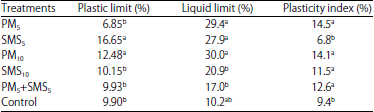 | |
| Means followed by the same letters within the same parameter were not significantly different at p<0.05 | |
| Table 2: | Effects of treatment on aggregate stability and other physical properties of the soil |
 | |
| Ksat: Saturated hydraulic conductivity, BD: Bulk density, WC: Water content, MWD: Mean weight diameter. Means followed by the same letters within the same parameter were not significant at p<0.05 | |
| Table 3: | Effects of treatments on some chemical properties of the soil |
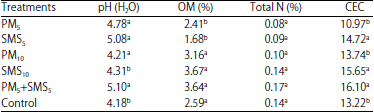 | |
N: Nitrogen, OM: Organic matter, CEC: Cation exchange capacity. Means followed by the same letters within the same parameter were not significantly different at p<0.05 | |
Effects on aggregate stability and other physical properties of the soil: In Table 2, poultry manure and spent mushroom substrate had significant effects on water stability of aggregates measured by the mean weight diameter (MWD) of water stable aggregates and related physical properties. Sand, silt and clay were not altered significantly by the treatments although the inter-layer cementing effects of the manures had significant influence on aggregate stability and soil water content at saturation potential. Saturated hydraulic conductivity was 4.11 cm h–1 for SMS5 and 4.5 cm h–1 for Pm5, indicating a non-significant different among the treatments. The highest value of Ksat (5.75 cm h–1) was found in SMS10 indicating the superior effect of SMS in enhancing soil permeability. Saturation water content was significantly (p<0.05) higher in Pm5+SMS5 with corresponding increase in MWD of water stable aggregates and total porosity. This showed that Pm5+SMS5 improved soil water content and aggregation due to inter-particle organelles.
Effects of treatment on some chemical properties of the soil: The effects of treatment on certain chemical properties of the soil are shown in Table 3. Soil pH, organic matter, total N and CEC varied significantly due to treatments. The PM5+SMS5 lowered the soil acidity (5.1) significantly compared to the control and PM10. This result indicated that the five annual applications of PM10 and SMS10 did not benefit the soil pH and CEC of the soil compared to PM5+SMS5. Soil organic matter (SOM) and total N did not show significant increases for PM10, SMS10 and PM5+SMS5. However, the lowest SOM was found in SMS5 indicating that spent mushroom substrate (SMS) increased C: N ratio of the soil than poultry manure. Values tend to show little disparity in treatment means for pH, SOM and total N.
DISCUSSION
The study revealed that poultry manure and spent mushroom substrate altered the Atterberg limits of the soil, much due to contributions by other factors of the soil which varied according to the type and amount of clay and moisture content26. The quantity of water at the Atterberg limits and other physical properties depended on the pore-water composition of the soil as induced by the applications of PM and SMS27. Although the plastic and liquid limit values were below the critical values28. Plastic limit indicating the optimum water content for tillage was higher in SMS5 soils while the susceptibility of the soil to structural deformation during cultivation as indicated by the liquid limit values was higher in PM10. When compared to the control plots with least value of liquid limit, five annual applications of poultry manure increased has the tendency to induce destruction of soil structure during cultivation.
On the other hand, spent mushroom substrate generally induced greater optimal cultivation moisture content of the soils. The superior influence of SMS over the PM in increasing plastic limit of the soil could be attributable to the free inter-particle and inter-aggregate pore water created by the spent mushroom substrate29,30. Long-term application of poultry manure could lead to increasing clay dispersion index (CDI) and reduced aggregated silt and clay (ASC)31,32.
This was further supported by the highest value of saturated hydraulic conductivity obtained in SMS10 soils. The increased in MWD of water stable aggregate with concomitant increases in saturation water content and total porosity due to PM5+SMS5 confirmed that combination of PM and SMS may be a superior option to improve aggregate stability of sandy loam soils. This is in agreement with previous studies that found improvement in aggregate stability, soil strength and bulk density after application of 5 t ha–1 of cattle manure on a hard setting and crusting chronic Luvisol in South Africa33.
The mean-weight diameter of aggregates is widely used indices to measure macro-aggregate stability of soils probably because of the preponderance of macro-aggregate-size classes over micro-aggregate-size classes in its calculation34. Since saturation moisture content of soil is related to surface area of the soil and the hydraulic conductivity, they could be used to evaluate the Atterberg limits of the soil in this study. Significant improvement of SOM, N and CEC in PM10, SMS10 and PM5+SMS5 further confirmed the important of these manures in improving soil properties35,36.
CONCLUSION
Conclusions drawn from this study are that: Five annual applications of 10 t ha–1 of poultry manure increased the likelihood of structural deformation during cultivation. Spent mushroom substrate increased plastic limit of the soil. Although poultry manure improved soil organic matter, total N and CEC, further application of this manure may lead to mechanical deformation and structural damage. The soil is also considered to be sensitive to mechanical manipulation as well as heavy cultivation. Saturation water content and aggregate stability were positively improved by poultry manure and spent mushroom substrate. The threshold value for bulk density (indication of reduced compaction) was not exceeded due to the manure treatments. This study discovered that 5 t ha–1 of poultry manure, combined with 5 t ha–1 spent mushroom substrate improved optimal cultivation moisture content, reduced structural deformation and increase macro-aggregate-size class.
REFERENCES
- Pertile, P., D. Holthusen, P.I. Gubiani and J.M. Reichert, 2018. Microstructural strength of four subtropical soils evaluated by rheometry: Properties, difficulties and opportunities. Scientia Agricola, 75: 154-162.
CrossRefDirect Link - Gharib, M., H. Saba and A. Barazesh, 2012. An experimental study for identification and comparison of plastic index and shrinkage properties of clay soils with the addition of cement. Eur. J. Exp. Biol., 2: 1034-1038.
Direct Link - Nciizah, A.D. and I.I.C. Wakindiki, 2012. Aggregate stability and strength of a hardsetting soil amended with cattle manure. Afr. J. Agric. Res., 7: 68-73.
CrossRefDirect Link - Haigh, S.K., P.J. Vardanega and M.D. Bolton, 2013. The plastic limit of clays. Geotechnique, 63: 435-440.
Direct Link - Shi, Z.H., F.L. Yan, L. Li, Z.X. Li and C.F. Cai, 2010. Interrill erosion from disturbed and undisturbed samples in relation to topsoil aggregate stability in red soils from subtropical China. Catena, 81: 240-248.
CrossRefDirect Link - Igwe, C.A., 2005. Erodibility in relation to water‐dispersible clay for some soils of Eastern Nigeria. Land Degrad. Develop., 16: 87-96.
CrossRefDirect Link - Markgraf, W., R. Horn and S. Peth, 2006. An approach to rheometry in soil mechanics-structural changes in bentonite, clayey and silty soils. Soil Tillage Res., 91: 1-14.
CrossRefDirect Link - Markgraf, W. and R. Horn, 2007. Scanning electron microscopy-energy dispersive scan analyses and rheological investigations of South-Brazilian soils. Soil Sci. Soc. Am. J., 71: 851-859.
CrossRefDirect Link - Pertile, P., J.M. Reichert, P.I. Gubiani, D. Holthusen and A.D. Costa, 2016. Rheological parameters as affected by water tension in subtropical soils. Rev. Brasil. Ciencia Solo, Vol. 40.
CrossRefDirect Link - Mbagwu, J.S.C. and K. Auerswald, 1999. Relationship of percolation stability of soil aggregates to land use, selected properties, structural indices and simulated rainfall erosion. Soil Till. Res., 50: 197-206.
CrossRefDirect Link - Ishaque, F., M.N. Hoque and M.A. Rashid, 2010. Determination of plastic limit of some selected soils using rolling device. Progr. Agric., 21: 187-194.
CrossRefDirect Link - Wasti, Y. and M.H. Bezirci, 1986. Determination of the consistency limits of soils by the fall cone test. Can. Geotech. J., 23: 241-246.
CrossRefDirect Link - Holthusen, D., M. Janicke, S. Peth and R. Horn, 2012. Physical properties of a Luvisol for different long‐term fertilization treatments: II. Microscale behavior and its relation to the mesoscale. J. Plant Nutr. Soil Sci., 175: 14-23.
CrossRefDirect Link - Ajayi, A.E., D. Holthusen and R. Horn, 2016. Changes in microstructural behaviour and hydraulic functions of biochar amended soils. Soil Tillage Res., 155: 166-175.
CrossRefDirect Link - Kemper, W.D. and R.C. Rosenau, 1986. Aggregate Stability and Size Distribution. In: Methods of Soil Analysis. (Part 1). Physical and Mineralogical Methods, Klute, A. (Ed.). ASA and SSSA, Madison, WI., pp: 425-442.
Direct Link - Klute, A. and C. Dirksen, 1986. Hydraulic Conductivity and Diffusivity. In: Methods of Soil Analysis Part 1. Physical and Mineralogical Methods, Klute, A. (Ed.). ASA and SSSA, Madison, WI., ISBN: 0-89118-088-5, pp: 687-734.
Direct Link - McLean, E.O., 1982. Soil pH and Lime Requirement. In: Methods of Soil Analysis, Part 2: Chemical and Microbiological Properties, Page, A.L., R.H. Miller and D.R. Keeney (Eds.). 2nd Edn., ASA and SSSA, New York, USA., pp: 199-224.
Direct Link - Van der Ploeg, R.R., W. Bohm and M.B. Kirkham, 1999. On the origin of the theory of mineral nutrition of plants and the law of the minimum. Soil Sci. Soc. Am. J., 66: 1055-1062.
CrossRefDirect Link - Prakash, K., A. Sridharan and H.S. Prasanna, 2009. A note on the determination of plastic limit of fine-grained soils. Geotech. Test. J., 32: 342-374.
CrossRefDirect Link - Or, D. and M. Tuller, 2002. Cavitation during desaturation of porous media under tension. Water Resour. Res., Vol. 38.
CrossRefDirect Link - Dexter, A.R. and N.R.A. Bird, 2001. Methods for predicting the optimum and the range of soil water contents for tillage based on the water retention curve. Soil Tillage Res., 57: 203-212.
CrossRefDirect Link - Udom, B.E. and J.K. Adesodun, 2016. Soil penetrating quality in cultivated and forested coastal plain sands of Southern Nigeria. Arch. Agron. Soil Sci., 62: 963-971.
CrossRefDirect Link - Suzuki, L.E.A.S., J.M. Reichert, J.A. Albuquerque, D.J. Reinert and D.R. Kaiser, 2015. Dispersion and flocculation of vertisols, alfisols and oxisols in Southern Brazil. Geoderma Reg., 5: 64-70.
CrossRefDirect Link - Mosaddeghi, M.R., M. Morshedizad, A.A. Mahboubi, A.R. Dexter and R. Schulin, 2009. Laboratory evaluation of a model for soil crumbling for prediction of the optimum soil water content for tillage. Soil Tillage Res., 105: 242-250.
CrossRefDirect Link - Wesley, L.D., 2003. Residual strength of clays and correlations using Atterberg limits. Geotechnique, 53: 669-672.
Direct Link - Blazejczak, D. and J.B. Dawidowski, 2013. Comparison of moisture properties of soils in the context of their susceptibility to compaction with wheels of farm vehicles. Inzynieria Rolnicza, 4: 5-13.
Direct Link - Udom, B.E. and J.O. Ogunwole, 2015. Soil organic carbon, nitrogen and phosphorus distribution in stable aggregates of an ultisol under contrasting land use and management history. J. Plant Nutr. Soil Sci., 178: 460-467.
CrossRefDirect Link