

C.N. Ariole
Department of Microbiology, University of Port Harcourt, P.M.B. 5323, Port Harcourt, Rivers State, Nigeria
LiveDNA: 234.8048
A.A. Onuorah
Department of Microbiology, University of Port Harcourt, P.M.B. 5323, Port Harcourt, Rivers State, Nigeria
H.O. Stanley
Department of Microbiology, University of Port Harcourt, P.M.B. 5323, Port Harcourt, Rivers State, Nigeria
Journal of Applied Sciences
Year: 2019 | Volume: 19 | Issue: 4 | Page No.: 343-348


ABSTRACT
Background and Objective: Siderophores are essential in the extremely iron-reduced environment of the intestine where probiotic bacteria effectively compete for iron. The diversity and antibacterial potential of siderophore producing bacteria isolated from marine fish species from the bight of Bonny at Bonny Island, Nigeria were investigated. Materials and Methods: Bacteria were isolated from intestine of 10 marine fish species: Sleeper (Eleotridae bostrychus), Smooth grouper (Dermatolepsis striolata), Angel fish (Monodactylus argenteus), Tilapia (Tilapia guiniensis), Silver catfish (Chrysichthys auratus), Snapper (Lutjanus gorensis), Grunt (Pomadaysis jubilenie), Barracuda (Kudoa sphyraeni), Mud skipper (Periophthalmus papillo) and Mullet (Mugil cephalus) using spread plate technique. Isolates were screened for siderophore production using Chrome Azurol Sulphonate (CAS) assay and percent siderophore units were determined. Siderophore producers were screened for antibacterial activity against 5 marine pathogens (Escherichia coli, Salmonella sp., Staphylococcus aureus, Vibrio cholerae and Vibrio paraheamolyticus) using agar well diffusion assay. The active strains were identified using molecular method. Results: Seventy four bacterial strains belonging to 13 genera (Pseudomonas, Staphylococcus, Salmonella, Shigella, Vibrio, Bacillus, Klebsiella, Escherichia, Aeromonas, Proteus, Providencia, Morganella and Enterobacter) were isolated from the samples at different frequencies with Staphylococcus and Vibrio predominating. Seven fish species harboured at least one siderophore producer. All siderophore producing isolates inhibited at least one pathogen. Six marine fish species that harboured 10 bacterial isolates belonging to 7 genera which produced siderophore with strong antibacterial potential are Angel fish: Pseudomonas aeruginosa strain ET05, Aeromonas sp. Strain JDMASP8, Morganella morganii strain HX08027 and Vibrio fluvialis strain FSP561/08; Sleeper fish: Vibrio fluvialis strain ATCC33809 and Morganella morganii strain FDAARGOS 172; Smooth grouper: Enterobacter aerogenes A244438.1; Silver fish: Proteus sp. SBP10; Snapper: Providencia stuartii strain S2S and Grunt fish: Aeromonas caviae strain AH07. Conclusion: These organisms and their siderophores can be characterized for use as siderophore genic probiotics for iron nutrition and biocontrol in marine aquaculture.
PDF Abstract XML References Citation
Article History
Received: January 09, 2019;
Accepted: February 02, 2019;
Published: April 18, 2019
Copyright: © 2019. This is an open access article distributed under the terms of the Creative Commons Attribution License , which permits unrestricted use, distribution and reproduction in any medium, provided the original author and source are credited.
How to cite this article
C.N. Ariole, A.A. Onuorah and H.O. Stanley, 2019. Diversity and Antibacterial Potential of Siderophore Producing Bacteria Isolated from Marine Fish Species. Journal of Applied Sciences, 19: 343-348.
DOI: 10.3923/jas.2019.343.348
URL: https://scialert.net/abstract/?doi=jas.2019.343.348
DOI: 10.3923/jas.2019.343.348
URL: https://scialert.net/abstract/?doi=jas.2019.343.348
INTRODUCTION
Diverse bacteria are capable of producing siderophore which is a biological molecule1. Siderophore is the strongest soluble Fe3+ binding agent with extensive application in diverse fields2-4. Membrane receptor molecules which are encoded by 5 genes in operon transport siderophore-free iron complex into the cell. When enough iron has been moved into the cell, operon is then turned off. Iron is implicated in vital life processes5 and in marine microbial diversity regulation6. Iron nutrition is a problem for microbes and siderophore production is the most appropriate help for iron assimilation under aerobic environment7. Hence, siderophores are essential in the extremely iron-reduced environment of the intestine where probiotic bacteria effectively compete for iron8.
According to Balcazar et al.9 the utilization of beneficial bacteria or probiotics that control pathogens via many mechanisms, is more and more seen as a substitute to antibiotic treatment owing to increase in strains that are resistant to antibiotic. Verschuere et al.8 affirmed that antibacterial potential of bacteria is as a result of a number of factors that incorporate the siderophores. Consequently, a constant exploration for intestinal microflora with antimicrobial action and siderophore producing capability is essential.
Information on the diversity and antibacterial activity of siderophore producing fish intestinal bacteria from Nigerian coast is not available. Therefore, in this study, the diversity of bacterial isolates from the intestine of coastal marine fishes capable of siderophore production as well as antibacterial ability of the isolates were examined for additional information, for the first time, to the ecology of coastal marine fish intestinal microbiota in the Niger Delta.
MATERIALS AND METHODS
Sample collection: The following fish samples; Sleeper (Eleotridae bostrychus), Smooth grouper (Dermatolepsis striolata), Angelfish (Monodactylus argenteus), Tilapia (Tilapia guinensis), Silver catfish (Chrysichthys auratus), Snapper (Lutjanus gorensis), Grunt (Pomadaysis jubilenie), Barracuda (Kudoa sphyraeni), Mud-skipper (Periophthalmus papillo) and Mullet (Mugil cephalus) were collected with the aid of local fisherman from the bight of Bonny, in Bonny Island, Nigeria. They were transported to the laboratory for analysis in plastic container containing habitat water.
Source of marine pathogenic bacteria: Marine pathogenic bacteria (Escherichia coli, Salmonella sp., Staphylococcus aureus, Vibrio cholerae and Vibrio parahaemolyticus) were obtained from culture collection in Environmental Microbiology Division, University of Port Harcourt, Port Harcourt, Nigeria.
Bacterial isolation: Healthy live fish samples were killed by hitting hard object on the head, they were cleaned externally with ethanol and their gastrointestinal tracts dissected under sterile condition. Then, 1 g of intestinal contents were homogenized in separate 9 mL of sterile normal saline from which 10 fold serial dilution of each of the sample was carried out using sterile normal saline. Then, 0.1 mL portions of dilutions 10–3 and 10–4 of the samples were plated onto already prepared sterile plates of Salmonella shigella agar, Thiosulphate citrate bile salt agar, mannitol salt agar and Pseudomonas cetrimide agar. Also 10–5 and 10–6 dilutions of the samples were inoculated onto sterile nutrient agar plates and incubated at 37oC for 24 -48 h. Colonies on the culture plates were counted, macroscopically characterized and purified by streaking onto fresh nutrient agar plates. The purified isolates were identified to generic level using their characteristics in terms of morphology, physiology and biochemistry with reference to Bergey’s Manual of Determinative Bacteriology10.
Siderophore production and quantification: The amount of siderophore produced was determined using Chrome Azurol Sulphonate (CAS) agar and CAS assay solutions in cell-free culture supernatant11. CAS agar plates, prepared according to the method described by Chau et al.12, were inoculated with a loopful of 24 h culture of the isolates by streaking the surface. The plates were incubated at 37°C for 48 h and observed for a change in the medium from blue to orange, indicating siderophore production. Iron deficient defined medium (Minimal medium 9), prepared according to the method described by Chau et al.12, were inoculated with pure culture of bacterial isolates. The flasks were incubated at 30°C for 24 h. Cultures were then centrifuged at 6,000 rpm, 4°C for 15 min and then filtered with 0.2 μm pore size filters to obtain cell free culture supernatants. One millilitre of each cell-free culture supernatant was mixed with equal volume of CAS assay solution and 20 μL of shuttle solution (0.2 M 5-sulfosalicylic acid) was added to the resultant mixture and allowed to reach equilibrium. The absorbance of the mixture at 630 nm was measured using spectrophotometer. The minimal medium served as a blank while CAS assay solution plus minimal medium plus shuttle served as a reference (r). The quantity of siderophore produced was then calculated:
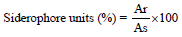 |
where, Ar is the reference absorbance and As is the sample absorbance12.
Determination of the antimicrobial activity of the siderophore producing isolates: All the isolates capable of siderophore production were screened for antagonistic activity against selected marine pathogens such as Escherichia coli, Salmonella sp., Staphylococcus aureus, Vibrio cholerae and Vibrio paraheamolyticus using agar well diffusion assay. Wells measuring 6 mm in diameter were made in plates of nutrient agar seeded with 0.1 mL of 24 h old broth culture of the pathogens. Also 0.1 mL of 24 h old broth culture of the isolates capable of producing siderophore was used to fill the wells. The plates were incubated at 30°C for 24 h. The diameters of the clear zones surrounding the wells were measured and recorded.
Molecular identification of isolates capable of siderophore production: Extraction of genomic DNA of the isolates was done using Zymo Research extraction kit. The DNA concentration and purity were checked in order to know if further dilutions are necessary during PCR using Nano-drop machine. The sub unit 16S rRNA gene amplification was carried out using polymerase chain reaction (PCR) using universal forward primer 27F-5- AGAGTTTGATCCTGGCT CAG -3’ and 1492R 5’-GGTTACCTTGTTACGACTT-3’. The product was resolved on a 1% agarose gel at 120 V for 15 min and visualized on a UV trans illuminator. Sequencing was done using the BigDye Terminator kit on a 3510 ABI sequencer by Inqaba Biotechnological, Pretoria South Africa. The sequence generated were visualized using bioinformatics algorithms such as chromas lite for base calling, Bio edit was used for sequence editing before performing Basic Local Alignment Search Tool (BLAST) using NCBI data base. Similar sequences were downloaded and aligned with Cluster X and phylogenetic tree was drawn with MEGA 6 software13. The evolutionary history was inferred using the Neighbour-joining method14. The bootstrap consensus tree inferred from 500 replicates15 is taken to represent the evolutionary history of the taxa analyzed. The evolutionary distances were computed using the Jukes and Cantor16 method.
Statistical analysis: The result obtained from bacterial enumeration of the coastal marine samples was compared by one-way analysis of variance (one-way ANOVA) and multiple range test to find the differences between the values means at 5% (0.5) significant level. The data were analyzed using IBM SPSS statistics version 20.0 (Gailly and Adler, US).
RESULTS
Bacterial enumeration and isolation: The bacterial loads of marine fish intestinal contents are presented in Fig. 1. The highest aerobic heterotrophic bacterial count was encountered in Mud skipper while Grunt gave the lowest counts of all the bacterial groups enumerated. Table 1 shows the frequencies of occurrence of different bacterial genera associated with the fish species. A total of 74 bacterial species were identified. Examination of the distribution of the isolated bacterial genera showed that the highest diversity was associated with Mud skipper while the lowest diversity was found in Grunt. The bacteria isolated from the samples were predominantly Gram-negative. Bacteria of the genera Pseudomonas, Staphylococcus, Salmonella, Shigella, Vibrio, Bacillus, Klebsiella, Escherichia, Aeromonas, Proteus, Providencia, Morganella and Enterobacter were isolated from the samples at different frequencies with Staphylococcus and Vibrio predominating.
Siderophore production: Bacterial isolates capable of siderophore production and the siderophore units produced are shown in Table 2. Angel fish (Monodactylus argenteus) harboured the highest number of siderophore producing bacteria.
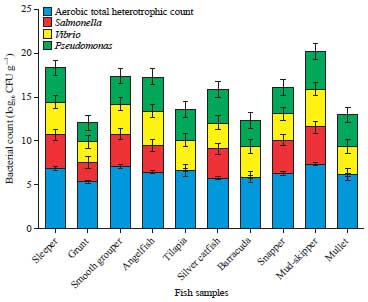 | |
| Fig. 1: | Bacteria loads of marine fish intestinal samples |
| Table 1: | Frequency of isolation of bacterial genera |
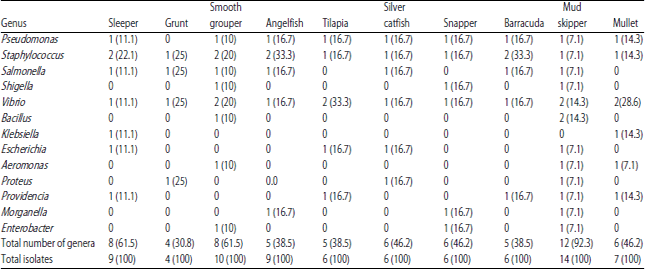 | |
| Numbers in parentheses represent the percentage frequencies | |
| Table 2: | Bacterial isolates capable of siderophore production |
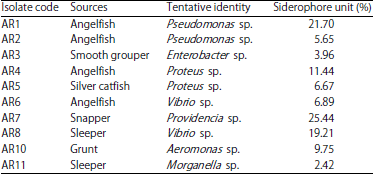 | |
The siderophore units produced by the isolates ranged from 2.42-25.44 as detected by the CAS assay method. Seven out of ten fish species studied haboured at least one bacterial species that produced siderophore. Seven out of thirteen genera isolated produced siderophore. The ten isolates capable of siderophore production were Gram-negative rods.
Antibacterial potential of siderophore producing strains: The antibacterial activities of siderophore producing strains against marine pathogens are shown in Table 3. All siderophore producing isolates inhibited at least one marine pathogen with inhibition zones ranging from 16-21 mm.
Molecular identification of siderophore producing isolates: Table 4 shows the ten isolates that were successfully identified using molecular method and their accession numbers as well as gene bank closest relatives. The siderophore producing strains and the fish species that haboured them are as follows-Angel fish: Pseudomonas aeruginosa strain ET05, Aeromonas sp. Strain JDMASP8, Morganella morganii strain HX08027 and Vibrio fluvialis strain FSP561/08; Sleeper fish: Vibrio fluvialis strain ATCC33809 and Morganella morganii strain FDAARGOS 172; Smooth grouper: Enterobacter aerogenes A244438.1; Silver fish: Proteus sp. SBP10; Snapper: Providencia stuartii strain S2S and Grunt fish: Aeromonas caviae strain AH07.
DISCUSSION
The abundance and diversity of bacterial populations in the gut contents of marine fish species as reported in Fig. 1 and Table 1, respectively are noteworthy. This is because most of the bacteria found in intestinal content and mucus are opportunistic pathogens17. Pond et al.18 proposed that fish digestive tract is a reservoir of many pathogens. The overgrowth of pathogens and the transmission of disease may then break out following a breach of intestinal microflora due to a stressor such as pollution and intensive farming cultivation19. Members of the genera Vibrio17, 20, Pseudomonas21, Aeromonas17,22, Providencia23, Morganella24, Proteus25 and Enterobacter26,27 have previously been detected in the gut of wide variety of fresh and marine fishes. Some strains of these bacteria posses the virulence factors necessary to induce disease28.
Thirteen fish intestinal bacteria produced siderophore (Table 2) indicating their ability to survive and grow in the iron deficient conditions. Chau et al.12 stated that iron is a limiting bioactive metal in seawater and essential for the growth of marine bacteria. Competition for iron is also a possible mechanism for aquaculture probiotics to control the pathogens. Numerous studies have implicated siderophores as bacteriostatic substances produced by Pseudomonas species29,30 and the inhibitory activity of many Pseudomonas strains seemed indeed mediated by siderophores31,32.
| Table 3: | Antibacterial activity of siderophore producing bacterial isolates against marine pathogens |
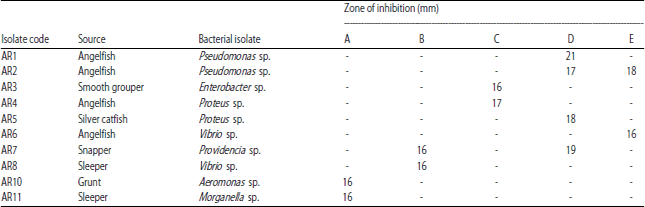 | |
| A: Escherichia coli, B: Salmonella sp., C: Staphylococcus aureus, D: Vibrio cholerae, E: Vibrio parahaemolyticus | |
| Table 4: | Molecular characteristics of the marine fish intestinal isolates capable of siderophore production |
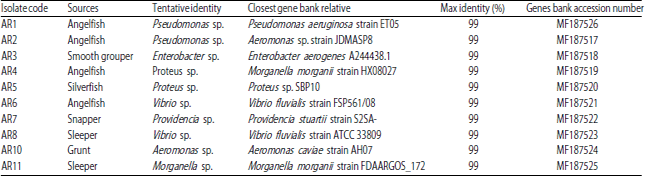 | |
The siderophore producers were found to be antagonistic to at least one marine pathogen tested (Table 3). These novel marine fish intestinal bacterial strains listed in Table 4 will boost the existing literature on ecology of coastal marine fish intestinal microbiota in the Niger Delta. These organisms are different from the ones isolated in Japan by Sugita et al.33 from intestinal tracts of different fish species. Sugita et al.33 identified six bacterial species, Enterovibri norvegicus, Photobacterium leiognathi, Photobacterium phosphoreum, Photobacterium rosenbergii, V. crassostrea and Vibrio scophthalmi as possible candidates for use as probionts in fish aquaculture. The 10 siderophore producing strains with antibacterial ability isolated in this study are novel and have been deposited in gene bank with accession numbers MF187517-MF187526. The indigenous strains will be better adapted to local environment when used for aquaculture than imported strains. These isolates can be antagonistic to the pathogens in the intestine and in marine waters by making iron unavailable for their survival and produce some other antagonistic metabolites consequently leading to the pathogen’s death. Marine micro-organisms are well-known for the production of novel bioactive metabolites (or natural products) which are believed to be a requirement for their survival in the sea to counter acute competition from other species. These metabolites are found to have wide pharmaceutical and biotechnological applications34,35.
CONCLUSION
The study has revealed the existence of siderophore producing bacteria with strong antibacterial potential in the intestine of marine fish species. These organisms and their siderophores can further be characterized for use as siderophoregenic probiotics for iron nutrition and biocontrol in marine aquaculture.
REFERENCES
- Patel, A.K., J.J. Ahire, S.P. Pawar, B.L. Chaudhari, Y.S. Shouche and S.B. Chincholkar, 2010. Evaluation of probiotic characteristics of siderophoregenic Bacillus spp. isolated from dairy waste. Applied Biochem. Biotechnol., 160: 140-155.
CrossRefDirect Link - Hider, R.C. and X. Kong, 2010. Chemistry and biology of siderophores. J. Nat. Prod. Rep., 27: 637-657.
CrossRefDirect Link - Loper, J.E. and M.D. Henkels, 1999. Utilization of heterologous siderophores enhances levels of iron available to Pseudomonas putida in the rhizosphere. Applied Environ. Microbiol., 65: 5357-5363.
Direct Link - Andrews, S.C., A.K. Robinson and F. Rodriguez-Quinones, 2003. Bacterial iron homeostasis. FEMS Microbiol. Rev., 27: 215-237.
CrossRefDirect Link - Kirchman, D.L., B. Meon, M.T. Cottrell, D.A. Hutchins, D. Weeks and K.W. Bruland, 2000. Carbon versus iron limitation of bacterial growth in the California upwelling regime. Limnol. Oceanogr., 45: 1681-1688.
CrossRefDirect Link - Chincholkar, S.B., B.L. Chaudhari, S.K. Talegaonkar and R.M. Kothari, 2000. Microbial Iron Chelators: A Sustainable Tool for the Biocontrol of Plant Diseases. In: Biocontrol Potential and its Exploitation in Sustainable Agriculture, Upadhyay, R.K., K.G. Mukerji and P.C. Chamola (Eds.). Springer, Boston, MA., ISBN: 978-1-4615-4209-4, pp: 49-70.
- Verschuere, L., G. Rombaut, P. Sorgeloos and W. Verstraete, 2000. Probiotic bacteria as biological control agents in aquaculture. Microbiol. Mol. Biol. Rev., 64: 655-671.
CrossRefPubMedDirect Link - Balcazar, J.L., D. Vendrell, I. de Blas, I. Ruiz-Zarzuela, J.L. Muzquiz and O. Girones, 2008. Characterization of probiotic properties of lactic acid bacteria isolated from intestinal microbiota of fish. Aquaculture, 278: 188-191.
CrossRefDirect Link - Payne, S.M., 1994. Detection, isolation and characterization of siderophores. Methods Enzymol., 235: 329-344.
CrossRefDirect Link - Chau, N.T.T., P.H. Quang, P.T.N. Lan, M. Matsumoto and I. Miyajima, 2011. Identification and characterization of Pseudomonas sp. P9 antagonistic to pathogenic Vibrio spp. isolated from shrimp culture pond in Thua Thien Hue-Viet Nam. J. Fac. Agric. Kyushu Univ., 56: 23-31.
Direct Link - Tamura, K., G. Stecher, D. Peterson, A. Filipski and S. Kumar, 2013. MEGA6: Molecular evolutionary genetics analysis version 6.0. Mol. Biol. Evol., 30: 2725-2729.
CrossRefPubMedDirect Link - Saitou, N. and M. Nei, 1987. The neighbor-joining method: A new method for reconstructing phylogenetic trees. Mol. Biol. Evol., 4: 406-425.
CrossRefPubMedDirect Link - Felsenstein, J., 1985. Confidence limits on phylogenies: An approach using the bootstrap. Evolution, 39: 783-791.
CrossRefDirect Link - Jukes, T.H. and C.R. Cantor, 1969. Evolution of Protein Molecules. In: Mammalian Protein Metabolism, Munro, H.N. (Ed.), Academic Press, Cambridge, Massachusetts, ISBN: 9781483232119, pp: 21-132.
CrossRefDirect Link - Wu, S., T. Gao, Y. Zheng, W. Wang, Y. Cheng and G. Wang, 2010. Microbial diversity of intestinal contents and mucus in yellow catfish (Pelteobagrus fulvidraco). Aquaculture, 303: 1-7.
CrossRefDirect Link - Pond, M.J., D.M. Stone and D.J. Alderman, 2006. Comparison of conventional and molecular techniques to investigate the intestinal microflora of rainbow trout (Oncorhynchus mykiss). Aquaculture, 261: 194-203.
CrossRefDirect Link - Hovda, M.B., B.T. Lunestad, R. Fontanillas and J.T. Rosnes, 2007. Molecular characterisation of the intestinal microbiota of farmed Atlantic salmon (Salmo salar L.). Aquaculture, 272: 581-588.
CrossRefDirect Link - Ariole, C.N., H.A. Nwogu and P.W. Chuku, 2014. Enzymatic activities of intestinal bacteria isolated from farmed Clarias gariepinus. Int. J. Aquacult., 4: 108-112.
CrossRefDirect Link - Ariole, C.N. and N.A. Kanu, 2013. Bacterial flora associated with intestine of tropical estuarine fish species. J. Chem. Biol. Phys. Sci., 4: 209-215.
Direct Link - Ariole, C.N., E.O.N. Onwudiwe and G.S.C. Okpokwasili, 2017. Diversity and antibacterial potential of culturable coastal marine bacteria. J. Global Ecol. Environ., 6: 149-159.
Direct Link - Austin, B., 2006. The bacterial microflora of fish, revised. Scient. World J., 6: 931-945.
CrossRefPubMedDirect Link - Zhou, Z., Y. Liu, P. Shi, S. He, B. Yao and E. Ringo, 2009. Molecular characterization of the autochthonous microbiota in the gastrointestinal tract of adult yellow grouper (Epinephelus awoara) cultured in cages. Aquaculture, 286: 184-189.
CrossRefDirect Link - Ariole, C.N. and S.C. Uchegbu, 2016. Assessment of phytase producing ability of marine fish intestinal bacteria and yeasts. Int. J. Mar. Sci., 6: 1-6.
Direct Link - Cahill, M.M., 1990. Bacterial flora of fishes: A review. Microb. Ecol., 19: 21-41.
CrossRefDirect Link - Guerinot, M.L., 1994. Microbial iron transport. Annu. Rev. Microbiol., 48: 743-772.
CrossRefDirect Link - Vijayan, K.K., I.S.B. Singh, N.S. Jayaprakash, S.V. Alavandi and S.S. Pai et al., 2006. A brackishwater isolate of Pseudomonas PS-102, a potential antagonistic bacterium against pathogenic vibrios in penaeid and non-penaeid rearing systems. Aquaculture, 251: 192-200.
CrossRefDirect Link - Gram, L., 1993. Inhibitory effect against pathogenic and spoilage bacteria of Pseudomonas strains isolated from spoiled and fresh fish. Applied Environ. Microbiol., 59: 2197-2203.
Direct Link - Gram, L., J. Melchiorsen, B. Spanggaard, I. Huber and T.F. Nielsen, 1999. Inhibition of Vibrio anguillarum by Pseudomonas fluorescens AH2, a possible probiotic treatment of fish. Applied Environ. Microbiol., 65: 969-973.
Direct Link - Sugita, H., H. Mizuki and S. Itoi, 2012. Diversity of siderophore‐producing bacteria isolated from the intestinal tracts of fish along the Japanese coast. Aquacult. Res., 43: 481-488.
CrossRefDirect Link - Nithya, C. and S.K. Pandian, 2010. Isolation of heterotrophic bacteria from Palk Bay sediments showing heavy metal tolerance and antibiotic production. Microbiol. Res., 165: 578-593.
CrossRefDirect Link