

M.S. Sreekanth
Department of Computer Applications, Bharathiar University, Coimbatore, India
R. Rajesh
Department of Computer Science, Central University of Bihar, Patna, India
J. Satheeshkumar
Department of Computer Applications, Bharathiar University, Coimbatore, India
Journal of Applied Sciences
Year: 2015 | Volume: 15 | Issue: 1 | Page No.: 153-156


ABSTRACT
Forecasting rainfall and thunderstorm is one of the important requirements for planning and management of many applications, including, agriculture, flood and traffic. Considering the relevance and importance of the study, this research study aims at classification of rainfall and thunderstorm. There are various classifiers available but not limited to, Support Vector Machine (SVM), Artificial Neural Network (ANN), K-Nearest Neighbourhood classier (KNN), Adaboost, etc. Recently Dr. G.B. Huang suggested and proposed an efficient classifier based on single layer feedforward Neural Network called as Extreme Learning Machine (ELM) which is extremely powerful to be an Universal classifier. Hence, this study focuses on the classification of rainfall and thunderstorm. The results of the classification using ELM show a classification accuracy of 87.69% which is much better when compared to the results of other classifiers, namely, SVM and ANN. Hence, ELM can be considered as a good classifier for the classification of rainfall and thunderstorm.
PDF Abstract XML References Citation
Article History
Received: August 06, 2014;
Accepted: October 14, 2014;
Published: November 20, 2014
How to cite this article
M.S. Sreekanth, R. Rajesh and J. Satheeshkumar, 2015. Extreme Learning Machine for the Classification of Rainfall and Thunderstorm. Journal of Applied Sciences, 15: 153-156.
DOI: 10.3923/jas.2015.153.156
URL: https://scialert.net/abstract/?doi=jas.2015.153.156
DOI: 10.3923/jas.2015.153.156
URL: https://scialert.net/abstract/?doi=jas.2015.153.156
INTRODUCTION
Weather forecasting is the application of science and technology to predict or classify the weather at a given location. Weather forecasts are made by collecting data about the weather parameters at a given place and applying mathematical models to that data. Rainfall and thunderstorm forecasts are essential for many fields such as agriculture, flood, traffic etc. It helps better planning and management in many applications. Despite the growth of science and technology, rainfall and thunderstorm prediction is still a challenging problem.
The ANN (Sharma and Manoria, 2006; French et al., 1992) based approach is used by several researchers to forecast rainfall successfully. Similar research includes but not limited to thunderstorm forecasting by Ali et al. (2011), Chen and Takagi (1993) study using meteorological satellite images to predict four different rain intensity levels, weather forecasting system by Sharma and Manoria (2006) to forecast rain, thunderstorm, sunshine and dry, daily rainfall simulation to identify the weather types (Cheng et al., 2010).
Extreme Learning Machines (ELMs) proposed by Huang et al. (2006) are universal approximators and can be used for classification. The ELM out performs other machine learning techniques like Neural Network and Support Vector Machines. Hence, by considering the relevance of the prediction of rainfall and thunderstorm and by considering the advantages of ELM, the aim and objective of this study focuses on the classification of rainfall and thunderstorm using extreme learning machines (ELMs).
MATERIALS AND METHODS
Traditional neural networks take initial weights randomly and optimize those values using some iterative methods and hence these methods will lead to local optima and will be slow. Extreme learning machines proposed recently by Huang et al. (2004, 2006) makes use of single hidden layer feedforward networks (SLFNs) in which inputs weights (i.e., the weights of the connection between input layer and hidden layer) are assigned or chosen randomly and the output weights (i.e., the weights of the connection between hidden layer and output layer) are calculated using Moore-Penrose (MP) pseudoinverse.
Suppose there are N known observations:
([xj1, xj2, xj3, … xjP], [tj1, tj2, …, tjQ]), j = 1,2,3, …, N
where, P is the number of input variables, Q is the number of output variables. Then a SLFN can be constructed as shown in Fig. 1.
Then the output of k-th output neuron for j-th observation will be:
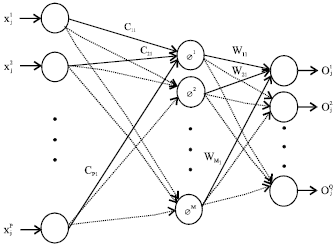 | |
| Fig. 1: | Single Layer Feedforward Network (SLFN) with P input neurons, M hidden neurons and Q output neurons |
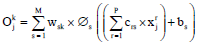 |
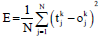
If the transfer functions in all the hidden neurons are same then øS in the above equation can written as ø. Now the problem is to have weights in such a way that the error given by the following equation is minimum:
 |
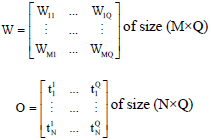
The matrix format for the SLFN can be written as:
O = HW
Where:
 |
and:
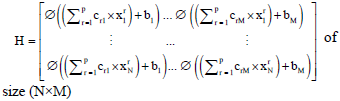 |
Now in ELM (Huang et al., 2004, 2006), the input weights were randomly generated and the output weights were calculated using W = H+ O.
The MP pseudoinverse, H+, can be calculated (Huang et al., 2004, 2006) using any of the equations: (1) (HTH)-1HT (orthogonal projection method), (2) (HTH+λI)-1HT (regularized orthogonal projection method), (3) VΣ+UT, where, V and U are unitary matrices and Σ+ is a diagonal matrix and the values are the inverses of the singular values of H.
Other extended versions of ELM includes but not limited to, evolutionary extreme learning machine (Zhu et al., 2005), convex incremental extreme learning machine (Huang and Chen, 2007), online sequential extreme learning machine (Er et al., 2012). Two of the interesting applications of ELM include illuminance prediction through Extreme Learning Machines (Ferrari et al., 2012) and comparison of short-term rainfall prediction models for real-time flood forecasting (Toth et al., 2000).
RESULTS AND DISCUSSION
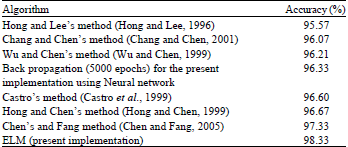
Inorder to show the performance in terms of classification for Extreme Learning Machine (ELM), a benchmarking dataset, namely, IRIS dataset is chosen. The Iris dataset is a multivariate dataset with 150 samples of iris flowers falling in the categories of setosa, versicolor and virginica (fifty instances for each category). The attributes are sepal length, petal length, sepal width and petal width. The total dataset is divided into two and 120 instances are used for training and 30 instances are used for testing. Table 1 shows the results of Iris data classification. It is clear from the Table 1 that ELM outperforms other methods.
Now, in the following, the classification of rainfall and thunderstorm using ELM is shown.
The meteorological parameters for rainfall and thunderstorm predication includes, temperature, dew point (moisture level in air), humidity, sea level pressure (rainfall and sea level pressure are inversely proportional), visibility, wind speed, cloud cover and wind direction degrees. The dataset is collected from www.wunderground.com for the year 2010 at a particular location with 362 samples. This dataset contains real time observations of the weather for a particular period of time at a particular location. There are mainly three classes: (1) Day without rain and thunderstorm, (2) Days with rain or thunderstorm, (3) Days with rain and thunderstorm. The total dataset divided into two, 297 instances used for training and 65 instances used for testing.
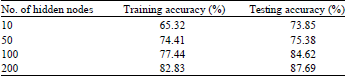
Table 2 shows the results of rainfall and thunderstorm classification using ELM for various numbers of hidden nodes.
| Table 1: | Comparison of IRIS data classification |
 | |
| Table 2: | Rainfall and thunderstorm classification using ELM for various numbers of hidden nodes |
 | |
| Table 3: | Comparative results of the classification of rainfall and thunderstorm |
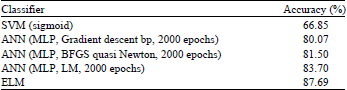 | |
As the dataset for rainfall and thunderstorm classification is not used by anybody in the literature for classification purpose, comparison with existing literature study is very difficult and hence not provided. Hence, the comparison of the dataset for various other classifiers for the classification of rainfall and thunderstorm is shown in Table 3.
The results show that the performance of ELM is highly efficient for the classification of rainfall and thunderstorm. The ELM can also be used as a Universal Classifier for classifying any type of dataset.
CONCLUSION
In this study Extreme Learning Machine (ELM) is used to classify rainfall and thunderstorm. The results are compared with SVM and MLP. The result shows ELM is suitable for weather forecasting and can be considered as an alternative to traditional meteorological approaches for classification.
ACKNOWLEDGMENT
The first and third authors would like to thank Bharathiar University for research support. The second author would like to thank Central University of Bihar for the research support.
REFERENCES
- Ali, A.F., D. Johari, N.F. Nik Ismail, I. Musirin and N. Hashim, 2011. Thunderstorm forecasting by using artificial neural network. Proceedings of the 5th International Power Engineering and Optimization Conference, June 6-7, 2011, Shah Alam, Selangor, 369-374.
CrossRefDirect Link - Sharma, A. and M. Manoria, 2006. A weather forecasting system using concept of soft computing: A new approach. Proceedings of the International Conference on Advanced Computing and Communications, December 20-23, 2006, Surathkal, pp: 353-356.
CrossRef - Castro, J.L., J.J. Castro-Schez and J.M. Zurita, 1999. Learning maximal structure rules in fuzzy logic for knowledge acquisition in expert systems. Fuzzy Sets Syst., 101: 331-342.
CrossRefDirect Link - Chen, S.M. and Y.D. Fang, 2005. A new approach for handling the Iris data classification problem. Int. J. Applied Sci. Eng., 3: 37-49.
Direct Link - Chen, T. and M. Takagi, 1993. Rainfall prediction of geostationary meteorological satellite images using artificial neural network. Proceedings of the International Geoscience and Remote Sensing Symposium, Better Understanding of Earth Environment, Volume 3, August 18-21, 1993, Tokyo, pp: 1247-1249.
CrossRefDirect Link - Er, M.J., L.Y. Zhai, X. Li and L. San, 2012. A hybrid online sequential extreme learning machine with simplified hidden network. IAENG Int. J. Comput. Sci., Vol. 39.
Direct Link - Ferrari, S., M. Lazzaroni, V. Piuri, A. Salman, L. Cristaldi, M. Rossi and T. Poli, 2012. Illuminance prediction through extreme learning machines. Proceedings of the IEEE Workshop on Environmental Energy and Structural Monitoring Systems, September 28, 2012, Perugia, pp: 97-103.
CrossRef - French, M.N., W.F. Krajewski and R.R. Cuykendall, 1992. Rainfall forecasting in space and time using a neural network. J. Hydrol., 137: 1-31.
CrossRefDirect Link - Hong, T.P. and J.B. Chen, 1999. Finding relevant attributes and membership functions. Fuzzy Sets Syst., 103: 389-404.
CrossRefDirect Link - Hong, T.P. and C.Y. Lee, 1996. Induction of fuzzy rules and membership functions from training examples. Fuzzy Sets Syst., 84: 37-47.
CrossRefDirect Link - Huang, G.B., Q.Y. Zhu and C.K. Siew, 2006. Extreme learning machine: Theory and applications. Neurocomputing, 70: 489-501.
CrossRefDirect Link - Huang, G.B. and L. Chen, 2007. Convex incremental extreme learning machine. Neurocomputing, 70: 3056-3062.
CrossRefDirect Link - Cheng, C.S., G. Li, Q. Li and H. Auld, 2010. A synoptic weather typing approach to simulate daily rainfall and extremes in Ontario, Canada: Potential for climate change projections. J. Applied Meteorol. Climatol., 49: 845-866.
CrossRefDirect Link - Toth, E., A. Brath and A. Montanari, 2000. Comparison of short-term rainfall prediction models for real-time flood forecasting. J. Hydrol., 239: 132-147.
CrossRefDirect Link - Wu, T.P. and S.M. Chen, 1999. A new method for constructing membership functions and fuzzy rules from training examples. IEEE Trans. Syst. Man Cybernetics B Cybernetics, 29: 25-40.
CrossRefDirect Link - Zhu, Q.Y., A.K. Qin, P.N. Suganthan and G.B. Huang, 2005. Evolutionary extreme learning machine. Pattern Recognition, 38: 1759-1763.
CrossRefDirect Link