

Cengiz Guler
Department of Forest Industrial Engineering, Faculty of Forestry,Duzce University, 81260 Duzce, Turkey
Yalcin Copur
Department of Forest Industrial Engineering, Faculty of Forestry,Duzce University, 81260 Duzce, Turkey
Mehmet Akgul
Department of Forest Industrial Engineering, Faculty of Forestry,Duzce University, 81260 Duzce, Turkey
Umit Buyuksari
Department of Forest Industrial Engineering, Faculty of Forestry,Duzce University, 81260 Duzce, Turkey
Journal of Applied Sciences
Year: 2007 | Volume: 7 | Issue: 5 | Page No.: 755-758


ABSTRACT
The aim of this study was to determine some chemical, physical and mechanical properties of juvenile wood from black pine (Pinus nigra Arnold) plantations. Black pine, one of the important softwood species covers the most of the plantations in Turkey. Black pines that naturally grow in Duzce were 20-23 years old with the dimensions of 13-17 cm utilized in this study. Specimens were prepared and tested according to Turkish standards. The physical properties were measured and air and oven dry wood densities were found to be 0.464 and 0.431 g cm–3, respectively. The volume weight was 0.383 g cm–3. The radial, tangential and volumetric shrinkage values were 4.05, 6.19 and 10.24%, respectively. The radial, tangential and volumetric swelling values were also found to be 3.69, 7.79 and 11.5%, respectively. The mechanical tests resulted in that the static bending and compression strengths were 79.1 and 42.4 N mm–2, respectively. In addition juvenile wood had higher lignin and lower holocellulose content compared to the mature wood. Conclusively, the physical and mechanical properties of juvenile pine wood examined in this study were observed to be lower compared to the mature pine wood.
PDF Abstract XML References Citation
How to cite this article
Cengiz Guler, Yalcin Copur, Mehmet Akgul and Umit Buyuksari, 2007. Some Chemical, Physical and Mechanical Properties of Juvenile Wood
from Black Pine (Pinus nigra Arnold) Plantations. Journal of Applied Sciences, 7: 755-758.
DOI: 10.3923/jas.2007.755.758
URL: https://scialert.net/abstract/?doi=jas.2007.755.758
DOI: 10.3923/jas.2007.755.758
URL: https://scialert.net/abstract/?doi=jas.2007.755.758
INTRODUCTION
Naturally grown European black pine (Pinus nigra Arnold) covers more than 2 million ha. area and several black pine plantations have lately been established all over the Turkey. To overcome the wood demand, short rotational plantations, shorter forest management periods lately gain importance all over the world. Shorter management periods results in wood including higher rate of juvenile wood. Therefore, knowledge on physical and mechanical properties of juvenile wood is significant to decide the utilization place in the industry.
Juvenile wood a part of the tree occurred in the early growth was usually found in the first 5 to 25 years. The ratio of juvenile wood varies depending on the wood species and wood age (Clark and Saucier, 1989). Juvenile wood found in softwoods and hardwoods and ultramicroscopic structure, chemical composition; anatomical, physical and mechanical properties of juvenile wood vary from mature wood. Juvenile wood is accepted to be a growth defect in wood anatomy and existence of juvenile wood limits the wood utilization due to mostly the working characteristics in industrial applications. The poor wood quality of juvenile wood is particularly reduces the mechanical properties for conifers. Densities of juvenile woods are lower because they contain relatively few latewood cells. Earlywood cells found in a high proportion in juvenile wood have a thin wall layer that is one of the reasons for lower density (Haygreen and Bowyer, 1996).
Ewans et al. (2000) studied the effect of juvenile wood on the mechanical and physical properties of red alder (Alnus rubra). They found that tree growth in the first 10 to 20 years reduced the mechanical strength properties of the tree species.
Göker (1977) studied the properties of mature black pine wood. He obtained test samples from Dursunbey Turkey. The physical properties found to be as follow: density 0.560 g cm–3, oven dry density 0.530 g cm–3, volume weight 0.464 g cm–3, volumetric shrinkage 13.7%. The bending strength and compression strength was found to be 109.6 and 47.9 N mm–2. Also Gunduz (1999) studied the properties of Camiyani black pine wood. He obtained test samples from Yenice Turkey. The physical properties found to be as follow: Density 0.590 g cm–3, oven dry density 0.550 g cm–3, volume weight 0.47 g cm–3, volumetric shrinkage 10.2%. The bending strength and compression strength was found to be 119.9 and 56.93 N mm–2.
This study focused to examine some chemical, physical and mechanical properties of juvenile black pine wood, which has been planted 20 years ago in Duzce-Turkey.
MATERIALS AND METHODS
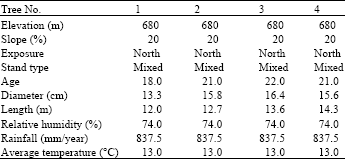
Wood samples have been collected from black pine plantations in Duzce-Turkey. Samples were selected according to the Turkish standards TS 4176 (1984). Table 1 shows the characteristics of the trees and the district that the samples were taken.
Logs were collected from 2-4 m heights of the tree. CuSO4 solution (10%) was sprayed onto cross sections of 1m long green logs in order to prevent staining and the logs were then left for pre-drying for 3 months. Specimens for physical and mechanical properties were also prepared according to TS 2470 (1976) standard. Prepared samples were then conditioned in a conditioning room at a temperature of 20°C and 65±5% relative humidity until the specimens were reached to the equilibrium moisture content of 12% MC (TS 642-ISO 554, 1997).
The physical properties; density of wood (air-dry and oven- dry) (TS 2472, 1976), shrinkage (TS 4083, 1983; TS 4085, 1983) and swelling (TS 4084, 1983; TS 4086, 1983) were tested. The mechanical properties; bending strength (TS 2474, 1976) and compression strength parallel to grain (TS 2595, 1977) were also studied. Static quality values of the samples were calculated (As, 1992).
Samples for chemical analysis were prepared according to Tappi T 257 (Anonymous, 1992). Hollocelulose and-cellulose contents were determined according to the chloride (Wise and Karl, 1962) and Tappi (Tappi T 203) methods, respectively. The lignin (Tappi T 222) and ash (Tappi T 211 om-93) contents were determined. The solubility properties, alcohol-benzene (Tappi T 204), cold and hot-water (Tappi T 207) and 1% NaOH (Tappi T 212) were also measured. The analysis of variance (ANOVA) and Duncan mean separation tests were performed to evaluate the observed results.
| Table 1: | The characteristics of the test areas and trees |
 | |
RESULTS AND DISCUSSION
The chemical properties of back pine juvenile wood are given in Table 2. Juvenile wood had higher lignin and lower holocellulose content compared to the mature wood. The extractive content of juvenile wood was also found to be lower than mature wood. On the other hand, hot and 1% NaOH solubility values were found to be lower for juvenile wood.
Table 3 displays the density (air-dry, oven dry and weight in volume), shrinkage and swelling (radial, tangential and volumetric) values observed in this study. Density (air-dry and oven-dry) of the juvenile wood was compared to the mature black pine wood and the result indicated that the density of the juvenile wood was almost 20% (relative percentage) lower. In addition, juvenile wood had lower weight in volume than mature wood measured by Göker (1977). Lower density values in juvenile wood are expected because juvenile wood contain lower amount of latewood cells having thin cell walls.
When the volumetric shrinkage and swelling properties were examined (Table 3), the juvenile wood gave relatively lower values for both properties compared to the mature wood (Bozkurt and Erdin, 1997). The volumetric shrinkage and swelling properties are affected by several wood factors such as heartwood-sapwood ratio, fibrillar angle on S2 layer etc (Bektaş and Guler, 2001). The most important parameter effecting wood shrinkage and swelling is the wood density, mature wood having higher wood density held higher amount of water and resulted in higher wood shrinkage and swelling.
Table 4 shows the mechanical properties of the black pine juvenile wood. Based on wood classification (Bozkurt and Erdin, 1990), black pine juvenile wood was classified as fair based on compression strength and low based on bending strength. Compression and bending strength of pine juvenile wood were measured in this study stayed between 35-55 and 50-85 N mm–2 for both properties, respectively.
| Table 2: | Chemical composition of Black Pine (% of oven-dry wood) |
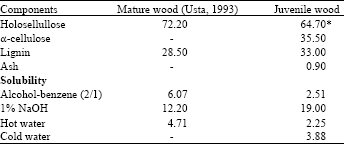 | |
| *Mean values are the average of duplicate measurements | |
| Table 3: | Values of air dry density (D12), oven dry density (Do), weight in volume (R), radial (r), tangential (t) and volumetric (V) shrinkage and swelling |
 | |
| Table 4: | The mechanical properties of juvenile wood Black Pine (Pinus nigra Arnold)a |
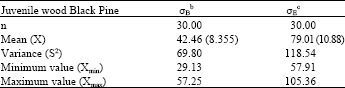 | |
| aValues in parentheses are the standard deviation of means; n denotes sample size; MC at test was 12%, bCompression strength parallel to grain (N mm-2), cStatic bending strength (N mm-2) | |
| Table 5: | Compression strength parallel to the grain (σB), Static bending strength (σE) and Static quality value (St) |
 | |
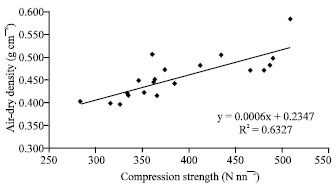 | |
| Fig. 1: | The relationship between compression strength and air-dry density |
The measured strength properties indicated that juvenile wood had lower compression and bending strength compared to the mature black pine wood (Table 4 and 5). Low density softwoods, such as black pine, can be classified as low, fair and good quality according to their static quality value. Static quality value higher than 8 is accepted to be good in quality for conifers (As, 1992). In this study, the calculated static quality value 8 wood quality for black pine juvenile wood.
Figure 1 and 2 shows the relationship between air dry density and compression and bending strengths. Results indicated density and strength values have a strong relationship. Coefficients of variations were observed to be R2 = 0.63 for density and compression strength and R2 = 0.60 for density and bending strength.
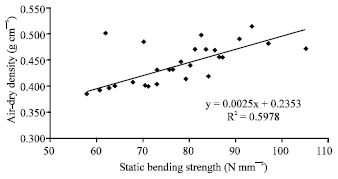 | |
| Fig. 2: | The relationship between static bending strength and air-dry density |
CONCLUSIONS
Juvenile wood had higher lignin and lower holocellulose content. The extractive content of juvenile wood was found to be lower compared to the mature wood. Juvenile wood had lower wood density. In addition, swelling and shrinkage properties were observed to be lower compared to the mature wood. Therefore juvenile wood works less than mature wood as the surrounding relative humidity varies. The mechanical properties of black pine juvenile wood was observed to lower compared to the black pine mature wood. Industries requiring high wood strength should not be utilized juvenile wood. On the other hand, black pine juvenile wood should be considered to be utilized in pulp-paper and board industries.
REFERENCES
- Bektas, I. and C. Guler, 2001. Determination of some physical properties of beech wood (Fagus orientalis Lipsky) from Andirin Region. Turk. J. Agric. For., 25: 209-215.
Direct Link - Evans-II, J.W., J.F. Senft and D.W. Green, 2000. Juvenile wood effect in red alder: Analysis of physical and mechanical data to delineate juvenile and mature wood zones. For. Prod. J., 50: 75-87.
Direct Link