

Irfan Chaudhuri
Department of Education, Colby College, Maine 04901, United States of America
LiveDNA: 1.42711
ORCID: 0000-0002-0486-0038
Mark Tappan
Department of Education, Colby College, Maine 04901, United States of America
Md. Shahidul Islam
Department of Mathematics, University of Dhaka, Dhaka 1000, Bangladesh
Journal of Artificial Intelligence
Year: 2023 | Volume: 16 | Issue: 1 | Page No.: 1-11


ABSTRACT
The intersection of Artificial Intelligence (AI) and education will continue to grow and evolve as data science continues to integrate itself into all sectors. To believe that AI won’t have an influence on education would be naive. The AI in education is one of the fields that is expanding the most in current times. Although, educators are still trying to find the best way to use AI for pedagogy on a larger scale, it can have a profound impact on teaching and learning in higher education. The advantages and disadvantages of artificial intelligence in education and how it impacts society were discussed. This paper will discuss the application of artificial intelligence in education. It will go through some of artificial intelligence’s educational uses. The paper also discusses the current personalized learning system, smart material consumption, the pervasive uses of AI and how these have been used to benefit student needs, focusing on the context of the United States of America. This paper concludes by emphasizing the difficulties that AI-based educational system has encountered so far and the potential for AI in the educational field.
PDF Abstract XML References Citation
Copyright: © 2023. This is an open access article distributed under the terms of the Creative Commons Attribution License , which permits unrestricted use, distribution and reproduction in any medium, provided the original author and source are credited.
How to cite this article
Irfan Chaudhuri, Mark Tappan and Md. Shahidul Islam, 2023. Impact of Artificial Intelligence on Education: Present Realities and Future Considerations. Journal of Artificial Intelligence, 16: 1-11.
DOI: 10.3923/jai.2023.1.11
URL: https://scialert.net/abstract/?doi=jai.2023.1.11
DOI: 10.3923/jai.2023.1.11
URL: https://scialert.net/abstract/?doi=jai.2023.1.11
INTRODUCTION
Education is dynamic and evolving, especially in this day and age where the internet and technology are becoming more integrated into education. The evolvement of education in the present day is moving further towards the immersion of technology, specifically AI, into the education sector. Artificial Intelligence (AI) represents the theory and development of intelligent machines that are able to perform tasks that near human-level intelligence, this includes computer vision, speech recognition, recommendation engines, machine learning, deep learning and data personalization1. The AI is prevalent throughout our lives today. It is responsible for suggested content on popular websites such as YouTube to Apple’s Siri and the emergence of self-driving cars. These applications of AI have enabled scientists to come up with technologies that stimulate and replace human intervention in industry settings.
The fast development of new technologies is altering education and presents a vast realm of possibilities for the future. If the history of technology is considered and the integration of the internet into our lives, we can see some parallels to the field of education. The internet has made previous concepts such as libraries, letter mail and face-to-face interactions with others a thing of the past. When a student needs to research something he will first look to online databases instead of going to the library. If a person needs to be contacted they will send an email and if a person wishes to interact socially they will log into their Facebook or Instagram pages. Indeed, the internet and integration of technology into our lives have changed the status quo of what we thought to be “normal” or convention. Thus, why should we assume that the integration of technology and specifically AI, should be any different?
The relationship between technology and education is multidimensional and can assist both teachers and students alike. The AI can be integrated into classes to provide additional study materials for students, personalizing individual learning2,3. The AI can also help teachers by freeing up their time in helping design lectures, grading exams and even sending out emails on the instructors’ behalf4,5. The teacher’s assistant role is heading towards a transition to an AI-based algorithm versus a human assistant. Thus, creating technologies that complement pedagogical efforts is necessary and pivotal as this will result in overall benefits for students and teachers alike6. Educational technologies will also assist disadvantaged students who suffer from a lack of resources, by increasing these student’s performance through access to computers and the Internet which promote personalized learning7-9.
This paper will focus on educational sectors on which AI has an impact and look specifically at the role of AI systems in the context of the United States. It will focus on Personalized Learning, Smart Content Creation, Universal Access, Task Automation and 24/7 Assistance. Lastly, the paper will also discuss how AI is bringing changes in these specific areas and how AI will become a useful tool that will become more prevalent and useful for teachers and students in the near future.
EFFECTS OF AI ON EDUCATION SECTORS
As technology continues to develop so does the integration of AI. The AI is already prevalent in our society and is continuing to grow as technology develops. As AI technology evolves so will its integration into the education sector. Companies such as Amazon, Google and Facebook recently contributed $25 million to the creation of artificial intelligence education (AIED) products1. They join other well-known, multimillion-dollar-funded AIED businesses like Knewton and Carnegie Learning. Increased awareness about the importance of technology and education has led to worldwide initiatives such as the “Global Learning XPRIZE”. The XPRIZE challenged teams to develop openly available software that would and encourage children to teach themselves basic reading, writing and math in less than 15 months with a $15 million prize for the winner9. Initiatives such as the XPRIZE demonstrate the opportunity to increase educational attainment worldwide and help alleviate the disparity of resources and access that many students struggle with.
The AI is also being incorporated into curriculums in some traditional schools to provide more personalized help to students via online tutoring. It is also being researched as a tool to enhance teacher preparation6. The market for AI in educational contexts is expected to be worth $6 billion by 2024, demonstrating the increasing demand and outlook for these technologies4.
The paper will go on to further discuss the educational areas where AI is making a significant impact in the field including: Personalized Learning, Smart Content Creation, Universal Access, Task Automation and 24/7 Assistance.
PERSONALIZED LEARNING
The process of personalized learning in software comes from the utilization of data mining, big data and associated technologies to customize education to a specific student or classroom. Here, educational data mining (EDM) and learning analytics are emphasized as the primary data resources for personalization in the education industry to generate the algorithms for personalized learning systems.
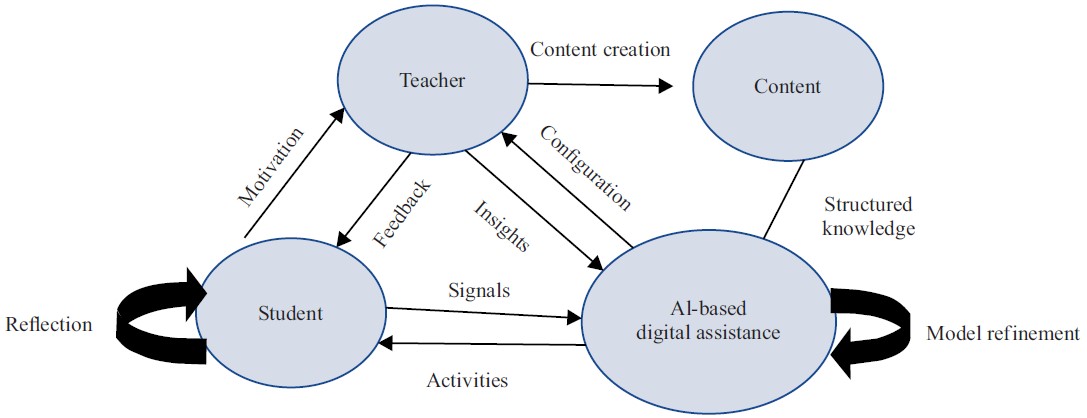 |
| Fig. 1: | Interaction between a teacher, an AI-based app and a student |
The EDM primarily focuses on creating algorithms to comprehend the learning environment better and create more accurate predictions about what students need to learn better10. The more data that the AI system has about the student the better the system will be at predicting the appropriate resources to allocate to the student for better comprehension of the material11. Learning analytics also primarily addresses the issue of how to employ those machine learning algorithms in AI, effectively12. The EDM and AI have seen significant success in recent years as the data available to the resources continues to grow, giving more opportunity for appropriate matching of relevant information to the student. Future steps of this process are to examine the data for patterns to create prediction models that help teachers choose the best learning options for each student’s learning style. There are increased opportunities for employing AI in the industry due to the increased use of Big data, EDM and learning analytics in education4.
We will likely see a shift towards the use of AI due to two crucial recent developments in learning analytics13. The first is the digital display of instructional and evaluation processes versus the typical pen and paper method. Assessment tasks are particularly benefiting from far higher degrees of machine automation and processing than were previously feasible. The second development is that students now have more access to smart devices. These devices can offer data for a better understanding of the context and usage habits of the student. More crucially, these developments have produced a far increased amount of data that can be obtained using AI algorithms. A teacher-digital assistant symbiosis can give the pupils a more significant learning experience. It must be recognized that AI systems are not at the level where they will be able to replace a teacher fully in the classroom. Rather, the AI system will alleviate pressure on the teacher to provide personalized time and allocate specific resources to each student. Thus, with the help of the AI system, teachers will be able to provide the most support to their students.
Figure 1 depicts the interconnection between the student, teacher and the AI-based software assistance system. Initially, the teacher is the one who creates the content of the course. This can extend from primary school education all the way up to university level learning and can also extend through a broad range of subjects from the Sciences to Humanities and even the Arts. Ultimately, though, it is up to the teacher to decide what material and at what level they would like to include in the AI system for the students to learn. This decision remains independent of the teacher and is not determined by the AI system. The AI system is rather, involved with providing supplementary information and providing additional, personalized help, to the student. This process is especially helpful for teachers who deal with a large number of students and finding time to provide individual support is difficult. This iterative cycle continues with the frequent interaction of all components of the model: The teacher, student and AI system.
The AI presents a potential solution to the high teacher-to-student ratio and aid to under-resourced schools that teachers must cope with and work through. In the context of rural Alabama, United States, AI has helped an underprivileged and under-resourced school with a low student to teacher ratio, increase their educational attainment scores. This Alabama School has seen a 15% increase in student reading proficiency after integrating AI into the classroom14. The AI presented a successful alternative to increasing teachers staffed in the school. Due to budget constraints, many schools are often not able to hire new faculty or teaching assistants. Thus, the AI alternative was a successful way in which students could get more personalized learning opportunities while schools would not have to invest in hiring new teachers. Rather, these schools could allocate resources to downloading AI software that can be installed on all computers in the respective school. A much cheaper, but nonetheless successful, alternative to improve student learning. The AI-based education systems can be used to help ease the burden of teachers who have large class sizes and are unable to provide personalized learning. The integration of AI into classrooms can be used across the globe to lessen the disparity of educational equity.
The AIED also differs from human teachers who must be present in a physical space to teach students. A prime example of an online teaching system is Khan Academy. The Khan Academy is a prominent online free learning tool that can be used by students worldwide. The system allows for the learning of a broad range of subjects primarily taught by founder Salman Khan. Anyone may learn using these technologies from any location in the world at their convenience. Again we see that through the increased use of technologies and AI, the disparity in educational equity is declining.
Effectiveness of personalized learning system on the education system: Personalized learning systems or environments (PLS/Es) have been shown to improve e-learning experiences and facilitate interactions15-17. In two semesters of computer programming classes, 110 undergraduate students participated in study on PLS’s impacts. The study showed that the PLS system assisted students in achieving their desired learning objectives and improved their educational experiences17. In a different research study, from researchers Kose and Arslan17 discovered that tailored mobile learning using AI and augmented reality (AR) enhanced both the learning process and the results of open computer education. It is continually shown through research that highly personalized learning will help students succeed and AI technologies can help in the matter.
Statistical record of online education market: Statistics further demonstrate the increased role of personalized learning and the online education market in AI an education. The graph below shows the increased amount of revenue that goes to the online education market in China. The online education market is indeed a tool that is becoming increasingly pervasive in our society today and critical events such as the COVID-19 pandemic have shown the ease and effectiveness of such online platforms for learning. An example of an online learning education tool is Coursera which utilizes personalized learning. Coursera uses a personalized learning method where they utilize AI to make different courses via analysis of students wants and needs. They then able to provide the student with a personalized learning space18.
Figure 2 shows that increase in the revenue of the online education market, demonstrating the increase in pervasive use of eLearning technologies and potential for further growth in the field. Over just 3 years from 2018 to 2021 the revenue of the online education market has nearly doubled from 252 to 457 Yuan19. The increases in revenue of online courses and the online education market demonstrate how widely accepted online learning is becoming.
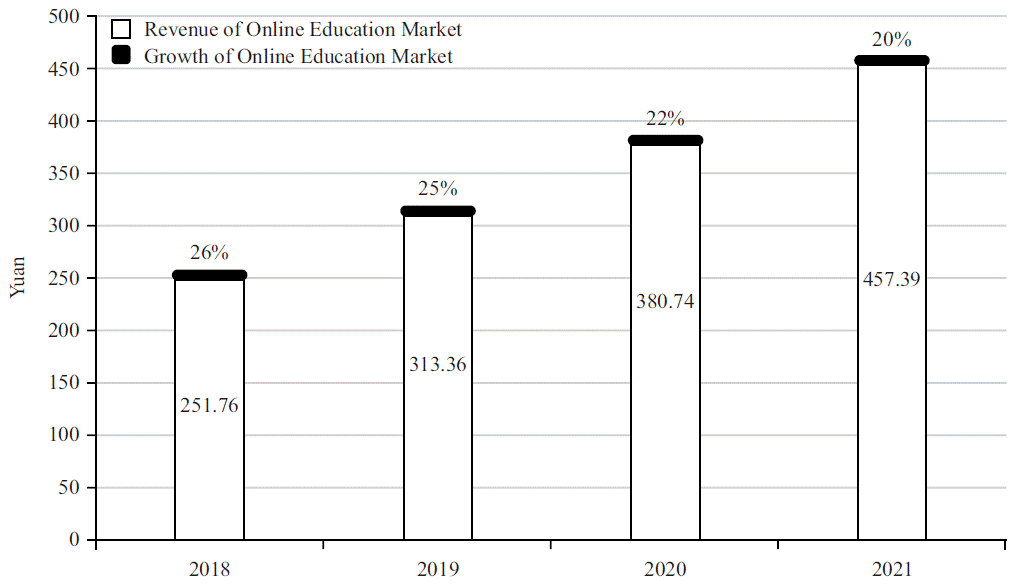 |
| Fig. 2: | Revenue of China’s Online Education Market in Billions of Yuan19 |
The COVID-19 pandemic shifted the way in which students and resulted in a paradigm change in the way we view the education system. Once it was believe that to learn a student had to go to a physical classroom and location. Contrarily, now we know that learning can take place anywhere as long as a student has a laptop and internet access. This has increased the need and potential of the online education market which were demonstrated in Fig. 2. This figure also shows slow decline in the growth of the online education market, such a trend is not seen for the growth of AI in the classrooms. Rather we see an exponential growth for the potential of AI to be used in the classroom and to be used be students and teachers alike1. Increases in online course enrollment are a reflection of how widely accepted online learning is becoming, including an increase in the number of remote students enrolling in higher education programs and students from underserved or rural areas.
SMART CONTENT CREATION
The days of all class material being only in books and recorded via class lectures are changing. Now, with the help of AI, many of the learning materials can be digitized and turned into smart content. The AI has the ability to create course material that is converted to digital format and content can be updated to fit the most recent scientific findings or historical discoveries via AI technology further revolutionizing the education system and changing it for the better. Course material can be supplemented by AI recommended course content and additional websites and online resources1.
Digital courses: Within digital learning, AI has produced study materials, digital textbooks and E-learning platforms that use AI, i.e., Coursera and Udemy, to make personalized courses so that all students can take their desired courses and learn from those platforms6.
Updating content knowledge: AI allows for the updating of course material which allows for the most recent content for students to learn about. Currently, some textbooks may be out of date and teacher’s information may not represent the most recent knowledge. Integration of AI will make this issue obsolete through access to fully updated online materials via the internet.
Individualized and differentiated instruction: Individualization of learning is a method that educators and schools have continually strived to achieve. For years, schools have prioritized tailoring instruction to meet the unique needs of each student. However, AI enables levels of differentiation and personalization that would be hard for instructors to achieve if they had a large number of students in each class. The AI is able to detect student knowledge gaps and aids students by employing smart content development based on student needs. The AI systems are designed to have the same course in different formats for individual students depending on their understanding level and shift focus to new topics, when necessary. As AI continues to develop, it is feasible that the system would be able to recognize the expression on a student’s face that shows confusion in understanding a concept and adjust a lesson accordingly. Currently, it is not practical for a regular educational system to personalize the curriculum to each student’s needs. Contrarily, AI-powered robotic assistants are capable of doing so by using the appropriate context.
UNIVERSAL ACCESS
The AI based products allow for more equitable access to resources which promotes use and helps students from all socioeconomic backgrounds. This includes those students who are disabled and require special education15,20. It also provides access to those students who face a language barrier in education. New AI based programs are allowing for students to get subtitles for what the teacher says during class lectures. This can decrease the language barrier that students may face and it also creates new learning opportunities for students who require a different level of instruction, ultimately providing a more equitable environment for all students6.
Use of universal access in the education sector: The AI will allow for the burden of simple tasks of teachers to be replaced by the AI system. Examples include grading tests and homework taking up a lot of a teacher’s time: AI can now intervene and finish up these jobs quickly while also making suggestions on how to fill in the learning gaps for students. In addition to already being able to grade multiple-choice exams, AI is getting close to being able to evaluate written replies to exams and homework. The AI replaces administrative work with automation, thereby giving teachers more time to spend with each student.
A key part of universal access is all people being able to understand the material in their own language. For example, it is difficult for native Spanish speakers to learn in a class that is all in English. The AI software also now exists which automatically translates a statement from one language into another. Language translation software is used to describe mechanically converting a statement from one language into another. Machine translation software, generally speaking, can be conceived of as working in various stages21:
| • | Speech recognition software that turns human speech into text such as Presentation Translator |
| • | Linguistic software examines this text in the source language to determine its syntactic structure |
| • | Result is a semantic representation of the statement that captures its intent |
| • | A semantic representation of the information content that each output sentence (which will be created in the target language) should include is produced |
| • | Each sentence’s syntactic structure is identified (e.g., the software plans the verb, subject and object of each sentence). For every sentence, a text string in a written language is generated |
A prime example of translation software is Google’s product of Google Translate. A free software that is available online through Google allows for the translation of material from a detected language into the one of interest. This can be done through recording processes or typing in the information that one wishes to be translated into another language.
Certainly, artificially intelligent systems would be very beneficial to everyone. Every student from every country speaks a distinct language, yet the effect of the native tongue is also quite strong. An American Tutor’s English is sometimes difficult for someone from a foreign country to grasp. Artificial intelligence can assist them in overcoming this barrier by allowing them to modify the same idea. Artificial intelligence can adapt the lectures to each person’s specific linguistic needs, for example, their native language, because some people prefer to learn things in their native tongue22. Figure 3 shows how the AI-Based Universal Access higher education system works.
The AI has the potential to greatly benefit special needs students. Students who must communicate through sign language will benefit from AI systems that are able to interface and identify sign language. The AI can also be used to the text of sign users into sign language. This presents a great benefit to deaf sign language users. For a computer to recognize the meaning of a user’s signing and translate it later into text or voice, sign recognition, an AI-based system, aims to automatically transform a human signer’s performance into a computational representation. These technologies have been studied to meet the need to make it easier for signers and non-signers to communicate. They also give computers an alternate method of receiving natural language input. While, specific sign languages have been the focus of some efforts, this technology is easily adaptable to a wide range of sign languages due to the statistical nature of the majority of this field’s research23.
The AI will help to remove the bias of teacher grading, making the AI-based universal access more equitable. It is well known by students that teachers may favor certain students in the class or another teacher is an easier grader than another. The AI systems take this human bias out of the equation as it is the AI software-based systems that will be doing the grading. The AI-powered universal access can considerably aid in semi-automation marking in all subject fields, particularly STEM. Instead of assessing hundreds of calculus entries, for example, an AI tool is far more appropriate for the job since it groups similar answers so they may all receive the same grade at once3. Gradescope, Graide or the Mobius platform are a few examples of software created specifically for this purpose.
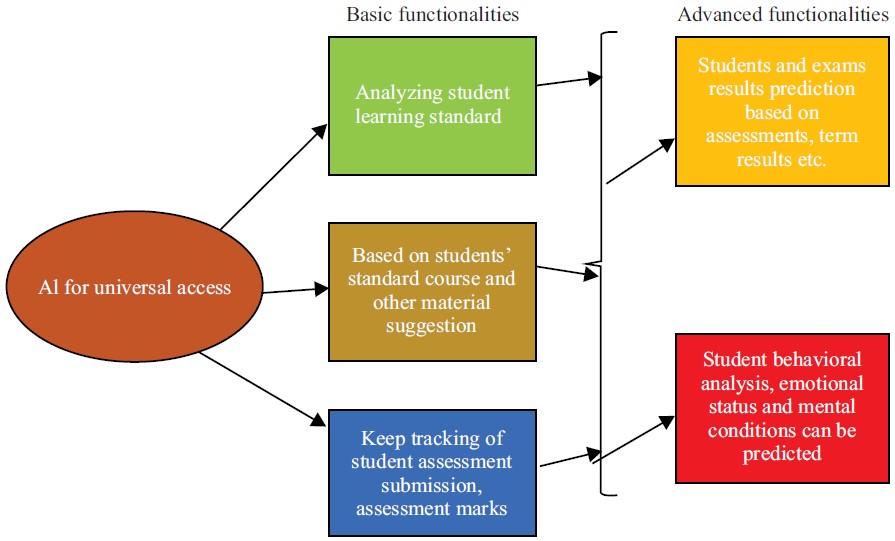 |
| Fig. 3: | AI-based universal access |
TASK AUTOMATION
Teachers main job may be teaching, but this is not the only role that they take. Teachers must also spend time on other issues. These include: Preparing class lectures, grading tests, managing the classroom during lectures, giving feedback to students, reporting progress to parents and many others. Today, teachers cannot focus on their primary job of teaching, but must rather inherit many other roles to uptake. The AI will be able to help teachers in automating the jobs that teacher have outside of teaching to help teachers focus on their main goal of teaching students class material6.
How school teachers’ extra work is altered with the help of AI task automation? Teachers today face the problem of not having enough time to devote to their students. The AI and technology will be able to help in solving this problem. Studies indicate that 20 to 40% of teachers’ time on tasks will be automated by utilizing current technologies. That equals almost 13 hrs per week that is freed up for a given teacher that educators may now devote to initiatives that improve student results and educator satisfaction instead of time dedicated to efforts other than teaching. The research shows that teachers will reallocate 20-40% of their time to activities that assist in students learning how to use current technology23.
Getting rid of manual administrative tasks simplifies teachers’ and faculty’s routines. Boring duties the personnel is no longer required to complete. The AI technologies are carrying out a variety of tasks24, including:
| • | Removing absenteeism warnings |
| • | Automatic delivery of report cards and other information to parents |
| • | Schedule and plan meetings |
| • | Automate student enrollments, regular paperwork and other processes to the appropriate department |
| • | Cut back on time spent writing progress reports |
| • | Simplifying any additional record-keeping procedures |
It can make it easier for professors and instructors to put less emphasis on tedious paperwork and more emphasis on raising educational standards. Bettini et al.25 has found that, more than 50% of a teacher’s time goes to tasks other than direct interaction with students, the most important role of a teacher. Contrarily, the main job of the teacher, instruction, is only being used for 32% of a teacher’s time as seen in Fig. 4. With the help of AI, a teacher’s free time and time devoted to working with students can most substantially be improved.
Figure 4 shows the different compositions of activities that a teacher must use for their working hours25. The future of AI’s potential in the classroom is vast. The AI may even be able to fully replace the teacher in certain scenarios. The AI can easily supervise and optimize learning already. It can be used for general tasks, such as summarizing a textbook’s content to develop a usable study guide. The AI system can do things that a teacher’s assistant would normally do such as proctoring exams, helping with homework and providing constructive criticism on assignments. In essence, AI is trending toward becoming the new teacher’s assistant for each individual student19. Thus, the introduction of AI technology systems into the classroom will greatly help all teachers find more free time for themselves to allocate towards helping their students7.
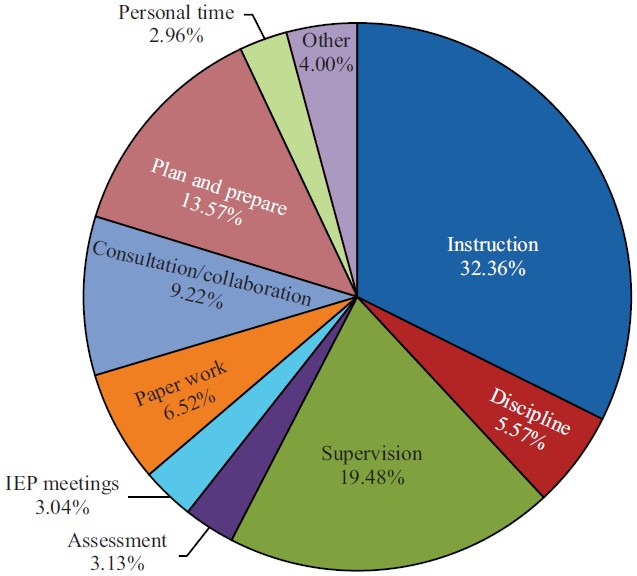 |
| Fig. 4: | Activity composition of teacher working hours25 |
AI adjusting the instructors’ role: The AI will lead to a paradigm shift in what it means to be an educator and how the education system works. As mentioned so far, major improvements in teaching strategies are supported by systematic changes in instructional content with AI. It should not be surprising that this new shift of AI integration into classrooms redefines the function of educators: The creation of a platform that allows for sharing teaching resources, access to MOOCs (Massive Open Online Courses) and cloud classrooms are all the direction that teaching and learning is headed towards20. It has been discovered that improvements in AI-based assessment systems and content supplementation relieve teachers of the tedious and cumbersome responsibilities of making lesson plans and grading assignments and papers. For instance, a platform with AI capabilities called Third Space Learning was discovered to lessen the burden on instructors in China7. The extra time that teachers had was used to foster positive, strong relationships between teachers and students and to advance overall long-term student development.
The AI-based administrative software may assist teachers with a variety of challenging tasks as well, such as budgeting, student enrollment, course management, application management, or data management, which not only improves the effectiveness and efficiency of the educational system but also frees up more time for teachers. Additionally, AI technologies help manage facilities, cut down on operational expenses for institutions and increase responsiveness.
24/7 ASSISTANCE
Through the integration of 24/7 assistance, students will no longer have to rely on only their teacher for help on the course material. It frequently arises today that students will have questions on material, but the instructor is unavailable to help them as it is outside of school time, or the teacher is unresponsive to email. Now, though, thanks to AI, teachers are not the only ones who are experts on the subject matter. Students may now use AI chatbots whenever they like to seek assistance even if the teacher is unavailable3. They serve as the students’ 24/7 aids, responding to their questions whenever they arise4.
AI in 24/7 assistance for students: The AI can provide information and answers to students 24/7, something impossible for human educators. One popular method is chatbots, which allow computer-based information technology systems to communicate with people. The chatbot features text, voice, graphics, or a combination of all of them to mimic a dialogue with human users4.
Many commercial and academic websites utilize the chatbot feature to respond to users in a process that emulates human interaction. Virtual assistants powered by technology are known as chatbots and they are created using AI or pre-written scripts. It operates around the clock by offering the information and responses required. It not only makes it easier for international students or anyone looking for information to get what they need whenever they need it, but it also eases the workload on the admission staff or other school faculty4,16,26. Chatbots search a script or database using a keyword or string similarity technique. The intricate layout of the chatbot and its operation was shown in Fig. 5. In essence, the chatbot will take input from the user through text or auditory methods and use a database to analyze the user’s request. Finally, the bot will identify the appropriate response through AI-based prediction techniques and compose its final reply to the user27.
Learning Management Systems (LMS) is a method that educational institutions can utilize to manage all of the schools’ online activities and keep track of the progress of all of its students. The LMS system acts as a central system software that is able to manage all of the school’s activities. This software is used for a variety of purposes, but they are often utilized to achieve the following:
| • | Assign coursework to students |
| • | Communicate with students and parents |
| • | Track student progress |
| • | Generate reports on student performance |
Case studies of the integration of 24/7 assistance AI based technologies have proved the effectiveness of the tools. A recent study was conducted on the use of 24/7 assistance AI technology in China, using an AI-based app, another example of 24/7 assistance for students, which allows teachers to give students feedback in real-time5. A test and control group of 387 graduate engineering students reported statistically higher scores in the case where they had the 24/7 assistance app, in terms of both learning engagement and willingness to share the learning experience. The distinction between the two groups demonstrates that the use of mobile technology and 24/7 assistance AI had a favorable impact on participants’ commitment to learning. The app also does administrative tasks, which reduces teachers’ load and gives them a little ease after work. The AI assistance tool provides students with the materials beforehand5. This technology can easily applied to the United States educational curriculum and we will likely see similar results. Ergo, students can follow everything accordingly without asking teachers every time for the course materials. In addition, through the app, students can sit for the auto test online without the teacher’s presence.
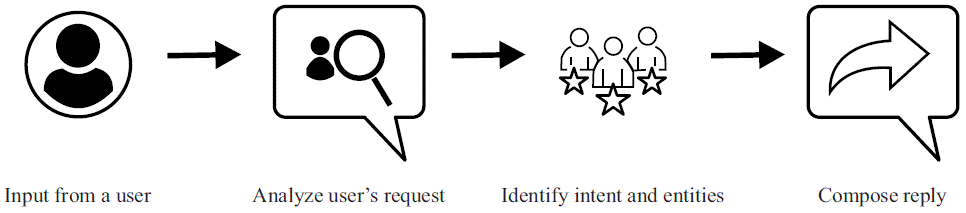 |
| Fig. 5: | Workflow of AI chatbot27 |
CHALLENGES OF ADOPTING AI IN EDUCATIONAL SECTORS
There are many steps that are involved in integrating AI into the education system and adopting AI in our educational system is still fraught with difficulties. Research on AI’s influence on education has primarily been conducted in affluent countries, whereas undeveloped countries have paid less attention to the topic. This effects the generalizability of the studies, which may not be relatable to developing countries. A comprehensive government plan for utilizing AI in the education sector has still not been fully developed, especially in developing countries. Public versus private company partnerships, the development of blueprints in the implementation phases of these AI software systems, data protection of students and AI algorithm transparency, as well as relevant benchmark measures to assess the performance of students, must all be incorporated into the policy to integrate AI into the education system of countries. There are important discussions on using AI in developing countries to enhance social equality and education28.
The primary barrier to implementing AI in education is financial planning and resource calculation. Budgets may become quite difficult to predict. For instance, if every school could have an AI system-based robot assistant, there would need to be a separate budget to sustain the robot. Therefore, nations would be compelled to provide a sizable budget toward upkeep. Understanding the available AI-based learning tools and how they benefit students is necessary to overcome this challenge.
Another primary challenge with applying AI technology in education is that the issue circumvents the deeper issues that surround education such as under-resourced schools in underfunded school districts and unqualified teachers. Instead of addressing these prevalent current issues and difficulties experienced by instructors, institutions are encouraging and adopting novel teaching strategies that conflict with conventional methods. The idea of fully implementing AI in our education system undervalue the relevance of human mentors in promoting learning, socio-emotional and creative views of teaching that go beyond only disseminating knowledge which AI systems promote28.
FUTURE OF EDUCATION IN AI
The integration of ML and AI-based technologies will continue to grow and be incorporated into learning technologies, requiring students to be familiar with how to use the technologies to their advantage2. A greater emphasis in schools will need to be placed on ensuring that students are able to use AIED technologies. The United States Department of education similarly finds that AI will continue to grow in the education sector and will be a valuable resource to teachers who will be able to allocate more time to their students through the integration of AI systems in task automation25.
Investments in AIED technologies continue to grow. Nearly $4 billion was invested internationally in AI tech start-ups in 2019, hoping AI may improve student learning by delivering individualized and personalized instruction3. Since the pandemic, technology has taken on a bigger role in delivering education due to the rise of digitization and the transition to online learning. This has increased the data used to address industry concerns and enhance higher education for both instructors and students29,30. However, the drawbacks highlight the necessity of using this technology as a supplement or help rather than a substitute for current practices.
Human teachers will never become fully replaced in the development of AI. Human teachers are necessary to be part of the education system because of the bond that teachers and students share which leads to the best learning outcomes and the limitations of the code which the AI systems are built upon. Bond and rapport cannot be built up with an AI-based system, there also exists a level of emotional support that teachers need to be able to provide students that AI cannot emulate. This is especially important with younger students such as those in elementary school. As AI continues to develop in the field of education human teachers will remain a part of the classroom, but will continue to be provided greater aid through the development of AI. Though AI may be able to suggest material and support students through personalized learning there also exists a barrier as to what material AI can provide and what specifically teachers feel is important for students to learn which is what appears on exams. The AI is not adaptive like a human brain is to recognize what may be more important for students to review before exams especially if a teacher is covering material outside the textbook or beyond what the AI system is capable of providing.
CONCLUSION
Through the development of AI software, it is clear that AI will continue to play and even further grow in the coming years to be a bigger part of education. The AI will be a tool that all teachers should utilize to aid in their teaching. In the future of AI and education, we believe that teachers will have AI-based systems in the classroom to serve as teaching assistants that will help teachers go through their lesson plans, help in grading assessments, be an additional resource to students who require extra help and recommending ways to further improve lectures and assessments. The AI systems are also likely to be present on every student’s laptop and another educational tool to allow for student development and help through AI. We do not believe, however, that there will ever be a scenario in which teachers are completely omitted from education. Ultimately, AI will provide teachers with a new dimension of teaching and learning where they will be able to create immersive classrooms in which they are aided by the help of smart technology to personalize lessons to students and have a non-human teaching companion that is AI. Just as other sectors have gone through a paradigm shift through the utilization of AI in their work, we believe that the education field will also become further integrated with AI in a positive way that helps teachers and students both.
SIGNIFICANCE STATEMENT
The research in this paper is significant because it outlines the application and future of Artificial Intelligence (AI) in education. The AI is already developing in the education sector and its influence will continue to grow. This paper outlines the current AI tools that can and already are being used in classrooms and the future for the development of AI tools. Results of the study show that AI will continue to develop as a pervasive tool that both teachers and students alike will use at higher rates as the AI systems develop and become more sophisticated.
REFERENCES
- Zawacki-Richter, O., V.I. Marín, M. Bond and F. Gouverneur, 2019. Systematic review of research on artificial intelligence applications in higher education-where are the educators? Int. J. Educ. Technol. High Educ., Vol. 16.
CrossRefDirect Link - Mijwil, M.M., K. Aggarwal, D.S. Mutar, N. Mansour and R.S.S. Singh, 2022. The position of artificial intelligence in the future of education: An overview. Asian J. Appl. Sci., 10: 102-108.
CrossRefDirect Link - Schiff, D., 2021. Out of the laboratory and into the classroom: The future of artificial intelligence in education. AI Soc., 36: 331-348.
CrossRefDirect Link - Zhang, K. and A.B. Aslan, 2021. AI technologies for education: Recent research & future directions. Comput. Educ.: Artif. Intell., Vol. 2.
CrossRefDirect Link - Roberts, H., J. Cowls, J. Morley, M. Taddeo, V. Wang and L. Floridi, 2021. The Chinese approach to artificial intelligence: An analysis of policy, ethics, and regulation. AI Soc., 36: 59-77.
CrossRefDirect Link - Chaudhry, M.A. and E. Kazim, 2022. Artificial intelligence in education (AIEd): A high-level academic and industry note 2021. AI Ethics, 2: 157-165.
CrossRefDirect Link - Rensfeldt, A.B. and L. Rahm, 2023. Automating teacher work? A history of the politics of automation and artificial intelligence in education. Postdigital Sci. Educ., 5: 25-43.
CrossRefDirect Link - Stephanidis, C., 2001. Adaptive techniques for universal access. User Model. User-Adapted Interact., 11: 159-179.
CrossRefDirect Link - Elias, T., 2019. Troubling “Technologies”: Exploring the global learning XPRIZE using the frameworks of skinner and foucault. Curr. Issues Emerging eLearning, 6: 1-20.
Direct Link - Bernacki, M.L. and C. Walkington, 2018. The role of situational interest in personalized learning. J. Educ. Psychol., 110: 864-881.
CrossRefDirect Link - Rahmani, A.M., E. Azhir, S. Ali, M. Mohammadi and O.H. Ahmed et al., 2021. Artificial intelligence approaches and mechanisms for big data analytics: A systematic study. PeerJ Comput. Sci., Vol. 7.
CrossRefDirect Link - Liu, S., X. Wang, M. Liu and J. Zhu, 2017. Towards better analysis of machine learning models: A visual analytics perspective. Visual Inf., 1: 48-56.
CrossRefDirect Link - Bhutoria, A., 2022. Personalized education and artificial intelligence in the United States, China, and India: A systematic review using a Human-In-The-Loop model. Comput. Educ. Artif. Intell., Vol. 3.
CrossRefDirect Link - Rodway, P. and A. Schepman, 2023. The impact of adopting AI educational technologies on projected course satisfaction in university students. Comput. Educ.: Artif. Intell., Vol. 5.
CrossRefDirect Link - Smiderle, R., S.J. Rigo, L.B. Marques, J.A.P. de Miranda Coelho and P.A. Jaques, 2020. The impact of gamification on students’ learning, engagement and behavior based on their personality traits. Smart Learn. Environ., Vol. 7.
CrossRefDirect Link - Xu, D. and H. Wang, 2006. Intelligent agent supported personalization for virtual learning environments. Decision Support Syst., 42: 825-843.
CrossRefDirect Link - Kose, U. and A. Arslan, 2016. Intelligent E-learning system for improving students' academic achievements in computer programming courses. Int. J. Eng. Educ., 32: 185-198.
Direct Link - Al-Badi, A., A. Khan and E. Alotaibi, 2022. Perceptions of learners and instructors towards artificial intelligence in personalized learning. Procedia Comput. Sci., 201: 445-451.
CrossRefDirect Link - Osadcha, K.P., V.V. Osadchyi and O.M. Spirin, 2021. Current state and development trends of E-learning in China. Inf. Technol. Learn. Tools, 85: 208-227.
CrossRefDirect Link - Everhart, J.M., S.R. Alber-Morgan and J.H. Park, 2011. Effects of computer-based practice on the acquisition and maintenance of basic academic skills for children with moderate to intensive educational needs. Educ. Training Autism Dev. Disabilities, 46: 556-564.
Direct Link - Kettle, M., 2018. Connecting Digital Participation and Informal Language Education: Home Tutors and Migrants in an Australian Regional Community. In: Digital Participation through Social Living Labs: Valuing Local Knowledge, Enhancing Engagement, Dezuanni, M., M. Foth, K. Mallan and H. Hughes (Eds.), Chandos Publishing, Oxfordshire, United Kingdom, ISBN: 9780081020593, pp: 173-190.
CrossRefDirect Link - Hu, K.H., 2023. An exploration of the key determinants for the application of AI-enabled higher education based on a hybrid soft-computing technique and a DEMATEL approach. Expert Syst. Appl., Vol. 212.
CrossRefDirect Link - Papastratis, I., C. Chatzikonstantinou, D. Konstantinidis, K. Dimitropoulos and P. Daras, 2021. Artificial intelligence technologies for sign language. Sensors, Vol. 21.
CrossRefDirect Link - Ghamrawi, N., T. Shal and N.A.R. Ghamrawi, 2023. Exploring the impact of AI on teacher leadership: Regressing or expanding? Educ. Inf. Technol.
CrossRefDirect Link - Bettini, E., J. Kimerling, Y. Park and K.M. Murphy, 2015. Responsibilities and instructional time: Relationships identified by teachers in self-contained classes for students with emotional and behavioral disabilities. Preventing Sch. Fail.: Altern. Educ. Children Youth, 59: 121-128.
CrossRefDirect Link - Seo, K., J. Tang, I. Roll, S. Fels and D. Yoon, 2021. The impact of artificial intelligence on learner-instructor interaction in online learning. Int. J. Educ. Technol. High Educ., Vol. 18.
CrossRefDirect Link - Adamopoulou, E. and L. Moussiades, 2020. An Overview of Chatbot Technology. In: Artificial Intelligence Applications and Innovations, Maglogiannis, I., L. Iliadis and E. Pimenidis (Eds.), Springer International Publishing, Cham, Switzerland, ISBN: 978-3-030-49185-7, pp: 373-383.
CrossRefDirect Link - Niemi, H., 2021. AI in learning: Preparing grounds for future learning. J. Pac. Rim Psychol., Vol. 15.
CrossRefDirect Link - Yang, H.H., L. Feng and J. MacLeod, 2019. Understanding college students’ acceptance of cloud classrooms in flipped instruction: Integrating UTAUT and connected classroom climate. J. Educ. Comput. Res., 56: 1258-1276.
CrossRefDirect Link - Ribeiro, J., R. Lima, T. Eckhardt and S. Paiva, 2021. Robotic process automation and artificial intelligence in industry 4.0-A literature review. Procedia Comp. Sci., 181: 51-58.
CrossRefDirect Link