

Jin Xing
State Grid Jibei Electric Power Company Limited, Xicheng, Beijing, 100053, China
Jun Li
State Grid Jibei Electric Power Company Limited, Xicheng, Beijing, 100053, China
Zeping Gong
State Grid Jibei Electric Power Company Limited, Xicheng, Beijing, 100053, China
Information Technology Journal
Year: 2014 | Volume: 13 | Issue: 16 | Page No.: 2626-2631


ABSTRACT
Voltage stability margin is an important index to evaluate the security and stability of power system. In view of voltage stability margin’s solution using normal nonlinear programming method did not consider the growth mode of generators’ active power outputs, the results of load margin are too ideal. A dynamic nonlinear programming method model which considered the growth mode of generators’ active power outputs was proposed in this study based on dynamic power flow. In the model, the unbalanced active power was distributed by the growth mode of generators’ active power outputs which is based on the actual situation. So, the results of load margin calculated by dynamic nonlinear programming method are more practical and not affected by the selection of slack node. Tests on IEEE-30 system and Liaoning power system show that results of voltage stability margin calculated by dynamic nonlinear programming method are more reasonable and practical than normal nonlinear programming method.
PDF Abstract XML References Citation
Article History
Received: June 26, 2014;
Accepted: October 17, 2014;
Published: October 30, 2014
How to cite this article
Jin Xing, Jun Li and Zeping Gong, 2014. Voltage Stability Margin’s Solution Using Nonlinear Programming Method Based on Dynamic Power Flow. Information Technology Journal, 13: 2626-2631.
DOI: 10.3923/itj.2014.2626.2631
URL: https://scialert.net/abstract/?doi=itj.2014.2626.2631
DOI: 10.3923/itj.2014.2626.2631
URL: https://scialert.net/abstract/?doi=itj.2014.2626.2631
INTRODUCTION
As the economy develops at a high speed, more and more electric power is needed. With the limitation of the environment, economy, construction costs and other factors, the speed of power network construction is lower than that of power source construction. So, power system often operates under the condition of heavy load and some hidden troubles of safety and stability exist. Voltage stability has a great influence on power system stable operation and voltage stability margin namely load margin is an important index to reflect the voltage stability. Dispatchers can know the statement of voltage stability by voltage stability margin and choose the appropriate voltage regulation strategy (Craig and Tapan, 2003; Hong et al., 1997). Therefore, whether the result of voltage stability margin is practical or not will influence the correctness of dispatchers’ decision and then that will be related to the safe and stable operation of the whole power system.
There are many methods to compute the voltage stability margin’s index at present and the most common methods are continuation power flow (Canizares and Alvarado, 1993; Ajjarapu and Christy, 1992) and nonlinear programming method (Van Cutsem, 1991; Irisarri et al., 1997; Rosehart et al., 2005). Continuation power flow obtains the system’s P-U curve by computing power flow repeatedly and determine the voltage stability margin according to the position of voltage collapse critical point in the P-U curve. But the method is not comprehensive enough in considering the system safety constraints, its computational efficiency is not high enough and the position of critical point obtained is not accurate enough (Chiang et al., 1995; Jean-Jumeau and Chiang, 1993). By using nonlinear programming method, the solution of critical point can be transformed into load optimization problem and then the optimization problem can be solved through establishing mathematical model and choosing the appropriate optimization method (Van Cutsem, 1991; Parker et al., 1996). The method can consider many kinds of system constraints flexibly and analyze and research in different emphasis points according to the actual situation. So the result of voltage stability margin computed by using nonlinear programming method is more practical and useful for dispatchers.
Normal nonlinear programming method computes the voltage stability margin under specified load increasing modes by introducing a load growth factor into equality constraints. Guo et al. (1999) computes the voltage collapse critical point by using normal nonlinear programming model and predictor corrector primal dual interior point method under load increasing modes at different nodes, such as at a single node, at an area or at all nodes. Using normal nonlinear programming model can compute the system voltage stability margin under many load increasing modes. The output of generators is decided by calculation results of the optimization algorithm, instead of combining with the practical growth mode of generators’ active power outputs. When considering the growth mode of generators’ active power outputs, if only the load increment is distributed to generators, the specified slack node will undertake all of the unbalanced active power produced by network loss. Thus, on the one hand, the results of voltage stability margin will be affected by the selection of slack node. On the other hand, when load increases nearby the voltage collapse critical point, the increment of network loss is significant. If the network loss is only undertaken by the specified slack node, that will affect the accuracy of voltage stability margin’s results.
This study considers the growth mode of generators’ active power outputs based on the normal nonlinear programming model and builds the nonlinear programming model combined with dynamic power flow (Ramanathan et al., 1986), named dynamic nonlinear programming model. The model can distribute the unbalanced power produced by load growth to many generators reasonably and results of voltage stability margin calculated are not affected by the selection of slack node. Meanwhile, interior point method is selected to solve the nonlinear programming problem, because of its low computational complexity, simpleness and good convergence (Granville et al., 1996). Tests on IEEE-30 system and Liaoning power system verified the advantages and effectiveness of the method.
METHODOLOGY
Load margin: Now indexes of voltage stability evaluation mainly include the state index and margin index (Chiang et al., 1997). The margin index has many advantages, such as its definite physical meaning, the linear relationship between its magnitude and the distance between the system operating point and the voltage collapse critical point and so on. Dispatchers can know the statement of the system clearly and take effective measures in advance to avoid voltage collapse by the margin index. So the margin index is widely used in the system operation.
The P-U curve is shown in Fig. 1. The abscissa represents active load and the ordinate is node voltage.
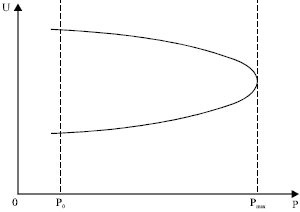 | |
| Fig. 1: | P-U curve |
Expression of load margin is as follows:
 | (1) |
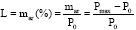
The expression of load margin percentage is as follows:
 | (2) |
where, P0 represents active load of the current operating point, Pmax represents active load of the voltage collapse critical point.
Model of load margin’s solution using normal nonlinear programming method: Load margin’s solution using normal nonlinear programming method can ensure that the results satisfy the constraints rigorously. So, the determination of constraints is a key link of the method and the difference of constrains will have large influence on the results. The mathematical model of load margin’s solution using normal nonlinear programming method includes three parts which are objective function, equality constraints and inequality constraints.
The objective function is to make the factor of load growth λ maximum. The expression is as follows:
 | (3) |
Because the interior point method is a method to obtain the minimum, the maximum of λ should be transformed into the minimum of -λ. Where λ obtains its maximum is the voltage collapse critical point.
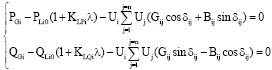
The equality constraints are balance equations of power flow which are modified. The expression in polar coordinates is as follows:
 | (4) |
where, PLi0, QLi0 represent, respectively active power, reactive power of load i in the ground state, λ represents the factor of load growth, KLPi, KLQi represent, respectively load growth coefficients of active power, reactive power. PLi and QLi from the balance equations of power flow are modified appropriately in Eq. 4. The sign of KLPi and KLQi reflects growth directions of active and reactive load and the magnitude of KLPi and KLQi reflects the proportion of load increment of each node to the total load increment.
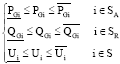
The inequality constraints include mainly the constraints of generators’ active power outputs, generators’ reactive power outputs and node voltage amplitude. The expression is as follows:
 | (5) |
where, SA, SR represent, respectively the sets of active sources and reactive sources, S represents the set of all nodes, represent, respectively the upper limit and lower limit of generators’ active power outputs,
  represent, respectively the upper limit and lower limit of generators’ reactive power outputs,
  represent, respectively the upper limit and lower limit of node voltage amplitude. In practical applications, other inequality constraints can be added flexibly according to the need so that various conditions can be considered in the model.
When KLPi and KLQi are both equal to 1, λ is equal to the load margin percentage. Under other load growth modes, the load margin percentage L should be computed according to Eq. 6:
 | (6) |
where, PLimax represents the load of node i at the voltage collapse critical point, SD represents the set of load growth nodes.
Model of load margin’s solution using dynamic nonlinear programming method: In the normal calculation of power flow, the unbalanced power of the system will be balanced by a slack node. That is not exactly accord with the practical operation of power system. When much unbalanced power exists in the system, the results of power flow calculation may not reflect the practical distribution of system’s power flow exactly. In the calculation of dynamic power flow, unbalanced power will be shared by the generators which still have regulating ability and that is accord with the practical operation of power system. So, the slack node is no need in the calculation of dynamic power flow and the results are more practical.
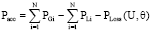
Assuming that the expression of unbalanced power in the system is as follows:
 | (7) |
where, PGi and PLi represent respectively active power output and active load of node i under the current state, PLoss is represents total network loss. The unbalanced power will be shared by the generators which have regulating ability according to dynamic power flow. So, the balance equation of active power flow turns into follows:
 | (8) |
where, βi represents the distribution coefficient of system’s unbalanced active power shared by generators and
 |
is satisfied. If there is no generator on node i or the generator has no regulating ability, βi = 0.
Combining with the theory of dynamic power flow, this study adds an equation constraint to the model of normal nonlinear programming method. The equation constraint is as follows:
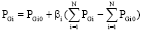 | (9) |
where, PGi0 is represents the active power output of generator in the ground state,
 |
represents the total unbalanced active power, including the increment of active load and network loss. After the equation constraint is added, when the load increases, the optimization variable PGi will satisfy not only the balance equation of active power flow but also some unbalanced power required.
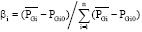
The value of the distribution coefficient βi can be determined by the concrete application. βi can be determined by frequency response characteristics of generators, some economic criteria, distribution of unit capacity, distribution of unit capacity margin and so on. Because data information of the example used in this paper is limited, βi is determined by the distribution of unit capacity margin. The expression is as follows:
 | (10) |
Meanwhile, the active power outputs of generators will not decrease when the load increases according to the practical operation of power system. So, this study, turns the inequation constraints of active power outputs into follows:
 | (11) |
Therefore, the objective function of the improved nonlinear programming model based on the theory of dynamic power flow is not changed. The equation constraints are composed of Eq. 4 and 9. The inequation constraints are changed by replacing the constraint of active power outputs in Eq. 5 with 11. The improved model is applied in IEEE-30 system and Liaoning power grid in this study and load margin of the two systems is calculated by means of the interior method in the optimization toolbox of MATLAB.
RESULTS
Results of IEEE-30 system: Power flow of IEEE-30 system was calculated based on the basic parameters of IEEE-30 system and Newton Laphson algorithm was used in the process of the calculation. The result of power flow calculation was used as the ground state of load margin’s solution.
Table 1 showed the results of load margin of IEEE-30 system calculated by normal nonlinear programming method and dynamic nonlinear programming method. The mode of load growth was all of load in the system growing simultaneously with the constant power factor and equal ratio. The limits of generators’ reactive power outputs was given in the basic parameters of IEEE-30 system but the limits of generators’ active power outputs and node voltage was not given. So they could only be determined by practical experience. The base capacity was 100 kVA.
Results of liaoning power system: This study, took the power flow of Liaoning power system operating in the maximum mode of the winter as the ground state of calculating the load margin. Because the load was larger in the winter, most of generators work on the upper limit of active power outputs.
| Table 1: | Results of load margin of IEEE-30 system |
 | |
| Table 2: | Results of load margin of Liaoning power grid |
 | |
There were only 7 generator nodes and 6 tie line nodes of 517 nodes having regulating ability of increasing active power outputs in the power flow used in this study.
Table 2 showed the results of load margin of Liaoning power system calculated by normal nonlinear programming method and dynamic nonlinear programming method. The mode of load growth was all of load in the system growing simultaneously with the constant power factor and equal ratio. The limits of generators’ active and reactive power outputs, active power of tie line nodes and node voltage were given in the basic parameters of Liaoning power system. The limits of tie line nodes’ reactive power were determined according to the active power flowing in the tie line. The power factor of tie lines should be no less than 0.95 in the lagging phase operation and no less than 0.97 in the leading phase operation. So, the power factor would not be too low during the power transmission of tie lines and that is close to actual conditions.
DISCUSSION
Table 1 and 2 both show that the growth mode of generators’ active power outputs affects the results of load margin immediately. The load margin and increment of network loss calculated by normal nonlinear programming method Zarate et al. (2006) are both greater than that calculated by dynamic nonlinear programming method which considers unbalanced power distribution based on the unit capacity margin.
In the process of load margin calculation using normal nonlinear programming method, the increment of generators’ active power outputs is determined only by the constraint of generators’ active power outputs and the objective function, instead of a definite growth rule. So the load margin calculated by the method is greater and the voltage stability condition reflected is ideal. In the practical operation of power system, the growth mode of generators’ active power outputs is determined on the basis of frequency adjustment, operation economy and some other aspects, instead of satisfying the objective function. So, in the practical growth mode of generators’ active power outputs, the load margin will be lower than that calculated by normal nonlinear programming method. After adding the equation constraint which considers the growth mode of generators’ active power outputs, the load margin is calculated under the condition of distributing unbalanced power to generators based on the definite rule. Because of the limited original data provided by the example, the growth mode of generators’ active power outputs determined in this study doesn’t confirm to reality completely but very close to reality. So, the thoughts of this study can be still proved. As for the result of network loss increment, load margin is greater calculated by normal nonlinear programming method in a ideal condition, so, it is closer to the voltage collapse critical point. The increment of network loss increases with the load point close to the voltage collapse critical point, so the increment of network loss calculated by normal nonlinear programming method is greater.
Meanwhile, unbalanced power produced by load growth is distributed to all the generators which have regulating ability, including the generator used as the slack node in the calculation of power flow. So, the results of load margin calculated by dynamic nonlinear programming method are not affected by the selection of slack node.
CONCLUSION
This study analyzes the deficiency of load margin calculated by normal nonlinear programming method without considering the growth mode of generators’ active power outputs and builds the model of dynamic nonlinear programming method which considers the growth mode of generators’ active power outputs based on the thoughts of dynamic power flow. In dynamic nonlinear programming method, all of unbalanced active power in the system can be distributed to the generators which have regulating ability with a definite rule. So, the results of load margin calculated are not affected by the selection of slack node. Meanwhile, as dynamic nonlinear programming method considers the growth mode of generators’ active power outputs, whether the voltage stability margin calculated is practical or not will be closely related to the growth mode of generators’ active power outputs. So, if the growth mode of generators’ active power outputs confirms the reality completely, the results of voltage stability margin calculated will be more practical. And the results will have important reference value for dispatchers.
This study, mainly considers the influence of growth mode of generators’ active power outputs to voltage stability margin. The author will consider the regulation mode of reactive power when the load increases combined with reactive voltage control, reactive power optimization and other contents in the follow up research. And a further research on the influence of regulating mode of reactive power to the voltage stability margin of power system will be done in the future.
REFERENCES
- Hong, Y.H., C.T. Pan and W.W. Lin, 1997. Fast calculation of a voltage stability index of power systems. IEEE Trans. Power Syst., 12: 1555-1560.
CrossRefDirect Link - Canizares, C.A. and F.L. Alvarado, 1993. Point of collapse and continuation methods for large AC/DC systems. IEEE Trans. Power Syst., 8: 1-8.
CrossRefDirect Link - Ajjarapu, V. and C. Christy, 1992. The continuation power flow: A tool for steady state voltage stability analysis. IEEE Trans. Power Syst., 7: 416-423.
CrossRef - Van Cutsem, T., 1991. A method to compute reactive power margins with respect to voltage collapse. IEEE Trans. Power Syst., 6: 145-156.
CrossRef - Irisarri, G.D., X. Wang, J. Tong and S. Mokhtari, 1997. Maximum loadability of power systems using interior point nonlinear optimization method. IEEE Trans. Power Syst., 12: 162-172.
CrossRefDirect Link - Rosehart, W., C. Roman and A. Schellenberg, 2005. Optimal power flow with complementarity constraints. IEEE Trans. Power Syst., 20: 813-822.
CrossRef - Chiang, H.D., A.J. Flueck, K.S. Shah and N. Balu, 1995. CPFLOW: A practical tool for tracing power system steady-state stationary behavior due to load and generation variations. IEEE Trans. Power Syst., 10: 623-634.
CrossRef - Jean-Jumeau, R. and H.D. Chiang, 1993. Parameterizations of the load-flow equations for eliminating ill-conditioning load flow solutions. IEEE Trans. Power Syst., 8: 1004-1012.
CrossRefDirect Link - Parker, C.J., I.F. Morrison and D. Sutanto, 1996. Application of an optimisation method for determining the reactive margin from voltage collapse in reactive power planning. IEEE Trans. Power Syst., 11: 1473-1481.
CrossRefDirect Link - Ramanathan, R., H. Ramchandani and S.A. Sackett, 1986. Dynamic load flow technique for power system simulators. IEEE Trans. Power Syst., 1: 25-30.
CrossRefDirect Link - Granville, S., J.C.O. Mello and A.C.G. Melo, 1996. Application of interior point methods to power flow unsolvability. IEEE Trans. Power Syst., 11: 1096-1103.
CrossRefDirect Link - Chiang, H.D., C.S. Wang and A.J. Flueck, 1997. Look-ahead voltage and load margin contingency selection functions for large-scale power systems. IEEE Trans. Power Syst., 12: 173-180.
CrossRefDirect Link - Zarate, L.A.L., C.A. Castro, J.L.M. Ramos and E.R. Ramos, 2006. Fast computation of voltage stability security margins using nonlinear programming techniques. IEEE Trans. Power Syst., 21: 19-27.
CrossRefDirect Link