

Md. Mahbub-E-Noor
Department of Computer Science, South Asian University, New Delhi, India
Shah Md. Tanvir Siddiquee
Department of Computer Science, South Asian University, New Delhi, India
Md. Saifur Rahman
Department of Information and Communication Technology, Noakhali Science and Technology University, Noakhali, Bangladesh
Information Technology Journal
Year: 2014 | Volume: 13 | Issue: 16 | Page No.: 2508-2513


ABSTRACT
The phenomenon “cloud computing” started from 2006-07 but it came into existence through a very smooth historical events. From the concept of multiprogramming then virtualization, grid computing, SaaS, utility computing and then finally cloud computing came to today’s IT world. Though, the tools used to build cloud are increasing day by day, so it makes a confusion and difficulty to select a suitable tool for the cloud consumers and enterprises to build their cloud for business purpose due to holding various features. Due to facing this problem, it is now inevitable to differentiate these tools. For this reason, this study is about to build a basic infrastructure of two separate clouds using two open source IaaS (Infrastructure as a Service) cloud tools i.e., OpenStack and CloudStack to check how these two differ from each other. This study will also show their evaluation and future scopes.
PDF Abstract XML References Citation
Article History
Received: April 26, 2014;
Accepted: July 18, 2014;
Published: September 29, 2014
How to cite this article
Md. Mahbub-E-Noor, Shah Md. Tanvir Siddiquee and Md. Saifur Rahman, 2014. Evaluation of OpenStack (Havana Release) and CloudStack (4.3 Release) Open Source Cloud Solutions. Information Technology Journal, 13: 2508-2513.
DOI: 10.3923/itj.2014.2508.2513
URL: https://scialert.net/abstract/?doi=itj.2014.2508.2513
DOI: 10.3923/itj.2014.2508.2513
URL: https://scialert.net/abstract/?doi=itj.2014.2508.2513
INTRODUCTION
In this new globalization era of information technology, a huge amount of computing power is needed to produce business insights and to sustain in the competitive market. A traditional way for IT industries to process their data is to use the computing power of their own data centres. Thereby to maintain and operate their massive datacentres with the rapid increasing data, processing request from their clients and end users can be very complex and pricey which could be thought as a prime problem for what cloud computing emerged.
Though, there can be other ways but cloud computing can be a great alternative. Cloud computing, as a term which provides internet based service, was launched by industry giants (e.g., Amazon, Google etc.) in late 2006 (Liu and Orban, 2008; Yang and Tate, 2009). Now-a-days, cloud computing not only gives an alternate solution for the aforementioned problem but also provides many other services (e.g., software as a service, platform as a service, network as a service, data as a service, etc.,). Users of cloud have to pay per use to different cloud vendors in different schemes like monthly, yearly and so on.
Though, the phenomenon “cloud computing” started from 2006-07 but its history is very smooth. From the concept of multiprogramming then virtualization, grid computing, SaaS, utility computing and then finally cloud computing came to today’s IT world. That’s why, all technologies are connected to each other. Grid computing can supply a huge computing power which can be thought as one type of virtualization as it seems a single machine provides this huge power though it comes through a parallel and distributed way from many machines. Using this huge power in any public companies or private organizations, consumers can rent this computing power on-demand based on usage (pay as much used) from the clients or owner, similar to the way services from traditional public utility services such as water, gas, electricity, telephony and so on. And this is called utility computing and using that concept Software as a Service (SaaS) started later. Traditional desktop software such as word processing, spread-sheet and even games can be accessed as a service through online but offer functionality is same as locally installed computer programs. This technique of delivering applications, named as SaaS, which removes the burden of software maintenance for customers and finally by adding all of these models, facilities and techniques cloud computing appeared. In just a few short years, almost most important IT companies (e.g., Amazon, Microsoft, Vmware, Salesforce.com, Google, IBM, Rackspace, Citrix Systems, Joyent, SoftLayer etc.) have changed their systems into cloud (Julie, 2013). So, it can be easily said that future computing will obviously depend upon cloud computing.There are many existing tools (e.g., Apache VCL, AppLogic, Citrix Essentials, Enomaly ECP, Eucalyptus, Nimbus3, OpenNebula, OpenPEX, oVirt, Platform ISF, vCloud, OpenStack, ClouStack etc.,) for building IaaS cloud (Voorsluys et al., 2011; Ristov and Gusev, 2013). Among them, which tools are the most beneficial, easier to install, operate and provision; having more scalability, availability, reliability, security, sustainability; having more virtualization capability; having more scope to develop by the developer are the main issues. That’s the main reason behind to select the topic of this study on cloud computing.
For this reason, it is good to see the previous related studies to see how the idea has grown. Here a very short description has been given about seven studies’ main theme, which were published in some renowned conferences and journals.
In May 2011 at IEEE MIPRO conference, Voras et al. (2011b) described about some open source cloud computing solutions and discussed the criteria that can be used to evaluate the stability, performance and features of open source clouds, compared some available solutions. And this study gave the first inspiration to this study to work with open source cloud solutions.
In June 2011 at 33rd IEEE International Conference on ITI (Information Technology Interfaces), Voras et al. (2011a) described about an elaborate set of criteria for evaluation and comparison of open source IaaS cloud computing solutions which can be used for ranking and choosing between the available products.
In February 2013 at IEEE 3rd International Advance Computing Conference (IACC), Bist et al. (2013) told that in the next five years, people come to around the globe would choose open source deployment not just because they cut down cost but also helps avoid vendor lock-in. They compared among DeltaCloud, OpenStack and XCP three open source clouds and told that this comparison will help researcher and other users to decide which one would be a better option for their enterprise.
In May 2013 at IEEE MIPRO conference, Donevski et al. (2013) described about virtual machine security threats that might occur by other tenants (security challenges due to multi-tenancy) or outside the cloud and also compared the security level that the most common open source clouds provide for a particular virtual machine.
In July 2013 at IEEE EUROCON conference, Ristov and Gusev (2013) described about the analysis of the most common open source cloud architectures which they installed i.e., OpenStack, Eucalyptus, Open-Nebula and CloudStack and evaluated the security aspects of their architecture and their compliance with security requirements defined by the ISO 27001:2005 standard which specifies the requirements for establishing, implementing, operating, monitoring, reviewing, maintaining and improving a documented Information Security Management System within the context of the organization’s overall business risks.
In 2012 at IEEE 10th International Symposium on ISPA, Gomez-Folgar et al. (2012) described about performance of the CloudStack KVM pod primary storage under NFS version 3. They told that the performance of the Virtual Machines running in the increasing number of open source solutions for buliding Clouds is a key point and the way the Virtual Machines are created in Clouds can have important effects upon their disk I/O operations.
In October 2012 at ACM Symposium on Cloud Computing (SoCC), Baset (2012) showed an overview of the open source cloud technologies, a brief overview and analysis of four IaaS open source clouds [i.e., OpenStack (Folsom) (github), CloudStack (Acton 3.0) (Apache incubator project), Eucalyptus (3.1) (github) and OpenNebula (3.6.0)], feature comparison of CloudStack and OpenStack and at last, he described in-depth analysis of OpenStack.
The primary goal of this study is to show the basic architectures installed by the help of installation guides of OpenStack Havana release and CloudStack 4.3 release (RCC, 2014a; ASF, 2014) and the future plan is to do analysis and study the tools for comparing and evaluating them on the basis of some criteria which have been discussed in the above stated 1st, 2nd, 3rd and 5th conference study. As this study is about OpenStack and CloudStack to build IaaS (Infrastructure as a Service) cloud, so in the discussion part primary evaluation during installation is given which could be said as our results. This study is based on open source tools as it is open secret that the benefit of the open source softwares are greater than the proprietary softwares. Besides, now-a-days open source tools are the first choice to the most of the IT companies.
Now the question is why this OpenStack and CloudStack? After having inspired from the above 2nd, 3rd, 2nd last and last stated studies, thinking about the comparison and evaluation among open source clouds came into the minds of the authors. Security issues has been discussed in the above stated 5th study which was published in IEEE in July 2013 and in that study, authors showed that CloudStack has the highest security among OpenStack, CloudStack, Eucalyptus and OpenNebula. But OpenStack community also increased their security issues in their later releases even in this Havana releases also. Besides, it is now open secret that OpenStack and CloudStack are competing with themselves as Vaughan-Nichols (2012) said in his study which was published in a business publication named ZDNet. He told that almost all heavy-weights companies like Dell, AT and T, Canonical, HP, IBM, Nebula, Rackspace, Red Hat, and SUSE started to use and support OpenStack. Also in the study of Julie (2013) in Business Insider, this issue has been discussed. So, these are the main reasons behind why authors of this study were interested with these two platforms.
Methodology: Though, by using OpenStack and ClouStack, a huge cloud can be possible to build but for testing and research purpose, basic structures of those need to know to build a smaller ranged cloud. The details structure and components’ details of these two IaaS cloud can be known from their installation guides which are the products of Rackspace (RCC, 2014a) and Apache Software Foundation (ASF, 2014) and these guides are available in internet for being open source tools. So, here the smallest ranged cloud deployment technique, which authors have implemented in their lab, is given.
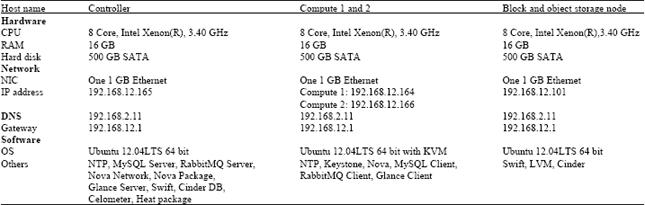
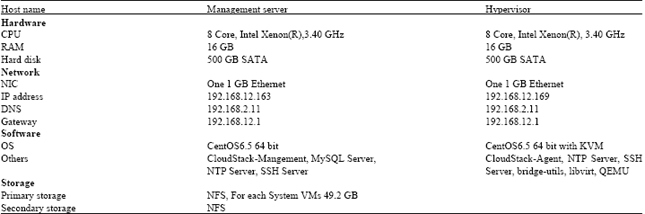
Figure 1 and 2 shows the architectures of the OpenStack and CloudStack, respectively to implement in very smaller range and Table 1 and 2 shows the configurations of the machines to build.
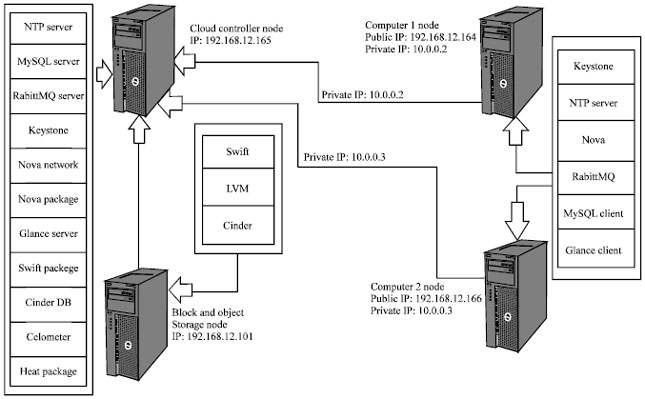 | |
| Fig. 1: | OpenStack configuration overview |
| Table 1: | Configuration of OpenStack |
 | |
| Table 2: | Configuration of CloudStack |
 | |
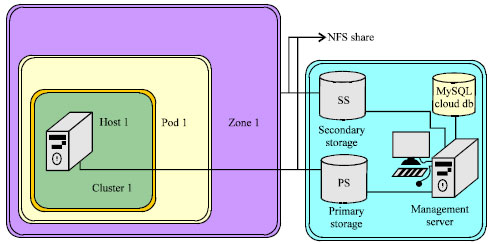 | |
| Fig. 2: | Conceptual view of the basic deployment of the CloudStack |
For CloudStack,it is possible to use one machine but using two machines is good to do many test and for OpenStack three machines need according to the structure described in the installation guide but here four machines’ configurations are given.
If CloudStack is used to build a wide ranged cloud with multi zones then the conceptual architecture could be depicted by the above (Fig. 3).
RESULTS AND DISCUSSION
During installation and configuration, important findings are discussed and evaluated in the following.
Architecture: OpenStack installation procedure was a fragmented way as all the parts of the installation were not depended upon other parts. But for making cloud, all parts should be connected with the particular parts and that was controller node. But CloudStack installation process was in a monolithic way which is sometimes good because when all the parts are ready then by giving some appropriate information in the Graphical User Interface (GUI), CloudStack installs at a time. It is easier to install but only fact is that all parts should be ready according to the proper heirarchical way before installation and correct information should be provided in the GUI. So, it becomes a tiresome matter when a higher hierarchy parts would not work due to misconfiguration of one lower hierarchy part.
MySQL: In OpenStack, MySQL was used in controller nodes as well as in compute nodes. In controller node, MySQL server was installed for storing all types of data of the OpneStack and in the compute nodes, MySQL client was installed for connecting with the MySQL server because in compute nodes keystone, nova and glance packages’ data were stored in MySQL client which works properly only after connecting with MySQL server. On the other hand, for CloudStack, only MySQL server was installed in the management server which is responsible to manage all types of data. Here no other MySQL client required.
Security: Then in the OpenStack security-guide, it is written that “the OpenStack Identity service (keystone) supports multiple methods of authentication, includingusername and password, LDAP and external authentication methods.
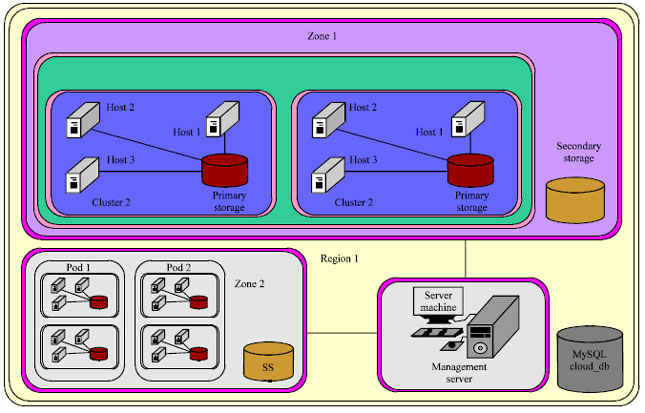 | |
| Fig. 3: | A region with multiple zones in a CloudStack deployment |
| Table 3: | Observed differences between OpenStack and CloudStack |
 | |
Upon successful authentication, the identity service provides the user with an authorization token used for subsequent service requests. Transport Layer Security TLS/SSL provides authentication between services and persons using X.509 certificates. Although, the default mode for SSL is server-side only authentication, certificates may also be used for client authentication” (RCC, 2014b). Here, keystone was responsible for the security purpose. On the other hand, in CloudStack, every security issues depended upon firewall. CloudStack gives a strong firewall mechanism which can be configured and controlled through iptables. Administrator can block any one by blocking some particular port.
Community: Another point is that during installation of OpenStack, a lot of problems had been faced. Most of the solutions were found from the OpenStack community, but on the other hand, CloudStack community not so much active. For that reason, many problems had to be solved by the authors themselves and it took more time to finish the installation than OpenStack due to small problems but finding no solutions from the community.
Table 3 shows a brief overview of the results of this study.
CONCLUSION
This evaluation and comparative study will help cloud consumers or organizations to decide to set up their private, public or hybrid cloud using these two open source cloud platform. An enterprise/an organization can use any of these two open source clouds according to their requirements, scalability, flexibility, usage, CPU provisioning and utilizations. Though, both of these provide almost same facilities but one have to choose these on the basis of installation procedure; if anybody wants to install at a time whole infrastructures then CloudStack is suitable but he/she must know the total procedure and he should know the troubleshooting capability due to lackings of getting enough help from the CloudStack community. On the other hand, for availability of the community help during installation, management of the cloud infrastructures and if anybody wants to install in a fragmented way then he/she can choose OpenStack which is growing more day by day and most vendor companies are preferring it.
We can build cloud by other open source tools and compare them with themselves so that we can evaluate which one is good for what issues. We can compare our cloud with the existing other clouds like Amazon, Google, Microsoft, etc. There is also scope to do quantitative comparison of the presented solutions through performance evaluation measurements on the basis of some criteria which was also mentioned in our strategy and motivation part.
REFERENCES
- Baset, S.A., 2012. Open source cloud technologies. Proceedings of the 3rd ACM Symposium on Cloud Computing, October 14-17, 2012, San Jose, CA., USA.
CrossRef - Bist, M., M. Wariya and A. Agarwal, 2013. A comparing delta, open stack and Xen Cloud Platforms: A survey on open source IaaS. Proceedings of the 3rd Advance Computing Conference, February 22-23, 2013, Ghaziabad, pp: 96-100.
CrossRef - Liu, H. and D. Orban, 2008. GridBatch: Cloud computing for large-scale data-intensive batch applications. Proceedings of the 8th IEEE International Symposium on Cluster Computing and the Grid, May 19-22, 2008, Lyon, France, pp: 295-305.
CrossRef - Ristov, S. and M. Gusev, 2013. Security evaluation of open source clouds. Proceedings of the IEEE EUROCON, July 1-4, 2013, Zagreb, Croatia, pp: 73-80.
CrossRef