

Georgia Rugumira
Communication Research Centre, Harbin Institute of Technology, Harbin, Heilongjiang 150001, People`s Republic of China
Gang Wang
Communication Research Centre, Harbin Institute of Technology, Harbin, Heilongjiang 150001, People`s Republic of China
Nguyen Thi Dieu Linh
Communication Research Centre, Harbin Institute of Technology, Harbin, Heilongjiang 150001, People`s Republic of China
Information Technology Journal
Year: 2012 | Volume: 11 | Issue: 7 | Page No.: 910-915


ABSTRACT
Precoded orthogonal frequency division multiplexing (Precoded-OFDM) and vector-OFDM (VOFDM) systems was proposed to eliminate channel spectral nulls and reduce the cyclic prefix length by V times in a single transmit antenna systems, respectively. However, the insertion of one or more zeros between each two sets of V consecutive information symbols in precoded-OFDM expands the data rate overhead of the system hence high Peak to Average Power Ratio (PAPR). VOFDM system does not shown good performance in the spectral nulls channels. This study merges the VOFDM with carrier interferometry code (CI-VOFDM) to improve the performance of OFDM system in intersymbol interference (ISI) channel. The simulation results show a great improvement in terms of Bit Error Rate (BER) performance in the CI-VOFDM system.
PDF Abstract XML References Citation
Article History
Received: November 11, 2011;
Accepted: March 26, 2012;
Published: May 29, 2012
How to cite this article
Georgia Rugumira, Gang Wang and Nguyen Thi Dieu Linh, 2012. Carrier Interferometry-based Vector-OFDM Robust to ISI Channel and with Reduced
PAPR. Information Technology Journal, 11: 910-915.
DOI: 10.3923/itj.2012.910.915
URL: https://scialert.net/abstract/?doi=itj.2012.910.915
DOI: 10.3923/itj.2012.910.915
URL: https://scialert.net/abstract/?doi=itj.2012.910.915
INTRODUCTION
Orthogonal Frequency Division Multiplexing (OFDM) has been proved to be a promised system in high speed wireless communications. Communication standards such as Wireless Local Area Network (WLAN), high performance local area networks type 2 (HIPERLAN2), IEEE 802.11, Digital Audio Broadcasting (DAB), Digital Video Broadcasting (DVB), Asymmetric Digital Subcarrier Line (ADSL), Very High Speed Digital Subcarrier Line (VDSL) and High Bit Rate Digital Subcarrier Line (HDSL) (Prasad, 2004). OFDM has also been selected as a candidate of 4G mobile communication due to its ability to support high data rate transmission in frequency selective channels. OFDM system use the serial to parallel convertor to segment the high data rate stream into low rate data stream and transmit each of the converted data over individual orthogonal carrier. Through the conversion of the high data rate to low rate data stream and the added cyclic prefix, the intersymbol interference (ISI) channel is converted into ISI free channel. However, OFDM system still suffers from multi-path fading channels with spectral nulls and some symbols may be degraded or cancelled out.
Precoded-OFDM was proposed by Xia (2001) to remove the spectral nulls in the ISI channel; which was achieved by inserting zeros into two V consecutive information symbols. VOFDM is a special type of precoded-OFDM and was proposed to reduce the cyclic prefix overhead. Precoded or vector-OFDM converts an ISI channel into ISI-free vector channel while involving channel matrices instead of channel coefficients in one tap equalization to increase diversity. The Peak to Average Power Ratio (PAPR) and Bit Error Rate (BER) performance of VOFDM are comparable to conventional OFDM.
Carrier Interferometry (CI) code has improved the performance of OFDM and Coded OFDM (COFDM) whereby each low rate symbol is simultaneously modulated onto all N carrier by applying the orthogonal phase offset in the frequency domain (Wiegandt et al., 2003). In this study the phase offset is introduced in each individual component of N vectors in order to reduce the PAPR value in the VOFDM system and improve its BER performance.
In the previous study (Rugumira et al., 2011), the hybrid of precoded/VOFDM and Carrier Interferometry (CI) spreading codes was studied, the simulation results showed the reduction on PAPR value and was comparable with conventional OFDM. In this study, the evaluation of BER performance of the CI-based Vector-OFDM (CI-VOFDM) is introduced and compares its performance with precoded/vector-OFDM.
SYSTEM MODEL
Precoded/vector-OFDM and CI/OFDM systems: The precoded-OFDM system inserts a number of zeros between each two sets of V consecutive information symbols by using the precoder P (z), defined as:
 | (1) |
where, 0(P-V)xV is the (P-V)xV null matrix, P has to be greater than V (P>V) and IVxV is a VxV identity matrix.
 | |
| Fig. 1: | OFDM transmitter |
 | |
| Fig. 2: | CI/OFDM transmitter, where, Δθ = 2π/N |
This type of precoder provides a possibility of converting a spectral null channel into a non-spectral null channel. The binary to complex mapped information sequence a (n) is blocked into Vx1 vector sequence and precoded by the precoder P (z) which results in Px1 vector sequence  (n). The precoded vector sequence is blocked again into PNx1 vector sequence
  (n), the output of the inverse FFT (IFFT) after the insertion of cyclic prefix vectors, the vectors are transmitted serially through the channel. At the receiver, the inverse operation is taken to extract the original data symbols.
The vector-OFDM system is a special type of the precoded-OFDM system and it use VxV identity matrix as a precoder, i.e., no zeros added into two V consecutive information symbols. When the ISI channel length L+1 is large, the cyclic prefix length in the conventional OFDM systems is large too. Setting the CP length (Γ) greater than the order of the channel taps, i.e., Γ≥jL/Vk where L is the number of taps; the VOFDM may convert the ISI channel into N ISI-free vector channels. Also the data rate overhead in the OFDM systems is reduced by V times.
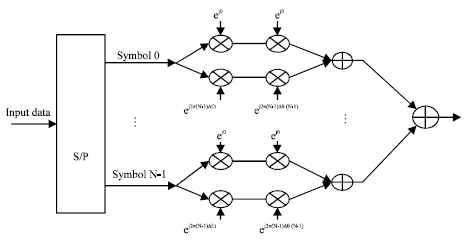
CI/OFDM system was proposed by Wiegandt et al. (2003) to reduce the Peak to Average Power Ratio (PAPR). CI/OFDM system differs from the conventional OFDM as follows: In CI/OFDM each symbol is modulated onto all carriers while in OFDM each symbol is modulated onto its own carrier. The separation between information symbol-i with other (N-1) information symbols is retained by the use of phase offset ρi. The phase offset is defined in form of matrix as:
 | (2) |
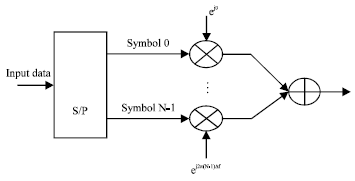
The block diagram of the conventional OFDM transmitter is shown in Fig. 1 and 2 illustrates the spreading of ith symbol into N carriers in the CI/OFDM transmitter. The serial data from the mapping scheme is converted into parallel by the serial to parallel convertor, spread and modulated by N-IFFT. The output data of IFFT is taking the same process as in the conventional OFDM except that, at the receiver the data has to be decomposed and combined to reduce the interferences. The CI/OFDM system is also robust to channel spectral nulls.
CI-VOFDM SYSTEM
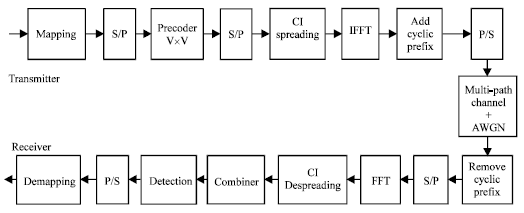
CI-VOFDM is a combination of vector-OFDM and CI spreading code, the block diagram is shown in Fig. 3 where the input data a (n) with length K (K = VN and V denotes the vector size), is mapped and blocked into VxN vector sequence and defined as:
 | (3) |
where,  N-1 and is of vector size Vx1. Since the precoder is the identity matrix, its output is equal to its input. The vector sequence (n) is blocked into NxV vector sequences and are given by:
 | (4) |
Each components of v (n), v = 0, 1,…, N-1 are spreaded by the carrier interferometry code defined as βiv = (ejo, ej(2π/N).1.v,…, ej(2π/N).(N-1).v) and we get:
 | (5) |
Then the individual components of the spreaded vector sequence is transformed by the N-point IFFT, its output is:
 | (6) |
where, ej(2π/N).i.v is the phase offset which ensures the orthogonality among individual components of N vectors v (n).
The vector sequence after cyclic prefix is:
 | (7) |
where, Γ is the length of the cyclic prefix. Then, the vector sequence  (n) is converted into scalar sequence s (n) and transmitted through a multipath channel.
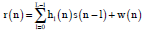
At the receiver, the received scalar sequence r (n) after removing the cyclic prefix is defined as:
 | (8) |
where, w (n) is the additive white Gaussian noise, L is the number of paths and h (n) is the channel response. Then r (n) is blocked into vector sequence:
 | (9) |
Each  (n) is the vector sequence with size Vx1. The output of N-point FFT is a vector sequence with size Vx1:
 | (10) |
Then the ith symbol phase offset in individual component in  (n) is removed from each carrier, the decision vector sequence is:
 |
where:
 | (11) |
The combiner based on Equal Gain Combining (EGC) is optimally used in AWGN and flat fading channels.
 | |
| Fig. 3: | The block diagram of CI-VOFDM system |
In frequency selective channel, Minimum Mean Square Error Combining (MMSEC) is used to minimize the intersymbol interference and noise effects. The combined vector sequence is defined as:
 | (12) |
where:
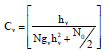 |
and is a known constant, defined as:
 |
The system can be simplified by using IFFT and FFT matrices as a CI spreading code and CI despreading codes, respectively. Equation 6 can be rewritten as  = IFFT [IFFT ()]. The length of the second IFFT is M = 4Nxβ, where β, oversampling factor can be described as:
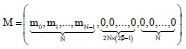 |
A combiner is allocated before the second FFT which is used as a despreading code, the vector sequence in Eq. 12 becomes  = FFT [C.FFT (
 )].
)].
Input and output matrix: In VOFDM, when Γ is greater than or equal to the order of the channel taps i.e., Γ≥L, the system can provide ISI-free vector channel, hence the received vector sequence is denoted by:
 | (13) |
where, (n), v (n) and  (n) are the received, transmitted and AWGN vector sequence, respectively. Hv is a blocked version of the single input and single output linear time invariant system with transfer function H(z) and is denoted by the pseudocirculant polynomial matrix as seen in Xia (2001):
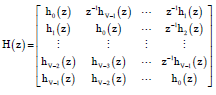 | (14) |
where:
 |
is the vth polyphase component of H (z), z = exp (j2πl/N).
For the case of CI-VOFDM, let us consider the combined output data; assume the EGC combiner is used, the input-output matrix equation is:
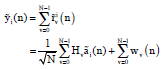 | (15) |
where,  are the received, transmitted and AWGN vector sequence, respectively and Hv is a blocked version of the single input and single output linear time invariant system. All vectors (n) are independently, identically distributed complex Gaussian random variables.
PAPR BENEFITS
CI-VOFDM system has PAPR benefits since when the energy of one information symbol in a vector sequence is at maximum value, the energies of other information symbols are at minimum value. Due to the uniformly spread of peaks in symbol energies over the symbol time in the vector sequence, it is not possible for all symbol energies to be combined at the same time. This results to a low peak power hence low PAPR value. The PAPR can be denoted as:
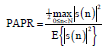 | (16) |
The PAPR benefit comparison between precoded-OFDM, VOFDM and CI-VOFDM are illustrated in Fig. 4, where PAPR levels across 10,000 transmissions for 256 symbols and 256 carriers are used. The result show that the PAPR value of precoded-OFDM exceeds 20, VOFDM PAPR value exceeds 10 with few reaching 20. CI/OFDM and CI-VOFDM figures demonstrated no PAPR value exceeding 8.
SIMULATION RESULTS
The performance of CI-VOFDM over ISI channel with two coefficients i.e., L = 1: Channel A, l = [0.8, 0.6] was obtained by using MATLAB, where different value of oversampling factor β = 4, 5, 6, 7 and 8, the input data block N = 256 are used.
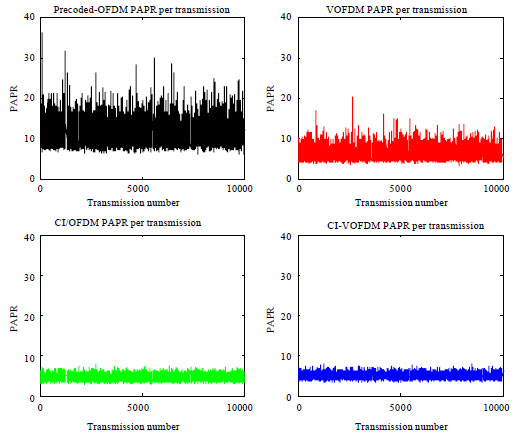 | |
| Fig. 4: | PAPR per transmission level |
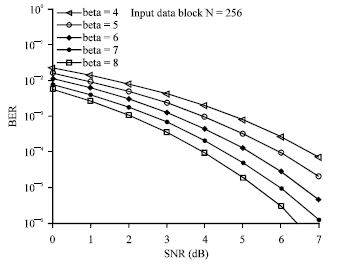 | |
| Fig. 5: | BER performance of CI-VOFDM with different numbers of oversampling factors |
The results displayed in Fig. 5 shows how the BER value decreases with an increase of oversampling factor. In channel A, oversampling factor of β = 4 is enough to give better results.
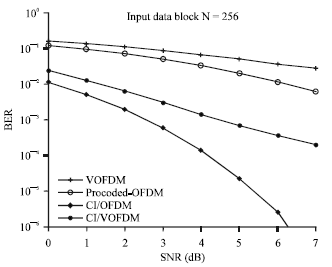
Figure 6 describes the comparison of precoded-OFDM, VOFDM, CI/OFDM and CI-VOFDM BER performance.
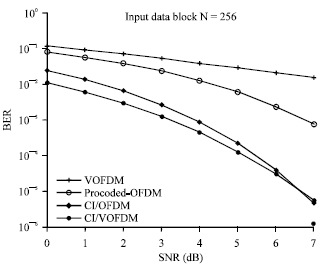 | |
| Fig. 6: | Channel A BER performance comparison of precoded-OFDM, VOFDM, CI/OFDM and CI-VOFDM |
The parameters used in this simulation are input data block N = 256, for Precoded-OFDM, V = 1, P = 2, for VOFDM and CI-VOFDM, V = P = 2 and oversampling factor β = 6 and the channel A is used in Fig. 4 has one coefficient L = 1, i.e., l = [0.8, 0.6], channel A does not have spectral nulls but its Fourier transform values are small at some frequencies.
The result shows a big improvement when CI-VOFDM is used compared to VOFDM, at a 10-3 BER there is a gain of 1 dB SNR compared to precoded-OFDM.
 | |
| Fig. 7: | Channel B BER performance comparison of precoded-OFDM, VOFDM, CI/OFDM and CI-VOFDM |
 | |
| Fig. 8: | Channel C BER performance comparison of precoded-OFDM, VOFDM, CI/OFDM and CI-VOFDM |
CI/OFDM outperforms CI-VOFDM on BER performance when SNR is greater than 7 dB but it has the reduced cyclic prefix overhead than CI/OFDM.
The performance in Fig. 7 was done by considering the ISI channel B with spectral nulls and it has two coefficients, L =2, l = [0.407, 0.815, 0.407], N = 256, V = 2 and P = 3 for precoded-OFDM, V = P = 3 for VOFDM and for CI-VOFDM β = 9. The results also are good compared to VOFDM and precoded-OFDM and CI/OFDM system outperforms the other three systems.
Figure 8 shows the simulation results of ISI channel C with free-spectral nulls l = [-0.0428+0.4732i, 0.5781+0.9020i]. Parameters are N = 256, β = 4. Compared to channels A and B, CI-VOFDM outperforms the performance of CI/OFDM, at 10-5 there is a gain of 1 dB SNR because the channel does not have spectral nulls.
CONCLUSIONS
In this research, a study of the hybridization of vector-OFDM and Carrier Interferometry (CI) spreading code has been proposed. The spreading and despreading process was implemented by IFFT and FFT instead of linear transform matrix. The simulation results of the combination of single transmit-antenna VOFDM system and CI showed the robustness to the ISI channels with spectral nulls compared with precoded-OFDM and VOFDM systems. The results of the CI/OFDM system are better but CI-VOFDM has an advantage of having a reduced cyclic prefix overhead by V times. As we increase the oversampling factor the BER performance becomes better in the channel with spectral nulls by the expense of a little increase of PAPR value, it does not exceeds the VOFDM PAPR values.
REFERENCES
- Xia, X.G., 2001. Precoded and vector OFDM robust to channel spectral nulls and with reduced cyclic prefix length in single transmit antenna systems. IEEE Trans. Commun., 49: 1363-1374.
CrossRef - Rugumira, G., G. Wang, X.L. Huang, L.T.D. Nguyen and J.R Li, 2011. PAPR reduction in precoded OFDM system via carrier interferometry. Proceedings of the 13th International Conference on Communication Technology, September 25-28, 2011, Jinan, China, pp: 456-461.
CrossRefDirect Link - Wiegandt, D.A., W.U. Zhiqiang and C.R. Nassar, 2003. High-throughput, high-performance OFDM via pseudo-orthogonal carrier interferometry spreading codes. IEEE Trans. Commun., 51: 1123-1134.
CrossRef