

Yun-Young Hwang
Department of Computer Engineering, Chungnam National University, 99 Daehak-ro, Yuseong-gu, Daejeon 305-764, Korea
Yun-Sub Kim
Department of Computer Engineering, Chungnam National University, 99 Daehak-ro, Yuseong-gu, Daejeon 305-764, Korea
Kyu-Chul Lee
Department of Computer Engineering, Chungnam National University, 99 Daehak-ro, Yuseong-gu, Daejeon 305-764, Korea
Information Technology Journal
Year: 2012 | Volume: 11 | Issue: 4 | Page No.: 540-543


ABSTRACT
In ubiquitous computing, service substitution and service similarity problems have become the new trends in the service-oriented community after the service discovery and service composition problems. When deployed services are unavailability, we have to find substitutable services that have capable of performing same of similar tasks. In this study, we propose an enhanced US-Broker (US-Broker2), enabling the runtime, semantic-based service substitution. The basic concepts of US-Broker2 are discussed along with an experimental evaluation of our first prototype. Our findings show that US-Broker provides the necessary means for achieving service substitution with a reasonable expense on the execution of service composition.
PDF Abstract XML References Citation
Article History
Received: October 28, 2011;
Accepted: October 31, 2011;
Published: January 20, 2012
How to cite this article
Yun-Young Hwang, Yun-Sub Kim and Kyu-Chul Lee, 2012. The Method for Semantic Service Substitution in Ubiquitous Computing. Information Technology Journal, 11: 540-543.
DOI: 10.3923/itj.2012.540.543
URL: https://scialert.net/abstract/?doi=itj.2012.540.543
DOI: 10.3923/itj.2012.540.543
URL: https://scialert.net/abstract/?doi=itj.2012.540.543
INTRODUCTION
Among the main challenges is the issue of service substitution for the combined services execution in ubiquitous computing environment. The combined services would like to continue to execute even when one of service fails to execute. When deployed services are unavailability, we have to find substitutable services that have capable of performing same of similar tasks.
In field of discovery of substitutable candidate services, several approaches tackle the issue of substituting an entity with another prefabricated backup entity (Van der Geer et al., 2000). However, the problem service is far more complex.
We already proposed Universal Services Broker (US-Broker) that supports service substitution in ubiquitous computing (Hwang and Lee, 2010). The basic concept in US-Broker is to derive a mapping between the target service that should be substituted and a substitute service that offers similar functionality through a different interface. To do this, US-Broker uses the Service Grouping Information that grouped by service’s functionality. If target service and another service are belongs to same service group, the service can be substitute service. It’s very simple, but it doesn’t guarantee substitute service is executable. To solve this problem, we propose an enhanced US-Broker (US-Broker2), enabling the runtime, semantic-based service substitution.
The major contributions of the paper are in defining and formalizing:
| • | The equivalence relations between services considering the functionalities they propose via their functional interfaces. We define and formalize the service model and the service equivalence relations based on the semantic annotation of their interfaces and operations. These relations allow defining if two services are functionally equivalent or not |
| • | Enhanced service substitution mechanisms for US-Broker executing in ubiquitous computing environments. Based on service equivalence relations, the ubiquitous computing environment can decide to substitute services by functionally equivalent ones |
UNIVERSAL SERVICE BROKER
US-Broker (Universal Service Broker) supports service brokering mechanism for interoperability and dynamic composition of heterogeneous ubiquitous services (Kopecky et al., 2007). US-Broker translates all ubiquitous services (such as Bluetooth services, ZigBee services, Jini services and etc.) to Web Services (called Virtual Web Services). This means service descriptions of all ubiquitous services are described in WSDL documents. US-Broker also supports simple mechanism for substitution of service. The basic idea is classifying services depends on their functionality. The services which have same functionality, belong to same service group. One service can belong to one or more service group and service group has also one or more services. If a service participating in combined services is not available or executable, US-Broker finds the substitutable services in same Service group with being substituted service. It is very simple and fast but it does not guarantee substitute service is executable. The substituted service has to be able to communicate existing services are located at the front and the back of being substituted service. We consider two cases to achieve these goals (Fig. 1). The first case is the services which are located the front and the back of being replaced service and substituted service have different numbers of I/O parameters. The left case in Fig. 1 shows this problem. The other case is there are inconsistent between two services (Fig. 1b). The both cases can appear between substituted service and front or back service of substituted service. US-Broker cannot address two cases. Therefore, we enhanced US-Broker to cover these problems. To address these problems, we used the semantic technology is SAWSDL (Semantic Annotation of WSDL), because our service description is represented by WSDL standard. The next section described our detailed approach.
SEMANTIC SERVICES SUBSTITUTION
We introduced the SAWSDL, and our approach is how US-Broker can find substituted services using semantic technology.
Semantic Annotation of WSDL: SAWSDL (Kopecky et al., 2007) is a simple extension of WSDL using the extensibility elements. It has two basic types of annotations, the model reference and the schema mapping. SAWSDL defined schema mapping annotations to address post-discovery issues in using a Web service. The model references can be used to help determine if a service meets the requirements of a client, but there may still be mismatches between the semantic model and the structure of the inputs and outputs. We can know our goals and SAWSDL’s goals are same. Therefore, SAWSDL can help finding the substituted services.
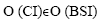
The process of finding candidate services: The process to find substitutable services consists of four steps. The first step is making first candidate services. US-Broker extracts services from Service group of target service should be substituted and makes candidate substitutable services list. Next, US-Broker checks whether between the model reference of candidate service and existing service, which will connect to substituted service. This process is based on from Eq. 1-4.
 | (1) |
 | (2) |
 | (3) |
 | (4) |
 | (5) |
Where:
| BSI.m | = | Modelreference of input parameter of existing services will be located back of substituted services |
| FSO.m | = | Modelreference of output parameter of existing services will be located front of substituted service |
| CI.m | = | Modelreference of input parameter of candidate substitutable service |
| CO.m | = | Modelreference of output parameter of candidate substitutable service |
| O | = | Ontology representing relationship service and service parameters |
According the location of services will connect to substituted service; candidate service satisfies equations from Eq. 1 to 4 or from Eq. 1 to 3 and 5. The third and last process is lifting and lowering process between different parameter types (Fig. 2) shows the parameter type matching process. The send Resource 2 On to.xslt can be used as a schema for mapping from Send Resource to Printer.wsdl to concepts in Ontology. The type of output parameter in WSDL document is postscript, and the normal type of output parameter defined PCL in Ontology.
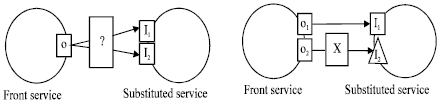 | |
| Fig. 1(a-b): | Considering cases during substitution; (a) case 1: Different number of parameters and (b) case 2: Different types of parameters |
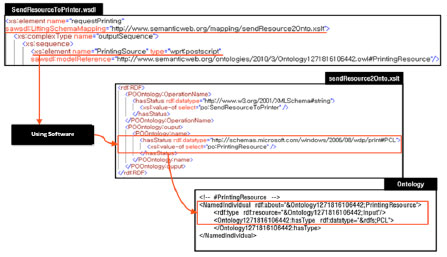 | |
| Fig. 2: | Type matching process |
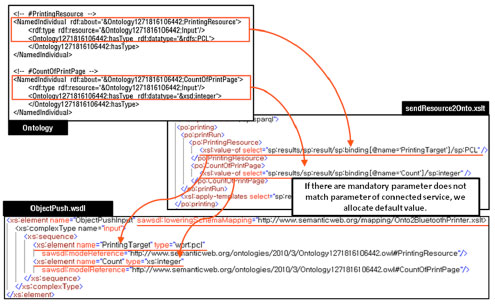 | |
| Fig. 3: | Structure matching process |
We support send Resource 2 Onto.xslt to mapping between different parameter types.
In addition, we address the problem about heterogeneous structures between parameters. This process is displayed in Fig. 3. Assuming SendResourceToPrinter.wsdl in Fig. 2 must connect to ObjectPush.wsdl in Fig. 3, ObjectPush.wsdl required the Count input is integer type and mandatory parameter. In this case, we support sendResource2Onto.xslt to allocate default value into Count input parameter automatically.
CONCLUSION
In order to enhance WSUN service substitution method, we use SAWSDL, which is Semantic Web Services technique. SAWSDL provides two construct: Modelreference and schemaMapping. A Modelreference specifies the association between a WSDL or XML Schema component and a concept in some semantic data. Semantic annotations using Modelreference help to discover substitutable operations. In addition, a schemaMapping solves the heterogeneity of I/O message structures and parameter types of operations. Consequently, even if the operation which has same functionality of unavailable operation, has different I/O message structures and parameter types of unavailable operation.
ACKNOWLEDGMENT
This research was supported by a grant (06KLSGB01) from Cutting-edge urban development-korean land spatialization research project funded by ministry of land, transport and maritime affairs
REFERENCES
- Kopecky, J., T. Vitvar, C. Bournez and J. Farrell, 2007. SAWSDL: Semantic annotations for WSDL and XML Scheam. IEEE Internet Comput., 11: 60-67.
CrossRefDirect Link