

Waseem Barkat
Faculty of Economics and Administration, University of Malaya, 50603 Kuala Lumpur, Malaysia
LiveDNA: 92.17083
Loo-See Beh
Faculty of Economics and Administration, University of Malaya, 50603 Kuala Lumpur, Malaysia
Asian Journal of Scientific Research
Year: 2018 | Volume: 11 | Issue: 3 | Page No.: 308-318


ABSTRACT
Background and Objective: Intellectual Capital IC has been much studied in developed nations, but less considered on developing countries. This study was conducted in the context of a developing country like Pakistan to discover its impact on organizational performance. This study aimed to develop a conceptual model and to measure the individual dimensional effects of intellectual capital (human, structural, relational and technological capital) on knowledge process capability as well as organizational performance in the context of a developing country. Methodology: The survey was conducted with 267 respondents from the textile industry in Pakistan. This research used structural equation modeling with partial least squares regression. The structural equation modeling (SEM) is applied to run the multiple regression analysis and the analysis is performed with Warp partial least square (WarpPLS) software. Results: Results corroborate that all dimensions of intellectual capital have significant positive effects on organizational performance, except for structural capital. Similarly, knowledge process capability is partially mediated with relational, human and technological capital. Conclusion: This study presents implications for human resource managers and policy makers by examining the various dimensions of intellectual capital on organizational performance in the context of a developing country. This study offers selected relevant intellectual capital dimensions in workplace settings and suggests the importance of knowledge process capability in an organizational context.
PDF Abstract XML References Citation
Article History
Received: September 07, 2017;
Accepted: November 01, 2017;
Published: June 15, 2018
Copyright: © 2018. This is an open access article distributed under the terms of the Creative Commons Attribution License , which permits unrestricted use, distribution and reproduction in any medium, provided the original author and source are credited.
How to cite this article
Waseem Barkat and Loo-See Beh, 2018. Influence of Intellectual Capital Dimensions on Knowledge Process Capability and Organizational Performance. Asian Journal of Scientific Research, 11: 308-318.
DOI: 10.3923/ajsr.2018.308.318
URL: https://scialert.net/abstract/?doi=ajsr.2018.308.318
DOI: 10.3923/ajsr.2018.308.318
URL: https://scialert.net/abstract/?doi=ajsr.2018.308.318
INTRODUCTION
Intellectual capital (IC) has been argued as one of the key elements for organizational value creation and has brought drastic productive changes in a competitive business environment1-3. However, in a quickly changing competitive market, merely owning knowledge resources does not ensure competitive advantage of the organization given that changes can be disruptive and uncertain. Accordingly, a careful approach is required to directly measure IC and performance4,5. The theory of knowledge-based view (KBV) considers knowledge process capability to be the key source for leveraging knowledge resources and performances5-7. The IC focuses on new methods to create value and the knowledge management process provides the needed inputs for the knowledge flow. The effective use of these two can bring success and viability for any organization8,9.
The IC is explained with various conceptualizations and its effect on performance. Most of the scholars explained IC in three dimensions, namely, human capital, structural capital and relational capital10-13. Moreover, the current study considers technological capital as a separate construct of IC. Bueno et al.14 used technological capital as a subpart of structural capital but did not test this criterion empirically.
The concept of knowledge management has been used and defined in various disciplines as well as contexts. However, a general consensus that knowledge management creates knowledge that ultimately add and generate values to the organization exists15,16. Knowledge process capability is significantly important for organizational success7,17. Hence, IC utilizes such knowledge management processes to improve organizational performances18.
Despite the vital significance of IC and its role on organizational performance, empirical research exploring the individual dimensional effect of IC on organizational performance remains scarce1,19. Investigating how such relationships differ from developed to developing economies is also interesting1,20. Similarly, imperative relations exist between IC and knowledge process capability, but inconsiderable empirical studies are conducted. How various aspects of IC influence knowledge process capability should be further explored5,18.
Accordingly, understanding the individual elements of IC and its relationship to organizational performance is crucial. This study contributes to the field of IC and knowledge process capability development for the following reasons. First, the individual dimensional effect of IC (human capital, structural capital, relational capital and technological capital) to organizational performance is explored. Second, the mediating role of knowledge process capability is also determined with IC and performance. Third, this study contributes to IC development application in a developing economy.
Human capital is the central and pivotal component of IC21,12. This criterion improves the economic values in an organization’s settings by skills, knowledge and experiences22,23. Human capital is defined as knowledge, skills, expertise, as well as capabilities in employees and are employed for organizational value creation3,21. Apart from tangible assets, employers should invest on such complex and inimitable intangible resources by giving quality training to employees and motivating them to share knowledge as well as experiences, which ultimately leads to organizational competitiveness24,25. Managers regularly mobilize and shape the collective talent, knowledge, brainpower and the eagerness of the employees for organizational challenges as well as opportunities26. A number of studies have asserted that human capital has positive effects on organizational performance in developed economies24,27,28. However, in developing economies, results are fairly satisfactory. Khalique et al.20 studied small and medium enterprises (SME’s) in Pakistan and confirmed the negative effect of human capital on organizational performance. Therefore, the current study will determine the effect of human capital on a large textile sector.
Structural capital fully belongs to organizations. This criterion includes all the processes, procedures, data bases and manuals that support organizational value creation12,27. An employee may have a good level of understanding or intellect, but the overall IC will not reach the highest level unless the organization improves its poor systems and procedures. This improvement can be attained only if an organization applies structural capital, which motivates employees to learn, apply new ideas and re-learn when they fail29. Basically, structural capital is a platform for employees to be creative in the organization and, compared with human capital, this criterion belongs totally to organizations. It provides an environment for organizational innovative learning, codification of information to knowledge and knowledge growth, which leads to highly productive firm performances.
Relational capital covers the relations that a company maintains with customers, suppliers and stakeholders29. Such relations develop knowledge capability30, which, in turn, contributes to organizational performance31. Relational capital connects organizations with the external environment and obtains information regarding customer’s needs and wants. Further, long-term and strong networks with clients boost customer loyalty toward organizations and help to inform organizations about their competitors’ capabilities32. According to Bontis29, this capital holds half of the business because companies gain knowledge from customers’ buying behavior. Managers should have a keen and sharp view on such capital. Therefore, this study explains relational capital as a cooperative relationship with customers, suppliers, stakeholders, governments and other agencies.
Among the other dimensions of IC, technological capital is also essential for organizational value creation. Scholars define the concept with different attributes, i.e., as a process of research and development (R and D)20, technological knowledge storage33 information and communication technology (ICT) knowledge, as well as operation and infrastructure. Further, Bueno et al.14 explained it as a set of ICT intangible formed by technical process innovation. Among various conceptualizations, this study proposes technological capital as ICT knowledge, (research and development) (R and D) and technological operations as well as infrastructure, which create competitive advantages for organizations20,34.
IC can be a productive tool for the organization to make knowledge available for the internal and the external environment35. Such a tool provides a learning platform for organizations to improve its process, procedures and system to enhance growth as well as successive relationships with customers and suppliers. However, many developing countries still lack such knowledge technology. According to McNamara36, technology shortage results from various factors, such as budget constraint, lack of technological knowledge as well as awareness, incompatible system and low level of IT equipment. Accordingly, this research utilizes the benefits of technological knowledge to envisage its growth in a developing economy.
Knowledge is considered as something broader, richer, as well as deeper than data and information. Davenport and Prusak37 defined knowledge as framed experiences, values, information and knowledge, which is available not only in repositories, but also in organizational processes, procedures, routines and norms. Organizations that have not developed their knowledge assets fail to survive38.
Knowledge process capability is a multi-faceted concept defined with different approaches and disciplines. Gold et al.39 defined knowledge process capability as knowledge acquisition, knowledge conversion and knowledge application. However, Filius et al.40 explained knowledge process capability in 5 sub segments: Knowledge acquisition, documentation, transfer, creation and application. Workforce obtains knowledge from the internal and the external environment as well as attains solutions through brainstorming meetings. Moreover, such sessions bring changes in procedures, policies and constructive knowledge for employees. In an organization, knowledge creation takes place through problem-solving and allocating new projects to employees. Lastly, knowledge is implemented by utilizing employees and customer experiences39,40.
Organizational performance has been explained in various perspectives. Moreover, organizational performance has been evaluated with different techniques in different studies and the operationalization as well as the conceptualization of such a concept is still progressing41,42. In the present study, organizational performance is measured by the management’s perception on internal sales, export growth, profitability and export profitability42-44. In addition, this study also gauges output per worker, value added per worker, cost of production and new product development45-47.
This research conceptual model is grounded on the theoretical perspectives of resource-based view (RBV) and knowledge-based view (KBV). According to Barney48 the resource-based theory provides a sustained competitive advantage, which is produced by organizational distinctive resources. Such resources ought to be valuable, rare, inimitable and non-substitutable. Resource-based view theory explains that all resources may not lead to organizational performance simultaneously and that resource utilization may differ across organizations and firms. In such case, the major challenge of organizations is to notify those resources that directly influence organizational performances49,50. According to Wernerfelt51, resources include not only products, but also tangible and intangible assets. Apart from the traditional tangible resources, numerous scholars investigated the intangible resources, such as IC (human, structural, relation and technological capital) and their effects on organizational performance27,29,52. Therefore, the current study used RBV as one of the base theories to depict the relationship between IC dimensions and organizational performances.
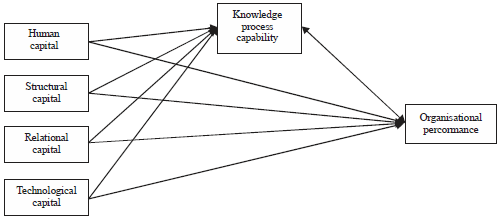
Furthermore, KBV theory considers knowledge as one of the most strategic resources of organizations7,53. Sustained competitive advantage can be achieved from such knowledge resources, which are difficult to imitate, considerably complex, heterogeneous and immobile. According to KBV theory, compared with tangible assets, knowledge-related resources highly contribute to attaining improved organizational performances7,53. Kianto et al.54 and Chen et al.55 expressed their opinion that organizations with productive background of IC can utilize their benefits with the proper usage of knowledge management processes and such knowledge management processes lead to improved organizational performances16,56. Therefore, this study utilized KBV theory to examine the indirect impact of IC on organizational performance (Fig. 1).
 | |
| Fig. 1: | Research Theoretical framework |
The most central and essential dimension of IC is human capital. Human capital with its inimitability elements brings competitive advantage in organizations24. The effective utilization of such valuable assets enhances creativity, which, in turn, brings improved organizational performances27,57. Employees need a sound working environment and management support to motivate them to complete their tasks efficiently and effectively. Among the dimensions of IC, structural capital serves as non-human knowledge resources to sustain and improve performances in a competitive business environment13,29,58. According to Zangoueinezhad and Moshabaki59, companies with conducive structural facilities communicate knowledge to employees, which help them perform well for organizational success.
Similarly, customers and suppliers are indirectly linked to businesses and this relationship is also as important as the other assets. Cousins et al.60 as well as Dewhurst and Navarro61 postulated that, by enhancing relations with customers and suppliers, companies gain promising ideas as well as experiences. On the other hand, Garcia-Merino et al.32 as well as Andreeva and Garanina1 portray the negative effects of relational capital on performance. They added that building relations with customers and suppliers takes time, thus, such capital has a delayed effect on performance. Subsequently, cultural effects also matter given that certain countries have already developed such capital that no longer brings competitiveness.
Lastly, technological capital plays an important role in organizations. Increasing business practices as well as improving efficiency and competitiveness have become a primary requirement for businesses20,62. However, such technology may differ in a different culture and also depends on the technology’s availability as well as usage36.
Accordingly, on the basis of the above analysis, authors have proposed the following hypotheses to show that, in a developing country perspective, a strong relationship exists between IC dimensions and organizational performances.
| H1: | Human capital has a strong positive effect on organizational performance |
| H2: | Structural capital has a strong positive effect on organizational performance |
| H3: | Relational capital has a strong positive effect on organizational performance |
| H4: | Technological capital has a strong positive effect on organizational performance |
Knowledge is a pivotal need for todays’ knowledge-based companies. Knowledge process capability needs an input, such as IC, to work in parallel and boost its utilization in organizations. IC and KM may be viewed as referring to knowledge stocks and processes, respectively63. Kianto et al.54 elaborated on the IC and KM relationship and how these 2 concepts are interlinked to support organizational performances.
Human capital plays a lead role to process such knowledge64. Jaw et al.28 elucidated that knowledge flow through human capital boosts organizational performances. The capabilities as well as teaching and leadership quality of senior managers should be used to produce an open-mind and conducive learning environment to encourage employees to complete their tasks. Similarly, companies’ structural reform helps knowledge creation. According to Nonaka et al.65, managers should create a learning environment by giving time, space and attention. Organizations can provide a good working space, a good database to reduce work hours and platforms for interaction to discuss common organizational goals. Such structural facilities promote prevailing knowledge and influence innovation in the organization3,58.
Moreover, relational capital is fairly important in the knowledge flow of organizations. Carmeli and Azeroual30 asserted that knowledge leads to constructive benefits for organizational performance. Moreover, customers and suppliers have wealth of knowledge and their efficient as well as effective utilization supports the organizations to accomplish the desired objectives29.
Currently, the role of technological capital is highly important in competitive and knowledge-based business organizations. Such technological capital promotes organizational effort for knowledge processes, i.e., knowledge acquisition, creation, integration and use66. Lopez et al.67 verified that ICT are positively associated with knowledge process capability. To apply such technology, firms must develop a knowledge strategy to provide the basis for the information technology strategy. In addition, Perez-Lopez and Alegre16 confirmed that IT plays a dominant role to enhance management processes, which leads to improved organizational performances. Accordingly, the following hypotheses are derived from the aforementioned conceptual model.
| H5: | Knowledge process capability mediates the relationship between human capital and organizational performance |
| H6: | Knowledge process capability mediates the relationship between structural capital and organizational performance |
| H7: | Knowledge process capability mediates the relationship between relational capital and organizational performance |
| H8: | Knowledge process capability mediates the relationship between technological capital and organizational performance |
MATERIALS AND METHODS
Measurements: A five-point Likert scale is applied for variable measurement, ranging from (1) = strongly disagree to (5) = strongly agree. A nine-item measurement of human capital was adopted form Bontis29 and Subramaniam and Youndt3. Structural capital was measured with 6 items developed by Bontis et al.27 and Roos et al.12. The remaining IC dimensions, such as relational capital and technological capital, were measured with 5 and 6 items, respectively. The items of both constructs are based on the works of previous researchers20,27,34,68. Knowledge process capability was measured with 6 items adopted from Filius et al.40. Finally, organizational performance was measured with 7 items42,44,47.
The present study is based on perceptual measures in collecting data for analysis. Kannan and Aulbur69 extensively discussed IC’s role in perceptual research. They asserted that such perceptual measures are crucial for employees’ performance, human capital development and overall organization’s performance. Furthermore, various studies have also used the perceptual measurement of IC and organizational performance52,70.
Sampling and data collection: This study is based on the textile industry in Pakistan, which has a tremendous contribution in the country’s exports. Furthermore, the textile sector accounts for 46% of the total manufacturing sector71. Large companies were selected for this study because such companies are more focused on knowledge and emphasized on IC. The survey data has been collected from January-June, 2017.
The respondents of this study are managerial level employees, distributed 525 questionnaires. The self-administrated and surface mail method was used for data collection. After discarding unusable responses, we used 267 usable responses in this study, with a response rate of 50.85%.
Statistical analysis: The SPSS software version 22 was used to find out the value of mean and standard deviation.
RESULTS AND DISCUSSION
For the measurement of measure, multiple regression analysis, warp partial least square (WapPLS) (version 0.5) was applied. Warp partial least square is Robust software of structural equation modelling that simultaneously deals with measurement and structural models. Moreover, WapPLS has the ability to automatically deal with missing data and applies different quality fit indices72.
Measurement model: The measurement model examined construct validity (convergent validity and discriminant validity) and reliability. Convergent validity was measured with factor loading (FL) and average variance extracted (AVE). Similarly, square root of AVE was checked to measure discriminant validity. Composite reliability and Cronbach alpha were used to measure reliability. Finally, block variance inflation factor was used to measure multicollinearity. The SPSS software was used to find out the value of mean and standard deviation. The value of mean ranged from3.782-4.148.
| Table 1: | Descriptive statistics and discriminant validity coefficients |
 | |
Diagonal in parentheses represents the square root of AVE while the other entries represent correlations | |
| Table 2: | Factor loading and reliability |
 | |
| CR: Composite reliability, AVE: Average variance extracted | |
All construct mean values were above a midpoint of 2.5. The standard deviation values ranged from 0.618-1.060, respectively. These values are reported in Table 1. The square root of AVE measures correlations among constructs and a construct has good discriminant validity if respondents fully understand questions related to a construct73. Table 1 shows the constructs in diagonal values, which refer to the square root of AVE and that all the diagonal constructs were greater than off-diagonal values. Accordingly, these results confirm that this study achieved discriminant validity.
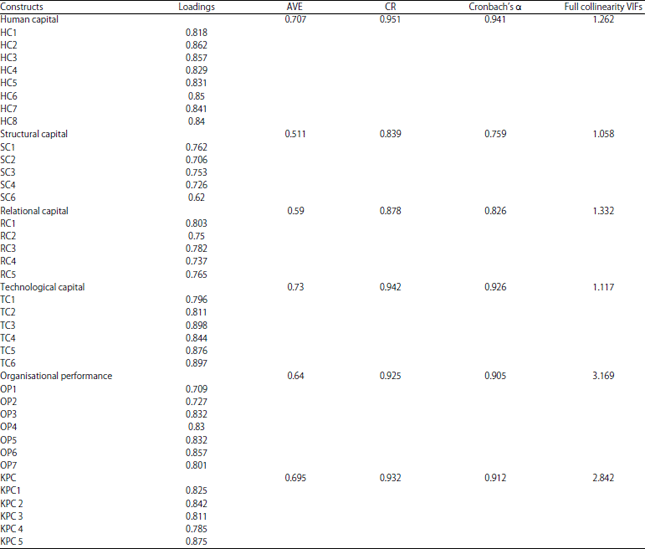
Table 2 reports FL, AVE, composite reliability, Cronbach alpha and full collinearity variance inflation factors.
 | |
| Fig. 2: | Estimated Model |
| Table 3: | Results of direct hypothesis testing (IC and organizational performance) |
 | |
| Table 4: | Mediation analysis (indirect effects) of model |
 | |
The results of FL ranged from 0.620-0.898, which fulfill the accepted criteria >0.574. However, 2 items (HC 9 and SC5), which did not fulfill the criteria, were deleted. The AVE values ranged from 0.511-0.707, achieving the cut-off value of 0.5. The composite reliability ranged from 0.839-0.951 and Cronbach alpha, from 0.759-0.941. All latent variables are within the acceptable satisfactory level of 0.7. The WarpPLS 5.0 also computes the vertical and lateral collinearity simultaneously among the constructs. The results ranged from 1.058-3.169, which fulfill the accepted criteria of below 3.3 Kock72.
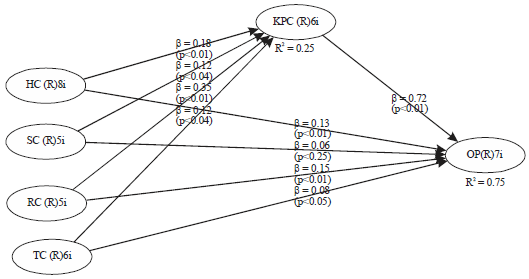
Assessment of the structural model: The hypothesized relationships among latent variables were discussed in the structural model (Fig. 2). Path coefficients and p-values were also calculated. The hypothesized model showed a model-data fit for all suggested indices. The values of average path coefficient were (APC) = 0.213, p = <0.001, average R-squared (ARS) = 0.503, p = <0.001, and average adjusted R-square (AARS) = 0.493, p = <0.001. The value of average block variance inflation factor (AVIF) was 1.154 (acceptable if <= 5, ideally <= 3.3) and Tenenhaus goodness of fit (GoF) = 0.570 (small >= 0.1, medium >= 0.25, large >= 0.36).
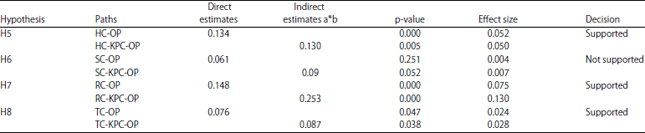
Table 3 exhibits the direct effects and Table 4 reports the mediation effects. The direct effect between human capital and organizational performance (β = 0.195, p = 0.002) was significant, thereby accepting H1. Moreover, the direct effect between relational capital and organizational performance (β = 0.426, p = 0.000) as well as technological capital and organizational performance (β = 0.206, p = 0.000) were significant, thereby supporting H3 and H4, respectively. The effect between structural capital and organizational performance were insignificant, thereby rejecting H2.
Table 4 shows the mediation analysis is shown. Boot strapping was applied for testing the mediation effect75,76. The indirect effect of human capital to organizational performance was (β = 0.130, p = 0.005), thereby accepting H5. The indirect effect of relational capital and organizational performance (β = 0.253, p = 0.000) as well as technological capital and organizational performance (β = 0.087, p = 0.038) were significant, thereby supporting H7 and H8, respectively. Lastly, the indirect effect of structural capital and organizational performance was insignificant, thereby rejecting H6.
This study tested a conceptual model by examining the different elements of IC, i.e., human, structural, relational and technological capital on knowledge process capability as well as organizational performance of textile companies in Pakistan. The outcome shows how intangible assets with knowledge process capabilities are able to generate organizational performance in developing economies, such as Pakistan.
This research inferred that the employees’ capability for organizational success is as important as other physical assets. Our results confirm the significant direct relationship between human capital and organizational performance and these findings are consistent with Bontis et al.27, who conducted a study in Malaysia and asserted that human capital is a strategic source for organizational success. Further, these results are also consistent with Felicio et al.77 and Wang et al.57. However, this result is not aligned with Khalique et al.20 outcome that shows a negative effect between human capital and organizational performance. One of the possible reasons is the difference in the industry type, where compared with SMEs, large companies have substantial setup and budget for human resource development. Similarly, the indirect relationship between human capital and organizational performance exists through knowledge process capability. These results are consistent with previous studies of Jaw et al.28 that managers should invest in human capital, which allows employees to absorb the importation of knowledge. In addition, such knowledge makes employees considerably knowledgeable for completing specific tasks. The owners and top management should also provide a learning and trustful environment that enables employees to share as well as apply their experiences for value-added product development and then improve the overall performance of the organization.
However, the direct and indirect relationships between structural capital and organizational performance are positive but non-significant. The outcomes of this study are aligned with Leitner78 research outcomes. While organizations in the developed countries have systematic organizational structures, organizations in developing countries, such as in Pakistan, lack databases, operating processes and procedures. Effective organizational design is needed to complete all structural requirements, which are obligatory in today’s competitive and technological environment.
Relations with customers, suppliers and other stakeholders enhance organizational performance. This result is aligned with Hormiga et al.31, which explained that companies should develop customers’ loyalty and good reputation. Such factor portrays a decisive role for the companies’ growth. Furthermore, knowledge process capability partially mediated between relational capital and organizational performance. The empirical results of Chen et al.55 also support the relationship between relational capital and knowledge process or transfer. Accordingly, relational capital through the partner’s involvement will strengthen the organization by implementing effective knowledge transfer activities. The outcome of the Carmeli and Azeroual30 study also supports the link of relational capital to knowledge combination capability (especially knowledge creation), which leads to organizational performance.
Finally, the role of technological capital is pivotal for organizational success. Similarly, knowledge process capability is equally important to boost up technological knowledge for organizational growth. The results of Perez-Lopez and Alegre16 also back the current study by proving the indirect effect of knowledge process capability between technological capital and organizational performance. Their results corroborate that the sole involvement of ICT is insufficient for organizational performance rather these technologies should be used to support the development of knowledge management processes which leads to better performance. Finally, the result of this study depicts that, similar to the developed countries, technological capital is equally important in developing countries, such as Pakistan, given that this criterion becomes an essential tool for organizations to deal with internal and external networks and knowledge.
Furthermore, IC has been the focus of researchers and practitioners. The past literature shows the competitiveness of IC and its effect on organizational performance. However, from the theoretical perspective, current study added new understanding by proposing imperative dimensions in IC, which is estimated to have significant values in the textile industry in Pakistan. Previous studies focused on the limited aspects of IC and their relationship with organizational performance (human capital, structural capital and relational capital), but the current study added knowledge in the literature by adding technological capital as a part of IC, which has been considered important by researchers. In addition, this research has empirical contribution by discussing about knowledge process capability as a mediating variable. Knowledge process capability shows significant outcomes, which indicates its importance in textile companies in Pakistan.
Similar to other studies, the present study has several limitations. First, the present study is cross-sectional and data are collected at a specific point in time. Second, this study is based on a single industry, future studies can include different industries and comparisons can be made. Third, the measurement instrument is a surveyed questionnaire and the results are based on the opinion and perception of informants. Although studies support perceptual measurements, they are highly susceptible to bias. Future studies can apply both measurements (perceptual and objective) and compare the results with the current study.
CONCLUSION AND DIRECTIONS FOR FUTURE RESEARCH
The present study tested a conceptual model to show the link among IC dimensions, i.e., human, structural, relational and technological capital with knowledge process capability as well as organizational performance. Using SEM for empirical analysis, this study supports the conceptual model with the following results: all dimensions of IC have significant positive relations with organizational performance, except for structural capital. Similarly, knowledge process capability partially mediated with relational capital, human capital and technological capital. These outcomes may be useful in developing countries, particularly in the context of Pakistan. Further, the results prove that knowledge-related resources have significant effects on companies in Pakistan and that further efforts could provide significant outcomes.
SIGNIFICANCE STATEMENT
This study added a new dimension of IC, the technological capital that has not been tested empirically. The results reveal that technological capital has significant positive relation with knowledge process capability and organizational performance. The findings of this study further confirm that IC has never been discussed in textile sector of Pakistan. The combination of various dimensions of IC provides new knowledge to the managers and policy makers to make better decision in textile and other manufacturing sectors.
ACKNOWLEDGMENTS
The authors would like to thank the University of Turbat (UOT), Department of Management Sciences for providing their support(Grant Number: PSDP 260) in this study. The authors are also grateful to the respondents of the survey for their precious time and support.
REFERENCES
- Andreeva, T. and T. Garanina, 2016. Do all elements of intellectual capital matter for organizational performance? Evidence from Russian context. J. Intellectual Capital, 17: 397-412.
CrossRefDirect Link - Subramaniam, M. and M.A. Youndt, 2005. The influence of intellectual capital on the types of innovative capabilities. Acad. Manage. J., 48: 450-463.
Direct Link - Eisenhardt, K.M. and J.A. Martin, 2000. Dynamic capabilities: What are they? Strategic Manage. J., 21: 1105-1121.
CrossRefDirect Link - Hsu, I.C. and R. Sabherwal, 2011. From intellectual capital to firm performance: The mediating role of knowledge management capabilities. IEEE Trans. Eng. Manage., 58: 626-642.
CrossRefDirect Link - DeCarolis, D.M. and D.L. Deeds, 1999. The impact of stocks and flows of organizational knowledge on firm performance: An empirical investigation of the biotechnology industry. Strategic Manage. J., 20: 953-968.
CrossRefDirect Link - Grant, R.M., 1996. Toward a knowledge-based theory of the firm. Strategic Manage. J., 17: 109-122.
Direct Link - Smith, K.G., C.J. Collins and K.D. Clark, 2005. Existing knowledge, knowledge creation capability and the rate of new product introduction in high-technology firms. Acad. Manage. J., 48: 346-357.
CrossRefDirect Link - Wiig, K.M., 1997. Integrating intellectual capital and knowledge management. Long Range Plann., 30: 399-405.
CrossRefDirect Link - Bontis, N., 1999. Managing organisational knowledge by diagnosing intellectual capital: Framing and advancing the state of the field. Int. J. Technol. Manage., 18: 433-462.
CrossRefDirect Link - Ngah, R. and A.R. Ibrahim, 2009. The relationship of intellectual capital, innovation and organizational performance: A preliminary study in Malaysian SMEs. Int. J. Manage. Innov. Syst., 1: 1-13.
Direct Link - Bueno, E., M.P. Salmador, O. Rodriguez and G.M. de Castro, 2006. Internal logic of intellectual capital: A biological approach. J. Intellectual Capital, 7: 394-405.
CrossRefDirect Link - Alavi, M. and D.E. Leidner, 2001. Review: Knowledge management and knowledge management systems: Conceptual foundations and research issues. MIS Q., 25: 107-136.
CrossRefDirect Link - Perez-Lopez, S. and J. Alegre, 2012. Information technology competency, knowledge processes and firm performance. Ind. Manage. Data Syst., 112: 644-662.
CrossRefDirect Link - Nonaka, I. and R. Toyama, 2005. The theory of the knowledge-creating firm: subjectivity, objectivity and synthesis. Ind. Corporate Change, 14: 419-436.
CrossRefDirect Link - Hsu, I. and R. Sabherwal, 2012. Relationship between intellectual capital and knowledge management: An empirical investigation. Decis. Sci., 43: 489-524.
CrossRefDirect Link - Wang, W.Y. and C. Chang, 2005. Intellectual capital and performance in causal models: Evidence from the information technology industry in Taiwan. J. Intell. Capital, 6: 222-236.
CrossRefDirect Link - Khalique, M., N. Bontis, A.B.S.J. Nassir and M.I.A. Hassan, 2015. Intellectual capital in small and medium enterprises in Pakistan. J. Intellectual Capital, 16: 224-238.
CrossRefDirect Link - Edvinsson, L., 1997. Developing intellectual capital at Skandia. Long Range Plann., 30: 366-373.
CrossRefDirect Link - Becker, G.S., 1962. Investment in human capital: A theoretical analysis. J. Political Econ., 70: 9-49.
Direct Link - Hatch, N.W. and J.H. Dyer, 2004. Human capital and learning as a source of sustainable competitive advantage. Strategic Manage. J., 25: 1155-1178.
CrossRefDirect Link - Mayo, A., 2000. The role of employee development in the growth of intellectual capital. Personnel Rev., 29: 521-533.
CrossRefDirect Link - Rastogi, P.N., 2003. The nature and role of IC: Rethinking the process of value creation and sustained enterprise growth. J. Intellectual Capital, 4: 227-248.
CrossRefDirect Link - Bontis, N., W.C.C. Keow and S. Richardson, 2000. Intellectual capital and business performance in Malaysian industries. J. Intellectual Capital, 1: 85-100.
CrossRefDirect Link - Jaw, B.S., C.Y.P. Wang and Y.H. Chen, 2006. Knowledge flows and performance of multinational subsidiaries: The perspective of human capital. Int. J. Hum. Resour. Manage., 17: 225-244.
CrossRefDirect Link - Bontis, N., 1998. Intellectual capital: An exploratory study that develops measures and models. Manage. Decis., 36: 63-76.
CrossRefDirect Link - Carmeli, A. and B. Azeroual, 2009. How relational capital and knowledge combination capability enhance the performance of work units in a high technology industry. Strategic Entrepreneurship J., 3: 85-103.
CrossRefDirect Link - Hormiga, E., R.M. Batista-Canino and A. Sanchez-Medina, 2011. The impact of relational capital on the success of new business start-ups. J. Small Bus. Manage., 49: 617-638.
CrossRefDirect Link - Garcia-Merino, J.D., L. Garcia-Zambrano and A. Rodriguez-Castellanos, 2014. Impact of relational capital on business value. J. Inform. Knowl. Manage., Vol. 13, No. 1.
CrossRefDirect Link - De Castro, G.M., M. Delgado-Verde, J. Amores-Salvado and J.E. Navas-Lopez, 2013. Linking human, technological and relational assets to technological innovation: Exploring a new approach. Knowl. Manage. Res. Pract., 11: 123-132.
CrossRefDirect Link - Garcia-Muina, F.E. and E. Pelechano-Barahona, 2008. The complexity of technological capital and legal protection mechanisms. J. Intellectual Capital, 9: 86-104.
CrossRefDirect Link - Ling, Y.H., 2013. The influence of intellectual capital on organizational performance-Knowledge management as moderator. Asia Pac. J. Manage., 30: 937-964.
CrossRefDirect Link - Gold, A.H., A. Malhotra and A.H. Segars, 2001. Knowledge management: An organizational capabilities perspective. J. Manage. Inform. Syst., 18: 185-214.
CrossRefDirect Link - Filius, R., J.A. de Jong and E.C. Roelofs, 2000. Knowledge management in the HRD office: A comparison of three cases. J. Workplace Learn., 12: 286-295.
CrossRefDirect Link - Neely, A., M. Gregory and K. Platts, 1995. Performance measurement system design: A literature review and research agenda. Int. J. Operat. Manage., 15: 80-116.
CrossRefDirect Link - Shoham, A., 1998. Export performance: A conceptualization and empirical assessment. J. Int. Market., 6: 59-81.
Direct Link - White, D.S., D.A. Griffith and J.K. Ryans Jr., 1998. Measuring export performance in service industries. Int. Market. Rev., 15: 188-204.
CrossRefDirect Link - Schreyer, P., 2001. The OECD productivity manual: A guide to the measurement of industry-level and aggregate productivity. Int. Prod. Monit., 2: 37-51.
Direct Link - Barney, J.B., 1991. Firm resources and sustained competitive advantage. J. Manage., 17: 99-120.
CrossRefDirect Link - Wade, M. and J. Hulland, 2004. Review: The resource-based view and information systems research: Review, extension and suggestions for future research. MIS Q., 28: 107-142.
Direct Link - Zack, M., J. McKeen and S. Singh, 2009. Knowledge management and organizational performance: An exploratory analysis. J. Knowl. Manage., 13: 392-409.
CrossRefDirect Link - Wernerfelt, B., 1984. A resource-based view of the firm. Strategic Manage. J., 5: 171-180.
CrossRefDirect Link - Asiaei, K. and R. Jusoh, 2015. A multidimensional view of intellectual capital: The impact on organizational performance. Manage. Decis., 53: 668-697.
CrossRefDirect Link - Grant, R.M., 1996. Prospering in dynamically-competitive environments: Organizational capability as knowledge integration. Organiz. Sci., 7: 375-387.
CrossRefDirect Link - Kianto, A., P. Ritala, J.C. Spender and M. Vanhala, 2014. The interaction of intellectual capital assets and knowledge management practices in organizational value creation. J. Intellectual Capital, 15: 362-375.
CrossRefDirect Link - Chen, C.J., H.A. Shih and S.Y. Yang, 2009. The role of intellectual capital in knowledge transfer. IEEE Trans. Eng. Manage., 56: 402-411.
CrossRefDirect Link - Valmohammadi, C. and M. Ahmadi, 2015. The impact of knowledge management practices on organizational performance: A balanced scorecard approach. J. Enterp. Inform. Manage., 28: 131-159.
CrossRefDirect Link - Wang, Z., N. Wang and H. Liang, 2014. Knowledge sharing, intellectual capital and firm performance. Manage. Decis., 52: 230-258.
CrossRefDirect Link - Huang, Y.C. and Y.C.J. Wu, 2010. Intellectual capital and knowledge productivity: The Taiwan biotech industry. Manage. Decis., 48: 580-599.
CrossRefDirect Link - Zangoueinezhad, A. and A. Moshabaki, 2009. The role of structural capital on competitive intelligence. Ind. Manage. Data Syst., 109: 262-280.
CrossRefDirect Link - Cousins, P.D., R.B. Handfield, B. Lawson and K.J. Petersen, 2006. Creating supply chain relational capital: The impact of formal and informal socialization processes. J. Operat. Manage., 24: 851-863.
CrossRefDirect Link - Dewhurst, F.W. and J.G.C. Navarro, 2004. External communities of practice and relational capital. Learn. Organiz., 11: 322-331.
CrossRefDirect Link - Indjikian, R. and D.S. Siegel, 2005. The impact of investment in IT on economic performance: Implications for developing countries. World Dev., 33: 681-700.
CrossRefDirect Link - Haas, M.R. and M.T. Hansen, 2005. When using knowledge can hurt performance: The value of organizational capabilities in a management consulting company. Strategic Manage. J., 26: 1-24.
CrossRefPubMedDirect Link - Argote, L., B. McEvily and R. Reagans, 2003. Managing knowledge in organizations: An integrative framework and review of emerging themes. Manage. Sci., 49: 571-582.
CrossRefDirect Link - Nonaka, I., R. Toyama and N. Konno, 2000. SECI, Ba and leadership: A unified model of dynamic knowledge creation. Long Range Plann., 33: 5-34.
CrossRefDirect Link - Sambamurthy, V. and M. Subramani, 2005. Special issue on information technologies and knowledge management. MIS Quart., 29: 1-7.
Direct Link - Kim, D.Y. and V. Kumar, 2009. A framework for prioritization of intellectual capital indicators in R&D. J. Intellectual Capital, 10: 277-293.
CrossRefDirect Link - Kannan, G. and W.G. Aulbur, 2004. Intellectual capital: Measurement effectiveness. J. Intellectual Capital, 5: 389-413.
CrossRefDirect Link - Sharabati, A.A.A., S.N. Jawad and N. Bontis, 2010. Intellectual capital and business performance in the pharmaceutical sector of Jordan. Manage. Decis., 48: 105-131.
CrossRefDirect Link - Fornell, C. and D.F. Larcker, 1981. Evaluating structural equation models with unobservable variables and measurement error. J. Market. Res., 18: 39-50.
CrossRefDirect Link - Preacher, K.J. and A.F. Hayes, 2004. SPSS and SAS procedures for estimating indirect effects in simple mediation models. Behav. Res. Meth. Instrum. Comput., 36: 717-731.
CrossRefDirect Link - Preacher, K.J. and A.F. Hayes, 2008. Asymptotic and resampling strategies for assessing and comparing indirect effects in multiple mediator models. Behav. Res. Methods, 40: 879-891.
CrossRefDirect Link - Felicio, J.A., E. Couto and J. Caiado, 2014. Human capital, social capital and organizational performance. Manage. Decis., 52: 350-364.
CrossRefDirect Link - Leitner, K.H., 2015. Intellectual capital, innovation and performance: Empirical evidence from SMEs. Int. J. Innov. Manage., Vol. 19, No. 5.
CrossRefDirect Link