

Oktay Erdogan
Nazilli Cotton Research Institute, Aydm, Turkey
Volkan Sezener
Nazilli Cotton Research Institute, Aydm, Turkey
Nedim Ozbek
Nazilli Cotton Research Institute, Aydm, Turkey
Taner Bozbek
Nazilli Cotton Research Institute, Aydm, Turkey
Ilkay Yavas
Faculty of Agriculture, Adnan Menderes University, Aydm, Turkey
Aydin Unay
Faculty of Agriculture, Adnan Menderes University, Aydm, Turkey
Asian Journal of Plant Sciences
Year: 2006 | Volume: 5 | Issue: 5 | Page No.: 867-870


ABSTRACT
This study was conducted in Aegean Region, western Turkey, in non-infected and naturally infected fields to determine the influence of verticillium wilt on yield and fiber quality parameters. The cotton cultivars, Nazilli 84 S (Aegean Region standard cotton cultivar), Carmen (tolerant to verticillium wilt) and Cukurova 1518 (susceptible to verticillium wilt) were used as a material. It was found that verticillium wilt significantly reduced the seed cotton yield, fiber length and fiber strength. Yield reduction was determined as 15.93%. Finally, Carmen was recommended for yield and fiber quality in infected area.
PDF Abstract XML References Citation
How to cite this article
Oktay Erdogan, Volkan Sezener, Nedim Ozbek, Taner Bozbek, Ilkay Yavas and Aydin Unay, 2006. The Effects of Verticillium Wilt (Verticilli1m dahliae Kleb.) on Cotton Yield and Fiber Quality. Asian Journal of Plant Sciences, 5: 867-870.
DOI: 10.3923/ajps.2006.867.870
URL: https://scialert.net/abstract/?doi=ajps.2006.867.870
DOI: 10.3923/ajps.2006.867.870
URL: https://scialert.net/abstract/?doi=ajps.2006.867.870
INTRODUCTION
Aegean cotton generally is considered to be the best quality and is preferred for its longer staple length by the local textile industry. Cotton production in Aegean Region for 2005 was 254,000 tones at 176,000 ha planting areas and lint yield was 1445 kg ha-1 (Ozudogru and Cakaryıldırım, 2005). Cotton diseases are one of the major constraints affecting yield and quality in Aegean Region. Especially, verticillium wilt incited by the soilborne fungus Verticillium dahlie Kleb., is found in many cotton fields. Onan and Karcılıoglu (1998) reported that pathotype of pathogen is SS-4 in Aegean Region.
Weather and cultural conditions that generally favor more severe occurrences of Verticillium wilt include prolonged periods of cool, wet weather, cool weather with frequent irrigations and cultural practices (such as excessive fertilization or irrigation) that encourage rank growth and delayed maturity. Continuous cropping with less-tolerant (more susceptible) cotton varieties and less aggressive crop rotations out of cotton has been shown to sustain or even increase levels of microsclerotia. Higher surface soil levels of microsclerotia have been shown to increase the chance of severe infections with more-susceptible varieties (Hutmacher et al., 2005).
Symptoms of Verticillium wilt are easily confused with two other widespread diseases, Fusarium wilt or yellows and bacterial wilt. However, Verticillium wilt is found mostly in temperate zones and is prevalent in the northern states having relatively low soil temperatures (optimum 21°C). The disease is most severe during cool to warm weather, but not as prevalent in hot weather. It is not unusual for every plant in a badly infested field to be infected, especially where susceptible crops have been grown for many years. If weather conditions are unfavorable for Verticillium development, only a slight reduction in yield or quality may occur. The fungus produces toxins that cause tyloses or gums to form in the vascular (water-conducting) tissues, resulting in a greatly decreased flow of water from the roots to the foliage (Anonymous, 1997).
The foliar symptoms of verticillium wilt were approximately 27% for Aegean Region, 25% for Cukurova and 16% South Eastern Anatolia in Turkey. The losses of seed cotton yield due to verticillium wilt were estimated 12, 12 and 10% for Aegean Region, Cukurova and South Eastern Anatolia, respectively (Esentepe, 1979; Sezgin, 1985; Sagir and Tatli, 1995).
Bejorano-Alcazar et al. (1997) revealed that the greatest yield reduction was observed in plants showing symptoms before opening of first flowers and yield increased with delay in the development of foliar symptoms after opening of the first bolls. Incidence of verticillium wilt foliar symptoms is highly influenced by inoculum density and the virulence of V. dahlia pathotypes prevailing in soil, as well as by air and soil temperature and cultivar tolerance (Bejorano-Alcazar et al., 1995). The correlation between seed cotton yield and wilt severity was negative, while correlations between lint percentage, fiber length, fiber fineness and fiber strength with wilt severity changed by susceptibility of cultivar (Kaymak et al., 1976). Fiber quality parameters were nagatively affected by verticillium wilt in especially high yielding cultivars (Yelin and Ersan, 1985; Kechagia and Xanthpoulos, 1998; Abbasi, 1998).
The objective of this study was to determine the influence of veriticillium wilt on yield and fiber quality parameters in two different fields.
MATERIALS AND METHODS
This study was conducted at Nazilli Cotton Research Institute (latitude 37044l-37049l N and longitude 27044l-27050l E) in 2004-2005. The cotton cultivars (Gossypium hirsutum L.), Nazilli 84 S (Aegean Region standard cotton cultivar), Carmen (tolerant to verticillium wilt) and Cukurova 1518 (susceptible to verticillium wilt) were used as a material.
Cotton cultivars were planted in two different fields to test the verticillium wilt performance of cultivars. One of the fields were infected field with non-defoliating pathotype V. dahliae Kleb., 24 p/g), other was non-infected (control). The experiments were arranged as a randomized complete block design with four replications. The plots were 12 m length and consisted of four each row. In this study, 60 kg ha-1 N and 60 kg ha-1 P2O5 were applied to soils as the pre-planting fertilizer from 20-20-0, 60 kg ha-1 N as pre-flowering fertilizer from ammonium nitrate (33%). The cultural managements such as irrigations and plant protection applicants were programmed according to recommended for Aegean Region cotton growing. Measured characteristics were seed cotton yield (kg ha-1), lint percentage (%), fiber length (mm), fiber fineness (mic) and fiber strength (g tex-1). Variance analysis and Fisher’s LSD mean separation tests at 0.05 probability level.
RESULTS AND DISCUSSION
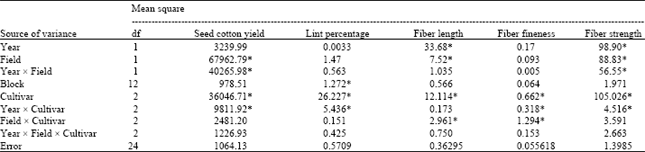
Results from the analysis of variance for observed characters were showed in Table 1. The differences between two years were found to be significant for fiber length and fiber strength, while yearly difference was non-significant for seed cotton yield. The effects of infected field or verticillium wilt on seed cotton yield, fiber length and fiber strength were significant. Also, the interaction of year x field were found to be significant for seed cotton yield and fiber strength. The differences among cultivars were significant for all characteristics and these differences changed year to year for all characters except fiber length.
The mean values of seed cotton yield for cultivars, years, fields and significant interactions were presented in Table 2. The highest seed cotton yields were obtained from non-infected field in both years. The seed cotton yield of 2005 infected field was higher than that of 2004. Therefore, it can be said that weather conditions and cultural applications during growing season affected occurrences of verticillium wilt (Hutmacher et al., 2005).
The difference between non-infected (4722.5 kg ha-1) and infected field (3969.9 kg ha-1) was 752.6 kg ha-1 or yield reduction was 15.93%. This loss of seed cotton yield due to verticillium wilt was higher than that of reported by Esentepe (1979) Sezgin (1985) and Sagir and Tali (1995). There was a significant interaction between year and cultivar. In both years, Carmen and Nazilli 84 S followed each other. Seed cotton yields of Cukurova 1518 were the lowest in both years. Because of non-significant interaction between field and cultivar, it can be said that cultivars showed similar reaction to verticillium wilt. Moreover, the differences among cultivars resulted from their yield capacity. Galanopoulou (2006) revealed that although there are not immune hirsutum varieties, there is great variability among them.
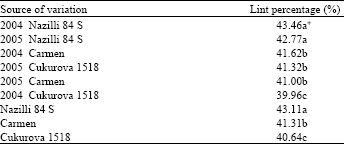
The differences among cultivars and year x cultivar interaction for lint percentage were found to be significant. The means of lint percentage were presented in Table 3. In both years, Nazilli 84 S had the highest lint percentage values (43.66%; 42.77%) and was followed by Carmen in 2004. Non-significant differences between non-infected and infected field and non-significant interaction between field and cultivar showed that lint percentage not affected by verticillium wilt.
| Table 1: | Variance analysis of yield and fiber quality characters |
 | |
| *, **; significant at probability level 0.05 and 0.01, respectively | |
| Table 2: | The mean of seed cotton yields about years, fields, cultivars and their interactions |
 | |
| +; Means in columns followed by the same letter are not significantly different (p>0.05) | |
| Table 3: | The means of lint percentage about cultivar and year x cultivar interaction |
 | |
| +; Means in columns followed by the same letter are not significantly different (p>0.05) | |
| Table 4: | The fiber length values for years, fields, cultivars and significant interactions |
 | |
| +; Means in columns followed by the same letter are not significantly different (p>0.05) | |
| Table 5: | The fiber fineness values for years, fields, cultivars and significant interactions |
 | |
| +; Means in columns followed by the same letter are not significantly different (p>0.05) | |
The correlation between lint percentage and verticillium wilt was changed by susceptibility of cultivar (Kaymak et al., 1976).
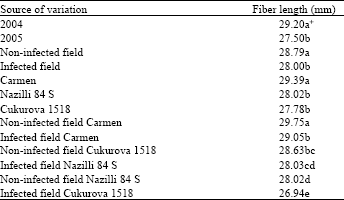
The differences between two years and fields for fiber length were found to be significant (Table 4). The fiber length value for non-infected field was significantly 2.82% higher and Carmen showed statistically significant performance (29.39 mm). Also, the interaction of field x cultivar demonstrated that Carmen was first rank in non-infected field and were followed Carmen in infected field and Cukurova 1518 in non-infected field. It can be said that Carmen was slightly affected from verticillium infection when a comparison among cultivars were evaluated. Similarly, Yelin and Ersan (1985) and El-Zik (1985) revealed that there was negative correlation between verticillium wilt and fiber length and fiber length shortened as infection of verticillium wilt increased.
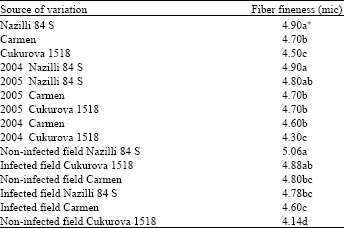
Aegean standard cotton cultivar, Nazilli 84 S, had the thickest fiber (4.90 mic) depending on their very high lint percentage and this cultivar followed by Carmen (4.70 mic) (Table 5). Also, the interaction of year x cultivar showed that although Nazilli 84 S were first rank in both years, Carmen and Cukurova 1518 in 2005 and Carmen in 2004 were second statistically group. Similarly, Nazilli 84 S in non-infected field had the thickest fiber, but other ranks changed. These results showed that although effects of year and verticillium infection on fiber fineness were significant, any factors not changed thick of Nazilli 84 S. On the other hand, it can be said that Carmen and Nazilli 84 S B were thicker in non-infected, while Cukurova 1518 in infected field had thicker fiber.
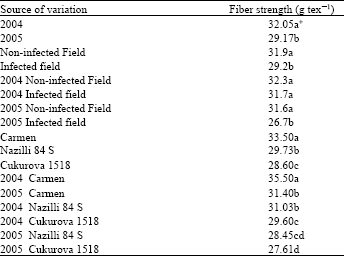
Both non-infected and infected field in 2004 and non-infected field in 2005 were statistically first group. The disease is most severe during cool to warm weather, but not as prevalent in hot weather. If weather conditions are unfavorable for verticillium development, only a slight reduction in yield or quality may occur (Anonymous, 1997). In this study, the interaction of year x field showed that infection severity of verticillium wilt changed year to year depending on weather conditions.
| Table 6: | The fiber strength values for years, fields, cultivars and significant interactions |
 | |
| +; Means in columns followed by the same letter are not significantly different (p>0.05) | |
Although 2005 was most suitable for verticillium wilt, fiber strength values of Carmen in both years were the most strength (35.5-31.4 g tex-1). These values followed by Nazilli 84 S (31.03 g tex-1) and then Cukurova 1518 (29.60 g tex-1) in 2004 (Table 6).
When yield and quality parameters of non-infected and infected fields were compared, verticillium wilt significantly reduced the seed cotton yield, fiber length and fiber strength. Yield reduction was determined as 15.93%. These effects changed year to year and the weather and soil conditions of 2005 increased the damage of verticillium wilt. The seed cotton yields of Carmen were the highest in both years. It was concluded that Carmen was slightly affected by verticillium wilt and Cukurova 1518 was determined as the most susceptible cultivar.
Non-significant differences between non-infected and infected field and non-significant interaction of field x cultivar showed that lint percentage not affected by verticillium wilt. In both years, Nazilli 84 S had the highest lint percentage values. If all fiber quality parameters were evaluated together, field x cultivar interaction for fiber length and fiber fineness, year x field and yield x cultivar interaction for fiber strength showed that the effects of verticillium wilt changed regarding to cultivars and years. It should be recommended that Carmen was the best cultivar for yield and fiber quality in infected area.
REFERENCES
- Bejorano-Alcazar, J., J.M. Melero-Vara, M.A. Blanco-Lopez and R.M. Jimenez-Diaz, 1995. Influence of inoculum density of defoliating and nondefoliating pathotypes of Verticillium dahliae on epidemics of verticillium wilt of cotton in southern Spain. Physiopathology, 85: 1474-1481.
Direct Link - Bejorano-Alcazar, J., M.A. Blanco-Lopez, J.M. Melero-Vara and R.M. Jimenez-Diaz, 1997. The influence of verticillium wilt epidemics on cotton yield in southern Spain. Plant Pathol., 46: 168-178.
Direct Link