

M. Arafa
Department of Civil Engineering, The Islamic University of Gaza, Gaza, Palestine
LiveDNA: 970.2959
S. Shihada
Department of Civil Engineering, The Islamic University of Gaza, Gaza, Palestine
M. Karmout
Department of Civil Engineering, The Islamic University of Gaza, Gaza, Palestine
Asian Journal of Materials Science
Year: 2010 | Volume: 2 | Issue: 1 | Page No.: 1-12


ABSTRACT
The aim of this study is to produce Ultra High Performance Concrete (UHPC) in Gaza strip using materials available at the local markets. Hence, different trial mixes are prepared to achieve a compressive strength in excess of 120 MPa. This study also includes the use of mineral admixture (silica fume), basalt aggregate, quartz sand and special type of fine aggregate (crushed quartz) in preparing these mixes. Furthermore, compressive strength, tensile splitting strength and flexural strength of UHPC mixes are evaluated. The test results reveal that it is possible to produce UHPC in Gaza Strip, with compressive strength in excess of 120 MPa using available materials, if these are carefully selected and properly mixed in such away to optimize a grain size distribution. Based on the results of this study, the modulus of rupture is about 9.0% of the compressive strength, while the tensile splitting strength is about 6.0% of the compressive strength. Moreover, a number of equations are developed for the prediction of tensile splitting strength and flexural strength in terms of compressive strength. The output of these equations conforms with the relationships available in the literature especially at an age of 28 days.
PDF Abstract XML References Citation
How to cite this article
M. Arafa, S. Shihada and M. Karmout, 2010. Mechanical Properties of Ultra High Performance Concrete Produced in the Gaza Strip. Asian Journal of Materials Science, 2: 1-12.
DOI: 10.3923/ajmskr.2010.1.12
URL: https://scialert.net/abstract/?doi=ajmskr.2010.1.12
DOI: 10.3923/ajmskr.2010.1.12
URL: https://scialert.net/abstract/?doi=ajmskr.2010.1.12
INTRODUCTION
In the mid 60’s, concrete with strengths ranging from 40 to 80 MPa was named High Performance Concrete (HPC). Its first use with significant quantities in major structures was in Chicago, USA. In the 70’s and 80’s, the first Ultra-High Performance Concrete (UHPC) was developed, Brunauer et al. (1973). The UHPC refers to materials with a cement matrix and a characteristic compressive strength, in excess of 120 MPa possibly attaining 200 MPa (Reda et al., 1999). The increase in compressive strength over HPC can be attributed to the particle packing and selection of specific constituent materials. Many studies are carried out on UHPC with basalt coarse aggregates such as those done by Orgass et al. (2004).
When UHPC is compared with normal and High Performance Concrete (HPC), the mechanical performance, durability and ductility of UHPC differ scientifically from normal and high strength concretes (Long et al., 2002; Scrivener and Kirkpatrick, 2008).
The UHPC is made using coarse, fine and micro fine aggregates, very low amounts of water, silica fume and high amounts of cement. Silica fume is an essential ingredient of UHPC which comprises of extremely fine particles that are not only filling the space between the cement grains, but also react with the cement, which increases the bond between the cement paste and aggregate particles (Orgass et al., 2004). Sufficient workability is obtained by using superplasticizers (Morin et al., 2001). The compressive strength reaches the same magnitude as that of reactive powder concrete RPC. The initial purpose of adding coarse aggregates is to reduce the cement usage so that the production cost is lowered. As a result of its superior performance, UHPC has found applications in the storage of nuclear waste, bridges, roofs, piers, long-span girders, shells and seismic-resistant structures. The relationship between indirect tensile strength (tensile splitting strength, modulus of rupture) and compressive strength of UHPC is of particular interest and is evaluated by Hugues et al. (2008) and Graybeal (2005) using empirical equations. The results indicate that the square root of the compressive strength is related to the indirect tensile strength through a linear constant multiplier.
The usage of high strength concrete with compressive strengths greater than 120 MPa in structural applications has increases worldwide and is expected to have an impact on Gaza strip due to the limited land area and the growing population. Based on what is mentioned above, this study intends to produce, for the first time, Ultra High Performance Concrete (UHPC) in Gaza strip and investigate its mechanical properties, using materials available at the local markets.
MATERIALS AND METHODS
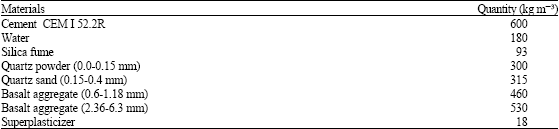
UHPC constituent materials used in this study, which was conducted in 2008, included High Strength Portland Cement CEM I 52.2R. This cement is manufactured by Nesher Cement, Inc. of Israel and conforms to ASTM C150 (2009) specifications, quartz sand and basalt aggregate. The nominal size of crushed basalt ranges from 0.6 to 6.3 mm, while that of quartz sand is in the range of 0.2 to 0.4 mm. The specific gravity is 2.8 and absorption is 1.48% for basalt. For quartz sand, the specific gravity is 2.66 and the absorption is 0.62%. Crushed quartz powder of a maximum size of 150 μm is used as very fine aggregate. The very fine particles have sizes ranging have from 0.1 to10 μm to fill the gaps between the cement grains while the larger particles have sizes ranging from 10 to150 μm to fill the gaps between the fine aggregate grains resulting in much denser matrix. Grey silica fume with SiO2 as main chemical component (95%), conforms to the requirements of ASTM C1240-05 (2005) is used. In addition, a superplasticizer PLAST.B101P, delivered from YASMO MISR company of Egypt is used to ensure suitable workability. Proportions of these constituent materials have been chosen carefully in order to optimize the packing density of the mixture as shown in Table 1.
Preparation of UHPC in the Laboratory
UHPC mixes were prepared in the Soil and Material Lab at IUG-Gaza. After the required amounts of all constituent materials were weighed properly, the next step was to mix them.
| Table 1: | UHPC Mixture proportions |
 | |
The mixing procedure included the following steps:
| • | Adding 40% of superplasticizer to the mixing water |
| • | Placing all dry materials (cement, silica fume, crushed quartz and aggregate) in the mixer pan and mixing for 2 min |
| • | Adding water (with 40% of superplasticizer) to the dry materials, mixing slowly for 2 min |
| • | Waiting for one minute before adding the remaining superplasticizer amount to the dry materials and mixing for 30 sec |
| • | Continuation of mixing until UHPC changes from a dry powder to fresh concrete |
The casting of all UHPC specimens used in this study was completed within 20 min after mixing. All specimens were cast and covered with burlap and thin plastic sheeting to prevent evaporation.
Test Specimens
The carried tests are focused on the mechanical properties including compressive strength and indirect tensile strength (tensile splitting strength and flexural strength) of UHPC which are measured at 3, 7, 14 and 28 days.
The following specimens are cast and tested:
| • | For compressive strength tests, 100x100x100 mm cubes based on ASTM C109 (2008) are used |
| • | For tensile splitting strength tests, 150x300 mm cylinders based on ASTM C496 (2004) are used |
| • | For modulus of rupture tests, 100x100x500 mm prisms based on ASTM C293 (2008) with central point load, are used |
RESULTS AND DISCUSSION
Compressive Strength Results
Table 2 shows that average compressive strength results at ages of 3, 7 and 14 days are about 55, 75 and 87%, respectively, of the 28 day average compressive strength. The UHPC has an average compressive strength of 128 MPa at age 28 days. Curing is done at 25°C by immersion in water without heat treatment.
Strength Versus Time Relationship
ACI 209R-92 (2002) recommends Eq. 1 for the prediction of compressive strength (fc)t of normal strength concrete at any time; that is for strengths up 41 MPa.
 | (1) |
Where:
| a | = | 4 (cement type I) |
| β | = | 0.85 (moist curing) |
| (fc)28 | = | 28-day strength |
| t | = | The age of tested concrete |
The ratios of compressive strength at any concrete age (fc)t to the compressive strength of concrete at 28 days (fc)28 for tested UHPC cubes and the corresponding ratios for Normal Strength Concrete (NSC), calculated using Eq. 1, are shown in Fig. 1.
| Table 2: | UHPC compressive strength test results at different ages |
 | |
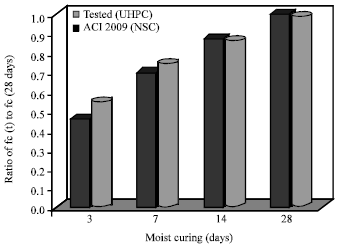 | |
| Fig. 1: | Comparisons of (fc)t /(fc )28 ratios for UHPC and NSC at different ages |
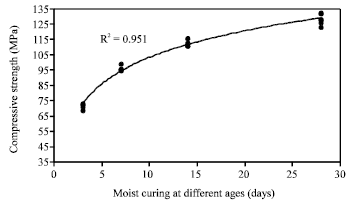 | |
| Fig. 2: | Compressive strength versus time from casting |
In Fig. 1, the compressive strength of UHPC increases more rapidly than NSC for 3 and 7 days of age. The strengths achieved at 3 and 7 days are about 56%, 75% of the 28 days strength, respectively. The mix, achieved about 88% of the 28-days strength at 14 days, is similar to normal strength concrete in behavior.
A regression analysis is conducted with a 90% confidence, based on the test results, in order to develop an equation that is comparable to equation (1) recommended by ACI 209R-92 (2002). In the developed equation, the parameters are taken as a =3 and β = 0.9, as expressed in Eq. 2 with regression value R2 of 0.951.
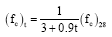 | (2) |
 | |
| Fig. 3: | Compressive strength versus density |
| Table 3: | UHPC tensile splitting strength at different ages |
 | |
Figure 2 shows the predicted compressive strength of tested UHPC cubes using Eq. 2 which may accurately evaluate the compressive strength gain of UHPC any time, (fc)t. This equation includes the time in days after casting, t and the 28-days compressive strength, (fc)28, in MPa units.
Compressive Strength Versus Density
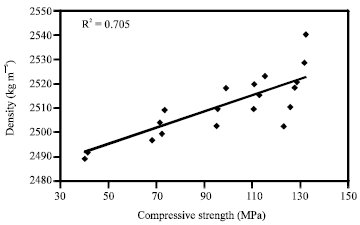
It is shown in Fig. 3 that there is a slight increase in compressive strength as the density increases. The results show that the values of UHPC density range from 2511 to 2530 kg m-3, with a mean value 2520 kg m-3. Estimating the density of UHPC as 2500 kg m-3 is quite reasonable.
The increase in concrete specimen's density may be explained by the continuous hydration of the main cement compounds such as C2S and C3S, liberating free calcium hydroxide hydrate. When silica fume is added to fresh concrete, it chemically reacts with calcium hydroxide hydrate (CH) to form calcium hydroxide hydrate (CSH). These calcium silicate hydroxide hydrates fill up the more open pores and the water in pores is removed. Thus, the bulk density increases and the total pore volume decreases.
Workability
The slump value for UHPC mix is 5.4 cm and is achieved by adding a 3% of cement weight dosage of the superplasticizer. This slump is considered of stiff plastic consistency (ACI 211.1-91, 2002). The workability is good and can be satisfactorily handled when the concrete is to be consolidated using external or internal vibrators.
Indirect Tensile Strength Results
Tensile Splitting Test Results
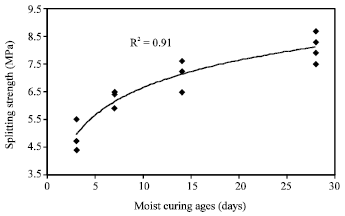
According to the results shown in Table 3, UHPC has a mean tensile splitting strength of 8.1 MPa at 28 days. The mean tensile splitting strength increases rapidly up to 14 days, after that it increases gradually up to 28 days.
 | |
| Fig. 4: | Tensile splitting strength versus time |
The tensile splitting strength achieved about 60, 78 and 88% of the 28 day at 3, 7 and 14 days, respectively. This is may be attributed to the higher content of silica fume which increases the bond between the cement paste and the aggregate particles, thus reducing the pores in cement paste.
Using the results obtained from the experimental program, a regression analysis, with a correlation coefficient of 0.91, was conducted in order to set an equation for predicting the tensile splitting strength of UHPC at any time, (fsp)t, as shown in Fig. 4 and Eq. 3.
 | (3) |
Where:
| (fsp)28 | = | The splitting strength at 28 days in MPa |
| t | = | The time in days |
The Relationship Between Tensile Splitting Strength, Modulus of Rupture and Compressive Strength at Different Ages
The relationship between the tensile splitting strength, modulus of rupture and compressive strength, for compressive strength concrete up to 70 MPa, is commonly established in two forms, as given by Eq. 4:
 | (4) |
 | (5) |
The two constants a and b are variant, as indicated by Ahmad and Shah (1985) and ACI 363R-92 (2002), where fsp is the splitting cylinder strength, fr is the modulus of rupture and fc is the compressive strength.
The Relationship Between Modulus of Rupture and Compressive Strength
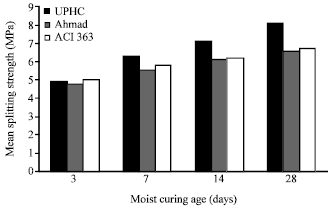
Figure 5 shows that at a moist curing age of 3 days, the tested tensile splitting strength values of UHPC are very close by those evaluated by Ahmad and Shah (1985) and ACI 363R-92 (2002) equations, which are valid for Normal Strength Concrete (NSC). At curing ages of 7 and 14 days, the tested UHPC specimens give tensile splitting strength values that are higher than those predicted by the above-mentioned references.
 | |
| Fig. 5: | Comparisons of tested and estimated tensile splitting strength of UHPC |
 | |
| Fig. 6: | Relationship between tensile splitting strength and compressive strength of UHPC at different ages |
For the moist curing age of 28 days, it is noticed that for UHPC concrete, the equation recommended by ACI 363R-92 (2002) underestimates the results by about 17%, while Ahmad and Shah (1985) equation underestimates the results of UHPC by about 19%. This is explained by the fact that the mentioned equations are developed for concretes with 28 days compressive strengths of 41 MPa.
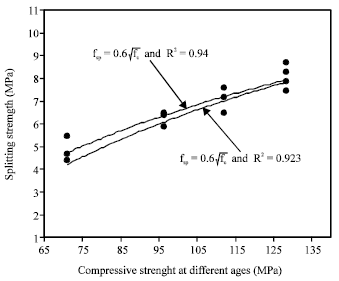
Adjustment of the equations proposed by Ahmad and Shah (1985) and ACI 363R-92 (2002) shown by Eq. 4, for the relationships between the tensile splitting strength and compressive strength at different ages is done using regression analysis based on the UHPC test results. The constant a is adjusted and the power value b will be kept the same as in Ahmad and Shah (1985) and ACI 363R-92 (2002) equations as shown in Fig. 6.
The relationships are proposed in Eq. 6 and 7 as follows:
 | (6) |
 | (7) |
 | |
| Fig. 7: | Comparisons of tensile splitting strength to compressive strength at different ages |
| Table 4: | UHPC modulus of rupture at different ages |
 | |
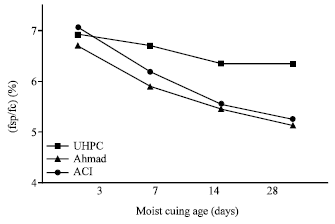
Figure 7 shows the ratios of tensile splitting strength to compressive strength for different ages of UHPC specimens. It is noticed that the test evaluates tensile splitting strength, (fsp), to the compressive strength, (fc), ratio, (fsp/fc) decreases as the curing time increases.
The ratios obtained by Weisse (2003) for UHPC and Hugues et al. (2008) for HSC varied from 6.5 to 7.5% and from 5.5 to 6.5%, respectively. In this study on UHPC, the mean ratio varied from 6 to 7%, while for Ahmad-Shah and ACI 363R-92 equations the mean ratio varied from 5 to 7%, with age.
Modulus of Rupture Test Results
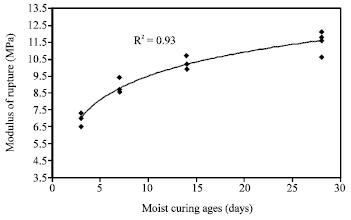
According to the results shown in Table 4, UHPC achieves a mean modulus of rupture of 11.7 MPa at 28 days. The mean modulus of rupture increases rapidly up to 14 days. After that, it increases gradually up to 28 days. At 3, 7 and 14 days, the modulus of rupture achieves about 59, 77 and 89% of the 28 days strength, respectively. This may be attributed to better bond due to the usage of silica fume which is the most effective way of densifying the Interfacial Transition Zone (ITZ).
A fitting function, with a correlation coefficient of 0.93, is set by regression analysis to predict the modulus of rupture of UHPC at any time, (frp)t, as shown in Fig. 8. The output is expressed in Eq. 8.
 | (8) |
Where:
| (frp)28 | = | Modulus of rupture at 28 days, in MPa |
| t | = | The time in days |
 | |
| Fig. 8: | Relationship between modulus of rupture of UHPC and curing time |
 | |
| Fig. 9: | Comparisons of modulus of rupture and estimated modulus of rupture |
 | |
| Fig. 10: | Relationship between the modulus of rupture and compressive strength at different ages for tested UHPC specimens |
The Relationship Between Modulus of Rupture and Compressive Strength
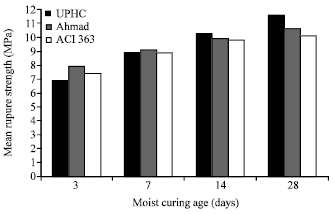
Figure 9 shows that for the moist curing age of 3 days, there is high variation in values of flexural modulus strength for the tested UHPC specimens and the equations developed for NSC. At the curing ages of 7 and 14 days, ACI 363R-92 (2002) equation, Ahmad and Shah (1985) equation and the tested UHPC specimen results for flexural modulus of rupture become close.
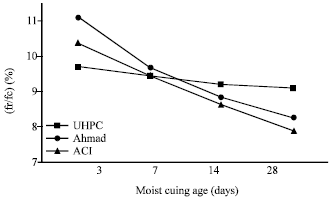 | |
| Fig. 11: | Comparisons of modulus of rupture (fr) to compressive strength (fc) at different curing ages |
It may be seen that for UHPC concrete, the equation recommended by ACI 363R-92 (2002) underestimates the results by 13%, while Ahmad-Shah equation underestimates the results of UHPC by 9%.
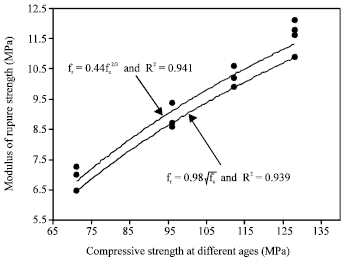
The relation ships between modulus of rupture and compressive strength of UHPC at different ages can be established statistically by performing regression analysis, as shown by Eq. 9 and Fig. 10:
 | (9) |
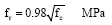 | (10) |
Figure 11 shows the ratios of modulus of rupture to compressive strength for different ages of UHPC specimens. The evaluated ratio of modulus of rupture, (fr), to the compressive strength, (fc), ratio, (fr/ fc) decreases as the curing time increases.
The ratio obtained for UHPC by Marco and Yvette (2004) varies from 6.5 to 9.5%, for three point flexural tests. The results of this study showed a mean ratio of 9.5%, while Ahmad-Shah (1985) and ACI 363R-92 (2002) equations yields ratios ranging from 8 to 11%, with age.
CONCLUSIONS
Based on the results of this particular testing program, the following conclusions may be drawn out:
| • | It is possible to produce UHPC with a minimum compressive strength of 120 MPa at 28 days in Gaza strip using materials available at Gaza local markets if they are carefully selected and mixed. Such concretes are produced using crushed basalt, quartz sand crushed quartz and silica fume as a mineral admixture |
| • | A flexural strength of about 11 MPa may be attained using the same materials |
| • | Because of the large amounts of cement Type (I), silica fume, along with low W/C ratios, the strength development of UHPC concretes is much more rapid in the first 7 days than predicted by the current recommendations of ACI 209R-92 (2002) for normal-strength concrete. The subsequent rate of strength growth is comparable to that predicted by the ACI method |
| • | The modulus of rupture is about 9% of the compressive strength while the tensile splitting strength is about 6% of the compressive strength |
| • | The tensile splitting strength and modulus of rupture of UHPC calculated using ACI 363R-92 (2002) and Ahmad and Shah (1985) equations are found to give lower values compared to the tests carried out in this study |
ACKNOWLEDGMENT
The authors extend their gratitude to the Director and the Staff of the Material and Soil Testing Laboratory at IUG-Gaza for providing the equipment and facility required for carrying out the experimental program.
REFERENCES
- ASTM C496/C496M-04e1, 2004. Standard Test Method for Splitting Tensile Strength of Cylindrical Concrete Specimens. American Society for Testing and Materials Standard Practice, Philadelphia.
Direct Link - ASTM C 1240-05, 2005. Standard Specification for Silica Fume Used in Cementitious Mixtures. American Society for Testing and Materials Standard Practice, Philadelphia, Pennsylvania, USA.
CrossRefDirect Link - ASTM C109/C109M, 2008. Standard Test Method for Compressive Strength of Hydraulic Cement Mortars (Using 2-in. or [50-mm] Cube Specimens). American Society for Testing and Materials Standard Practice, Philadelphia, Pennsylvania.
Direct Link - ASTM C293-08, 2008. Standard Test Method for Flexural Strength of Concrete (Using Simple Beam With Center-Point Loading). American Society for Testing and Materials Standard Practice, Philadelphia, Pennsylvania.
CrossRefDirect Link - Brunauer, S., M. Yudenfreund, I. Odler and J. Skalny, 1973. Hardened portland cement pasted of low porosity, VI mechanism of the hydration processes. Cem. Concr. Res., 3: 129-147.
CrossRef - Long, G., X. Wang and Y. Xie, 2002. Very-high-performance concrete with ultrafine powder. Cem. Concr. Res., 32: 601-605.
CrossRef - Morin, V., F.C. Tenoudji, A. Feylessourfi and P. Richard, 2001. Superplasticizer effects on setting and structuration mechanisms of ultrahigh-performance concrete. Cem. Concr. Res., 31: 63-71.
CrossRef - Orgass, M., F. Dehn, J. Ma and N. Tue, 2004. Comparative investigations on ultra-high performance concrete with and without coarse aggregates in ultra high performance concrete. Proceeding of the International Symposium on Ultra-High Performance Concrete, Sept. 13-15, Kassel University Press, Germany, Kassel, pp: 205-212.
- Reda, M.M., N.G. Shrive and J.E. Gillott, 1999. Microstructural investigation of innovative UHPC. Cem. Concr. Res., 29: 323-329.
CrossRef - Scrivener, K. and R.J. Kirkpatrick, 2008. Innovation in use and research on cementitious material. Cem. Concr. Res., 38: 128-136.
CrossRef