



S. Antony Raj
Department of Physics, St. Joseph`s College (Autonomous), Trichy, 620 002, India
N. Lawrence
Department of Physics, St. Joseph`s College (Autonomous), Trichy, 620 002, India
Asian Journal of Applied Sciences
Year: 2016 | Volume: 9 | Issue: 1 | Page No.: 30-33
ABSTRACT
The charge density wave system 1T-TaTe2 is a current topic of interest due to its interesting phase change phenomenon at the transition temperature. In this study, the theoretically calculated values of specific heat capacity, thermal conductivity and Debye Waller factor of 1T-TaTe2 in both the normal and CDW phases have been reported. Present results account the phase change phenomenon in agreement with the experimental results.
PDF Abstract XML References Citation
Article History
Received: June 08, 2015;
Accepted: August 06, 2015;
Published: December 03, 2015
How to cite this article
S. Antony Raj and N. Lawrence, 2016. Lattice Dynamics of 1T-TaTe2. Asian Journal of Applied Sciences, 9: 30-33.
DOI: 10.3923/ajaps.2016.30.33
URL: https://scialert.net/abstract/?doi=ajaps.2016.30.33
DOI: 10.3923/ajaps.2016.30.33
URL: https://scialert.net/abstract/?doi=ajaps.2016.30.33
INTRODUCTION
Charge Density Wave (CDW) phenomena have been observed predominantly in transition metal dichalcogenide layered compounds (Rossnagel, 2011; Zhu et al., 2015). The electron-phonon coupling (Gor'kov, 2012; Sadowski et al., 2013; Zhu et al., 2015) triggers the phase transition in these compounds, because of lattice instability and in-turn results in abnormal variation in their thermal properties. One of the 1T phase layer structured transition metal dichalcogenides namely 1T-TaTe2 exhibits charge density wave phenomena below 180 K. This compound has similar crystal structure like CdI2 with octahedral coordination between the transition metal ion and six chalcogen atoms (Wilson et al., 1974). Van der walls type of interaction exists between the three layers of this compound. A Commensurate Charge Density Wave (CCDW) super lattice of size  has been observed below 180 K for this compound (Sharma et al., 2002).
Phonon dispersion curves for the normal phases of 1T-TaS2 compound were calculated by Takaoka and Motizuki (1980) using rigid ion model and shell model which is applicable for this compound also. The phonon dispersion curves and specific heat capacity variation with temperature have been calculated for the normal and CDW phases employing Born-Von Karmann formalism with necessary boundary conditions.
Neutron Scattering experiments have been performed by Di Salvo et al. (1976) in which they observed the new phonon modes in the first Brillouin zone as an effect of charge density wave induced atomic displacements.
From literature, it is clear that this system is a subject of much experimental study than theoretical study. Hence in this work; the theoretically calculated values of Debye Waller factor B(k) for various temperatures for both types of atoms in both phases have been reported. In addition to this the worked out thermal conductivity values for various temperatures in both phases have also been presented.
MATERIALS AND METHODS
Method of calculation: Based on the Born von Karman formalism, the dynamical matrix was constructed using the force constants evaluated by employing Pawley’s potential (Dietrich et al., 1975) and optic phonons. The calculated force constant values in units of 104 dynes cm–1 has presented below:

The diagonalization of dynamical matrix of the order (18×18) yields the eigenvalues and the eigenvectors. Using the calculated phonon frequency modes, the normal phase properties were computed for 84 wave vector points derived from the Brillouin zone Di Salvo et al. (1976). For the CCDW phase the computation is done for a set of 180 wave vector points obtained using folding technique. With the computed phonon frequency distribution, all the three thermal properties of 1T-TaTe2 have been computed.
RESULTS AND DISCUSSION
The distribution of computed frequency modes are depicted in Fig. 1. The * and • marked curves respectively are for the normal and CCDW phases. It can be noted from the frequency distribution curves that the peaks in the CCDW phase have shifted slightly from that of normal phase. There are no reported values of phonon frequency distribution for this system available in the literature. Hence, this study’s result is compared with the curves for 1T-TiSe2 and 1T-TaS2, which is of the same structure. In the case of 1T-TiSe2 the phonon frequency modes were concentrated in the higher frequency modes comparing to normal phase. Similarly, in 1T-TaSe2 more number of frequencies is distributed in the higher frequency domain in CCDW phase in comparison with regular phase (Balaguru et al., 2001). Presented results from this study also behaved in the same way.
The specific heat capacity values for different temperatures have been calculated for both the phases using the phonon frequencies of these phases. The specific heat capacity versus temperatures curve is shown in Fig. 2. The curve shows a normal behaviour except a discontinuity at the transition temperature 180 K. Hence, this curve supports the phase change phenomenon (Balaguru et al., 2002).
Using these phonon, frequencies and eigen vectors the Debye Waller factors for Ta and Te atoms for both phases were calculated is depicted in Fig. 3. The mark ⊕ is for Ta atom and the * mark is for Te atom. An abnormal transition was observed at the phase transition temperature. At the phase transition, for Ta atoms there is a slight decrease in W (k) but for the Te atoms there is an increase of this factor.
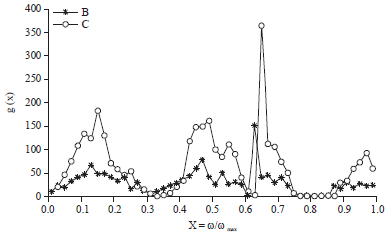 | |
| Fig. 1: | X versus g(x) frequency distribution curves |
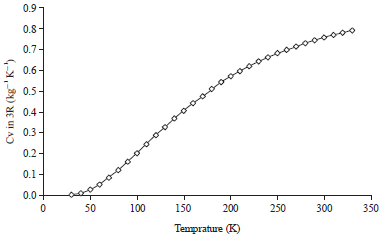 | |
| Fig. 2: | Specific heat capacity versus temperature |
 | |
| Fig. 3: | Debye-Waller factor for Ta(⊕) and Te(*) |
But an interesting abnormal behaviour has been observed in CCDW phase. Based on this phase higher mass Te has high value and lower mass Ta has low value is reported. This may be attributed to the change in peak position in the frequency distribution curve in CCDW phase.
The estimated thermal conductivity values of 1T-TaTe2 are graphed in Fig. 4. This curve also shows an interesting discontinuity at the transition temperature. Moreover, the thermal conductivity values have been found to be high in the low temperature region. This might be the result of increased number frequency modes in the CCDW phase.
There are neither experimental nor other theoretical results available to compare this work results with them. A similar result has been found for 1T-TaS2 (Rayappan et al., 2010).
This study has been compared the onset of CDW in the 1T type transition metal dichalcogenides like 1T-TaS2 (Takaoka and Motizuki, 1980; Rayappan et al., 2010), 1T-TaSe2 (Balaguru et al., 2001), 1T-TiSe2 (Di Salvo et al., 1976; Takaoka and Motizuki, 1980). The variations in the transition temperature play a significant role in determining the CDW induced phase transitions. In addition, the structure variations of supper lattice (Di Salvo et al., 1976) decide the number modes of vibrations in-turn decide the thermal properties like specific heat capacity, thermal conductivity, etc. of these layered compounds.
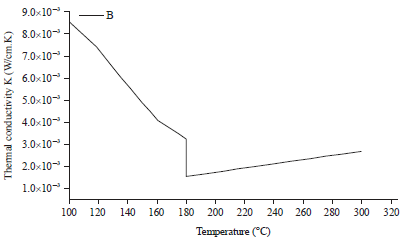 | |
| Fig. 4: | 1T-TaTe2 thermal conductivity results |
CONCLUSION
The phonon frequency distribution of the charge density wave system 1T-TaTe2 was computed for a set 84 wave vector points. The computed frequency distributions of both the phases were used to compute the thermal properties of 1T-TaTe2. The computed results were compared with the existing results.
REFERENCES
- Di Salvo, F.J., D.E. Moncton and J.V. Waszczak, 1976. Electronic properties and superlattice formation in the semimetal TiSe2. Phys. Rev. B, 14: 4321-4328.
CrossRefDirect Link - Balaguru, R.J.B., N. Lawrence and S.A.C. Raj, 2002. Lattice Instability of 2H-TaSe2. Int. J. Mod. Phys. B, 16: 4111-4125.
CrossRefDirect Link - Balaguru, J.B., N. Lawrence and S.A.C. Raj, 2001. Specific study on 1T-TaSe2 in the context of commensurate charge density wave. Phys. Status Solidi, 223: 779-784.
CrossRefDirect Link - Rayappan, J.B.B., S.A.C. Raj and N. Lawrence, 2010. Thermal properties of 1T-TaS2 at the onset of charge density wave states. Phys. B: Condensed Matter, 405: 3172-3175.
CrossRefDirect Link - Sharma, S., L. Nordstrom and B. Johansson, 2002. Stabilization of charge-density waves in 1T-TaX2(X=S,Se,Te): First-principles total energy calculations. Phys. Rev. B, Vol. 66.
CrossRefDirect Link - Wilson, J.A., F.J. di Salvo and S. Mahajan, 1974. Charge-density waves in metallic, layered, transition-metal dichalcogenides. Phys. Rev. Lett., 32: 882-885.
CrossRefDirect Link - Takaoka, Y. and K. Motizuki, 1980. Lattice Dynamics of 1T-TiSe2. J. Phys. Soc. Jpn., 49: 1838-1844.
CrossRefDirect Link - Dietrich, O.W., G.A. Mackenzie and G.S. Pawley, 1975. The structural phase transition in solid DCN. J. Phys. C: Solid State Phys., 8: L98-L102.
CrossRefDirect Link - Gor'kov, L.P., 2012. Strong electron-lattice coupling as the mechanism behind charge density wave transformations in transition-metal dichalcogenides. Phys. Rev. B, Vol. 85.
Direct Link - Rossnagel, K., 2011. On the origin of charge-density waves in select layered transition-metal dichalcogenides. J. Phys.: Condensed Matter, Vol. 23.
CrossRefDirect Link - Sadowski, J.W., K. Tanaka and Y. Nagai, 2013. Effects of band structure and electron-phonon coupling on charge density waves. Can. J. Phys., 91: 487-489.
CrossRefDirect Link - Zhu, X., Y. Cao, J. Zhang, E.W. Plummer and J. Guo, 2015. Classification of charge density waves based on their nature. Proc. Natl. Acad. Sci., 112: 2367-2371.
CrossRefDirect Link