

D.V.S.R. Anil Kumar
Department of Mathematics, Nizam Institute of Engineering and Technology, Deshmukhi, Nalgonda (DT.), Hyderabad, Andhra Pradesh, India
J. Venkateswara Rao
Department of Mathematics, Mekelle University, Mekelle, Ethiopia
Putcha V.S. Anand
Center for Mathematical Sciences-DST, CR Rao Advanced Institute of Mathematics, Statistics and Computer Science, University of Hyderabad Campus, Hyderabad, 500 046, India
T. Nageswara Rao
St. Mary`s Women`s Engineering College, Budampadu, Guntur Rural, Guntur District, Andhra Pradesh, India
Asian Journal of Algebra
Year: 2012 | Volume: 5 | Issue: 2 | Page No.: 34-43


ABSTRACT
This study explored the concept of Lebesgue decomposition and its uniqueness of a signed lattice measure. It originates the concepts of lattice measure space, lattice finite measure, lattice finite measure space and σ-finite measure. Further instigation was done on σ-finite measure space, positive and negative parts of v, mutually singular lattice measures and absolutely continuous lattice measures. In addition the well known Lebesgue decomposition and its uniqueness for signed lattice measure were obtained.
PDF Abstract XML References Citation
Article History
Received: November 12, 2011;
Accepted: April 14, 2012;
Published: July 10, 2012
How to cite this article
D.V.S.R. Anil Kumar, J. Venkateswara Rao, Putcha V.S. Anand and T. Nageswara Rao, 2012. Lebesgue Decomposition and its Uniqueness of a Signed Lattice Measure. Asian Journal of Algebra, 5: 34-43.
DOI: 10.3923/aja.2012.34.43
URL: https://scialert.net/abstract/?doi=aja.2012.34.43
DOI: 10.3923/aja.2012.34.43
URL: https://scialert.net/abstract/?doi=aja.2012.34.43
INTRODUCTION
Hus (2000) brought the concept of outer measures associated with lattice Measures. Further the concept of weakly tight functions and their decomposition was deliberated by Khare and Singh (2005). In fact the concept of lattice-valued Borel measures was launched by Khurana (2008). The structure of a gamma lattice was prepared by Anil Kumar et al. (2011a). Further Radon-Nikodym theorem for signed lattice measure was get hold by Anil Kumar et al. (2011b). Another theorem for signed lattice measure was attained by Anil Kumar et al. (2011c). Putcha and Malladi (2010) formulated a mathematical model on litter, detritus and predators in mangrove estuarine ecosystem and solved system by extending the Adomian’s decomposition method. Deekshitulu et al. (2011) established some fundamental inequalities and comparison results of fractional difference equation of Volterra type. Anand et al. (2011) found multiple symmetric positive solutions for a system of higher order two-point boundary-value problems on time scales by determining growth conditions and applying a fixed point theorem in cones under suitable conditions.
The notion of lattice in the structure of Pre A*-Algebra was successfully detected by Praroopa and Rao (2011a). Further Praroopa and Rao (2011b) acknowledged the Pre A*-Algebra structure as a Semilattice. In fact the semilattice structure can be derived in the concept Pre A*-Algebra by Venkateswara Rao and Satyanarayana (2010). Rao and Kumar (2010) contributed the notion of weakly distributivity in semilattice *Rao and Praroopa (2011) introduced the concepts logic circuits and gates in Pre A*-Algebra. Venkateswara Rao and Koteswara Rao (2010) developed a subdirect representation in A*-Algebra. Satyanarayana et al. (2011) successfully obtained prime and maximal ideals in Pre A*-Algebra. Recently Anil Kumar et al. (2011c). find a class of measurable Borel lattices. Also Anil Kumar et al. (2011b) introduced the concepts lattice boolean valued measurable functions, function lattice, σ-lattice and lattice measurable space.
MATERIALS AND METHODS
In this study the definitions and foundations of the lattice theory are based on measure theory. Incidentally the Caratheodory outer measure is a direct generalization of the Borel-Lebesgue outer measure well known form Royden (1981).
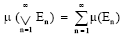
Here the lattice measure μ on the σ-algebra β have the following properties:
| • | For an interval J, μ (J) = l (J) |
| • | If {En} be a sequence of disjoint lattices (For which μ is defined), |
 |
| • | μ is translation invariant, that is, if E is a set for which μ is defined and if E+α is the set {x+α|x∈E} then μ(E+α) = μ(E) |
Anger and Porternier (1992) initiated the notion of lattice measurable function. Tanaka (2008) instituted Hahn decomposition theorem of signed fuzzy measure. Further, Tanaka (2009) achieved a Hahn decomposition theorem of signed lattice measure and classified the notions of lattice measure and signed lattice measure on a σ-algebra as well as the definitions of positive lattice and negative lattice. Qiang (1995) made a further conversation on the Hahn decomposition theorem for signed fuzzy measure.
The present study instituted the perceptions of lattice measurable space, lattice measure space, lattice finite measure and lattice finite measure space. Further, the notions of lattice σ-finite measure, lattice σ-finite measure space, absolutely continuous lattice measure are introduced and derived the result that if a is a fixed element of lattice L then achieved the sublattices M1 = {x in L/x≤a} and M2 = {x in L/x≥a}. Also obtained that if L is a lattice and a, b in L then M = {x in L/a≤x≤b} is a sublattice. Finally it has been derived the Lebesgue Decomposition and its uniqueness of a signed lattice measure.
PRELIMINARIES
In this study, the union and intersection of set theory may be regarded as ∧ and ∨. Also there is a brief appraisal of well-known facts on Birkhoff (1967) lattice theory and propose an extension lattice, and investigate its properties.
L, ∧ and ∨ is called a lattice if it is enclosed under operations ∧ and ∨ and satisfies, for any elements x, y, z, in L:
| • | L1 the commutative law: x ∧ y = y ∧ x and x ∨ y = y ∨ x |
| • | L2 the associative law: x ∧ (y ∧ z) = (x ∧ y) ∧ z and x ∨ (y ∨ z) = (x ∨ y) ∨ z |
| • | L3 the absorption law: x ∨ (y ∧ x) = x and x ∧ (y ∨ x) = x |
Hereafter, the lattice (L, ∧, ∨) will often be written as L for simplicity.
A mapping h from a lattice L to another lattice L1 is called a lattice-homomorphism, if it satisfies h (x ∧ y) = h(x)∧h(y) and h (x ∨ y) = h (x)∨h (y), ∀ x, y∈L.
If h is a bijection, that is, h is one-to-one and onto, it is called a lattice isomorphism and in this case, L1 is said to be lattice-isomorphic to L.
A lattice (L, ∧, ∨) is called distributive if, for any x, y, z, in L.
L4 the distributive law holds:
x∨(y ∧ z) = (x ∨ y)∧(y ∨ z) and x∧(y ∨ z) = (x ∧ y)∨(y ∧ z) |
A lattice L is called complete if, for any subset A of L, L contains the supremum ∨ A and the infimum ∧ A. If L is complete, then L itself includes the maximum and minimum elements which are often denoted by 1 and 0 or I and O, respectively (Khare and Singh, 2005).
A distributive lattice is called a Boolean lattice if for any element x in L, there exists a unique complement xc such that:
x ∨ xc = 1 | (L5) the law of excluded middle |
x ∧ xc = 0 | (L6) the law of non-contradiction |
Let L be a lattice and c: L→L be an operator. Then c is called a lattice complement in L if the following conditions are satisfied:
| • | (L5) and (L6); ∀ x ∈ L, x ∨ xc = 1 and x ∧ xc = 0 |
| • | (L7) the law of contrapositive; ∀ x, y ∈ L, x<y implies xc>yc |
| • | (L8) the law of double negation; ∀ x ∈ L, (xc)c = x |
Throughout this paper, it has been considering the lattices as complete lattices which obey (L1)- (L8) except for (L6) the law of non-contradiction.
Here R stands for real number system and  for extended real number system and φ for empty set. Unless otherwise stated, X is the entire set and L is a lattice of any subsets of X.
Definition 1: If a lattice L satisfies the following conditions, then it is called a lattice σ-Algebra;
| • | ∀ h ∈ L, hc ∈ L |
| • | if hn ∈ L for n = 1, 2, 3 ....., then  hn ∈ L hn ∈ L |
Note that σ(L) = β is a lattice σ-Algebra generated by L.
Example 1: The set {φ, X} is a lattice σ-Algebra.
| • | P(X), the power set of any nonempty set X is a lattice σ-algebra |
Example 2: Let X = , L = {measurable subsets of } with usual ordering (≤). Here L is a lattice, σ(L) is a lattice σ-algebra generated by L.
Example 3: Let L = {all topologies on X}. Here, L is a complete lattice but not σ-algebra.
Example 4: Let X = and L = {E</E is finite or Ec is finite}. Here, L is lattice algebra but not lattice σ-algebra.
Definition 2: If the function μ: β→R ∪ {∞} satisfies the following properties, then μ is said to be a lattice measure on the lattice σ-algebra β:
| • | μ(φ) = μ(0) = 0 |
| • | For all h, g ∈ β, such that μ(h), μ(g)≥0; h≤g⇒ μ(h)≤ μ(g) |
| • | For all h, g ∈ β: μ(h ∨ g) + μ(h ∧ g) = μ(h) + μ(g) |
| • | If hn⊂β, n ∈ N such that h1 ≤ h2 ≤ ... ≤ hn ≤ ...., then μ( hn) = lim μ(hn) hn) = lim μ(hn) |
Let μ1 and μ2 be lattice measures define on the same lattice σ-algebra β. If one of them is finite, the set function μ(E) = μ1(E)-μ2(E), E∈β is well defined and countably additive on β. However, it is necessarily nonnegative; it is called a signed lattice measure.
Example 5: Let X be any set. β = P(X) be the class of all sub sets of X. Define for any A∈β, m (A) = + ∞ if A is infinite = |A| if A is finite. where, |A| is the number of elements in A. Then m is a countable additive set function defined on β and hence m is a lattice measure on β.
Definition 3: By a signed lattice measure on the lattice measurable space (X, β) we mean v: β→R ∪{∞} or R∪{-∞}, satisfying the following properties:
| • | v(φ) = v(0) = 0 |
| • | (i) For all h, g∈β such that v(h), v(g)≥0; h≤g⇒v(h)≤v(g) |
| (ii) For all h, g∈β such that v(h), v(g)≤0; h≤g⇒(g)≤v(h) | |
| • | For all h, g∈β: v(h∨g) + v(h∧g) = v(h)+v(g) |
| • | If hn⊂β, n∈N such that h1≤h2≤ ... ≤hn≤ ...., then v( hn) = lim v(hn) |
This is meant in the sense that if the left-hand side is finite, the limit on the right-hand side is convergent and if the left-hand side is ±∞, then the limit on the right-hand side diverges accordingly.
Example 6: Every lattice measure is a signed lattice measure, since it never takes the value -∞, it takes the value 0 at φ and it is countably additive.
Note that the converse is not true, for example, if μ is a lattice measure and a lattice measurable space (X, β) and if we define v(E) = -μ(E) for all E∈β then v is a signed lattice measure but not lattice measure.
Definition 4: The ordered pair (X, β) is said to be lattice measurable space.
Example 7: Let X = , L = {All Lebesgue measurable sub sets of } (, ß) is a lattice measurable space.
Definition 5: A set A is said to be lattice measurable or lattice measurable, if A belongs to β.
Example 8: The interval (a, ∞) is a lattice measurable under usual ordering.
Example 9: The interval [0, 1]< is lattice measurable under usual ordering.
Example 10: Every Borel lattice is a lattice measurable.
Definition 6: A is a positive lattice if A is lattice measurable and for any lattice measurable E in A, v(E)≥0; Similarly, B is a negative lattice if B is lattice measurable and for any lattice measurable E in B, v(E)≤0.
Example 11: The empty set is a positive lattice with respect to any signed lattice measure.
Definition 7: Let (X, β) be a lattice measurable space and v be a signed lattice measure defined on β then there exists a positive lattice A and a negative lattice B such that A∨B = X and A∧B = φ. We denote lattice Hahn decomposition by {A, B}.
Example 12: Let X = L = and A = {x∈L/f(x)≥0} be a positive lattice with respect to a signed lattice measure v and B = { x∈L/f(x)<0} be a negative lattice with respect to a lattice signed measure v then A∨B = X and A∧B = φ.
Definition 8: Positive and negative parts of v: Let (X, β) be a lattice measurable space and v be a signed lattice measure defined on β. If we define v+ and v¯ on for all E∈β such that v+(E) = v(E∧A) and v¯(E) = -v(E∧B) with v = v+-v.
Then v+ and v¯ are called the positive and the negative parts of a signed lattice measure respectively. Where {A, B} be a lattice Hahn decomposition on X.
Example 13: In the above example 12. if we define v+ and v¯ by  . Now
. Now  .
.
Definition 9: Mutually singular lattice measures: Let (X, β) be a lattice measurable space and v be a signed lattice measure defined on β. If we define two measures v1 and v2 are said to be mutually singular lattice measures with each other to be denoted by v1⊥v2. If there exists two lattice measurable A and B such that A∨B = X and A∧B = φ and v1 (A) = v2(B) = 0.
Example 14: Let μ be a lattice measure and let the lattice measures v1, v2 be given by v1 (E) = μ(A∧E), v2(E) = μ(B∧E) where, μ(A∧B) = 0 and E, A, B∈β. Then v1⊥v2 since v1 (B) = μ(A∧B) = 0, v2 (A) = μ(B∧A) = 0.
Definition 10: The lattice measurable space (X, β) together with a lattice measure μ is called a lattice measure space and it is denoted by (X, β, μ).
Example 15: is a set of real numbers, μ is the lattice Lebesgue measure on and β is the family of all Lebesgue measurable subsets of real numbers. Then, (, β, μ) is a lattice measure space.
Example 16: Let be the set of real numbers and β is the class of all Borel lattices, μ be a lattice Lebesgue measure on then (, β, μ) is a lattice measure space.
Definition 11: Let (X, β, μ) be a lattice measure space, if μ(X) is finite then μ is called lattice finite measure.
Example 17: The lattice Lebesgue measure on [0, 1] is a lattice finite measure.
Example 18: When a coin is tossed either head or tail comes when the coin falls. Let us assume that these are the only possibilities. Let X = {H, T}, H for head and T for tail. β = {φ, {H}, {T}, X}. Define P: β→[0, 1] by P(φ) = 0, P ({H}) = P ({T}) = ½, P(X) = 1 then P is a lattice finite measure on (X, β).
Definition 12: If μ is a lattice finite measure then (X, β, μ) is called a lattice finite measure space.
Example 19: Let β be the class of all Lebesgue measurable sets of [0, 1] and μ be a lattice Lebesgue measure on [0, 1] then ([0, 1], ß, μ) is a lattice finite measure space.
Definition 13: Let (X, β, μ) be a lattice measure space if there exists a sequence of lattices measurable sets {xn} such that:
| (i) | X = xn |
| (ii) | μ (xn) is finite |
Then, μ is called a lattice σ-finite measure.
Example 20: The lattice Lebesgue measure on (, μ) is a lattice σ-finite measure since  and μ ((-n,n)) = 2n is finite for every n.
Definition 14: If μ be a lattice σ-finite measure then (X, β, μ) is called lattice σ-finite measure space.
Example 21: Let β be the class of all Lebesgue measurable sets on and μ be a lattice Lebesgue measure on then (, β, μ) is a lattice σ-finite measure space.
Definition 15: Absolutely continuous lattice measure: Let (X, β, μ) be a lattice measure space and v be a lattice measure defined on β. For each sublattice A of X, when ever μ (A) = 0 implies v (A) = 0. Then, v is said to be absolutely continuous lattice measure with respect to μ and it is denoted by v<<μ.
Example 22: If f is a non negative integrable function defined on a lattice measure space (X, β, μ), define v by  , for each A belongs to β. Then, v is a lattice measure and v<<μ, since μ (A) = 0 implies v (A) = 0.
Definition 16: Lattice measurable function: An extended real valued function f defined on a lattice measurable E is said to be lattice measurable function if the set E(f>α) = {x∈E/f(x)>α} is lattice measurable for all real numbers α.
Example 23:
| • | Constant functions are lattice measurable functions |
| • | Continuous functions from → are lattice measurable functions |
Result 1: Let E = [a, b]. Now:
 |
Theorem 1: Radon-Nikodym theorem on signed lattice measure: Suppose (X, β, μ) be a lattice σ-finite measure space and v be a lattice measure defined on β which is absolutely continuous with respect to μ. Then there exists, a non negative lattice measurable function f such that for all E in β we have  . Moreover the lattice measure f is unique in this sense that if g is also a non negative lattice measurable function such that
  , Eεβ then f = g almost every where on X with respect to μ.
Result 2: If a is a fixed element of lattice L then M1 = {x in L/x≤a} is a sublattice and M2 = {x in L/x≥a} is a sublattice.
Proof: Given L is a lattice and a is a fixed element in L.
Case 1: Let x1, x2 in M1 . Then x1, x2 in L such that x1≤a, x2≤a.
Which implies x1∨x2, x1∧x2 in L such that x1∧x2 = a∧a = a, x1∨x2 = a∧a = a.
This leads to x1∨x2, x1∧x2 is in M1.
Case 2: Let x1, x2 in M1. Then x1, x2 in L such that x1≥a, x2≥a.
Which implies x1∨x2, x1∧x2 in L such that x1∧x2≤a∧a = a, x1∨x2≤a∧a = a.
Which leads to x1∨x2, x1∧x2 is in M1.
Result 3: If L is a lattice and a, b in L then M = {x in L / a = x = b} is a sublattice.
Proof: Given a, b in a lattice L.
Let x1, x2 in M. Then x1, x2 in L such that a≤x1≤b and a≤x2≤b.
Which implies x1∨x2, x1∧x2 in L such that a = a∨a≤x1∨x2≤b∨b = b and a = a∧a = x1∧x2≤b∧b = b. Which leads to x1∨x2, x1∧x2 in M.
Therefore, we have proved every closed interval is a sublattice of L.
Similarly its compliment becomes every open interval, is a sublattice of L.
By using all the above discussions here we define the interval, is a sublattice also open intervals, closed intervals are sublattices of a lattice L.
LEBESGUE DECOMPOSITION AND ITS UNIQUENESS OF A SIGNED LATTICE MEASURE
Theorem 1: Suppose (X, β, μ) be a lattice σ-finite measure space and v be a lattice σ-finite measure defined on β. Then the following hold good:
| • | a lattice measure v0 mutually singular lattice measure with respect to μ and |
| • | a lattice measure v1 absolutely continuous lattice measure with respect to μ such that |
| • | v = v0+v1 moreover v0 and v1 are unique |
Proof: Let (X, β, μ) be a lattice σ-finite measure space and v be a lattice σ-finite measure defined on β.
Now μ and v are lattice σ-finite measures.
Therefore, λ = μ+v is also a lattice σ-finite measure.
Also evidently, μ<<λ and v<<λ.
Therefore, by Radon-Nikodym Theorem there exists two non negative lattice measurable functions f and g on X such that for every Eεβ:
 | (1) |
 | (2) |
Now, f is a non-negative lattice measurable function defined on X.
Define two sets A and B such that A = {xεX/f(x)>0} and B = {xεX/f(x) = 0}
Clearly A∨B = X and A∧B = φ
From Eq. 1:
 |
Therefore, μ (B) = 0
Case 1: Define a measure v0 such for every Eεβ.
Note that v0 (E) = v (E∧B).
Now v0 (A) = v (A∧B) = v (φ).
Therefore, there exists two lattice measurable sets A and B such that:
A∨B = X and A∧B = φ also v0 (A) = v0 (B) = 0.
Therefore, v0 and μ are mutually singular lattice measures.
Case 2: Define a lattice measure v1 such for every Eεβ.
Note, that v1 (E) = v(E∧A).
Let, E be a lattice measurable set of μ measure zero.
Now, μ(E) = 0 implies ∫f dλ = 0 (by (1)). Then λ (E) = 0. Which implies λ (E∧A) = 0.
So, μ(E∧A)+v (E∧A) = 0 (since λ = μ+v).
Which leads to 0+v(E∧A) = 0 (since μ(E) = 0). Then, v(E∧A) = 0 = v1 (E) = 0.
Hence, μ(E) = v1(E) = 0. Therefore, v1 absolutely continuous lattice measure with respect to μ.
Case 3: Note that for every Eεβ, E = (E∧A)∨(E∧B).
So, v (E) = v(E∧A)+v (E∧B). Then, v (E) = v0 (E)+v1 (E). Which implies v = v0 + v1.
Uniqueness: Suppose there exists two pair of lattice measures v0, v1 and v01, v11 such that:
 | (3) |
 | (4) |
Let {A, B} and {A1, B1} be two pair of lattice measurable sets as explained above and A∨B = X, A∧B = φ and A1∨B1 = X, A1∧B1 = φ.
 | (5) |
So for every:
 | (6) |
Since, μ(B) = μ(B1) = 0, the μ lattice measure of last three terms of (6) are zero.
But v1<<μ implies the v1 lattice measure of last three terms of (6) are zero.
Equation 3-4 gives:
 | (7) |
In view of the above argument for every Eεβ,(v11-v1)(E) = (v11-v1) (E∧A∧A1)
Which implies (v11-v1)(E) = (v0-v01) (E∧A∧A1) = 0 (since(5)).
This is true for every Eεβ, that is v11-v1 = 0 implies v11 = v1.
Therefore, v1 is unique lattice measures.
Now from Eq. 7 v0-v01 = 0 implies v0 = v01 implies v0 is unique lattice measure.
Therefore, there exists a unique pair of lattice measures v0 and v1 such v = v0+v1.
CONCLUSION
This study is well thought-of the concepts of lattice measurable space, lattice measure space, lattice finite measure and lattice finite measure space. Further, the perception of lattice σ-finite measure, lattice σ-finite measure space, absolutely continuous lattice measure are get underway and derived the result that if a is a fixed element of lattice L then generate the sublattices M1 = {x in L/x≤a} and M2 = {x in L/x≥a}. Also, reach the objective that if L is a lattice and a, b in L then M = {x in L/a≤x≤b} is a sublattice. Finally it has been guaranteed the Lebesgue Decomposition and its uniqueness of a signed lattice measure.
ACKNOWLEDGMENT
P. Anand is supported by projects Lr. No. SR/S4/MS:516/07 and Dt.21-04-2008 from the DST-CMS.
REFERENCES
- Qiang, Z., 1995. Further discussion on the hann decomposition theorem for signed fuzzy measure. Fuzzy Sets Syst., 70: 89-95.
CrossRef - Hus, P.S., 2000. Characterization of outer measures associated with lattice measures. Int. J. Math. Math. Sci., 24: 237-249.
Direct Link - Khare, M. and B. Singh, 2005. Weakly tight functions and their decomposition. Int. J. Math. Math. Sci., 18: 2991-2998.
CrossRefDirect Link - Khurana, S.S., 2008. Lattice-Valued Borel Measures III: Archivum Mathematicum (BRNO). Tomus, 44: 307-316.
Direct Link - Anil Kumar, D.V.S.R., J.V. Rao and J. Pramada, 2011. Radon-Nikodym theorem and its uniqueness of signed lattice measure. Int. J. Math. Comput. Vol. 12.
Direct Link - Anil Kumar, D.V.S.R., J. Venkateswara Rao and E.S.R. Ravi Kumar, 2011. Jordan decomposition and its uniqueness of signed lattice measure. Int. J. Contemp. Math. Sci., 6: 431-438.
Direct Link - Putcha, V.S. and R. Malladi, 2010. A mathematical model on detritus in mangrove estuarine eco system. Int. J. Pure Applied Math., Bulg., 63: 169-182.
Direct Link - Deekshitulu, G.V.S.R., J.J. Mohan and P.V.S. Anand, 2011. Fractional difference inequalities of volterra type. Int. J. Pure Applied Math. Bul., 70: 137-149.
Direct Link - Anand, P.V.S., P. Murali and K.R. Prasad, 2011. Multiple symmetric positive solutions for the system of higher order boundary value problems on time scales. Electron. J. Differ. Equat. USA., 2011: 1-12.
Direct Link - Praroopa, Y. and J.V. Rao, 2011. Lattice in Pre A*-algebra. Asian J. Algebra, 4: 1-11.
CrossRefDirect Link - Praroopa, Y. and J.V. Rao, 2011. Pre A*-Algebra as a semilattice. Asian J. Algebra, 409: 12-22.
CrossRefDirect Link - Venkateswara Rao, J. and A. Satyanarayana, 2010. Semilattice structure on pre A*-algebras. Asian J. Sci. Res., 3: 249-257.
CrossRefDirect Link - Rao, J.V. and E.S.R.R. Kumar, 2010. Weakly distributive and sectionally *semilattice. Asian J. Algebra, 3: 36-42.
CrossRefDirect Link - Rao, J.V. and Y. Praroopa, 2011. Logic circuits and gates in pre A*-algebra. Asian J. Applied Sci., 4: 89-96.
CrossRefDirect Link - Venkateswara Rao, J. and P. Koteswara Rao, 2010. Subdirect representations in A*-Algebras. Asian J. Math. Stat., 3: 249-253.
CrossRefDirect Link - Satyanarayana, A., J. Venkateswara Rao and U. Suryakumar, 2011. Prime and maximal ideals of pre A*-algebra. Trends Applied Sci. Res., 6: 108-120.
CrossRefDirect Link