

D. Mohammaditabar
Iran University of Science and Technology, Tehran, Iran
E. Teimoury
Iran University of Science and Technology, Tehran, Iran
Journal of Applied Sciences
Year: 2008 | Volume: 8 | Issue: 17 | Page No.: 2928-2938





ABSTRACT
In the main part of this study an integrated three-phased methodology is developed to solve two problems of carrier selection and network flow assignment concurrently. In the first phase, after reviewing the existing literature, 5 groups of criteria that influence the carrier selection and evaluation are determined which are: cost, insurance of service provision, handling services, customer service and strategic compatibility. In the second phase, using AHP techniques and the criteria of the first phase, a weight factor is assigned to each carrier. Then in a multiple objective mixed integer linear programming model the flow of the product in the network and the amount of freight allocated to carriers are determined. The objectives are to maximize total value of freight allocation and to minimize the transportation and inventory costs. In the end the application of the methodology in the Middle East giant auto manufacturer IKCO is explained. This methodology proposes a step by step approach that is applicable in any other industry.
PDF Abstract XML References Citation
How to cite this article
D. Mohammaditabar and E. Teimoury, 2008. Integrated Freight Transportation Carrier Selection and Network Flow Assignment: Methodology and Case study. Journal of Applied Sciences, 8: 2928-2938.
DOI: 10.3923/jas.2008.2928.2938
URL: https://scialert.net/abstract/?doi=jas.2008.2928.2938
DOI: 10.3923/jas.2008.2928.2938
URL: https://scialert.net/abstract/?doi=jas.2008.2928.2938
INTRODUCTION
Outsourcing of logistics activities to third party logistics service providers (3PL) has now become a common practice (Jharkharia and Shankar, 2007). Outbound transportation is among the most common outsourced activities (Langley et al., 2003) which require companies to select carriers for their freights. Carrier selection is one of the most important decisions in the transportation strategic planning that affects both logistics cost and customer service. As the entire supply chain is affected by carrier selection, the decision process should incorporate all the factors in the chain including transportation, inventory and facility costs and also some qualitative criteria like customer service (Liberatore et al., 1995). In the early studies, the decision process consisted of two different stages. In the first stage the mode of transportation was determined and then in the second stage among the carriers active in that mode, one was selected (Coyle, 1980; Baker, 1984). Nowadays with new technological advances in transportation and the growing competition between different modes, they have become very similar so the researchers suggest concentrating on carrier selection rather than mode selection.
In addition, with the growth of globalization, companies have more extended transportation networks and also many market areas, so it is less possible to select one carrier which is the best in all markets. In this regard companies need to consider the transportation network simultaneously with carrier selection. The importance of carrier selection decision in company`s success and also its complexity, make it necessary to follow a methodology. In this research, an integrated methodology for carrier selection and network flow assignment is developed. This methodology considers all the logistics factors and reduces the effect of personal opinions in judgments. It is designed to suit with carrier selection process. In this regard, we have built a detailed methodology to adjust to the steps of carrier selection, performed a comprehensive study on the carrier selection criteria and categorized them to be used in the AHP hierarchy, adjust the AHP process to reduce the complexity of the process and improve its consistency by proposing how to judge scales and using rating in the lowest level of the hierarchy instead of alternatives, propose a multi objective mixed integer linear model and finally demonstrate the implementation and control of the selection.
MATERIALS AND METHODS
The use of AHP in carrier selection is proposed by many researchers and this is mainly because of its capability in handling both qualitative and quantitative criteria which exist in carrier selection. The hierarchical structure of the AHP model can enable users to visualize the problem systematically in terms of criteria and sub-criteria and the user can compare and determine the priorities of the criteria and alternatives effectively (Demirats and Ustun, 2008). Bagchi (1989) explains the application of AHP in a simple carrier selection problem and Liberatore et al. (1995) develops an AHP based decision support system which considers both qualitative and quantitative criteria. In this way the carrier will be chosen according to their weights but when there are some other capacity constraints the selection will be unclear. Very few authors proposed mathematical programming to address the problem but the combination of AHP and other techniques were more welcomed in the literature. Lehmusvaara et al. (1999) uses the AHP to assign a weight to each carrier and maximizes the multiplication of quantity and weight of carriers in a linear model.
If we consider carrier as a vendor that supplies the company with transportation services we can adopt many other researches in the field of vendor selection that have proposed AHP for their methods (Nydick and Hill, 1992; Maggie, 2001; Cebi and Bayraktar, 2003). Fuzzy AHP and analytic network process (an extension to AHP) are also suggested by some researchers (Demirats et al., 2008; Kahraman et al., 2003).
In the context of supplier selection, Ghodsypour and O`Brien (1998) were the pioneers that proposed the combination of AHP and linear programming in their methodology. Their methods of supplier selection consists of five steps of defining the criteria, calculating the weights, rating the alternative suppliers, computing the overall score and building the linear model. As their methodology is in the general area of suppliers, they do not go into details of each step. For example there is no specific study of the selection of the relevant criteria in their works. Also in the case that the number of alternative suppliers are large, there would be a lot of pair wise comparisons between suppliers that will intricate the AHP process. In addition, since the objective functions of their linear programming is totally dependent to the outcomes of the AHP, a small variation in the preference of suppliers, criteria or emerging a new supplier, the whole process of AHP and linear programming should be repeated.
The main principles of the methodology proposed in this research are based on Ghodsypour and O`Brien (1998) and Lehmusvaara et al. (1999) in combining AHP with linear programming and also PDCA (Plan-Do-Check-Act) loop in decision making. Some modification and improvements to their methodology is performed and some features have been added to adjust the methodology with carrier selection problem. Some of these features are:
| • | All the steps of the methodology is adjusted to the carrier selection problem and explained in detail. |
| • | A comprehensive study of the carrier selection criteria is presented. The mostly mentioned criteria in the literature are listed in a Table and a classification of them is suggested. |
| • | At the lowest level of the hierarchy, the ratings are used instead of alternatives. |
| • | How to judge guideline is proposed |
| • | Quantitative factors are excluded from the AHP hierarchy and considered in an objective function of the linear programming model. |
| • | The implementation and control of the process is included in the methodology. |
| • | The network flow assignment has been integrated to carrier selection. |
As shown in Fig. 1 the methodology consists of three phases. The first phase, requirement identification, constitutes the definition of objectives and identification of criteria. The second phase, planning, has two main parts namely AHP weighting and linear programming model. In AHP weighting part, the AHP structure is designed based on the data gathered in the first phase and a weight is calculated for each carrier.
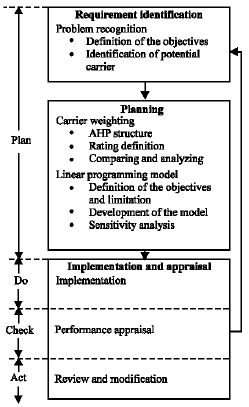 | |
| Fig. 1: | Integrated methodology of carrier selection and network flow assignment |
Linear programming model uses this weight in one of its objective functions to allocate the freight to carriers and the network. In the last phase, implementation, carrier`s performances and possible failures will be evaluated and some modifications in each phase of the methodology will be proceeded.
Each phase of the methodology will be discussed as followed:
Phase one: Requirements identification: The ultimate goal is to select carriers which are best suited for the firm to achieve its objectives. So, the first question is what are the objectives in each market? For instance in a market that the firm has newly entered, it needs to suggest a high level of service to be able to get a share, or in a market in which there is a strong competition on the price the firm should try to reduce its costs. Each of the objectives will define the kind of carriers it needs. For example, a responsive and an effective carrier are appropriate for each of the mentioned objectives, respectively.
With the objectives which are not appropriate for the market, even the best method of carrier selection may not help the firm to succeed. So, the exact definition of objectives is a crucial task which should be considered before going into the process of carrier selection.
After the identification of objectives, the relevant criteria should be defined. So the kind of criteria that a decision maker considers is dependent to the objectives and this dependency prevents suggesting a fixed number of criteria to all the firms even in a similar industry.
Various criteria in different industries and from multiple viewpoints (carrier, shipper) have been studied by some authors and can be used as a reference list (Murphy et al., 1997; Liberatore et al., 1995; Korpela and Tuominen, 1994; Whyte and James, 1993; Abshire and Premeaux, 1991; Bagchi, 1989; Coulter et al., 1989). In this regard, after the study of seven comprehensive researches, 52 criteria were obtained. These 52 criteria were decreased to 28 after some similar were combined and repeated (written in different ways) were expelled. The 28 criteria are shown in Table 1. As it is clear from the Table 1, some researchers have calculated the importance of each criterion and some others have just listed them. The lower the number in front of each criteria, the more important it is from the viewpoint of that researcher. The missed numbers in the Table are for the expelled criteria. In the case that no number was devoted, the value 1 was used for all of them.
| Table 1: | The list of mostly mentioned carrier selection criteria in the literature and delivery |
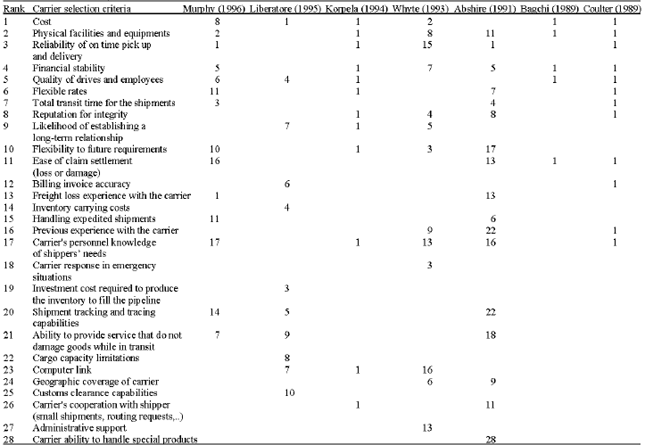 | |
The criteria in the Table 1 are listed according to the number of researches that have mentioned them and also according to the importance of them in those researches. However, this order is not definite and different firms in various situations can put different importance to each criteria but it seems that cost of transportation is usually the most important one.
Phase two: Planning
Carrier weighting: The data necessary in this section (criteria, potential carriers, objectives and etc.) are gathered in the previous section. In the first step, all the carrier selection criteria should be categorized. There are usually some major factors that influence others, so using them makes the process of pair wise comparisons in the AHP easier and the major attention will be directed toward major factors.
In an independent project that studied Iranian auto industry, all the criteria were divided into 5 groups by the use of factor analysis technique. These categorized criteria are put in the hierarchy tree which is shown in Fig. 2. As far as this study is discussing the methodology there is no need to explain the process of categorization. Also, this categorization or the criteria can differ for other industries in various countries, so they should be viewed as a general guide.
The first group contains cost relevant criteria but is not included in the hierarchy and will be treated independently in an objective function of the linear programming. As far as the carrier selection process should consider the effects of the decision on all the logistics costs, the transportation, inventory and in transit inventory holding costs are all included in this group. The discount program and flexibility in price are categorized in the same cost group.
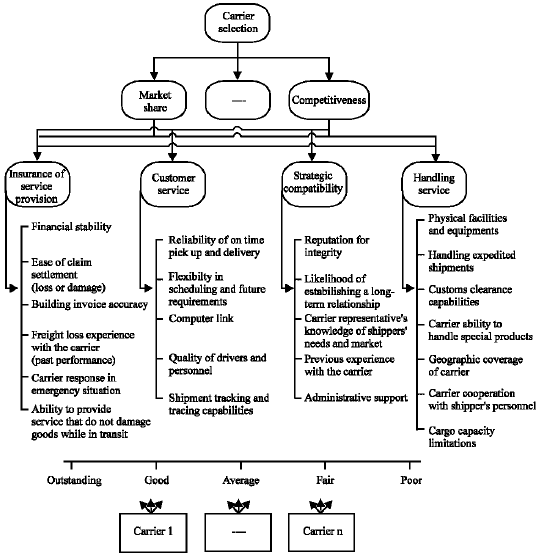 | |
| Fig. 2: | AHP decision tree for carrier selection |
The second group consists of criteria of customer service. Quality of drivers and personnel of the carrier, computerized links and flexibilities in deliveries can affect the reputation of the firm and are included in this group.
Financial stability of carrier makes the firm sure that they can trust on the alliance. This leads us to third group which is named insurance of service provision. The forth group consists of freight handling services. Facilities, the ability to handle special freights, expedited shipments and capacity are main considerations of this group.
The last group is about strategic compatibility between the firm and the carrier. Previous experiences, consistency of strategies, reputation and the possibility of long term relationships are included in this group.
After categorizing the criteria, the hierarchy tree should be structured. Bagchi (1989) proposes a simple structure without sub-criteria or company objectives. In the other hand, Korpela and Tuominen (1994) used a more detailed hierarchy with sub-criteria and objectives. Generally by adding the items in hierarchy tree the complexity of the solution is raised but in the same time the influence of personal judgments is decreased. So based on the decision maker`s knowledge of the nature of criteria the amount of details in the hierarchy is determined. For example, if customer service is not considered an understandable criterion among all decision makers the use of sub-criteria can clarify its meaning. The AHP structure proposed in this study is in its most complete form including the goal, objectives, criteria, sub-criteria, alternatives and ratings. As it is shown in Fig. 2 in the lowest level of the hierarchy there are ratings instead of alternatives. This creates the advantage that in the case of appearance of a new carrier there is no need to rerun the AHP process and also the numerous comparisons between too many alternatives are reduced to a few between ratings.
By running the AHP each criteria and each rating would have a weight. So, by multiplying the weight of each criterion in the weight of the ratings that carrier has achieved and making a summation on all criteria, weights for carriers are calculated. This will be more clarified in the case study.
Because, in performance appraisal and new situations (new carriers) the weight of carriers is calculated based on the weights of criteria and ratings, it is necessary to judge the new carrier with assumptions of previous ones. For example, if in previous judgments a carrier with transportation cost less than 10% of price was considered very good at the relevant criteria, it should be the same for a new carrier with similar price. This leads to a judgment with less personal influence and improves the consistency of AHP. That is why a how to judge guideline should be defined.
A team of major decision makers can define this guideline and also previous judgments can be helpful. For instance if the past two carriers with transportation costs equal to 10 and 15% of the price were considered very good in relevant criteria so for a new carrier with transportation cost between 10 and 15% of price, the same rating of very good should be given. An example for the definition of how to judge guideline in reliability criteria can be as follows:
Outstanding: Less than 30 min deviation in delivery time in 99.5-100% of cases.
Good: Less than 30 min deviation in delivery time in 99-99.4% of cases.
Average: Less than 30 min deviation in delivery time in 95-98.9 % of cases.
Fair: Less than 30 min deviation in delivery time in 80-94.9% of cases.
Poor: Less than 30 min deviation in delivery time in less than 80% of cases.
This section of the methodology is completed by the calculation of carriers` weights. As there are numerous researches about AHP process, we do not explain it and refer the interested reader to Tummala and Wan (1994).
Linear programming model: Here, with the use of carrier`s weights and a linear programming model, flow assignment and freight allocation will be done. To build a linear model we need to define objective functions, limitations and assumptions. The objective function could be minimization of costs, wastes, transit time or a combination of them. As far as many of these considerations existed in the selection criteria, the most appropriate objective function might be the maximization of weights. But, it is suggested all the quantitative cost criteria be minimized in a separate objective function as they are the most visible and somehow most important criteria for decision makers. Also, because cost factors are more possible to fluctuate if they are in the hierarchy it will affect the weights and the AHP process should be rerun. Other qualitative criteria are less possible to differ in their pair wise comparisons but cost is very uncertain especially when the cross border transportation exists. In this way the quantitative cost criteria can be removed from the hierarchy tree and the weights be calculated only by qualitative criteria.
In order to maximize the total value of weights, they are multiplied by the amount of freight allocated to carriers. In this way, the model will try to allocate as maximum as possible freight to high weighted carriers.
Limitations vary among different firms and situations, so same as what was mentioned for criteria there is no unique list of limitations for all firms. Some of the most common limitations are:
| • | The minimum and maximum number of carriers |
| • | Capacity and economies of scale for carriers |
| • | Product characteristics |
| • | Time window |
All the assumptions of linear programming should be considered in the model and the reader is referred to Hillier and Liberman (2005). Some other simplifications are also possible in the model. For example, all the products with similar transportation characteristics can be considered a single product. More explanations will be made in the case study.
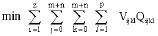
Here, a general model is proposed. The model assumes that there is a transportation network in which there are some markets (nodes which can be both origin and destination of a journey) and one single node to supply all of them. Carriers have some weights for each pair of origin destination which is calculated in the AHP process. The model should determine the amount of freight allocated to each carrier. There are also some constraints in the model. There are two objectives for the problem which are maximizing the allocation of products to carriers with higher weights and minimizing transportation and inventory holding related costs. Equations 1 and 2 represent these objectives, respectively. Equation 1 maximizes the summation of carrier`s weights multiplied by the quantity allocated to them. So the model tries to allocate as more quantity as possible to carriers with high weights. Equation 2 minimizes the transportation and inventory costs. The model is as follows:
| i | : | Carrier | |
| j | : | Origin | |
| k | : | Destination | |
| l | : | Product | |
| m | : | No. of markets | |
| z | : | No. of carriers | |
| p | : | No. of products | |
| Qijkl | : | The amount of product l allocated to carrier i to carry from the origin j to destination k | |
| Wijkl | : | The weight of carrier i in carrying the product l from the origin j to destination k | |
| tijkl | : | Transit time of product l to be carried by carrier i from the origin j to destination k | |
| hl | : | Unit annual inventory holding cost for product l | |
| Fijkl | : | Unit transportation cost | |
| Vijkl | : | Unit cost of inventory and transportation (Fijkl+hltijkl = Vijkl) | |
| L | : | Minimum number of carriers | |
| U | : | Maximum number of carriers | |
| Xi | : | 1 if carrier i is selected | |
| 0 otherwise | i = 1,2,...,z | ||
| Rjl | : | The demand of product l | |
| in market j | j = 1, 2,...,m | ||
| Rjl for markets | j= 1, 2,...,m | ||
| Djl: | : |  For the origin For the origin | j = 0 |
| Cil | : | The maximum capacity of carrier i for product l | |
| CCijkl | : | Capacity consumption index | |
Model is as follows:
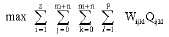 | (1) |
 | (2) |
Subject to
 | (3) |
 | (4) |
 | (5) |
 | (6) |
 | (7) |
Equation 3 guarantees that each node`s demand will be satisfied. Equation 4 limits the number of selected carriers between an upper and lower bounds. Equation 5 guarantees that the total amount of freight allocated to each carrier doesn`t exceed its capacity and also if a carrier is not selected no freight allocates to it. a capacity consumption index (cc) is multiplied in the quantity of freight to consider the differences each pair of origin destination have in distance, transit time and other characteristics, which affects carrier`s capacity.
Phase three: Implementation and appraisal
Implementation: As is stated by Bowersox (1996) there are four steps in implementing a logistics project which are: planning, timing, success criteria and implementation.
According to the Bowersox (1996) the definition of implementation includes breaking down the project into independent activities, determining the sequence and relations between activities and assigning a person or a team to each activity.
Identification of potential carriers and their characteristics, data gathering, carrier negotiation and contract management are some activities in the breakdown of carrier selection activities. In addition, as logistics activities are cross functional, in assignment of personnel to each task at least one member of each beneficiary department should be incorporated. Also in timing, sufficient time considering negotiation, training and infrastructure preparation should be devoted to the implementation process. At the end, success criteria should be an evaluator of the closeness to objectives.
Performance appraisal: After implementation, in order to measure the deviation from the objectives, some performance appraisal programs should be done. Figure 3 shows the relationship between performance appraisal, modification and planning.
In performance measurement, the difference between the actual and planned outcome will be calculated and in a case with significant difference, the real causes will be investigated. This difference could be caused by the weakness or negligence of the carrier and be solved with more cooperation with them. For example, inefficient routing by the carrier may have cause late deliveries or the increase in the transportation costs. This could be solved by helping the carrier in routing programs.
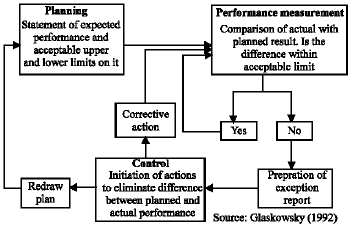 | |
| Fig. 3: | The relationship between performance appraisal and planning |
In some other cases the difference could be caused of the inherent inefficiency in the plan itself and it should be revised. At the end it should be mentioned that in the case of major changes and also in some fixed periods (annually), the whole process should be revised to ensure its verification.
CASE STUDY
Iranian auto manufacturer IKCO found new market for its latest product in some countries including Azerbaijan, Venezuela and Syria. The company outsources all its transportation activities, so it needs to choose carriers for international movements. This section explains the project of carrier selection in IKCO which was performed according to the methodology of this study.
Phase one: Requirement identification: The logistics team of the IKCO divided all the parts into two main categories namely body and parts. Body consists of the body and all the items that were assembled on it in the IKCO site in Iran. Parts were all other packages which were not assembled on the body. These categories were selected due to similar transportations features of the items. For example although the body for the export to Azerbaijan included some different items in comparison to Syria, both of them needed similar equipment in transportation so were considered a same product.
As far, the IKCO did not intend to have any possible fleet, all its transportation activities had to be outsourced. In this regard 7 carriers were candidates for the movements of the items in the international context which two of them were ocean carriers. Among road carriers, two of them were only able to carry parts but the other 3 carriers had the capability to transport both freights. Because, the third party logistics is not developed very well in Iran these carriers had little expertise in the international transportation and all of them were merely road carriers.
For the identification of the criteria an independent study was performed. In this project all the criteria which was determined by the study of the literature (Table 1) was evaluated by the experts in the IKCO and other auto manufacturers of Iran for their importance. Then, by the use of factor analysis they were divided into five groups including handling services, strategic compatibility, customer service, insurance of service provision and cost. Because the major concentration of this paper is on the methodology, the process of classification of the criteria is not explained in detail.
After identifying potential carriers and selection criteria, we need to define objectives to complete this section. The company determined same objectives of market share and competitiveness in all markets for the IKCO, they are included in the AHP hierarchy tree.
Phase two: Planning
Carrier weighting: The process of AHP modeling constitutes four stages of structuring the problem, data gathering, calculating the weights and sensitivity analysis (Tummala and Wan, 1994). In the first step, the hierarchical structure of the problem is defined. This structure should include the goal, objectives, criteria, sub-criteria and alternatives which are all gathered in the previous section. As long as, quantitative criteria are easy to calculate and in some way more visible for the top management we excluded them from the AHP hierarchy tree and put them in the objective functions of the linear programming which will be explained in the next section. The hierarchy is shown in Fig. 2. As mentioned earlier in the lowest level of the hierarchy instead of alternatives the ratings are used. This prevents running the whole AHP process in the case of a new carrier and also it is more practical to compare the fewer ratings instead of numerous alternatives.
Next step in the AHP modeling process is data gathering. To have the data of the comparisons between criteria we need to define a team. In this regard, logistics manager, sales manager and the manager of the assembly line in the destination countries have the expertise and information necessary to compare different alternatives.
As is suggested by Saaty (1980) to combine their judgments the geometrical average was used. Their judgments and the results for one of the criteria are shown in the Table 2. As is clear in the Table, the inconsistency index is less than 0.1 which is acceptable.
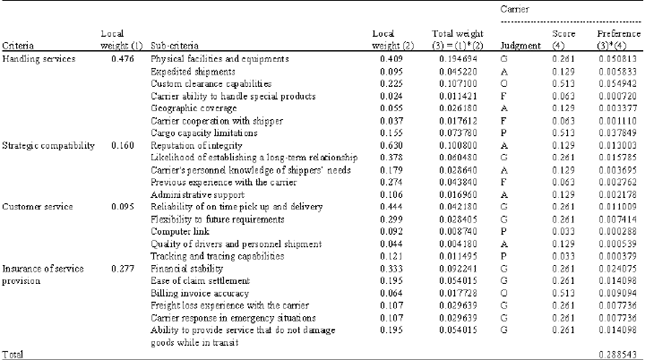
Liberatore (1992) suggested a 5 point rating scale of outstanding (O), good (G), average (A), fair (F) and poor (P) which we also use here. Although pair wise comparison of ratings can be different under various criteria, in order to avoid complexity we have assumed fixed weightings for the ratings which is shown in the Table 3. Then by multiplying the weight of each sub criteria and acquired ratings, the overall weight of each carrier is calculated. In the Table4, the overall weights and the process of calculation for a specific carrier is demonstrated. In the next step the model will try to maximize the freight allocated to high weighted carriers and minimize costs.
Linear programming model: After the calculation of carrier`s weights, with the help of a linear programming model the allocation of freight to carriers and the flow assignment will be done. The business of third party logistics in Iran is not well developed and carriers have a very limited experience in the cross border transportation. So, none of the carriers volunteer to the transportations of the products used multimodal methods and was mostly truck carriers. But in the case of export to Venezuela and even for Azerbaijan there were some potential in water transportation.
The linear programming model should be able to consider the combination of carrier`s services to create the potential paths through water. This combination imposes some fixed costs including the synchronization cost and unloading and reloading between two carriers. The model in general is a network with an origin, some middle points and some destinations. Each destination has its own demand and the middle points are ports or terminals with zero demand to transfer the product between two carriers. So, if there are n middle point constraints 8 is added to the model to guarantees that only if a middle node is selected (Yj = 1) they could be the destination for some freights.
| Table 2: | Pair wise comparison judgment matrix for calculation of the weights of sub criteria of handling services |
 | |
| Table 3: | Pair wise comparison judgment matrix for five-point rating scale |
 | |
| Table4: | Calculation of the total weight of a specific carrier |
 | |
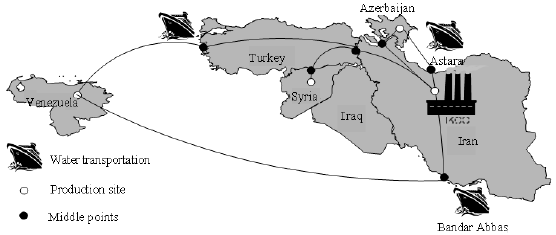 | |
| Fig. 4: | transportation network of IKCO |
 | (8) |
The cost minimization objective function changes to include fixed costs of selecting a middle point. This new objective function is presented by Eq. 9.
 | (9) |
As is shown in the Fig. 4, the direct route to Syria which passes through Iraq was excluded because of security measures.
The top manager has determined a minimum of two selected carriers in order to avoid complete dependency on one single carrier. Also in order to decrease the complexity of paper work and in order to make stronger relationships, maximum number of selected carriers was set to 3.
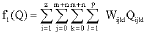
There are various methods in solving multi objective models. The method proposed in this research is based on the LP metric methods. This method is trying to minimize the bias between the objective function and ideal solution. This bias is calculated by a metric distance which is shown in Eq. 11.
| Table 5: | The amount of freight allocated to each carrier γ1 = 0.3, γ2 = 0.7 |
 | |
 | |
| Fig. 5: | Amount of bodies allocated to each carrier with different γ1 |
In order to calculate the ideal solution, each objective should be solved without considering other objectives. So, the ideal solution is the best value an objective function can acquire in the absence of others.
 | (10) |
 | (11) |
 | (12) |
The top management put the γ1 = 0.7, γ2 = 0.3 as they consider costs as an important factor. P was set to 2. Then, the data necessary in the mode including carrier`s capacities for body and parts, carrier`s weights, capacity consumption index, variable costs of transportation, annual demand of each market and fixed cost of journey to middle nodes was gathered.
The model was solved in LINGO version 9.0 which resulted in the selection of 3 carriers. The results shown in Table 5 shows that no freight is sent through middle nodes.
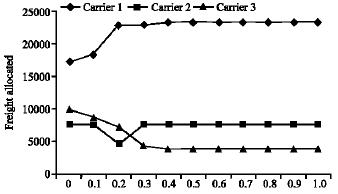
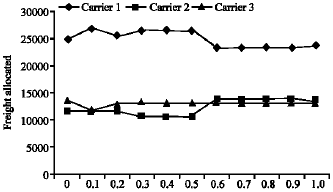
Sensitivity analysis: Sensitivity analysis for different amount of γ1 from zero (the decision is only based on costs) to one (the decision is only based on carrier`s weights) was performed. Figure 5 and 6 show the amount of body and parts allocated to each carrier with different values of γ1.
 | |
| Fig. 6: | Amount of parts allocated to each carrier with different γ1 |
As is clear from both figures, carrier 1 is always the best choice. Carrier 2 and 3 are some how similar but carrier 2 is more appropriate for bodies where carrier 3 is better in parts. Other carriers were never suggested and this could be caused by the undeveloped market of third party logistics in Iran in which few carriers can satisfy the requirements of IKCO`s top management. So, top management was assured that the selection of three carriers (carrier 1, 2 and 3) are the best solution but the amount of freight allocated to each of them can be a matter of debate.
CONCLUSION
The methodology proposed in this study provides a step by step method to select carriers which is suited for the company and reduces the entire logistics cost. This methodology solves the carrier selection and network flow assignment with an integrated approach. in the linear programming phase different situations for the firm can be considered. This study at the beginning tried to propose a general methodology in carrier selection and network flow assignment to be applicable in various industries and then explained the use of the methodology in a specific industry in Iran. Considering the results of the case study it is worth to mention that since the third party logistics in undeveloped countries are not very competitive there may be very few or even no carrier that satisfies the company. In this regard, carrier selection process can be integrated with carrier development in which carriers that have more potential to progress with less required resources will be selected.
REFERENCES
- Cebi, F. and D. Bayraktar, 2003. An integrated approach for supplier selection. Logistics Inform. Manage., 16: 395-400.
CrossRefDirect Link - Coulter, R.L., W.R. Darden, M.K. Coulter and G. Brown, 1989. Freight transportation carrier selection criteria: Identification of service dimensions for competitive positioning. J. Business Res., 19: 51-66.
CrossRefDirect Link - Demirats, E.A. and O. Ustun, 2008. An integrated multi objective decision making process for supplier selection and order allocation. Int. J. Manage. Sci. Omega, 36: 76-90.
CrossRefDirect Link - Ghodsypour, S.H. and C. O'Brien, 1998. A decision support system for supplier selection using an integrated analytical hierarchy process and linear programming. Int. J. Prod. Econ., 56-57: 199-212.
CrossRefDirect Link - Jharkharia, S. and R. Shankar, 2007. Selection of logistics service provider: An Analytic Network Process (ANP) approach. Int. J. Manage. Sci. Omega, 35: 274-289.
CrossRefDirect Link - Kahraman, C., U. Cebeci and Z. Ulukan, 2003. Multi-criteria supplier selection using fuzzy AHP. Logist. Inform. Manage., 16: 382-394.
CrossRefDirect Link - Lehmusvaara, A., M. Tuominen and J. Korpela, 1999. An integrated approach for truck carrier selection. Int. J. Logist. Res. Applications, 2: 5-20.
CrossRefDirect Link - Liberatore, M.J., R.L. Nydick and P.M. Sanchez, 1992. The evaluation of research papers (or how to get an academic committee to agree on something). Interfaces, 22: 92-100.
Direct Link - Liberatore, M.J. and T. Miller, 1995. A decision support approach for transport carrier and mode selection. J. Bus. Logist., 16: 85-116.
Direct Link - Murphy, P.R., J.M. Daley and P.K. Hall, 1997. Carrier selection: Do shippers and carriers agree, or not?. Transport. Res. Part E, 33: 67-72.
CrossRef - Nydick, R.L. and R.P. Hill, 1992. Using the analytical hierarchy process to structure the supplier selection procedure. J. Purch. Mater. Manage., 25: 31-36.
Direct Link - Whyte, J.L., 1993. The freight transport market: Buyer-seller relationships and selection criteria. Int. J. Phys. Distribut. Logist. Manage., 23: 29-37.
CrossRefDirect Link - Tam, M.C.Y. and V.M.R. Tummala, 2001. An application of the AHP in vendor selection of a telecommunications system. Omega, 29: 171-182.
CrossRef