

H.I. Javed
Maize, Sorghum and Millet Programme, National Agriculture Research Centre, Islamabad, Pakistan
M.A. Masood
Maize, Sorghum and Millet Programme, National Agriculture Research Centre, Islamabad, Pakistan
S.R. Chughtai
Maize, Sorghum and Millet Programme, National Agriculture Research Centre, Islamabad, Pakistan
H.N. Malik
Maize, Sorghum and Millet Programme, National Agriculture Research Centre, Islamabad, Pakistan
M. Hussain
Maize, Sorghum and Millet Programme, National Agriculture Research Centre, Islamabad, Pakistan
A. Saleem
Maize, Sorghum and Millet Programme, National Agriculture Research Centre, Islamabad, Pakistan
Asian Journal of Plant Sciences
Year: 2006 | Volume: 5 | Issue: 2 | Page No.: 207-210





ABSTRACT
Six maize genotypes were evaluated in National Uniform Maize Yield Trials across six contrasting locations having different agro-climatic conditions. Pooled analysis of variance for grain yield indicated significant differences for genotypes across the environments, environment across genotypes and their interactions. These significant interactions indicated uneven performance of the genotypes across the environments and years. In stability analysis, all the parameters applied proved two genotypes as the most stable across the environments. These genotypes gave the highest grain yield and were also earlier in maturity. One genotype showed fitness for favourable environments and two for poor yielding environments.
PDF Abstract XML References Citation
How to cite this article
H.I. Javed, M.A. Masood, S.R. Chughtai, H.N. Malik, M. Hussain and A. Saleem, 2006. Performance of Maize Genotypes on the Basis of Stability Analysis in Pakistan. Asian Journal of Plant Sciences, 5: 207-210.
DOI: 10.3923/ajps.2006.207.210
URL: https://scialert.net/abstract/?doi=ajps.2006.207.210
DOI: 10.3923/ajps.2006.207.210
URL: https://scialert.net/abstract/?doi=ajps.2006.207.210
INTRODUCTION
Maize (Zea mays L.) is the leading world cereal both in terms of production and productivity (FAO, 2004). It has great significance for countries like Pakistan, where rapidly increasing population has already out stripped the available food supplies. It is annually grown on an area of about 0.896 million hectares with annual grain production of about 2.8 million tones (FAO, 2004). The current maize yield in Pakistan (2097 kg ha-1) is much lower than the world’s average (FAO, 2004). Furthermore, within Pakistan there is a large gap between potential and actual maize yields (UN, 2000). Maize is consumed as food, feed and fodder and also has many industrial uses. It has high potential for more nutritive food and it is a good source of high quality edible oil (UN, 2000; Serna-Saldivar et al., 1994).
With shrinking land resources and increasing population, the best option is to strive for progressive yield growth in all major food crops. Maize being the most productive cereal in the world and being a traditional crop in Pakistan offers the best opportunity to narrow the gap between population growth and food production (FAO, 2000a). An important reason for low production of maize is less coverage under high yielding hybrids which is only 25% of total maize area in Pakistan (Chughtai et al., 2003). The national average yields of maize could be raised if significant improvements are made in the genetic content of the crop in the lower productivity regions (CIMMYT, 1989; Rajaram et al., 1998). Farmers should be encouraged to adopt the best hybrids to increase maize productivity in Pakistan (Tran et al., 2001). Chand and Longmire (1990) observed 62% increase in yield by the use of improved variety only.
Maize crop possesses great genetic diversity and can be grown across varied agro-ecological zones (Ferdu et al., 2002). According to CIMMYT (1991), improved varieties gave high and stable yields across the environments where they were adapted. The improved genotypes should have the characteristics of adaptability across a range of diverse environments. Unstable varieties are a major source of risk. Stability in performance of a genotype over a range of environments is a desirable attribute and depends on the magnitude of genotype x environment interactions (Ahmad et al., 1996). The stability parameters have been studied in different crops for measuring phenotypic stability (Anonymous, 1995; Bakhsh et al., 1995; Sharif et al., 1998; Qureshi, 2001), but very little information is available on stability of maize vanities. Some genotypes show highly specific response to a particular environment, others are uniform in performance over a range of environments. The objectives of present study were to evaluate and identify the genotypes with wider adaptation over a range of environments and yield performance.
MATERIALS AND METHODS
Six maize genotypes were evaluated in National Uniform Maize Yield Trials conducted during 2001 and 2002 across six contrasting locations. The genotypes were Hycorn-11, Hycorn-798, R-2302, R-2210, EV-5098 and EV-6098 and the locations were D.I. Khan, Bahawalpur, Faisalabad, Jaglot, Chiniot and Yousafwala having different agro-climatic conditions. At each location, the experiment was planted under Randomised Complete Block Design (RCBD) with three replications. Each genotype was sown on four row plot (5.0 meter long and 0.75 m apart). The central two rows were used for observations.
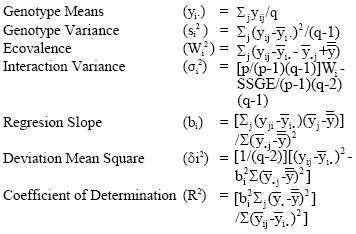
All the inputs and cultural practices were same at all locations. Data regarding agronomic traits were recorded. In this paper, data of mid silking (days) as indicator of maturity and grain yield (kg ha-1) were discussed. Data were analysed across all locations and years using pooled data. Analysis of Variance and Duncan’s Multiple range Test (Gomez and Gomez, 1987) were used for significance of the results. The mean yield data across locations and years were subjected to stability analysis by using different stability parameters like genotype mean, variance (Si2), ecovalence (Wi2), interaction variance (σi2), regression slope (bi), deviation mean square (δi2) and coefficient of determination (R2). Several of these have been summarized and compared by Lin (1986). The models used for these parameters are:
 |
RESULTS AND DISCUSSION
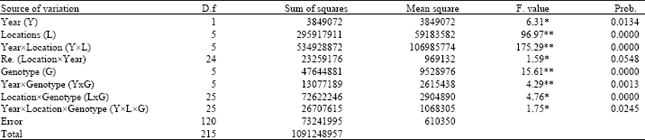
On the average across the locations and years, R-2302 showed excellent performance (Table 1) with highest yield of 7650 kg ha-1 followed by R-2210 (7071 kg ha-1) and EV-5098 (7026 kg ha-1). R-2302 was the earliest genotype (Table 2) with 54.89 days to mid silking followed by EV-5098 (55 days). Because, Jaglot is cooler place, the m id silking was late (58.50 to 62.67 days). The mean mid silking period over genotypes was the lowest at D.I. Khan (54.17) and Chiniot (54.22). Pooled analysis of variance (Table 3) for grain yield indicates statistically significant difference for genotypes across locations and years and for all interactions. These significant interactions indicated uneven performance of the genotype across the locations and years. High yield should not be the only criterion for a genotype unless its superior performance is confirmed over the varying environmental conditions (Qari et al., 1990; Kinyua, 1992; Golmirzaie et al., 1990; Liu et al., 1992).
The variation in grain yields was detected in all the environments in which maize genotypes were evaluated. Bahawalpur gave the highest mean grain yield of 8324 kg ha-1 and Yousafwala gave the lowest mean grain yield of 5092 kg ha-1 (Table 1). This variation shows the influence of the environments on expression of yield potential. Environmental factors contributing to these differences in mean grain yields across all the six environments and two years may include the soil type, sowing dates, sunshine hours and rainfall during the whole crop cycle. Across the locations and years, analysis of variance (Table 3) of grain yield showed statistically significant genotypexenvironment interaction. For the six environments and two years, the genotypes showed wide variation in their reactions. The lower and upper bounds for reliable intervals for linear regression coefficients were determined to be 0.91 to 1.18 and those for grain yields were 6872 to 7650 kg ha-1 (Table 4). The genotypes within this range of regression coefficient were considered stable. Maize genotypes with stable yield performance across this set of environments are R-2302, R-2210 and Hycorn-11. Further, these genotypes contributed the least to the genotypes x environment interaction as measured by ecovalence (Wi2) and the interaction variance (σi2). In addition, these three genotypes have the smallest deviation from regression on site index as measured by the deviation mean square (δi2) of all genotypes. Of these genotypes, R-2302 (b = 1) is the most stable genotype followed by R-2210 (b = 0.91). They produced the highest grain yields of 7650 and 7071 kg ha-1, respectively across location. They appear to be broadly adapted across the six test environments (Petersen, 1988; Shukla, 1972 and Eberhardt and Russell, 1966).
| Table 1: | Evaluation of maize genotypes across the locations during 2002-2003 (Grain yield, kg ha-1) |
 | |
| Table 2: | Evaluation of maize genotypes across the locations during 2002-2003 (50% silking, days) |
 | |
| Table 3: | Pooled analysis of variance for grain yield (kg ha-1) of maize genotypes during 2002-2003 |
 | |
| * = p< 0.05, ** = p< 0.01 | |
| Table 4: | Stability parameters for six genotypes across location and years |
 | |
| Si2 = Genotype variance, Wi2 = Ecovalence, σi2 = Interaction variance, bi = Regression slope, δi2 = Deviation mean square, R2 = Coefficient of determination and CV = Coefficient of Variance | |
Hycorn-798 has the regression coefficient significantly above unit (b = 1.56) and considered to be adoptable to favourable environments. On the other hand, EV-5098 (b = 0.67) and EV-6098 (b = 0.5), with the regression coefficient significantly below the unit and are considered to be adaptable to poor environments. Petersen (1988) and Finlay and Wilkinson (1963) described that the genotypes with regression slope (b) significantly greater than unity were specifically adapted to high yield environments and the genotypes with regression slope significantly lower than unity were better adapted to low yielding environments. According to CIMMYT (1991), improved varieties gave high and stable yield across the environments where they are adopted.
The identified stable genotypes should be recommended for a wide range of environments while the genotype which proved to be suitable for high yielding or low yielding environments, should be recommended for the respective areas.
REFERENCES
- Ahmad, J., M. Chaudhery, S. Salah-ud-Din and M.A. Ali, 1996. Stability for grain yield in wheat. Pak. J. Bot., 28: 61-65.
Direct Link - Eberhart, S.A. and W.A. Russell, 1966. Stability parameters for comparing varieties. Crop Sci., 6: 36-40.
CrossRefDirect Link - Finlay, K.W. and G.N. Wilkinson, 1963. The analysis of adaptation in a plant-breeding programme. Aust. J. Agric. Res., 14: 742-754.
CrossRefDirect Link - Lin, C.S., M.R. Binns and L.P. Lefkovitch, 1986. Stability analysis: Where do we stand? Crop Sci., 26: 894-900.
CrossRefDirect Link - Shukla, G.K., 1972. Some statistical aspects of partitioning genotype-environmental components of variability. Heredity, 29: 237-245.
CrossRefDirect Link