

D.R. Pant
Department of Environmental Sciences, Institute of Agriculture and Animal Sciences, Rampur Campus, Rampur, Chitawan, Nepal
T. Bhattarai
Department of Botany, Amrit Campus, Kathmandu, Nepal
E. Beck
Department of Plant Physiology, University of Bayreuth, Universitaetsstrasse 30, D-95447, Bayreuth
S. Fettig
Department of Plant Physiology, University of Bayreuth, Universitaetsstrasse 30, D-95447, Bayreuth
Pakistan Journal of Biological Sciences
Year: 2009 | Volume: 12 | Issue: 2 | Page No.: 101-109





ABSTRACT
Two Nepalese spring wheat cultivars were transformed with an ipt gene from Agrobacterium tumefaciens under the control of the senescence inducible promoter pSEE1 from maize using biolistic method. The resulting transgenic lines, one from Pasang Lahmu and seven from Annapurna-1, were studied for the expression of the transgene and the phenotype characters like chlorophyll content, chlorophylla/b ratio, PS II quantum yield and other parameters of agronomic importance. Analysis of transgene expression by RT-PCR revealed very weak or no signal at all, indicating either partial or complete silencing of the transgene in the lines tested. None of the plants exhibited a phenotype that was significantly different from the respective azygous controls.
PDF Abstract XML References Citation
How to cite this article
D.R. Pant, T. Bhattarai, E. Beck and S. Fettig, 2009. Genetic Transformation of Nepalese Spring Wheat (Triticum aestivum
L.) Cultivars with ipt Gene under the Regulation of a Senescence
Enhanced Promoter from Maize. Pakistan Journal of Biological Sciences, 12: 101-109.
DOI: 10.3923/pjbs.2009.101.109
URL: https://scialert.net/abstract/?doi=pjbs.2009.101.109
DOI: 10.3923/pjbs.2009.101.109
URL: https://scialert.net/abstract/?doi=pjbs.2009.101.109
INTRODUCTION
Senescence is a developmental phase during which a plant or a plant organ undergoes distinct structural and metabolic changes, which finally lead to death (Nooden, 1988). It contributes to the fitness of a plant by recycling nutrients to actively growing regions or storage organs (Lohman et al., 1994). External and internal factors are known to trigger leaf senescence. The external factors include low light intensity due to shading, drought, heat, pathogen infection (Thomas and Stoddart, 1980) and nutrient deficiency. Internal factors that trigger senescence are related to the processes of pollination, seed development (Nooden, 1988) and the progression of ageing (Jiang et al., 1993; Hensel et al., 1993) that results in end of temporal niche of the plants (Lim et al., 2007).
Senescence of a leaf represents an essential adaptive mechanism of the plant to cope with biotic and abiotic stresses (Dangl et al., 2000) in a feed-forward way, saving nutrients and concomitantly energy (Feller and Fischer, 1994). In the other hand senescence unavoidably reduces a plant′s source strength and limits its productivity (Thomas, 1992; Lim et al., 2007). Senescence may also cause post harvest spoilage such as yellowing or loss of nutrients in vegetable crops (Lim et al., 2007).
Senescence of a plant or a plant organ can be controlled externally by application of inputs like fertilizers, pesticides, hormones and irrigation. As far as it is genetically regulated (Oh et al., 1999; Thomas and Howarth, 2000), it can be a target for control by biotechnological means. Manipulation of enzymes involved in the biosynthesis of hormones like cytokinins or ethylene have different effects on leaf senescence. Regulation of synthesis of these hormones by genetic manipulation can be used to control senescence (Gan and Amasino, 1995).
The effect of cytokinins in delaying of leaf senescence was known as early as late fifties, even before the hormone was actually isolated from plants. But the molecular basis of such action has recently been discovered. Buchanan-Wollaston et al. (2005) demonstrated that leaf senescence is reported to be associated with downregulation of genes involved in cytokinin biosynthesis like cytokinin synthase and ipt and/or upregulation of those involved in cytokinin degradation like cytokinin oxidase resulting in low cytokinin contents of senescing leaves.
Gan and Amasino (1995) pioneered the use of developmental targeting of cytokinin synthesis in transgenic tobacco by transferring ipt gene from Agrobacterium tumefaciens under the regulation of senescence specific promoter SAG12 from Arabidopsis thaliana. During senescence cytokinin synthesis in transgenic tobacco was enhanced and the senescence was delayed. The transgenic lines were reported to show not only the delaying of senescence but also a significant increase in biomass and seed production. Furthermore, the transgenics were reported to have a different N-distribution in the whole plant, due to an inhibition of the remobilization of leaf constituents from the older leaves (Jordi et al., 2000). Delaying of senescence has also been achieved in different plants like broccoli (Chen et al., 2001), lettuce (McCabe et al., 2001), rice (Lin et al., 2002), wheat (Daskalova et al., 2002; Sykorova et al., 2008) etc., using the same strategy.
Such attempts to delay senescence by enhancing cytokinin biosynthesis at the onset of senescence have not always been successful. Young et al. (2004) could not find delaying of senescence in maize plants expressing the same transgene. However, the transgenic lines were reported to exhibit other phenotypic effects like reversal of pistil abortion in maize. Xi et al. (2004) also could not find any significant effect in leaf cytokinin content, leaf senescence and agronomic performance of the transgenic wheat lines possessing the same transgene. However, Sykorova et al. (2008) succeeded in demonstrating increased cytokinin content, delayed senescence and increased nitrate influx and nitrate reductase activity in transgenic wheat expressing the SAG12::IPT transgene. The grain yield in transgenic lines however, was not significantly different from that in respective controls. Robson et al. (2004) cloned the senescence induced promoter PSEE1 and fused the ipt gene from Agrobacterium tumefaciens to this promoter and to a nopaline synthase (nos) terminator. This construct, i.e., (pBKK2PSEE1XbaIPTNOS) was then used to transform maize plants and significantly delay senescence in transgenic lines.
In the present study the transformation of two cultivars of wheat (T. aestivum L.) from Nepal with the same construct as that used by Robson et al. (2004) and the effects of the transgene on delaying senescence in transgenic lines is reported.
MATERIALS AND METHODS
Materials: The plant material consisted of scutellar explants from two Nepalese spring wheat cultivars Annapurna-1 and Pasang Lahmu. The plasmids used for the bombardment were pBKK2PSEE1XbaIPTNOS (Robson et al., 2004) and pGFPBAR (Huber et al., 2002). These two plasmids were bombarded together. pGFPBAR was used for ease of selection of transgenic lines. It contains two marker genes: gfp and bar. Expression of gfp gives the advantage of non destructive selection of transgenic lines due to their ability to produce bright green fluorescence under ultraviolet or blue light. The gfp expression can be observed with a standard fluorescence microscope equipped with the appropriate filters (Chalfie et al., 1994). The expression of bar gene gives the advantage of selecting the plants against the herbicide phosphinothricin® or Basta®.
Media: The media used for culture of immature embryos consisted of basal MS media with slight modifications. Basically two variants of MS media, M3 medium and ME3S medium (Pellegrineschi et al., 2002) with various concentrations of 2,4-D were tried for callus induction. M3 medium consisted of MS macro- and micro salts, MS vitamins, 3% maltose, 0.8% Agar and 4.5 μM 2,4-D, while ME3S medium consisted of 2x MS macro salts, 1x MS micro salts, MS vitamins, 0.2% sucrose, 0.8% Bacto Agar and ca 9 μM (i.e., 2 mg L-1) of 2,4-D. Additional Thiamin-HCl (Sigma) was added to give end concentration of ca 1.5 mM. L-Asparagine (Serva) was also added to the medium at the end concentration of ca 1.36 mM. In another variation 2,4-D concentration of the medium was reduce to half, i.e., 4.5 μM (1 mg L-1). The regeneration medium consisted of normal MS medium without any phytohormones, but usually supplemented with 5 mg L-1 Phosphinothricin (Duchefa). The media for osmotic treatment consisted of either M3 medium supplemented with 0.5 M mannitol (M3-manit) or ME3S/ ME3S-1 medium containing 15% maltose instead of sucrose (ME15M/ME15M-1). The rooting medium was the same as regeneration medium without Phosphinothricin.
Culture of scutellar explants: Scutellar explants excised from immature caryopses ca 15 days past anthesis were pre-cultured in callus induction medium at 24°C in dark for 4 days or kept directly on the osmotic medium. Twenty five best explants were selected and subjected to osmotic treatment usually for 4 h by placing them at the middle of a petridish with osmotic medium under aseptic conditions. The explants were then used for bombardment.
Bombardment of the scutellar explants/calli: Following a modified CIMMYT protocol, scutellar explants from immature embryos were transformed with pSEE1-IPT by biolistic delivery using the particle gun PDS-1000/He (Biorad, Munich, Germany). The gene construct pGFPBAR (Huber et al., 2002) was co-bombarded for screening the material for putative transgenics. The plasmids were purified by 2-3 additional rounds of phenol chloroform extraction. Both plasmids were precipitated in equimolar concentrations onto gold particles of 0.6 μm diameter. Plasmid DNAs equivalent to 30 ng of pBKK2PSEE1XbaIPTNOS and 20 ng of pGFPBAR were used for each bombardment. Other bombardment conditions were according to Fettig and Hess (1999).
The bombarded explants were maintained in dark at 24°C for 2 weeks and embryogenic calli were selected in MS medium without hormones and supplemented with 5 mg L-1 of herbicide phosphinothricin. The calli were observed for gfp expression with a LEICA MZFLIII fluorescence microscope. The gfp expressing calli were marked and allowed to grow on selection free media and their further development was regularly recorded. The gfp expressing plantlets were transferred to phosphinothricin-free MS medium in order to minimize somaclonal variations. Non gfp expressing calli with regenerating plantlets were further transferred to selection medium and cultured at 24°C under 16 h light/8 h dark photoperiod for 6 weeks. After 6 weeks, the surviving plantlets were subjected to one more selection round of 6 weeks. The plantlets surviving two rounds of selection in phosphinothricin containing medium were considered as putative transgenics. They were allowed to grow for two weeks in phosphinotricin-free medium and then transferred to soil.
Extraction of DNA: Genomic DNA was extracted from young destarched leaves using a modified CTAB method as described by Wilkie (1997). Leaves (2 g fresh weight) were ground to fine powder with mortar and pestle in liquid nitrogen. Fifteen milliliter of 2x concentrated CTAB solution (100 mM Tris-HCl pH 8.0, 1.4 M NaCl, 20 mM EDTA pH 8.0, 2% w/v CTAB, 40 mM β-Mercaptoehanol) pre-heated to 90°C was added to the leaf powder in 50 mL falcon tubes and the suspension was heated to 65°C for 1 h and then centrifuged on Eppendorf Table centrifuge at 5000 rpm (10 min at room temperature). The supernatant was transferred to a fresh tube, treated with an equal volume of chloroform: isoamyl alcohol (24:1 v/v), mixed by gentle shaking and centrifuged as before. This procedure was repeated once. To the supernatant, 0.6 volume of isopropanol was added and the precipitated nucleic acids were transferred with blunt pipette tips to 2 mL reaction tubes. The DNA was washed once with 76% ethanol containing 0.1 M (NH4)2SO4 and twice with 70% ethanol. Subsequently it was dissolved in 2 mL of TE buffer containing 50 μg mL-1 of RNAse A and stored at -20°C.
Polymerase chain reaction: Proof of the presence of PSEE1XbaIPTNOS was done by amplification of an approximately 0.6 kb fragment spanning the promoter CDS fusion region using IPT1 and Xba5 as primers (Robson et al., 2004), or alternatively by amplification of a 473 bp fragment of ipt using the primers 5-GGAAGAACTGAAAGGAACGAG-3 (forward) and 5-GAGCGATCCCATGAATCAAC-3 (reverse). For PCR 1 μL of undiluted genomic DNA preparation was used. For amplifying the 583 bp fragment the program was: initial denaturation at 94°C for 3 min, followed by 35 cycles of 1 min each at 94 and 55°C and 30 sec at 72°C and a final extension at 72°C for 5 min. For 473 bp fragment the cycles were: One min at 94°C, 45 sec at 63°C and 30 sec at 72°C, initiation and termination as before. PCR reactions were performed in a Peltier PTC100 thermal cycler (MJ Research, NJ). The final concentrations in the reaction mixture were long PCR buffer (50 mM Tris-HCl pH 9.0, 160 mM (NH4)2SO4, 0.15 mg mL-1 bovine serum albumin), 2.5 mM MgCl2, 0.16 pM of forward and reverse primers, 0.1 mM of dNTPs and 0.25 units of Taq-polymerase (Fermentas, Germany) in a final volume of 25 μL. The PCR products were separated electrophoretically in 0.8% agarose gels in 1x TAE buffer.
Southern blot: The probe for Southern blotting was prepared by PCR with Xba5 and IPT1 primers (Robson et al., 2004) and labelled with DIG-11-dUTP following the manufacturer′s protocol (Roche Applied Sciences). Twenty μg of genomic DNA were digested with KpnI (Fermentas) and the digest was electrophoretically separated (0.8% Agarose) and subsequently blotted on positively charged nylon membrane (Biodyne B from Pall) by neutral capillary transfer using 10x SSC. The DNA was fixed on the membrane by baking (80°C, 30 min) and fixing with UV (254 nm, 1 min). Hybridisation with probe was done at 50°C for 12 h and CSPD (Roche Applied Sciences) was used for visualization following the manufacturer′s instruction. A signal at 2.9 kb confirmed the presence of transgene in the tested lines.
RNA extraction and reverse transcription PCR: Total RNA was extracted from young and mature leaves as described by Sambrook and Russel (2001). One microgram of total RNA from each preparation was pipetted into 1.5 mL microfuge tubes in an ice bath and treated with DNAse I (Fermentas, Germany) to remove residual DNA, following manufacturer′s instructions. After DNA digest the RNA was reverse-transcribed using oligo dT(18) primers and M-MuLV reverse transcriptase (Fermentas). PCR with the resulting cDNA was performed with ipt primers as described above. Wheat actin was used for PCR control with 5-GACCCAGACAACTCGCAACT-3_as forward and 5-CTCGCATATGTGGCTCTTGA-3 as reverse primers (Pellegrineschi et al., 2004).
Physiological characterisation of the plants: Chlorophyll content was measured in an extract of the distal 7 cm of the 4th leaf, 45 days after sowing (the period at which it showed symptoms of yellowing of leaf tip). For extraction the leaves were cut to small pieces and 2-3 pieces were weighed and immersed in 1 mL of N,N-dimethylformamide (DMF) at -20°C for 72 h in darkness. The suspension was centrifuged at 12,000 rpm for 10 min and the absorbance was read at 646.8, 663.8 and 750 nm; chlorophyll a and b was calculated as described by Porra et al. (1989). Leaf samples were taken from different plants of transgenic and control lines in fifteen to twenty repetitions and the chlorophyll contents were compared. The statistical significance of the differences in the mean values was determined by using Students′ t-test.
Quantum yield of PS II of the dark-adapted 4 top leaves (including the flag leaf) of the primary tiller was measured by chlorophyll a fluorescence with a PAM101 fluorometer (Heinz Walz, Effeltrich, Germany). F0 and Fm at saturating light flashes were determined thrice from the middle of each leaf with 5 plants from each transgenic and control lines. Quantum yield was calculated by using formula:
Quantum yield: (Fmax-F0)/Fmax |
Effect on leaf senescence and leaf longevity: In order to determine the effect of the presence of the transgene on leaf senescence and leaf longevity, the date of emergence as well as that of complete yellowing of first three leaves in transgenic and control plants were recorded and the relative longevity of the individual leaves was determined by counting the number of days from emergence to complete yellowing.
Effect on morphology and agronomic performance: In order to assess the effect of the transgenes on the morphology and agronomic performance of the plants, the following parameters were determined: Plant height, number of tillers, ear length, total grain number, grain weight and above ground biomass. In order to determine the effect of the transgene on senescence, the date of initiation and yellowing of first three leaves was noted and relative longevity of those leaves in vivo was determined.
Statistics: All the statistical analyses were made using the software Sigma-Stat. t-test was used for the determination of statistical significance of the difference of means between transgenic and control lines in various parameters studied.
RESULTS
Generation of transgenic wheat plants: Starting with 1075 embryos from Annapurna-1, 12 putative transgenic plants could be obtained from 43 bombardment experiments. With Pasang only 5 putative transgenics could be raised out of 650 embryos, which were treated in 26 bombardments. Only 10 lines from Annapurna-1 and 4 lines from Pasang Lahmu were later confirmed as transgenics due to consistent presence of the SEE1::IPT transgene as revealed by the PCR results of the genomic DNA of respective lines (Fig. 1) or by the consistent expression of the reporter gene (gfp and/or bar) in putative transgenic lines in T0 and subsequent generations. The efficiency of transformation was around 0.94% in Annapurna-1 and 0.61% in Pasang Lahmu. Only the lines possessing the transgene SEE1::IPT (7 lines from Annapurna-1 and 1 line from Pasang Lahmu) were taken for further work and the rest were discarded. The presence of the transgenes in 6 transgenic lines from Annapurna-1 (10, 29, 66, 75, 84 and 87) and one from Pasang Lahmu (line 47) were also verified by Southern blotting of DNA from leaves of T0 as well as T1 plants (data not shown). Only these seven lines were taken for further work.
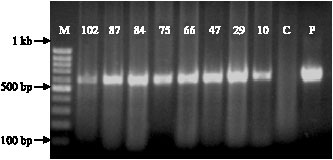 | |
| Fig. 1: | PCR of genomic DNA of eight wheat lines (numbers indicate respective wheat lines; line 47 is Pasang Lahmu, rest are Annapurna-1) showing the amplification of approximately 0.6 kb band of the transgene. P, plasmid (positive control); C, negative control (wildtype Annapurna-1), M, 100 bp ladder (Fermentas) |
The inheritance of the transgene was followed up to the T2 generation by PCR to verify the stable integration of the transgene into the genomic DNA. All the lines that were positive to ipt in T0 generation produced ipt positive progenies, thus indicating the stable integration of the transgene into wheat genome. The segregation ratio of the transgene in different lines was also calculated based on PCR data. Only two lines A-66 and A-87 were found to have the segregation of ratio of 3:1 segregation of the reporter gene (gfp or bar) as revealed by gfp fluorescence in different parts of the T1 and T2 transgenics or selection in the phosphinothricin containing medium. In other lines, the ratio was not exact 3:1 which may probably due to silencing of the transgene or due to multiple insertion of the transgene in the wheat genome. All of the plants expressing the reporter genes as well as those not expressing the reporter gene were tested by PCR for the presence of the transgene. Most of the transgenic lines were found to have co-segregation of reporter gene and SEE1::IPT transgene. Only the lines P-47 and A-84 did not show co-segregation of the co-bombarded transgenes. Seven lines that were positive for the presence of the SEE1::IPT transgene in PCR and southern hybridisations of DNA samples from T0 leaves were taken for further work. The lines containing only the reporter genes and chimeras containing SEE1::IPT transgene only in the T0 generation were discarded.
| Table 1: | Chlorophyll content (mg g-1 fresh weight) and chlorophyll a/b ratio of the fourth leaf (top) of the main tiller of T1 transgenic lines and controls of Nepalese Annapurna-1(A-) and Pasang Lahmu (P-) wheat cultivars measured 45 days after sowing (Mean±SD) |
 | |
| Table 2: | Relative longevity (Mean±SD; n = 5) of individual leaves in T2 plants of two lines of transgenic Annapurna-1 and their respective controls |
 | |
Physiological characterization of the transgenic lines Chlorophyll content: The chlorophyll a content in transgenic lines A-29, A-66 and A-87 was higher than in respective controls. Chlorophyll b content, on the other hand was higher in all transgenic lines except A-29 and P-47. Similarly chlorophyll a/b ratio in transgenic lines except A-29 and P-47 was lower than that of respective controls (Table 1). Despite the lack of significant differences in chlorophyll content and chlorophyll ratio two transgenic lines, A-10 and A-87 which showed about 15% decrease in the chlorophyll a/b ratio relative to the controls, were selected for comparison of chlorophyll fluorescence and quantum yield measurements, agronomic parameters and expression analysis.
Effect on leaf longevity: The relative longevity of individual leaves of the transgenic plants was found to be higher than that of respective leaves of control plants in both lines tested. However, statistically significant differences were observed in second and third leaves of the plants derived from transgenic lines A-87 (Table 2).
Chlorophyll fluorescence and quantum yield: Quantum yields of photosystem II as measured by chlorophyll a fluorescence of the flag leaf (L0) and subsequent leaves (L1, L2 and L3) of the primary tiller of T2 plants of the transgenic and control lines is presented in Fig. 2. The transgenic lines showed higher quantum yield than control, however the differences were not statistically significant (p<0.05).
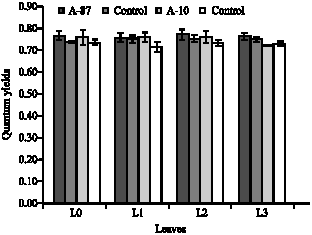 | |
| Fig. 2: | Quantum yields of flag leaf (L0) and subsequent leaves (L1 to LF3) of the main tiller of two transgenic Annapurna-1 lines A-87 and A-10 and their respective controls (error bars represent SD) |
Expression analysis of ipt: The RT-PCR of mRNA from transgenic and control Annapurna-1 plants of the T2 generation of both transgenic lines is shown in Fig. 3. A positive signal was obtained with only three plants from line A-87 out of five plants and there was no signal in plants from line A-10.
Agronomic parameters: As is evident from the Table 3 was no differences between the transgenic and control lines of the plants of both transgenic lines in plant height as determined by measuring the culm length of the primary tiller.
| Table 3: | Comparison of agronomic parameters of two transgenic lines of Annapurna-1 with their respective controls (Mean±SD) |
 | |
| *Data taken only from the main tiller | |
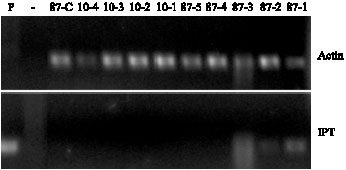 | |
| Fig. 3: | RT-PCR of T2 lines of transgenic Annapurna-1 87-1 to 10-4 containing pSEE1-IPT and control 87-C and 10-C showing amplification of wheat actin (upper row, each slot containing 5 μL of pcr product) and ipt (lower row; each slot containing 10 μL of pcr product) transcripts. Numbers represent the respective lines, P is the plasmid control (2.5 μL of pcr product); - is negative control (tobacco cDNA for actin and SAG12-kn1 for ipt) |
The number of tillers also showed inconsistent results. The number of total tillers was higher in transgenics than in control lines in plants derived from A-87 while it was just the opposite in plants derived from A-10. The differences however were not statistically significant in both cases. The trend in the number of fertile tillers was also similar to that of the number of total tillers. The length of the ear of the primary tiller also were not significantly different between transgenic and control lines in plants derived from both transformation events A-10 and A-87. The ear length in control (azygous) plants was more than that of transgenic plants in T2 generations of both lines. Similarly the number of grains per ear was also not significantly different in transgenics and their respective controls. The value for the transgenic lines was higher and lower than in azygous controls, respectively in plants derived from line A-87 and A-10.
The single grain weight was found to be slightly higher in controls lines than in transgenic. In both cases the differences, however, were not statistically significant.
Plant biomass (dry weight without grains) was also found to be not significantly different between the controls and transgenics from both transgenic lines. The variation in the values of the plant weight was found to be similar to that of the number of grains.
DISCUSSION
ipt transgene and expression: Senescence-specific expression of the ipt gene from Agrobacterium have been reported to have a positive effect in delaying senescence in various plant species like Tobacco (Gan and Amasino, 1995; Jordi et al., 2000), broccoli (Chen et al., 2001), Lettuce (McCabe et al., 2001), Rice (Lin et al., 2002), Maize (Robson et al., 2004) and wheat (Daskalova et al., 2002; Sykorova et al., 2008). In all earlier studies except that of Robson et al. (2004) the expression of ipt gene was driven by the SAG12 promoter from Arabidopsis, a promoter from a dicot plant. Robson et al. (2004), however isolated SEE1 promoter from maize to drive the expression of ipt gene and succeeded in significant delaying of leaf senescence in transgenic lines. The same construct as used by Robson et al. (2004) was used in present investigation, considering that SEE1 (a promoter from a monocot species) will be more effective than SAG12 (a promoter from Arabidopsis thaliana, a dicot species) in driving the expression of ipt gene in wheat.
The effects on timing of anthesis and ripening were not significantly different in transgenic and controls plants (Data not shown). However, with the exception of increase in relative longevity of individual leaves in transgenic line A-87, no antisenescence effect could be seen in transgenic wheat lines containing the ipt gene under the control of SEE1 promoter from maize. In several previous reports about transgenic cereals containing ipt gene under the control of senescence inducible promoters delayed senescence could be related with the expression of ipt gene only in the case of rice (Lin et al., 2002), wheat (Daskalova et al., 2002; Sykorova et al., 2008) and maize (Robson et al., 2004). In all other works either the ipt gene was not expressed at all (Xi et al., 2004) or ipt expression did not result in delayed senescence effect as expected but showed other phenotypic effects (Young et al., 2004). Though all these works with the exception of Robson et al. (2004) involved SAG12 promoter, the contradicting effects of similar systems even in the same species may be due to variations in the degree of expression of the introduced genes. These differences might be caused by differences in promoter strength, or due to different responsiveness of different genotypes to the enhanced cytokinin level, the end product of gene expression. Furthermore, the differences in the effect of the same transgene even in the same species might also be caused by differential expression due to position of the transgene within the wheat genome.
Chlorophyll partitioning and effects on quantum yield of transgenics: Deficiency of chlorophyll b is reported to cause a decrease in relative abundance, relative antennae size and light harvesting capacity of PSII in rice (Terao and Katoh, 1996). Similarly, the senescing leaves of field grown wheat are reported to have higher chlorophyll a/b ratio, probably due to greater vulnerability of chlorophyll b towards degradation during senescence (Lu et al., 2001). Retention of relatively high chlorophyll b content and lowering of chlorophyll a/b ratio in transgenic lines compared to azygous lines in present investigation might be due to the senescence delaying effect of the transgene and/or greater stability to the degradation of proteins of LHCII complexes in those lines. Robson et al. (2004) had also reported lowering of chlorophyll a/b ratio in transgenic maize expressing the same transgene, but gave no explanation for this. Furthermore, the lowering of chlorophyll a/b ratio reported by Robson et al. (2004) was much higher compared to that of present work.
Other effects on morphology and agronomic performance: Cytokinins delay senescence in cereals by triggering pleiotropic effects on various senescence related processes (Kaminek et al., 2003). In addition to delay of senescence they also promote tillering by counteracting apical dominance. Release from apical dominance is seen not only at the level of tillers, but also at the level of ears/spikelets, where it counteracts the so called semibasal or medial dominance which would otherwise result in poorly developed or aborted grains at the distal parts of the spikelets (Williams and Cartwright, 1980; Kaminek et al., 2003). Cytokinins also increase the reproductive sink size in cereals in various ways. These effects of cytokinins on cereals have been proven either by applying exogenous cytokinins (Williams and Cartwright, 1980; Sivakumar et al., 2001; Kaminek et al., 2003) or by making use of the senescence induced increase in cytokinins in transgenic lines, using the pSAG12::IPT construct (Daskalova et al., 2002).
No such effects on morphology and agronomic performance could be observed in the present investigation. Xi et al. (2004) also reported such similar findings. They did not see transgene expression and enhancement of cytokinin levels in leaves. Daskalova et al. (2002) have reported an increase in grain yield in transgenic wheat by expressing ipt gene under the regulation of SAG12 promoter.
Endogenous cytokinin levels and senescence: Normally, leaf senescence is associated with downregulation of cytokinin biosynthetic gene like ipt and cytokinin synthase and up-regulation of cytokinin degradative enzymes like cytokinin oxidase (Buchanan-Wollaston et al., 2005). Therefore, leaf senescence is characterised by a decrease in the amount of cytokinins, especially of the zeatin type (Banowetz, 1997). Developmental targeting of ipt gene during senescence is reported to cause an increase in the concentration of cytokinins at the onset of senescence resulting in delayed senescence in plants like tobacco (Gan and Amasino, 1995; Jordi et al., 2000) and lettuce (McCabe et al., 2001). There have been reports of delayed senescence caused by similar strategy in other plants like broccoli (Chen et al., 2001) and maize (Robson et al., 2004), even though no enhancement of cytokinin content have been reported. The transgenic lines in the present study which contained the ipt gene under the control of senescence enhanced promoter from maize did not result in delaying of senescence.
Such lack of effects on leaf senescence in transgenic lines in present investigation may be due to the poor expression or complete lack of transgene expression caused by either the use of a weak promoter, or by partial or complete silencing of the transgene. The results of RT-PCR show either a weak expression (in three plants of line A-87) or no expression of the transgene (in rest of the lines from A-87 and all plants from A-10) in T2 plants indicating the possible involvement of similar mechanisms in the lack of delayed senescence phenotype in the transgenic lines in present investigation. The studies on transgenic wheat expressing pSAG12-ipt (Xi et al., 2004) also could not find any effect on senescence. Even the studies reporting a distinct phenotypic effects in different monocot species like rice (Lin et al., 2002) and maize (Robson et al., 2004; Young et al., 2004) have either not mentioned anything about the extent of enhancement in cytokinin content (Robson et al., 2004; Young et al., 2004) or found no significant change in cytokinin content (Lin et al., 2002). These facts make it difficult to make direct comparisons of the effects of such systems in different monocots and that in present investigation.
In the present work transgenic wheat with ipt under the control of senescence enhanced promoter were produced. However, no clear delayed senescence effect except some effects on chlorophyll partitioning in transgenic lines could be observed. Young et al. (2004) also had reported similar findings in transgenic maize lines expressing pSAG12-ipt. They had reported however, other phenotypic effects like inhibition of pistil abortion indicative of the effect of elevated cytokinin levels. Findings of Xi et al. (2004) in wheat are also consistent with that of the present study. The lack of delayed senescence effect of the transgene in the present case may be due to low level of expression or complete lack of expression caused by the use of a weak promoter or by partial or complete silencing of the transgene.
ACKNOWLEDGMENTS
The plasmid construct pBKK2PSEE1XbaIPTNOS is the property of Institute of Grasslands and Environmental Research (IGER), Aberystwyth, UK. The authors would like to thank Dr. Paul Robson, IGER for kindly providing the plasmid construct for present work and to National Wheat Research Program, Nepal Agricultural Research Council for providing the seeds of wheat cultivars released for cultivation in Nepal. The authors are also thankful to Prof. Dr. C. Lehner, Department of Genetics, University of Bayreuth for permission to use fluorescence microscope. The authors are thankful to German Academic Exchange Service (DAAD) for providing financial support to Mr. Pant during the period of his stay in Germany. Similarly, the support from the International club of the University of Bayreuth is highly acknowledged.
REFERENCES
- Banowetz, G.M., 1997. Cultivars of hexaploid wheat of contrasting stature and chlorophyll retention differ in cytokinin content and responsiveness. Ann. Bot., 79: 185-190.
CrossRef - Buchanan-Wollaston, V., T. Page, E. Harrison, E. Breeze and P.O. Lim et al., 2005. Comparative transcriptome analysis reveals significant differences in gene expression and signalling pathways between developmental and dark/starvation-induced senescence in Arabidopsis. Plant J., 42: 567-585.
CrossRef - Chen, L.F.O., J.Y. Hwang, Y.Y. Chang, C.W. Sun and S.F. Yang, 2001. Transformation of broccoli (Brassica oleracea var, italica) with isopentenyltransferase gene via Agrobacterium tumefaciens for post-harvest yellowing retardation. Mol. Breed., 7: 243-257.
Direct Link - Feller, U. and A. Fischer, 1994. Nitrogen metabolism in senescing leaves. Crit. Rev. Plant Sci., 13: 241-273.
CrossRef - Fettig, S. and D. Hess, 1999. Expression of a chimeric stilbene synthase gene in transgenic wheat lines. Transgenic Res., 8: 179-189.
CrossRef - Gan, S. and R.M. Amasino, 1995. Inhibition of leaf senescence by autoregulated production of cytokinin. Science, 270: 1986-1988.
CrossRef - Griffiths, C.M., S.E. Hosken, D. Oliver, J. Chojecki and H. Thomas, 1997. Sequencing, expressing pattern and RFLP mapping of a senescence-enhanced cDNA from Zea mays with high homology to oryzain Ύ and aleurain. Plant Mol. Biol., 34: 815-821.
CrossRef - Hensel, L.L., V. Grbic, D.A. Baumgarten and A.B. Bleecker, 1993. Developmental and age-related processes that influence the longevity and senescence of photosynthetic tissues in Arabidopsis. Plant Cell, 5: 553-564.
Direct Link - Huber, M., R. Hahn and D. Hess, 2002. High transformation frequencies obtained from a commercial wheat (Triticum aestivum L. cv. Combi) by microbombardment of immature embryos followed by GFP screening combined with PPT selection. Mol. Breed., 10: 19-30.
Direct Link - Jiang, C.Z., S.R. Rodermel and R.M. Shibles, 1993. Photosynthesis, rubisco activity and amount and their regulation by transcription in senescing soyabean leaves. Plant Physiol., 101: 105-112.
Direct Link - Jordi, W., A. Schaependonk, E. Davelaar, G.M. Stoopen and C.S. Pot et al., 2000. Increased cytokinin levels in transgenic PSAG12-ipt tobacco plants have large direct and indirect effects on leaf senescence, photosynthesis and N-partitioning. Plant Cell Environ., 23: 279-289.
Direct Link - Kaminek, M., B. Solcova, M. Trckova, V. Motyka, S. Daskalova and M.C. Elliott, 2003. Exploitation of Mechanisms Regulating Cytokinin Levels to Improve Cereals. In: Phytohormones in Plant Biotechnology and Agriculture, Machackova, I. and G.A. Romanov (Eds.). Kluwer Academic Publishers, Netherlands, pp: 109-128.
- Lim, P.O., H.J. Kim and H.G. Nam, 2007. Leaf senescence. Ann. Rev. Plant Biol., 58: 115-136.
CrossRefDirect Link - Lin, Y.J., M.L. Cao, C.G. Xu, H. Chen, J. Wei and Q.F. Zhang, 2002. Cultivating rice with delaying leaf-senescence by PSAG12-IPT gene transformation. Acta Bot. Sin., 44: 1333-1338.
Direct Link - Lohman, K.N., S. Gan, M.C. John and R.M. Amasino, 1994. Molecular analysis of natural leaf senescence in Arabidopsis thaliana. Physiol. Plant., 92: 322-328.
CrossRef - Lu, C., Q. Lu, J. Zhang and T. Kuang, 2001. Characterisation of photosynthetic pigment composition, photosystem II photochemistry and thermal energy dissipation during leaf senescence of wheat plant grown in the field. J. Exp. Bot., 52: 1805-1810.
CrossRef - McCabe, M.S., L.C. Garratt, F. Schepers, W.J.R.M. Jordi and G.M. Stoopen et al., 2001. Effects of PSAG12-IPT gene expression on development and senescence in transgenic lettuce. Plant Physiol., 127: 505-516.
CrossRef - Oh, S.A., J.H. Park, G.I. Lee, K.H. Paek, S.K. Park and H.G. Nam, 1999. Identification of three genetic loci controlling leaf senescence in Arabidopsis thaliana. Plant J., 12: 527-535.
Direct Link - Pellegrineschi, A., L.M. Noguera, B. Skovmand, R.M. Brito and L. Velaquez et al., 2002. Identification of highly transformable wheat genotypes for mass production of fertile transgenic plants. Genome, 45: 421-430.
Direct Link - Pellegrineschi, A., M. Reynolds, M. Pachco, R.M. Britto, R. Almeraya, K. Yamaguchi-Shinozaki and D. Hoisington, 2004. Stress induced expression in wheat of the Arabidopsis thaliana DREB1 gene delays water stress symptoms under greenhouse conditions. Genome, 47: 493-500.
Direct Link - Porra, R.J., W.A. Thompson and P.E. Kriedemann, 1989. Determination of accurate extinction coefficients and simultaneous equations for assaying chlorophylls a and b extracted with four different solvents: Verification of the concentration of chlorophyll standards by atomic absorption spectroscopy. Biochim. Biophys. Acta (BBA)-Bioenerget., 975: 384-394.
CrossRefDirect Link - Robson, P.R., I.S. Donnison, K. Wang, B. Frame, S.E. Pegg, A. Thomas and H. Thomas, 2004. Leaf senescence is delayed in maize expressing the Agrobacterium ipt gene under the control of a novel maize senescence-enhanced promoter. Plant Biotechnol. J., 2: 101-112.
CrossRef - Sambrook, J. and D.W. Russell, 2001. Molecular Cloning: A Laboratory Manual. 3rd Edn., Cold Spring Harbor Laboratory Press, New York, USA., ISBN-13: 9780879695774, Pages: 2344.
Direct Link - Sivakumar, T., Virendranath and G.C. Srivastava, 2001. Effects of benzyl adenine and abscissic acid on yield and yield componenets in triticale and wheat. J. Agron. Crop Sci., 183: 43-46.
CrossRefDirect Link - Sykorova, B., G. Kuresova, S. Daskalova, M. Trckova and K. Hoyerova et al., 2008. Senescence induced ectopic expression of the A. tumefaciens ipt gene in wheat delays leaf senescence, increases cytokinin content, nitrate influx and nitrate reductase activity, but does not affect grain yield. J. Exp. Bot.
Direct Link - Terao, T. and S. Katoh, 1996. Antenna sizes of Photosystem I and II in chlorophyll b deficient mutants of rice. Evidence for an antenna function of photosystem II centres that are inactive in electron transport. Plant Cell Physiol., 37: 307-312.
Direct Link - Williams, R.H. and P.M. Cartwright, 1980. The effect of applications of synthetic cytokinin on shoot dominance and grain yield in spring barley. Ann. Bot., 46: 445-452.
Direct Link - Xi, Y., O. Zhang, Y. Lin, W. Hou and M. Lu, 2004. Introduction of leaf senescence-inhibiting gene PSUB SAG12-IPT into common wheat via Agrobacterium tumefaciens soaked seeds. Scientia Agric. Sin., 37: 1235-1238.
Direct Link - Young, T.E., J. Giesler-Lee and D.R. Gallie, 2004. Senescence induced expression of cytokinin reverses pistil abortion during maize flower development. Plant J., 38: 910-922.
Direct Link