

Tariq Mahmood
Department of Agronomy, University of Agriculture, Faisalabad, Pakistan
M. Saeed
Department of Agronomy, University of Agriculture, Faisalabad, Pakistan
Riaz Ahmad
Department of Agronomy, University of Agriculture, Faisalabad, Pakistan
Pakistan Journal of Biological Sciences
Year: 2000 | Volume: 3 | Issue: 3 | Page No.: 531-533





ABSTRACT
Crop irrigated at 25 and 50 percent ASMD gave 21.53 and 17.10 percent greater grain yield ha–1 than that irrigated at 75 percent ASMD. Application of P2O5 at 200, 150 and 100 kg ha–1 increased grain yield by 24.50, 20.31 and 13.64 percent, respectively over control. In general, maize irrigated at 25 percent ASMD gave significantly higher grain starch and ail content, than that irrigated of 75 percent ASMD, but it significantly decreased grain protein content. Similarly application of K2O significantly increased grain starch and oil content. However, K2O application had non-significant effect on grain protein content in 1992 but caused significant increase in 1993.
PDF Abstract XML References Citation
How to cite this article
Tariq Mahmood, M. Saeed and Riaz Ahmad, 2000. Impact of Water and Potassium Management on Yield and Quality of Maize (Zea mays L.). Pakistan Journal of Biological Sciences, 3: 531-533.
DOI: 10.3923/pjbs.2000.531.533
URL: https://scialert.net/abstract/?doi=pjbs.2000.531.533
DOI: 10.3923/pjbs.2000.531.533
URL: https://scialert.net/abstract/?doi=pjbs.2000.531.533
INTRODUCTION
Maize (Zea mays L.), an important food and feed crop is ranked third after wheat and rice in the world. It has high yield potential and response greatly to potassium fertilizer. Therefore proper management of potassium nutrient is essential to realize maximum potential of the crop because it plays an important role in activating various enzymes (Tisdale et al., 1990). Thereby potassium affects plant metabolism, although the amounts needed for this propose are very small. Large amounts of potassium are also needed for regulation of different physico-chemical processes in plants including water utilization by the plants. An adequate supply of potassium confers drought tolerance and frost resistance on plants (Coranzzina et al., 1991).
Availability/uptake of potassium to plants depends on the amount of water available to them because diffusion of nutrients towards root depends upon sufficiently high soil moisture content. Besides water is essential for crop growth and productivity, as it not only maintain the turgor pressure of the cells but also regulates various metabolic functions. Irrigation, thus, improves the efficiency of fertilizer utilization by the crop (Shimshi, 1969). There are several reports which indicate that maize grain protein contents were increased by increasing irrigation frequency (Bajwa et al., 1987). Keeping the above information in view, present study was designed to determine the effect of various levels of potassium and available soil moisture deficit on yield and quality of maize.
MATERIALS AND METHODS
Experiment was conducted under field conditions at the University of Agriculture, Faisalabad, Pakistan during 1992 and repeated in 1993. Before sowing the crop, soil samples were collected to a depth of 30 cm from the experimental area. The samples were analysed for various physico-chemical properties of the soil.
Experiment was laid out in split plot design with three replications. ASMD levels for irrigation were placed in main plots while potassium levels were allocated to sub plots. The size of sub plot was 2.40×7.50 m. Maize cv. Akbar was sown on a well prepared seed bed in 60 cm spaced single rows with a single row hand drill. A basal dose of nitrogen and phosphorus at 200 kg N + 100 kg P2O5 ha–1 was applied. All of K in the respective plot and phosphorus and half of N were side dressed at sowing; while the remaining half of N was top dressed with first irrigation that was applied 10 days after sowing. Subsequent irrigation were applied when soil attained the specified available soil moisture deficit (ASMD) level in each treatment. Thinning was done at 2-4 leaf stage to maintain a plant to plant distance of 15 cm. All other Agronomic practices were adopted according to the requirement of crop.
Procedure for ASMD: Soil moisture was determined according to the procedure described by Hansen et al. (1979). Seed yield was recorded on sub plot basis and then transformed to t ha–1. Grain starch, oil and protein content were determined by using standard procedure. The data were statistically analysed using the micro computer MSTAT program. Least significance difference (LSD) test at 0.05 p (Steel and Torrie, 1984).
RESULTS AND DISCUSSION
Grain yield: There was significant increase in grain yield per hectare with a decrease ASMD level in both years. In 1992, although maize crop irrigated at 50 and 25 percent ASMD gave significantly higher grain yield per hectare than that irrigated at 75 percent ASMD, yet former two ASMD levels were statistically equal to each other. By contrast, in 1993 there was significant increase in grain yield per hectare with each decrease in ASMD. Irrigation at 25 percent ASMD produced significant maximum grain yield of 7.86 t ha–1 against the significant minimum of 6.39 t ha–1 at 75 percent ASMD. Overall crop irrigated at 25 and 50 percent ASMD gave 21.33 and 17.10 percent greater grain yield than that at 75 percent ASMD. Greater grain yield at lower ASMD is associated with higher number of grains cob–1.
Application of K significantly increased grain yield ha–1 over control in both years. In 1992, maize crop fertilizer at 200 kg K2O ha–1 produced greatest grain yield (8.39 t ha–1 ) followed by 150 and 100 kg K2O ha–1 which produced 8.06 and 7.39 tonnes grain ha–1, respectively and significantly differed from each other. In 1993, although there was a progressive increase in grain yield ha–1 with each increase in K2O level, yet difference between 200 and 150 kg K2O ha–1 or between 150 and 100 kg K2O ha–1 was non-significant. On an average, application of 200, 150 and 100 kg K2O ha increased grain yield by 24.50, 20.31 and 13.64 percent, respectively over control because of increased 1000-grain weight and grain weight cob–1. Greater test weight may be attributed to higher CGR and NAR as well as greater DW plant–1.
Grain starch contents: Irrigation at different levels of ASMD had significant effect on grain starch content in both years (Table 1). In 1992, maize irrigated at 25 and 50 percent ASMD significantly increased grain starch content over that irrigated at 75 percent ASMD but did not significantly differ from each other.
| Table 1: | Grain yield, quality and net income as affected by irrigation at varying ASMD levels and potassium application |
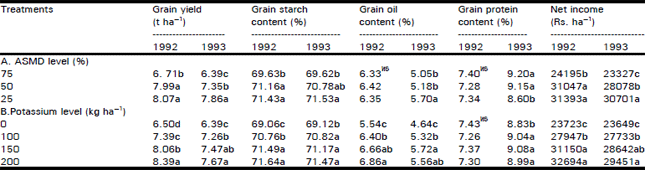 | |
In 1993, irrigation at 25 percent ASMD gave maximum grain starch content of 71.53 percent but was statistically equal to irrigation at 50 percent ASMD. Lower grain starch content in case of less water supply might be due to enhanced amylolytic activity in response to water stress (Todd, 1972; Jacobsen et al., 1986) that breaks down starch into simple sugar.
Maize crop fertilized at 200 kg ha–1 produced maximum grain starch content but was statistically equal to 150 kg K2O ha–1. These two K2O levels gave significantly greater grain starch content than control but did not significantly differ from one another. Greater starch content with K2O application may be due to the activation of starch synthetase, which is a key enzyme controlling the rate of starch synthesis and potassium is required for its activation (Tisdale et al., 1990). Interactive effect of irrigation at various ASMD levels and K2O application on grain starch content was non-significant.
Grain oil content: Grain oil content was significantly affected by irrigation at different levels of ASMD in 1993 but not in 1992. Crop irrigated at 25 percent ASMD significantly increased grain oil content over 50 and 75 percent ASMD. The latter ASMD levels were statistically equal to each other. It appears that adequate water supply may. have same promotive effect on some physiological process (es) responsible for oil synthesis and/or suppressive effect on oil degradation in maize grain.
In 1992, crop fertilized at 200 kg K2O ha–1 significantly increased oil content over 100 kg K2O ha–1 but was on a par with 150 kg K2O ha–1. Similarly, in 1993, application of 150 kg K 9 ha–1 significantly enhanced oil content over 100 kg K2O ha–1 but was statistically equal to 200 kg K2O ha–1. Promotive effect of potassium on grain oil content is due to the fact that K+ ions are required by two enzymes in the pathway of fatty acid bio synthesis, viz, acetyl-CoA synthetase and acetyl-CoA Carboxylase. Acetyl-CoA synthetase is activated by K ions (Hiatt, 1964) while small changes in K+ or Mg+2 concentrations have been reported to produce large changes in the activity of wheat germ acetyl-CoA carboxylase (Nielsen et al., 1979). Davidescu (1965) found that K applied in addition to NP increased grain oil content. Interactive effect of treatment combinations on grain pil content was non-significant.
Grain protein content: Irrigation at different levels of ASMD had a significant effect on grain protein content in 1993 but non-significant in 1992. Maize crop irrigated at 75 and 50 percent ASMD significantly increased grain protein content over that irrigated at 25 percent ASMD but the former ASMD levels were on a par with each other. There results suggest that there is an inverse relationship between moisture availability and protein content of maize grain. A high soil moisture content throughout the growth period of wheat has been reported to increase grain yield and decrease grain protein content (Neidig and Snyder, 1924).
Grain protein content was significantly affected by K2O application in 1993 but not in 1992. Different levels of K2O significantly increased grain protein content over control but differences among three K2O levels were non-significant. However, grain protein content, on an average, was 2.34 percent higher in crop fertilized with K2O compared with control. Greater protein content at high K2O levels may be due to the enhanced uptake and translocation of nitrate which provides nitrogen for amino acid synthesis. Moreover, K is involved in the synthesis of ATP that is required in both nitrogen uptake and protein biosynthesis (Tisdale et al., 1990).
Treatment combinations also had significant effect on grain protein content in 1993 but not in 1992. Crop irrigated at 50 percent ASMD and fertilized at 100 kg K2O ha–1 (I1k2) gave maximum grain protein content (9.29%) which was on a par with I1k3, I2k2, I1k2, I1k1, I2k0 and I1k0. By contrast, maize grown with irrigation at 25 percent ASMD and at zero kg K2O ha–1 (13K0) produced grains with the minimum protein content.
Net Income: Irrigation at various levels of ASMD significantly affected net income ha–1 in both years. ln 1992, crop irrigated at 25 percent ASMD gave maximum net income of Rs. 31,393 ha–1 and was statistically equal to 50 percent ASMD but significantly differed from irrigation at 75 percent ASMD. However, in 1993, each decrease in ASMD level significantly increased net income ha–1. Higher net income with adequate water supply is ascribed to the greater grain yield ha–1 with irrigation at lower ASMD levels.
Application of K2O also significantly increased net income ha–1 over control in both years. In 1992, application of K2O at 200 kg ha–1 gave maximum net income of Rs. 32,694 ha–1 and was statistically equal to 150 kg ha–1 but significantly differed from 100 kg K2O ha–1. By contrast, crop grown without K2O application gave significant minimum net income of Rs. 23,723 ha–1. The same trend was found in 1993 except that 100 and 150 kg K2O ha–1 were statistically on a par with each other. More net income with elevated K2O levels is attributed to the enhanced grain yield ha–1. Contrary to the individual significant effect of irrigation at different ASMD levels and K2O applications, their interactive effect on net income was non-significant.
REFERENCES
- Bajwa, M.S., A. Akhtar, M.R. Hussain and M.B. Raja, 1987. Effect of irrigation frequencies and nitrogen rates on the yield and protein content of maize. Pak. J. Agric. Res., 8: 325-329.
Direct Link - Hiatt, A.J., 1964. Further studies on the activation of acetic thiokinase by magnesium and univalent cations. Plant Physiol., 39: 475-479.
Direct Link - Jacobsen, J.V., A.D. Hanson and P.C. Chandler, 1986. Water stress enhances expression of an α-amylase gene in barley leaves. Plant Physiol., 80: 350-359.
Direct Link - Neidig, R.E. and V.S. Snyder, 1924. The relation of moisture and available nitrogen to the yield and protein content of wheat. Soil Sci., 18: 173-179.
Direct Link - Nielsen, N.C., A. Adee and P.K. Stumpf, 1979. Fat metabolism in higher plants. Further characterization of wheat germ acetyl coenzyme A carboxylase. Arch. Biochem. Biophys., 192: 446-456.
CrossRefDirect Link - Davidescu, D.D., 1965. Effect of NP and NPK fertilizers on grain protein, starch and oil content percentage in dry grain. Proceedings of the 4th Regional College International Potash Institute Bern, (IPI-Bull. No. 5. Fertilizing for Higher Yield Maize, 2nd Edn., International Potash Institute Bern), (IPI'65), Switzerland, pp: 85-97.
- Shimshi, D., 1969. Interaction between irrigation and plant nutrition, transition from extensive to intensive agriculture with fertilizers. Proceedings of the 7th Regional College International Potash Institute Bern, (IPI-Bull. No. 5. Fertilizing for Higher Yield Maize, 2nd Edn., International Potash Institute Bern), (IPI'69), Switzerland, pp: 111-120.