






Midhat A. El-Kasheif
National Institute of Oceanography and Fisheries, Al-Kanater Al-Khairya Fish Research Station, Egypt
Kariman A. Sh. Shalloof
National Institute of Oceanography and Fisheries, Al-Kanater Al-Khairya Fish Research Station, Egypt
Mohammad M.N. Authman
Department of Hydrobiology, National Research Centre, Dokki 12622, Giza, Egypt
Journal of Fisheries and Aquatic Science
Year: 2013 | Volume: 8 | Issue: 2 | Page No.: 323-339
ABSTRACT
Reproduction in fishes is one of the basic biological features enabling the maximum survival and continuation of species. The present study was aimed to investigate some aspects of the reproductive biology of Tilapia spp. inhabited Damietta branch of the River Nile, Egypt, to manage these species in this important fish resource. Tilapia spp. fishes were taken on a seasonally basis over a complete year round from the studied area. Sex ratio, maturity stages, gonadosomatic index (GSI), absolute fecundity and egg diameters were studied. The overall sex-ratio of male to female was 1:0.68 and 1:0.98 which deviates significantly (χ2 = 23.716; p<0.0001 and χ2 = 11.869; p = 0.0078) from the hypothetical distribution of 1:1, for Oreochromis niloticus and Tilapia zillii, respectively, whereas for Sarotherodon galilaeus, the overall sex-ratio was 1:0.81 (χ2 = 2.395; p = 0.4946). The maturity stages of Tilapia spp. were classified macroscopically into five stages. The breeding period (expressed by GSI) of Tilapia spp. exhibited several peaks. Variations found in fecundity and egg diameter were due to differences in reproductive habits of studied species. Fecundity and egg diameter, in Tilapia species were found to depend on length, weight or age of the fish. The data generated in this study are provide knowledge on rational stock utilization, protection of new recruits and the prediction of recruitment variability. So, to protect Tilapia spp. in Damietta branch of the River Nile, Egypt, from exploitation, it is recommended to ban the use of gears with illegal mesh sizes and other destructive fishing methods to allow the fish to breed, grow and recruit into the fishery.
PDF Abstract XML References Citation
Article History
Received: September 04, 2012;
Accepted: November 01, 2012;
Published: January 15, 2013
How to cite this article
Midhat A. El-Kasheif, Kariman A. Sh. Shalloof and Mohammad M.N. Authman, 2013. Studies on Some Reproductive Characters of Tilapia Species in Damietta Branch of the River Nile, Egypt. Journal of Fisheries and Aquatic Science, 8: 323-339.
DOI: 10.3923/jfas.2013.323.339
URL: https://scialert.net/abstract/?doi=jfas.2013.323.339
DOI: 10.3923/jfas.2013.323.339
URL: https://scialert.net/abstract/?doi=jfas.2013.323.339
INTRODUCTION
Damietta branch; one of the two main branches of the River Nile; passes to cut four governorates of length about 242 km with an average width of 200 m and depth varying between 12 and 20 m (Elewa and Ali, 1999). Damietta branch of the River Nile has a great vital importance, since it serves as a source of water for municipal, industrial, agricultural, navigation and feeding fish farms dispersed between El-Serw to Faraskour region (Authman et al., 2009). Some studies dealing with the environment, pollution and fishery of Damietta branch have been done by Zyadah (1997), Elewa and Goher (1999), Abdo (2004a, b), Ibrahim and Tayel (2005), Sabae and Rabeh (2007) and Authman et al. (2009).
Tilapias are the most important species participating in the fishery of Damietta branch of the River Nile, where they contribute about 23.59% (7124 tons) of its annual total catch (GAFRD, 2009). They are represented by three species namely: Oreochromis niloticus, Tilapia zillii and Sarotherodon galilaeus (Authman et al., 2009).
The study of reproduction is one of the major aspects in the study of fish biology (Khallaf and Authman, 1991). Descriptions of reproductive strategies and the assessment of fecundity are fundamental topics in the study of the biology and population dynamics of fish species and also for evaluation of the reproductive potential of individual fish species (Shalloof and Salama, 2008; Costache et al., 2011). Of course this will increase our knowledge about the state of a stock and improves standard assessments of many commercially valuable fish species (Hunter et al., 1992; Murua et al., 2003). Moreover, the availability of data based on reproductive parameters and environmental variations could lead to a better understanding of observed fluctuations in reproductive output and enhances our ability to estimate recruitment (Kraus et al., 2002).
The present study provides information on sex ratio, maturity stages, gonadosomatic index and fecundity of the three economically important Tilapia spp. inhabited Damietta branch of the River Nile. These details are needed for the establishment of their production potentials and recruitment which will enhance better rational exploitation, planning and management procedures.
MATERIALS AND METHODS
Sampling sites: Six field sites (Fig. 1), covering Damietta branch of River Nile namely El-Kanater, Benha, El-Mansoura, Talkha, Faraskour and Damietta, were selected to collect fish samples, where sites (I and II) represented El-Qalubia Governorate, sites (III and IV) covered El-Dakahlyia Governorate and sites (V and VI) represented Damietta Governorate. Water temperature was measured (±0.1°C) using a thermometer during each sampling occasion at each station and a seasonally average was calculated (Table 1).
Sampling of fish: Random fish samples were collected seasonally from the fishermen of Damietta branch during the period from February 2005 to November 2006. Samples were collected by fishermen by the most common fishing gears used in the River Nile which are trammel nets with stretched mesh sizes; locally named as Ghazl El-Mehair; which consists of three layers, the two outer layers have 120-160 mm mesh size, while the inner one has 25-35 mm mesh size.
The Tilapia samples, in the area of study, were identified to be: Oreochromis niloticus, Tilapia zillii and Sarotherodon galilaeus.
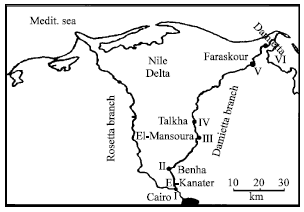 | |
| Fig. 1: | Map showing the sampling sites at Damietta branch |
| Table 1: | Population characteristics of Tilapia fish samples collected from each site at Damietta branch of the River Nile |
 | |
| *Values in parenthesis are Mean values, Avg.: Average | |
Throughout the period of study, 666 O. niloticus, 639 T. zillii and 395 S. galilaeus fishes were collected and the numbers of samples of each fish spp. collected from each site were presented in Table 1.
For each individual fish specimen, total length to the nearest millimeter and body weight to the nearest 0.1 g was measured and the population’s characteristics of each Tilapia spp. were presented in Table 1. Scales from the left side of each fish were removed from an area just below the lateral line and behind the pectoral fin. They were kept in special envelops with full information for further reading. In the laboratory the scales were placed in solution of 10% of NH4OH for 24 h, then washed with distilled water, dried with filter paper and mounted between two glass slides. Scales were examined under a binocular microscope (X20) using an eye piece micrometer, to measure the total scale radius and the radius of each annulus to the nearest 0.001 mm. Immediately after collection fish were dissected, sexed and gonad samples were weighed to the nearest milligram, on an electronic balance. The condition of the gonads was noted macroscopically and the gonads of both sexes of Tilapia spp. were preserved in labeled vials containing 5% buffered formalin for subsequent studies.
Reproduction characteristics
Maturity stages: The maturity stages of ovary and testes were identified and distinguished according to Legendre and Ecoutin (1989).
The gonadosomatic index (GSI): The gonadosomatic index (GSI), used as an indicator parameter for reproduction; was calculated for each specimen as the percentage of gonad weight to that of the fish weight (Khallaf et al., 1986; Khallaf and Authman, 2010) using the following equation:
 |
where, GW is weight of gonads (ovary or testes) (g) and W is total body weight of fish (g).
Absolute fecundity: Ovaries for 112 O. niloticus, 88 S. galilaeus and 58 T. zillii were found with opaque (mature, i.e., laden with yolk) eggs, distributed in the whole period of present study, collected from fish and were used for the study of fecundity. Absolute fecundity (F) was calculated here as the average number of mature eggs per ovary of fish prior to the spawning season, as indicated by many authors (Bagenal, 1978; Bagenal and Tesch, 1978; Khallaf et al., 1986; Duponchelle et al., 2000).
To obtain representative samples of the whole gonads, small portions were taken from the posterior, middle and anterior regions of both lobes of the ovary. These samples were weighed and the numbers of mature eggs were counted. The total number of mature eggs in the ovary was estimated by multiplying the number of mature eggs in the sample by the ratio of the ovary weight to the sample weight as follows (Khallaf et al., 2003):
 |
Fecundity is calculated as the average number of eggs per female fish length, weight or age.
Egg diameter: From each ovary, the egg diameter of about 100 ova; from the ovaries regions mentioned above; was measured to the nearest mm by an ocular micrometer fixed in an eye-piece of a light microscope (Khallaf and Authman, 1991). Tilapia mature eggs are oval in shape and average diameters for both axes of the eggs were used here.
Ageing: Fish were assigned to an age-groups according to the number of complete annuli on its scales (Authman et al., 2009). Growth analysis was not the concern of this paper and data were only used for correlations.
Statistical analyses: All raw data were tested for homogeneity of variance and no significant differences were observed between fish samples from different collection sites. Therefore, data were pooled by species and the basic descriptive statistics (means, standard errors and ranges), Chi-Square (χ2) and univariate regression analysis were estimated from pooled data. All statistical analyses were carried out using the Statistical Package for the Social Sciences (SPSS Inc.) program for Windows (Version 17.0) at the 0.05 level of significance.
RESULTS
Sex ratio: It was seen from sex distribution in Table 2, for studied Tilapia spp., that the two sexes did not occur in the same proportion during different seasons of the year, whereas, females predominated during autumn (52.76, 61.33 and 53.06% for O. niloticus, T. zillii and S. galilaeus, respectively), while males predominated during the rest of other seasons. The overall sex-ratio (M: F) was 1:0.68, 1:0.98 and 1:0.81 for O. niloticus, T. zillii and S. galilaeus, respectively, i.e., the existed number of males was relatively higher than that of females.
| Table 2: | Seasonal variations of sex ratio of Tilapia spp. at Damietta branch of the River Nile |
 | |
There was an association between sex distribution and seasons (Table 2) where the present values of sex-ratio of O. niloticus and T. zillii deviate significantly (χ2 = 23.716; p<0.0001 and χ2 = 11.869; p = 0.0078, respectively) from the hypothetical distribution of 1:1, whereas for S. galilaeus, there was no association between sex distribution and seasons where the sex-ratio value did not depart from the expected 1:1 rate (χ2 = 2.395; p = 0.4946).
Distribution of maturity stages: The seasonal variations in the macroscopic characteristics incidence of different gonad developmental stages are presented in Fig. 2. It is obvious that, for Tilapia spp., all different stages appeared in all seasons. The immature stages (I and II) represented the dominant maturity stages throughout the year with a peak in winter and summer. Mature stage (III), spawning stage (IV) and spent stage (V) of O. niloticus and S. galilaeus reached the maximum percentages in spring while those of T. zillii in spring and summer. The active reproductive period could be expressed by the sum of percentage of stages III and IV. So, the active reproductive period were recorded during autumn then spring and during winter then spring for males and females O. niloticus, respectively. For T. zillii and S. galilaeus, the active reproductive period was recorded during spring then summer for both males and females.
Gonadosomatic index (GSI): Seasonal variations in GSI of Tilapia spp. (Fig. 3) revealed that females have higher values GSI than males. Both O. niloticus sexes followed nearly the same trend and their higher mean values of GSI appeared during autumn and spring. Concerning T. zillii GSI, their higher mean values appeared during autumn, spring and summer. On the other hand, for S. galilaeus, the higher mean values of male GSI appeared during autumn, spring and summer, while for female, higher mean values appeared during autumn, winter and summer. This means that Tilapia spp. could breed more than once in a prolonged spawning season in this region and the periods with high values of GSI for the fish were coincided with warm temperatures (Table 1).
 | |
| Fig. 2(a-c): | Seasonal variations of maturity stages of Tilapia spp. (a) O. niloticus, (b) T. zillii and (c) S. galilaeus in Damietta branch |
 | |
| Fig. 3(a-c): | Seasonal variations of gonadosomatic index (GSI) of Tilapia spp. (a) O. niloticus, (b) T. zillii and (c) S. galilaeus in Damietta branch, Values are Means±SE |
| Table 3: | Variations of absolute fecundity and egg diameter relative to length of Tilapia spp. at Damietta branch of the River Nile |
 | |
| Values are Means±SE, **Highly significant at p<0.01 | |
Absolute fecundity: In the present study, it was found that absolute fecundity ranged between 398-9870 eggs corresponding to fish total length of 10-33 cm for O. niloticus and from 1226 to 6184 eggs for T. zillii fish ranging in total length from 8 to 17 cm. For S. galilaeus, it ranged between 385-5640 eggs corresponding to fish total length of 10-31 cm. There were a highly significant (p<0.01) difference in absolute fecundity with the variation of fish total length of O. niloticus and S. galilaeus (Table 3) whereas for T. zillii fish the difference was insignificant (p>0.05). On the other hand, absolute fecundity was found to vary highly significantly (p<0.01) with the variation of body weight from 25 to 775 and 25 to 500 g of O. niloticus and S. galilaeus, respectively (Table 4), whereas for T. zillii, it was found to vary significantly (p<0.05) with the variation of body weight from 25 to 100 g (Table 4). In addition, absolute fecundity of Tilapia spp. was found to vary highly significantly (p<0.01) with the variation of the fish age-groups from I-VI, I-III and I-V years for O. niloticus, T. zillii and S. galilaeus, respectively (Table 5).
| Table 4: | Variations of absolute fecundity and egg diameter relative to weight of Tilapia spp. at Damietta branch of the River Nile |
 | |
| Values are Means±SE, *Significant at p<0.05, **Highly significant at p<0.01 | |
| Table 5: | Variations of absolute fecundity and egg diameter relative to age-groups of Tilapia spp. at Damietta branch of the River Nile |
 | |
| Values are Means±SE, **Highly significant at p<0.01 | |
It was found that, for O. niloticus, absolute fecundity was better correlated with weight (r = 0.955, p<0.01) and age (r = 0.938, p<0.01) than with length (r = 0.830, p<0.01). Whereas for T. zillii, absolute fecundity was better correlated with weight (r = 0.908, p>0.05) and length (r = 0.870, p<0.01) than with age (r = 0.652, p>0.05).
 | |
| Fig. 4(a-c): | Relationships of absolute fecundity and egg diameter with length of Tilapia spp. (a) S. galilaeus, (b) T. zillii and (c) O. niloticus in Damietta branch |
While for S. galilaeus, it was better correlated with age (r = 0.990, p<0.01) and weight (r = 0.962, p<0.01) than with length (r = 0.880, p<0.01) (Fig. 4-6).
Egg diameter: The relationships between egg diameter and length, weight and age of the studied fish species are presented in Table 3-5 and illustrated in Fig. 4-6. It is obvious that O. niloticus egg diameter was better correlated with length (r = 0.928, p<0.01) and age (r = 0.813, p<0.05) than with weight (r = 0.646, p<0.01). Whereas for T. zillii, egg diameter was better correlated with age (r = 0.992, p>0.05) and weight (r = 0.987, p<0.05) than with length (r = 0.952, p<0.01). While for S. galilaeus, it was better correlated with length (r = 0.928, p<0.01) and age (r = 0.891, p<0.05) than with weight (r = 0.857, p<0.01).
DISCUSSION
Sex ratio should be a consideration when choosing a species of freshwater fishes for culture and reproduction (Mekkawy and Hassan, 2011; El-Kasheif et al., 2012). In fishes, the sex ratio varies from one species to another (Khallaf and Authman, 2010).
 | |
| Fig. 5(a-c): | Relationships of absolute fecundity and egg diameter with body weight of Tilapia spp. (a) S. galilaeus, (b) T. zillii and (c) O. niloticus in Damietta branch |
The overall sex ratio (M:F) of Tilapia spp., in the present study, is found in different numbers with obvious deviation from the expected ratio (1:1) where the number of males exceeded that of females. Nikolsky (1963) and Fryer and Iles (1972) pointed out that, in African water bodies, it is common in the cichlid populations that males dominate because they generally exhibited more growth than females. Also, this observation could be explained by the fact that once the eggs were fertilized, the females hide under vegetations where incubation and protection of the young took place. This activity gives room to the males who then migrate to the feeding zones where they become more vulnerable to catch (Pena-Mendoza et al., 2005; Offem et al., 2007; Shalloof and Salama, 2008; Olele, 2010). In addition, environmental conditions are defined to have variable effects on sex differentiation depending on the genetic background and developmental stability of different strains, where it is well known that temperature fluctuations could alter sex-determination pathways and influence the probability that development would be male or female (Devlin and Nagahama, 2002). While low temperature is capable of biasing sex differentiation toward females in many fish species, elevated temperature has been shown to skew sex ratios towards male in some others (Devlin and Nagahama, 2002).
 | |
| Fig. 6(a-c): | Relationships of absolute fecundity and egg diameter with age-groups of Tilapia spp. (a) S. galilaeus, (b) T. zillii and (c) O. niloticus in Damietta branch |
The values of sex ratio in the present study are in accordance with that estimated by some authors for studied species and differ from others (Table 6). These patterns of variations between Tilapia populations reflect time and locality factors (El-Kasheif et al., 2012). Also, this different situation may be caused by fishing gear and genetics structures of populations (Guclu and Kucuk, 2011).
In the present study the maturity stages of Tilapia spp. were classified macroscopically into five stages and this agrees with that mentioned by Shalloof and Salama (2008) for O. niloticus and Olele (2010) for S. galilaeus and differ with that mentioned by others (Table 6). These differences arises because the sexual maturity is a function of the size and may be influenced by the abundance and seasonal availability of food, the temperature, the photoperiod and other environmental factors at different localities (Nikolsky, 1963; Babiker and Ibrahim, 1979; Pena-Mendoza et al., 2005).
The gonadosomatic index was used to follow the seasonal development of the gonads (Komolafe and Arawomo, 2007). The breeding period (expressed by GSI) of Tilapia spp. in the present study exhibited several peaks. This prolonged period may suggest that fish breed more than once a season.
| Table 6: | Comparison of reproduction characteristics of Tilapia spp. collected from Damietta branch of the River Nile with some other Egyptian and world areas |
 | |
| Values in parenthesis are mean values | |
Similarly, Babiker and Ibrahim (1979) pointed out that, there is more than one spawning per year for O. niloticus in White Nile and other canals at Khartoum, Sudan, while, Payne and Collinson (1983) indicated that S. niloticus in lower Nile, Delta, Egypt, has a relatively restricted spawning season with a peak during April to May. Khallaf et al. (1986) reported that, in Bahr Shebeen canal, Egypt, T. nilotica high GSI values extended from September to April and fish with well-developed gonads and mature eggs were noticed throughout the year. Duponchelle et al. (1999) found O. niloticus, in man-made lakes of Côte d’Ivoire, breeds all year long. For O. niloticus in Coatetelco Lake, Morelos, Mexico, Gomez-Marquez et al. (2003) found that females breed more than once in a season. O. niloticus can spawn three times a year and therefore three clutches of offspring can be produced in the same season (Dikel et al., 2004). Pena-Mendoza et al. (2005) mentioned that, the periodicity of spawning for O. niloticus, at Emiliano Zapata Dam, Morelos, Mexico, indicates that the fish spawn at least twice during the breeding season. Shalloof and Salama (2008) mentioned that, for O. niloticus in Abu-Zabal Lake, Egypt, the period from March-September represented the spawning (breeding) period and females breed more than once a season. Mazrouh and Mahmoud (2009) observed that, O. niloticus, in Rosetta Branch, Nile River, Egypt, has prolonged spawning activities (higher values of GSI). It was found by Siddiqui (1979) that, Tilapia zillii, in Lake Naivasha, Kenya, breeds successively all year round (several times in a year). Khallaf et al. (1986) mentioned that, in Bahr Shebeen canal, Egypt, T. zillii GSI had its highest values in the months of April and May. Negassa and Getahun (2003) declared that T. zillii, in Lake Zwai, Ethiopia, breeds all the year round with peak activities between April and September. Akel and Moharram (2007) reported that, in Abu Qir Bay, Egypt, females T. zillii GSI was higher than males and the fish spawning season lasted from June to September with maximum activity during June and July. Fagade et al. (1984) explained the different peaks in GSI of S. galilaeus, in the IIta lake, Ibadan, Nigeria, to the partial spawning behavior of this species which readily yield its oocytes during a greater period (throughout the year). Onyedineke (2008) reported that, S. galilaeus fishes, in the lower Niger River at Illushi, Nigeria, spawned throughout the sampling period (February to July) and spawning intensity was highest in May (a rainy season month). Olele (2010) mentioned that, for S. galilaeus in Onah Lake, Delta State, Nigeria, the mean GSI was higher in females than in males, with a peak occurred in July, although there were other peaks which showed that this species exhibits multiple spawning with a breeding season extended from March to October. These differences in GSI among species and localities could be explained by different environmental factors such as water temperature, day length, light intensity and water level which influenced spawning (breeding) period (Philippart and Ruwet, 1982).
The assessment of fecundity is the corner stone of the reproductive biology since it is not a stable constant character due to changes in environmental conditions and species specific factors (Khallaf and Authman, 1991; Mekkawy and Hassan, 2011). The variations in fecundity between the species under study and their egg diameter could be attributed to the difference in their reproductive habits. Thus, the nest guarder T. zillii had mean fecundity more than that of O. niloticus and S. galilaeus, the mouth brooders, while the latter two had an egg diameter more than that of the T. zillii. This was in agreement with the findings of Khallaf et al. (1986). Disparity was noted between fecundity and egg diameter of fish in this study area and that of fish populations of other localities (Table 6). Fagade et al. (1984) suggested that variation in fecundity may be due to differential abundance of food. Also, Siddiqui et al. (1997) pointed out that, fecundity increased with increased feeding levels. Increased food availability improved fish health (body condition) and by extension enhanced reproduction (Fagade et al., 1984; Offem et al., 2007; Olele, 2010). In addition, marked differences in fecundity among species often reflect different reproductive strategies (Murua and Saborido-Rey, 2003; Shalloof and Salama, 2008). It was mentioned that, in mouth brooding cichlids; where limited space available for incubation of eggs and rearing of alevins in the buccal cavity; the fecundity is considerably low because the parents assure the survival of the offspring and in consequence less mortality (Moyle and Cech, 2000; Komolafe and Arawomo, 2007). Also, low fecundity was peculiar with specimens exhibiting either parental care and/or prolonged breeding habits (Fawole and Arawomo, 2000; Olele, 2010). Wootton (1979) and Esmaeili et al. (2009) reported that, fecundity variation, in different teleosts, has been attributed to effects of age, egg size and genetic factors.
Murua et al. (2003) postulated that, the fish size and condition are key parameters to properly assess fecundity at the population level. Consistent with that, the absolute fecundity of Tilapia spp. in Damietta branch was found to correlate significantly with fish length, weight and age. This agrees with the observation by Lagler et al. (1977) and Wootton (1992) that fecundity of fish increases with body size. In this respect, Duponchelle et al. (2000) and Olele (2010) found positive correlations, whereas, Babiker and Ibrahim (1979), Pena-Mendoza et al. (2005), Offem et al. (2007) and Shalloof and Salama (2008) found exponential relationships between fecundity and length and weight of O. niloticus but Khallaf et al. (1986) and Komolafe and Arawomo (2007) found logarithmic relationships between fecundity and length of O. niloticus. Khallaf et al. (1986) found linear relationship of fecundity with body weight of O. niloticus. Siddiqui (1979) found a curvilinear relationship between fecundity and length and a linear relationship with body weight of T. zillii, whereas, Akel and Moharram (2007) found logarithmic relationship between fecundity and length and body weight of T. zillii. Khallaf et al. (1986) found logarithmic relationship between fecundity and length and a linear relationship with body weight of T. zillii. Onyedineke (2008) found logarithmic relationship between fecundity and length of S. galilaeus. Khallaf et al. (1986) found a semi-log relationship between fecundity and age of T. zillii and a linear one for O. niloticus.
CONCLUSION
This study illustrates differences between reproductive biology of three Tilapia spp. sharing the same environment. It could be concluded that, the reproductive potential of Tilapia spp. in the Damietta branch of the River Nile, Egypt, vary with the species, size and season. Tilapia spp. breed continuously and breeding activity increases during periods of higher temperature where major breeding peaks (high values of GSI) of the fish are associated with warm temperature. The data generated in this study can provide knowledge on rational stock utilization, protection of new recruits and the prediction of recruitment variability. So, to protect Tilapia spp. in the Damietta branch of the River Nile, Egypt, from exploitation, it is recommended banning, by the concerned authorities, the use of gears with illegal mesh sizes and other destructive fishing methods to allow the fish to breed, grow and recruit into the fishery.
REFERENCES
- Abdo, M.H., 2004. Environmental studies on the River Nile at Damietta Branch region, Egypt. J. Egypt. Acad. Soc. Environ. Dev. (D-Environ. Stud.), 5: 85-104.
Direct Link - Akel, E.H.K.H. and S.G. Moharram, 2007. Reproductive biology of Tilapia zillii (Gerv, 1848) from Abu Qir bay, Egypt. Egypt. J. Aquat. Res., 33: 379-394.
Direct Link - Authman, M.M.N., M.A. El-Kasheif and K.A.S. Shalloof, 2009. Evaluation and management of the fisheries of Tilapia species in Damietta Branch of the River Nile, Egypt. World J. Fish Mar. Sci., 1: 167-184.
Direct Link - Babiker, M.M. and H. Ibrahim, 1979. Studies on the biology of reproduction in the cichlid Tilapia nilotica (L.): Gonadal maturation and fecundity. J. Fish Biol., 14: 437-448.
CrossRefDirect Link - Costache, M., D. Oprea, D. Radu and C. Bucur, 2011. Testing the reproductive potential of Nile Tilapia (Oreochromis niloticus) under eco technological conditions from Nucet. Bull. UASVM Anim. Sci. Biotechnol., 68: 118-124.
Direct Link - Devlin, R.H. and Y. Nagahama, 2002. Sex determination and sex differentiation in fish: An overview of genetic, physiological, and environmental influences. Aquaculture, 208: 191-364.
CrossRefDirect Link - Dikel, S., M.V. Alev and N.B. Unalan, 2004. Comparison of performance of Nile Tilapia (Oreochromis niloticus) at two different initial sizes in floating cages. J. Aric. Fac. C.U., 19: 85-92.
Direct Link - Duponchelle, F., P. Cecchi, D. Corbin, J. Nunez and M. Legendre, 1999. Spawning season variations of female Nile Tilapia, Oreochromis niloticuss, from man-made lakes of Cote D'Ivoire. Environ. Biol. Fishes, 56: 375-387.
CrossRefDirect Link - Duponchelle, F., P. Cecchi, D. Corbin, J. Nunez and M. Legendre, 2000. Variations in fecundity and egg size of female Nile Tilapia, Oreochromis niloticus, from man-made lakes of Cote D'Ivoire. Environ. Biol. Fishes, 57: 155-170.
CrossRefDirect Link - El-Kasheif, M.A., M.M.N. Authman and S.A. Ibrahim, 2012. Environmental studies on Synodontis schall (Bloch and Schneider, 1801) (Pisces: Siluriformes: Mochokidae) in the River Nile at Gizza Sector, Egypt: Biological aspects and population dynamics. J. Fish. Aquat. Sci., 7: 104-133.
CrossRefDirect Link - Esmaeili, H.R., Z. Ganjali and M. Monsefi, 2009. Reproductive biology of the endemic Iranian cichlid, Iranocichla hormuzensis Coad, 1982 from Mehran River, Southern Iran. Environ. Biol. Fishes, 84: 141-145.
CrossRef - Fagade, S.O., A.A. Adebisi and A.N. Atanda, 1984. The breeding cycle of Sarotherodon galilaeus in the IIta lake, Ibadan, Nigeria. Arch. Hydrobiol., 100: 493-500.
Direct Link - Fawole, O.O. and G.A.O. Arawomo, 2000. Fecundity of Sarotherodon galilaeus (Pisces: Cichlidae) in the Opa reservoir, Ile-Ife, Nigeria. Rev. Biol. Trop., 48: 201-204.
Direct Link - Gomez-Marquez, J.L., B. Pena-Mendoza, I.H. Salgado-Ugarte and M. Guzman-Arroyo, 2003. Reproductive aspects of Oreochromis niloticus (Perciformes: Cichlidae) at Coatetelco lake, Morelos, Mexico. Rev. Biol. Trop., 51: 221-228.
PubMedDirect Link - Guclu, S.S. and F. Kucuk, 2011. Reproductive Biology of Aphanius mento (Heckel in: Russegger, 1843) (Osteichthyes: Cyprinodontidae) in Kirkgoz Spring (Antalya-Turkey). Turk. J. Fish. Aquat. Sci., 11: 323-327.
Direct Link - Hunter, J.R., B.J. Macewicz, N.C. Lo and C.A. Kimbrell, 1992. Fecundity, spawning and maturity of female Dover sole Microstomus pacificus, with an evaluation of assumptions and precision. Fish. Bull. US., 90: 101-128.
Direct Link - Khallaf, E.A., M. Galal and M. Authman, 2003. The biology of Oreochromis niloticus in a polluted canal. Ecotoxicology, 12: 405-416.
CrossRefPubMedDirect Link - Komolafe, O.O. and G.A. Arawomo, 2007. Reproductive strategy of Oreochromis niloticus (Pisces: Cichlidae) in Opa reservoir, Ile-Ife, Nigeria. Rev. Biol. Trop., 55: 595-602.
PubMed - Kraus, G., J. Tomkiewicz and F.W. Koster, 2002. Egg production of Baltic cod (Gadus morhua) in relation to variable sex ratio, maturity and fecundity. Can. J. Fish. Aquat. Sci., 59: 1908-1920.
CrossRefDirect Link - Legendre, M. and J.M. Ecoutin, 1989. Suitability of brackish water tilapia species from the Ivory Coast for lagoon aquaculture. I- Reproduction. Aquat. Living Resour., 2: 71-79.
Direct Link - Mazrouh, M.M. and H.H. Mahmoud, 2009. Some aspects of reproductive biology with emphasis on the effect of pollution on the histopathological structure of gonads in Oreochromis niloticus from Rosetta Branch, Nile River, Egypt. World J. Fish Mar. Sci., 1: 190-198.
Direct Link - Mekkawy, I.A.A. and A.A. Hassan, 2011. Some reproductive parameters of Synodontis Schall (Bloch and Schneider, 1801) from the River Nile, Egypt. J. Fish. Aquat. Sci., 6: 456-471.
CrossRefDirect Link - Murua, H. and F. Saborido-Rey, 2003. Female reproductive strategies of marine fish species of the North Atlantic. J. Northwest Atlantic Fish. Sci., 33: 23-31.
Direct Link - Murua, H., G. Kraus, F. Saborido-Rey, P.R. Witthames, A. Thorsen and S. Junquera, 2003. Procedures to estimate fecundity of marine fish species in relation to their reproductive strategy. J. Northwest Atlantic Fish. Sci., 33: 33-54.
Direct Link - Nikolsky, G.V., 1963. The Ecology of Fishes. Academic Press, Cambridge, Massachusetts, ISBN: 9780125197502, Pages: 352.
Direct Link - Offem, B.O., Y. Akegbejo-Samsons and I.T. Omoniyi, 2007. Biological assessment of Oreochromis niloticus (Pisces: Cichlidae; Linne; 1958) in a tropical floodplain river. Afr. J. Biotechnol., 6: 1966-1971.
Direct Link - Offem, B.O., Y.A. Samsons and I.T. Omoniyi, 2008. Reproductive aspects of common freshwater fishes in the Cross River, Nigeria. J. Anim. Plant Sci., 18: 130-138.
Direct Link - Olele, N.F., 2010. Reproductive biology of Sarotherodon galilaeus (Artedi, 1757) in Onah Lake, Delta State, Nigeria. J. Applied Sci. Res., 6: 1981-1987.
Direct Link - Onyedineke, N.E., 2008. Aspects of the growth and reproductive biology of Sarotherodon galilaeus (Cichlidae) from the lower Niger river at Illushi, Nigeria. Adv. Sci. Technol., 2: 93-96.
Direct Link - Peña-Mendoza, B., J.L. Gómez-Márquez, I.H. Salgado-Ugarte and D. Ramírez-Noguera, 2005. Reproductive biology of Oreochromis niloticus (Perciformes: Cichlidae) at Emiliano Zapata Dam, Morelos, Mexico. Rev. Biol. Trop., 53: 515-522.
PubMedDirect Link - Sabae, S.Z. and S.A. Rabeh, 2007. Evaluation of the microbial quality of the River Nile waters at damietta branch, Egypt. Egypt. J. Aquat. Res., 33: 301-311.
Direct Link - Shalloof, K.A.S. and H.M.M. Salama, 2008. Investigations on some aspects of reproductive biology in Oreochromis niloticus (Linnaeus, 1757) inhabited Abu-Zabal Lake, Egypt. Global Vet., 2: 351-359.
Direct Link - Siddiqui, A.Q., 1979. Reproductive biology of Tilapia zillii (Gervais) in Lake Naivasha, Kenya. Environ. Biol. Fish., 4: 257-262.
CrossRefDirect Link - Siddiqui, A.Q., A.H. Al-Harbi and Y.S. Al-Hafedh, 1997. Effects of food supply on size at first maturity, fecundity and growth of hybrid tilapia, Oreochromis niloticus (L.) x Oreochromis aureus (Steindachner), in outdoor concrete tanks in Saudi Arabia. Aquacult. Res., 28: 341-349.
CrossRef