

Shuraya Tasnoova
The United Graduate School of Agricultural Sciences, Kagoshima University, 1-21-24 Korimoto, Kagoshima 890-0065, Japan
Khan M. Iqbal
Department of Aquatic Resource Science, Faculty of Fisheries, Kagoshima University, 4-50-20 Shimoarata, Kagoshima 890-0056, Japan
Izumi IWAMOTO
Faculty of Agriculture, Kagoshima University, 1-21-24 Korimoto, Kagoshima 890-0065, Japan
M. Mahfuzul Haque
Department of Fisheries Management, Faculty of Fisheries, Bangladesh Agricultural University, Mymensingh 2202, Bangladesh
Journal of Fisheries and Aquatic Science
Year: 2008 | Volume: 3 | Issue: 3 | Page No.: 206-212





ABSTRACT
Bangladesh has 10.4 million hectare of rice field which can be used for fish culture either in con-current or alternate with paddy production and such system of paddy and fish improves productivity and profitability. The present study was carried out to investigate the economic performance of fish based farming systems such as: Alternate-Rice-Fish (A-R-F), Rice-Cum-Fish (R-C-F) and Only-Rice-Farming (O-R-F). A total of 90 farmers were selected randomly where 30 from each of the farming systems for this study. Total return was highest for A-R-F farming than R-C-F and O-R-F which was calculated Tk.123,300, Tk.62,000 and Tk.31,725, respectively and the total cost also higher for A-R-F farming (Tk.42,599) than R-C-F (Tk.28,525) and O-R-F (Tk.19,569). Net return was also higher for A-R-F farming (Tk.80,701) than R-C-F (Tk.33,475) and O-R-F (Tk.12,156). To compare the net return of A-R-F farming was more than two times higher than the R-C-F farming and more than six times higher than the O-R-F and the net return for R-C-F farming was more than two times higher than the O-R-F farmers. It means that the net return ratio for A-R-F farming is quite high compared to R-C-F and O-R-F farmers and the R-C-F farming is more profitable than the O-R-F. The high profitability of A-R-F and R-C-F farming shown the good performance of fish based farming systems.
PDF Abstract XML References Citation
How to cite this article
Shuraya Tasnoova, Khan M. Iqbal, Izumi IWAMOTO and M. Mahfuzul Haque, 2008. Economic Performance of Fish Based Farming Systems in Bangladesh. Journal of Fisheries and Aquatic Science, 3: 206-212.
DOI: 10.3923/jfas.2008.206.212
URL: https://scialert.net/abstract/?doi=jfas.2008.206.212
DOI: 10.3923/jfas.2008.206.212
URL: https://scialert.net/abstract/?doi=jfas.2008.206.212
INTRODUCTION
Malnutrition and food insecurity are major problems in Bangladesh. Population pressure on land is increasing rapidly in developing countries in Asia that rely heavily on rice production, such as India or Bangladesh. Population density in India is projected to rise by more than 50% by 2050 and by more than 80% in Bangladesh (United Nations, 2002). In Bangladesh, early seventies modern rice technology were subsidized and the rice yield increased until 1980s. The withdrawal subsidies from agricultural input market, the rice yield either stagnant or decreased since mid 1990s (Jabber and Jones, 1997). As a result, the rice farming became non profitable. Consequently, agricultural productivity will have to rise proportionally to maintain the food security in this country, assuming that land availability remains constant, neither degrading nor expanding. To meet the projected increase in food demand, the intensification of land use is preferable to the convention of additional natural ecosystems to agricultural purposes, especially in view of maintaining biodiversity (Jenkins, 2003). During 1990s, fisheries scientists have developed a wide range of fisheries technologies where some of the species of fishes could harvest within six months of period (Tasnoova et al., 2007). Thus the low-lying areas are converting either in permanent bodies for fish culture or fish based farming system (World Fish Center, 2003). In addition to ponds, Bangladesh has 10.4 million hectares of rice field which can be used for fish culture either in con-current or alternate with paddy production and such system of paddy and fish improve productivity and profitability (Tasnoova and Iwamoto, 2007).
FSRDP (1987) mentioned that the Boro rice was cultivated from mid-December to April in Mymensingh district, after which the fields were left fallow due to excessive water during monsoon and suitable for fish based farming system. Therefore, fish based farming systems play a major role in the rice-ecosystem. It controls weeds and pests in the rice fields. It also reduces use of pesticides. Horstkotte et al. (1992) described fish based farming (rice-fish farming) as an Aquatic Life Management (ALM) practice and opined that it can play a vital role as a vehicle for sustainable crop technologies such as Integrated Pest Management (IPM). Fish combat iron toxicity in rice by dibbling at the root zones and thereby help in releasing phosphorus to the water from association of iron. Phosphorus nourishes the blue-green algae that fixes nitrogen from the atmosphere and makes the soil fertile for the next crop. Moreover, the faecal matter of fishes is rich in nutrients, which are distributed evenly in the rice field by the fish (Baruah and Borah, 2006). Hence, Bangladesh government is also giving importance to use the fallow land for increasing the productivity of fish and rice.
Rice-fish culture is an ancient practice in Asia. In recent years, the emphasis has laid on its scientific improvement for offering a greater efficiency in resource utilization for reducing the risk and for providing additional food and income. The integrated culture system was first introduced by FSRDP in Bangladesh and has now grater momentum in fish production system. By this time FSRDP has developed suitable technology on rice-fish farming for rural households. To determine the suitability and acceptability of different agro-ecological conditions FSES has conducted this alternate-rice-fish farming program in rice fields at different location with Bangladesh fisheries research institute.
Bangladesh has got an excellent geographical location and suitable ecological condition particularly, during the monsoon. Considering the vast areas covered by Aman paddies the potential of integrated paddy-cum-fish farming even for extensive/traditional type of management practice is great. Fisheries have been playing a very significant role in nutrition, employment, foreign exchange earning, food supply and more importantly socio-economic stability in the rural areas.
The broad objective of the study is to analyze the economic performance of fish based farming system in some areas of Mymensingh district. The present study was undertaken to accomplish the following objectives.
To investigate the socio- economic profile, to determine the relative profitability on per acre and to identify the major problems to conduct of fish based farming systems such as Alternate Rice- Fish (A-R-F), Rice-Cum-Fish (R-C-F) and Only-Rice (O-R) farming systems.
MATERIALS AND METHODS
Fulpur and Haluaghat sub-districts under Mymensingh district was selected purposively for this study because of popularity of fish based farming in those places. For this study, three types of farming systems were selected, these are A-R-F, R-C-F and O-R farming systems. Rice is extensively grown throughout the year of high to deeply flooded low land in three seasons, namely Aus (March-July), Aman (July-December) and Boro (January-June) with overlapping or short turnover periods (Tasnoova and Iwamoto, 2006). In the study areas A-R-F farming system started in 1990. During monsoon, low land left fallow and water can stay 6-7 months. So, farmers can produce nothing without fish culture. But farmers did not think using the land commercially. Therefore, Bangladesh government and some NGO’s also intended to use the fallow water body during monsoon season which is good for the fish culture. In the study areas, the fallow land were used for A-R-F farming system and medium high land is good for R-C-F farming system. A-R-F and R-C-F farming systems were indicated the fish based farming systems and both farming systems were compared with O-R farming system. Rice is the stable food in Bangladesh and more than 60% land were used for rice farming. In A-R-F farming, farmers produce rice and fish in the same field but in two different seasons. That means farmers use the land for rice farming during Boro season and rest of the time they used the land for fish culture. In R-C-F farming, rice and fish are produced at the same field in the same period over the year. Aus and Aman seasons are good for R-C-F farming but Aman season is popular for R-C-F farming system. O-R farming system, farmers produce only rice two times a year. A total of 90 farmers were chosen randomly where 30 farmers selected from each of the farming system for this study and the survey was conducted during May to August 2005. A tabular technique of analysis is used which is based on arithmetic mean, percentage ratio etc. Fish based farming systems like alternate rice-fish and rice-cum-fish farming systems have expanded in different areas of Mymensingh districts but comparative study yet not to be conducted to determine the economic performance of fish based farming systems. The present study was an attempt to conduct on comparison between fish based farming systems and only rice farming system.
RESULTS AND DISCUSSION
General Features of Farmers Surveyed
Table 1 shows the general feature of different farming systems. All categories of farmers were interviewed with an average age of 30 years old for A-R-F, 34 years for R-C-F and 52 years for O-R farming farmers and average family size was 5.5 for A-R-F, 5.6 for R-C-F and 6.0 for O-R farming farmers and average family labor was 1.0 for A-R-F, 1.2 for R-C-F and 2.0 for O-R farming farmers. The average farm land was 9.0 for A-R-F, 10.0 for R-C-F and 1.8 acres for O-R farming farmer. The average farm size was 3.0 for A-R-F, 2.5, for R-C-F and 1.0 acre for O-R farming farmers. From the view point of age and farm size, A-R-F and R-C-F farming farmers were much younger and bigger than that of O-R farming farmers.
Educational Status
Table 2 shows the educational status of head of A-R-F, R-C-F and O-R farming farmers. Educational status of O-R farming farmers was lower than A-R-F and R-C-F farming farmers.
| Table 1: | General features of farmers of Alternate-Rice-Fish (A-R-F), Rice-Cum-Fish (R-C-F) and Only- Rice (O-R) farming system |
 | |
| Field survey in 2005 | |
| Table 2: | Educational status |
 | |
| Field survey in 2005 | |
Fifty percent of O-R farming farmers were illiterate and 27% had below S.S.C (Secondary School Certificate) level of education and only 23% had S.S.C level of education. On the contrary, 60% A-R-F and 50% R-C-F farming farmers were educated up to graduate and above level of education.
Occupational Status
Table 3 shows the occupational status. About 37% of A-R-F, 33% of R-C-F and 7% of O-R farming farmers’ main occupation was agriculture and 7% of A-R-F, 17% of R-C-F and 3% of O-R farming farmers’ main occupation was business. 17% and 40% of A-R-F, 13% and 37% of R-C-F farming farmers had other service and main occupation was the fish culture, respectively. On the contrary, there were no O-R farming farmers found to have other service and fish culture and 90% of O-R farming farmers main occupation was day labor.
Per Acre Cost Structure for Different Farming System
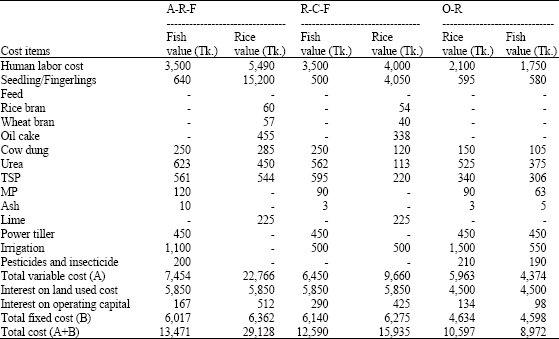
Table 4 shows per acre cost structure for A-R-F farming. Firstly, to examine the rice farming, interest on land used cost was highest cost item. In the study area the average value of land was estimated at Tk. 130,000 per acre. The interest rate 9% per annum was calculated for period of six months, which amounted to Tk. 5,850 and second highest cost item was human labor which included land preparation, transplanting, weeding, harvesting, threshing and carrying, drying and storage, selling and transporting etc and for fish farming, the highest cost item was fingerling which accounted Tk. 15,200 and second costly item was interest on land used cost and third highest cost was human labor cost.
| Table 3: | Occupational status |
 | |
| Field survey in 2005 | |
| Table 4: | Cost structure for fish based farming per acre |
 | |
| Field survey in 2005 | |
It was cleared that the total cost was highest for fish farming (Tk. 29,128) than rice farming (Tk. 13,471). Table 4 shows the cost structure for R-C-F farming and the cost was estimated separately for rice and fish farming. For rice farming, highest cost was also interest on land used which was calculated the same way of A-R-F farming. Here was the same per acre land value and interest rate as A-R-F farming. This table indicated that the total cost was higher for fish farming (Tk. 15,935) than rice farming (Tk. 12,590).
Table 4 also shows per acre cost structure for O-R farming. Cost item was almost same for both seasons (Aman and Boro). In both seasons, the interest on land used cost was highest. In the study area, the average value of land was estimated at Tk. 100,000 per acre. The interest rate at 9% per annum was calculated for period of six months, which amounted to Tk. 4,500 and second highest cost item was human labor which included land preparation, transplanting, weeding, harvesting, threshing and carrying, drying and storage, selling and transporting etc. It was cleared that the total cost was higher for Boro rice farming (Tk. 10,597) than Aman rice farming (Tk. 8,972).
Income-Cost-Profitability for per Acre of Different Farming System
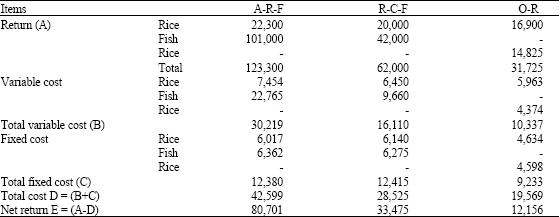
Table 5 shows the return of different farming systems. The total return was higher for A-R-F farming than R-C-F and O-R farming which was calculated Tk. 123,300, Tk. 62,000 and Tk. 31,725, respectively and total cost also was higher for A-R-F farming (Tk. 42,599) than R-C-F (Tk. 28,525) and O-R farming (Tk. 19,569). Net return was also higher for A-R-F farming (Tk. 80,701) than R-C-F (Tk. 33,475) and O-R farming (Tk. 12,156). To compare the net return of A-R-F farming was more than two times higher than R-C-F farming and more than six times higher than O-R farming and net return for R-C-F farming was more than two times higher than O-R farming system. It means that the net return ratio for A-R-F farming was quite higher compare to R-C-F and O-R farming system and R-C-F farming was more profitable than O-R farming system. The high profitability of A-R-F and R-C-F farming systems showed here the good performance of fish based farming systems than only rice farming system.
In A-R-F farming system, the production of rice and fish were 2,230 and 1,443 kg acre-1, respectively and in R-C-F farming system, the production of rice and fish were 2,000 and 840 kg acre-1, respectively. In O-R farming system, the production of rice during the Boro season was 1,690 kg acre-1 and Aman season was1,483 kg acre-1. The price of rice was almost same around the harvesting period and average rice price was 10 Tk kg-1 and fish price was higher at A-R-F than R-C-F farming system because of longer culture duration and deeper of water body. The average fish price was 70 and 50 Tk kg-1 for A-R-F and R-C-F farming systems, respectively.
| Table 5: | Income-cost- profitability for different farming systems |
 | |
| Field survey in 2005 | |
| Table 6: | Problems faced by farmers’ for different farming systems |
 | |
| Field survey in 2005 | |
Problems Faced by Farmers’ for Different Farming Systems
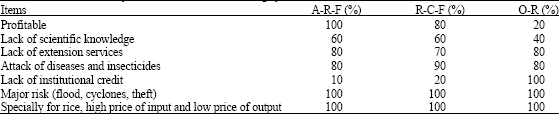
Table 6 shows the problem of the farmers. In the study areas, 80% of A-R-F farming farmers reported that lack of scientific knowledge and lack of extension services were problems which were problems for 80 and 70% of R-C-F farming farmers as well as for 40 and 60% of O-R-F farming farmers. For all farming systems, 100% farmers reported that the flood, cyclones, theft, specially for rice farming, high price of input and low price of output were main problems. Lack of institutional credit was main problem for O-R farming farmers which reported by 100% farmers because of their small farm size.
Rice is the most important cereal crop in Bangladesh. According to the survey result for different farming systems it was found that O-R farming farmers had the smallest farm size and 90% of O-R farming farmers’ main occupation was day labor and A-R-F and R-C-F farming farmers were more educated than O-R farming farmers. Educated farmers can take rational decisions and can adopt new technology easily. Fish based farming systems were more capital intensive than rice farming. Total cost for A-R-F farming (Tk. 42,599) was more than two times higher than O-R farming (Tk. 19,569) and total cost for R-C-F farming (Tk. 28,525) was also higher than only rice farming system (Tk. 19,569). A-R-F farming was more than two times higher than R-C-F farming and more than six times higher than O-R and net return for R-C-F farming was more than two times higher than O-R farming system. In the study areas, the major constraints faced by O-R farming farmers had not adequate amount of operating capital and 100% farmers reported that they did not get the institutional credit. Though, A-R-F farming system was most profitable enterprise than others but attack of diseases, unaccepted flood and risk bearing ability hampered the further extension of A-R-F farming system.
On the basis of the findings of the present study, the following policy recommendations may be highlighted:
| • | It was observed from the study that per acre average net return was higher in A-R-F farming than that of the farm producing R-C-F and O-R farming systems. Therefore, the concerned authority may take a decision to encourage farmers to adopt A-R-F farming in other parts of Bangladesh. |
| • | Government should take positive steps to train-up the concerned interested people on A-R-F and R-C-F farming. For this reason, provision of training of the farmers should be made. |
| • | Number of fisheries extension officer and agriculture extension officer should be increased. |
| • | Institutional credit should be made available on easy terms and condition for small size farmers. |
| • | The government should give policy support to the creation of opportunities for collaboration between various disciplines such as agronomy, soil science, hydrology, limnology, fisheries ecology and management, rice field engineering, pollution ecology and aquaculture. |
ACKNOWLEDGMENTS
The authors thank Fulpur and Haluaghat sub-district agriculture and fisheries officer of Mymensingh district and wish to appreciation to all farmers for their cordial cooperation in the collection of data.
REFERENCES
- Baruah, U.K. and B.C. Borah, 2006. Integrated fish into seasonally flooded rice fields: On-farm Trials in Assam, India. Naga World Fish Center Q., 29: 48-52.
Direct Link - Tasnoova, S. and I. Iwamoto, 2006. Kataribhog rice marketing system in Dinajpur district Bangladesh. Memoirs Fac. Agric. Kagoshima Univ., 41: 19-50.
Direct Link