

O.P. Abioye
Department of Microbiology, Federal University of Technology, P.M.B. 65, Minna, Niger State, Nigeria
V.T. Iroegu
Department of Microbiology, Federal University of Technology, P.M.B. 65, Minna, Niger State, Nigeria
S.A. Aransiola
Bioresources Development Centre, National Biotechnology Development Agency, KM 5, Ogbomoso/Iresapa Road, Onipaanu, Ogbomoso, Oyo State, Nigeria
Journal of Environmental Science and Technology
Year: 2015 | Volume: 8 | Issue: 3 | Page No.: 131-138





ABSTRACT
The release of azo dyes especially methyl red into the environment is of great concern due to coloration of natural water, toxicity, mutagenicity and their biotransformation product. Economical and bio-friendly approaches are needed to remediate dye contaminated waste water from various industries. In this study, Staphylococcus aureus capable of degrading azo dye was isolated from waste dump site. The isolate was studied for their ability to decolorize Methyl Red (MR) using UV spectrophotometer at 430 nm at 3 different concentrations (250, 500 and 750 mL) under aerobic condition for the period of 12 days. The 62, 58 and 50% methyl red decolorizations were recorded in 750, 500 and 250 mL dilution respectively at the end of 12 day. The results of this study suggest the potential of Staphylococcus aureus for the treatment of waste water containing methyl red.
PDF Abstract XML References Citation
Article History
Received: March 09, 2015;
Accepted: May 19, 2015;
Published: June 09, 2015
How to cite this article
O.P. Abioye, V.T. Iroegu and S.A. Aransiola, 2015. Biodegradation of Methyl Red by Staphylococcus aureus Isolated from Waste Dump Site. Journal of Environmental Science and Technology, 8: 131-138.
DOI: 10.3923/jest.2015.131.138
URL: https://scialert.net/abstract/?doi=jest.2015.131.138
DOI: 10.3923/jest.2015.131.138
URL: https://scialert.net/abstract/?doi=jest.2015.131.138
INTRODUCTION
Dyes contain chromophoric groups-decolorized electron systems with conjugated double bonds and auxochromes that cause or intensify the color of the chromophore. Usual chromophores are –C = C–, –C = N–, –C = O, –N = N–, –NO2 and quinonoid rings. Examples of auxochromes are –NH2, –SO3H, –COOH and –OH (Singh et al., 2012). Dyes may be classified according to types of chromophores in their structure or as per the method of application. Based on their chemical structures, dyes can be classified into 20-30 different types. Over one million tonnes of synthetic dyes are produced worldwide every year for dyeing and printing. Azo dyes which are aromatic compounds with one or more -N = – groups, contribute to environmental pollution and is one of the major and most important problems of the modern world. Elimination of colour from dye bearing wastewater is one of the major environmental problems, because of difficulties in treating such wastewaters by conventional methods, as most of the dyes are stable to heat and oxidizing agents (Adowei et al., 2012). Colour pollution may cause potential toxicity and turbidity problems, thus contributing significantly to the pollution of aquatic ecosystems.
Since, 1856, over 105 different dyes have been produced worldwide with an annual production of over 735 metric t (Chen et al., 2003). Paper and pulp mills, textiles and dyestuff industries, distilleries and tanneries are some of the industries which release highly colored wastewaters (Raghukumar, 2000). Due to large scale production and extensive application, synthetic dyes can cause considerable environmental pollution and are serious health-risk factors (Forgacs et al., 2004).
| Table 1: | Microbes use in azo dye degradation |
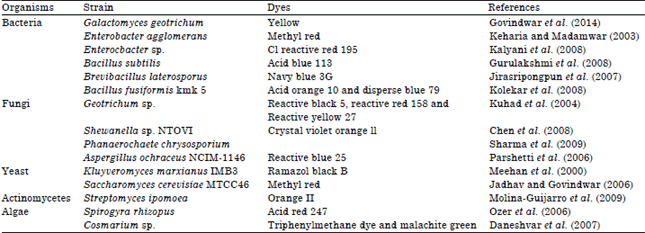 | |
The untreated dyeing effluents that are straightly used in agriculture have a serious impact on environment and human health (Pourbabaee et al., 2006). Para-Phenylene Diamine (PPD) also called 1,4-diamino benzene or 1,4-phenylene diamine, is an aromatic amine which is a major component of azo dyes. Para-Phenylene Diamine containing azo dyes are toxic and causes skin irritation, contact dermatitis, chemosis, lacrimation, exophthalmos and permanent blindness. Ingestion of PPD products leads to the rapid development of oedema on face, neck, pharynx, tongue and larynx along with respiratory distress. Sudha et al. (2014), Methyl red is an indicator dye that turns red in acidic solutions. It is an azo dye and is a dark red crystalline powder. Its molecular formula is C15H15N3O2, molar mass is 269.3 g mol-1, density is 0.791 g cm-3 and melting point is 179-182°C. Methyl red is a pH indicator, it is red in pH under 4.4, yellow in pH over 6.2 and orange in between, with a pKa of 5.1 (Sarkar et al., 2011). As an emerging technique, microbial degradation is one of the best techniques to detoxify the azo dyes (Shah, 2014). Microorganisms that has been identified to be have degradation ability to decolorize azo dyes are shown in Table 1. The present study is therefore, aimed at determining the biodegradation and decolorization of methyl red dye by Staphylococcus aureus isolated from waste dump site.
MATERIALS AND METHODS
Dye and chemicals: Methyl red, a member of azo dye was collected from the Department of Microbiology, Federal University of Technology, Minna, Niger state. Nigeria. The dye was of commercial grade.
Isolation of organism: The organism that was used for biodegradation activities was isolated from soil. The soil was collected from waste dump site located at Emir’s street, Kuntukwo village, Bosso LGA, Minna, Niger state, Nigeria. The soil was air dried in microbiology laboratory of Federal University of Technology, Minna, Niger state, Nigeria. The soil was serially diluted. Pour plate isolation technique was used for the isolation of the bacteria with dilution factor of 10-6 using nutrient agar.
Colonies which developed on the plates were counted and expressed as colony forming units per gram (CFU g-1) of soil. Pure culture was obtained by repeated sub culturing on media used for primary isolation and incubated for 24 h at 37°C. The slant culture was preserved at 4°C as stock culture.
Characterization and identification of isolate: The isolate was identified to generic level using Bergeys Manual of Determinative Bacteriology and the Barrow and Feltham (2003). It includes colonial, morphological characteristics, Gram’s staining reactions, biochemical test such as; glucose utilization, starch hydrolysis, catalase test, oxidate test, coagulase test among others. The organism was identified as Staphylococcus aureus.
Preparation of decolorizing medium: It is composed of 2.0 g L-1 yeast extracts, 0.5 g L-1 KH2PO4, 0.5 g L-1 NaCl, 1.0 g L-1 NH4Cl, 3.0 g L-1 MgSO4, 0.3 g L-1 (NH4)2 SO4, 1.0 g L-1 NaHCO3, 0.2 g L-1 CaCl2.6H2O, 0.2 g L-1 NaB4O7.10H2O, 0.1 g L-1 MnCl2.4H2O, 0.1 g L-1 ZnSO4.7H2O, 0.1 g L-1 CuSO4.5H2O.20 mg L-1 of Methyl red dye was added to 250, 500 and 750 mL of M9 synthetic medium, respectively. The pH was adjusted to neutral of 7.0 with 0.1 M HCl and 0.1 M NaOH using JENWAY, model 3020 pH meter. The medium containing methyl red dye was autoclaved at 121°C for 15 min. After the preparation of the mineral medium in which methyl red dye was added and the pH adjusted to neutral, the medium was sterilized by autoclaving at 121°C for 15 min. It was allowed to stay until ambient temperature is achieved before inoculating with test organism.
Decolorization of dyes by living cells: Twenty milliliter of decolorizing medium containing Methyl red in 50 mL Erlenmeyer flask was inoculated with 2 mL of standardized inoculum that was incubated for 24 h. All experiments were performed in triplicate. The flasks were plugged with sterile cotton wool and incubated at 37°C and aerobic condition was provided by shaking the flasks as described by Ren et al. (2006), throughout the duration of the experiment. Initial absorbance of methyl red dye was taking at 430 nm using UV-spectrophotometer (M®752 UV-spectrophotometer model Ym1208PTSL) after centrifugation at 1200 rpm for fifteen minute. The experiment lasted for 12 days and absorbance was taking at 3 days interval alongside the control in order to monitor decolorization activities. The percentage decolorization was calculated from the following equation according to Saranraj et al. (2010) as shown below:
 |
where, A0 and At represents initial and final dye concentrations in mg L-1, respectively.
RESULTS AND DISCUSSION
Biodegradation of Methyl Red (MR), a textile dye was studied against Staphylococcus aureus isolated from waste dump site. The results presented in tables and graphs showed that, Staphylococcus aureus is capable of degrading MR under aerobic condition. Percentage degradation of 20 mg of MR in 250 mL dilution were 47.11, 48.07, 50.17 and 51.04% at days 3, 6, 9 and 12, respectively (Fig. 1a).
This result indicates that Staphylococcus aureus is capable of utilizing MR as the sole carbon source. The Staphylococcus aureus decolorized MR in the range of 51.04-47.11% in 250 mL dilution (Fig. 1a), 60.04-52% in 500 mL dilution (Fig. 1b) and 66.07-59.04% in 750 mL dilution between 3-12 days incubation period under aerobic condition. Similar results were reported on biodegradation of azo dyes by yeast (Issatchenkia occidentalis), where maximum decolourization was observed under aerobic conditions (Ramalho et al., 2004). They further reported that under anoxic condition decolourization was lesser due to absence of metabolic activities.
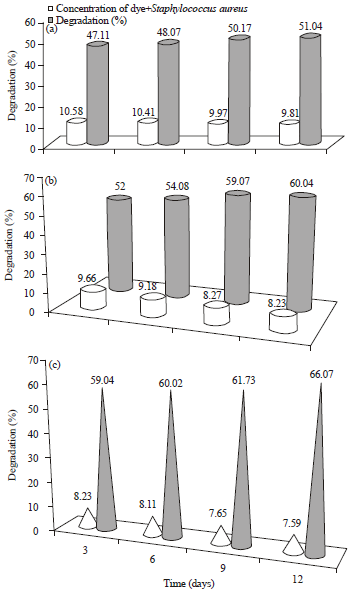 | |
| Fig. 1(a-c): | Percentage degradation of 20 mg MR in, (a) 250, (b) 500 and (c) 750 mL dilution |
The result in Fig. 1b shows the percentage degradation of 20 mg of MR in 500 mL dilution with 52% degradation at day three, 54.08% degradation at day six, 59.07% degradation at day 9 and 60% degradation at day 12 (Fig. 1b).
The result shows increase in percentage degradation of MR that as the number of days increases which shows that time is an important factor in degradation and this is in agreement with the work of Wang et al. (2009), where he reported 78.4% decolorization of Reactive Black 5 by Enterobacter sp. in 60 h of incubation and a maximum value of 92.6% decolorization after 108 h of incubation. The result in Fig. 1c shows the percentage degradation of 20 mg of MR in 750 mL dilution with 59.04% degradation at 3 day, 60.02% degradation at day six, 61.73% degradation at day 9 and 66.07% degradation at 12 day (Fig. 1c).
It was investigated by Deivasigamani and Das (2011) in their work on biodecolourization of basic violet-3 by Candida crusei isolated from textile wastewater. They reported maximum decolourizations of 74 and 100% in the media supplemented with sucrose and sugarcane bagase extract within 24 h, respectively.
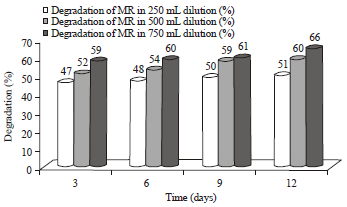 | |
| Fig. 2: | Percentage degradation of MR in 250, 500 and 750 mL dilution |
The result also shows that degradation was high in 750 mL dilution which recorded the highest percentage of 66% followed by 500 mL dilution with 60% and lastly 250 mL dilution with 51%. These shows that concentration is an important factors in dye biodegradation. Erkurt et al. (2007), investigated the effect of time or incubation period including prior to inoculation, during the exponential phase of growth after 3 days, during stationary phase of growth after 5 days or after 6 days of culture. Found that incubation period greatly affect degradation percentage and this agree with the present study.
There was progressive increase in percentage degradation of the dye as the incubation period increases in all the days for all the dilutions (Fig. 2). Dye concentration was also observed to affect the rate of degradation as 750 mL dilution of 20 mg MR yielded the highest degradation percentage of 66% at day 12 as compared with 250 and 500 mL dilution that yielded 51 and 60% degradation, respectively (Fig. 2).
Findings from this current report on the effect of dye concentration or dilution may be that as dye concentration increase, the dye becomes toxic to the organism. This is in line with earlier reports on dye decolorization. Ogunjobi et al. (2012) reported that, the percentage decolourization by the bacterial isolates was observed to decrease gradually as the concentration of the dyes increased from 200, 300, 400 and to 500 mg L-1. It has how ever been reported that dye decolorization can be strongly inhibited when a high concentration dyestuff is used to examine the poisonous effect of the dye on the degrading microorganisms (Wang et al., 2009). The type and concentrations of dyes and microbial concentration have been suggested to affect decolorization. Failure by the cultures to decolorize dye below certain concentration implies that there is a threshold level at which the microbial degrading mechanisms are stimulated and above which are inhibited (Adebiyi et al., 2011).
The result shows that, Staphylococcus sp. under aerobic condition can degrade methyl red dye. It agrees with Sarkar et al. (2011), where he reported the decolorization of Methyl red by Staphylococcus arlettae PF4. This study shows that bacteria have the ability to degrade dye as recorded by Ajibola et al. (2005), Moutaouakkil et al. (2003), Wang et al. (2009), Saratale et al. (2010), Agarry and Ayobami (2011), Palamthodi et al. (2011) and Ramya et al. (2010).
CONCLUSION
As an emerging technique, microbial degradation is one of the best techniques to decolorize the azo dyes, From the result obtained, it can be concluded that Staphylococcus aureus isolated from waste dump site has the ability to degrade methyl red under aerobic condition.
REFERENCES
- Adebiyi, A.O., C.A. Togo, T. Mutanda, C. Slatter and C.G. Whiteley, 2011. Decolourisation and degradation of reactive blue 2 by sulphate reducing bacteria (SRB) and zero valent iron in a biosulphidogenic reactor. Afr. J. Biotechnol., 10: 584-588.
Direct Link - Ajibola, V.O., S.J. Oniye, C.E. Odeh, T. Olugbodi and U.G. Umeh, 2005. Biodegradation of indigo containing textile effluent using some strains of bacteria. J. Appl. Sci., 5: 853-855.
CrossRefDirect Link - Chen, K.C., J.Y. Wu, C.C. Huang, Y.M. Liang and S.C.J. Hwang, 2003. Decolorization of azo dye using PVA-immobilized microorganisms. J. Biotechnol., 101: 241-252.
CrossRefDirect Link - Deivasigamani, C. and N. Das, 2011. Biodegradation of basic violet 3 by Candida krusei isolated from textile wastewater. Biodegradation, 22: 1169-1180.
CrossRefDirect Link - Erkurt, E.A., A. Unyayar and H. Kumbur, 2007. Decolorization of synthetic dyes by white rot fungi, involving laccase enzyme in the process. Process Biochem., 42: 1429-1435.
CrossRefDirect Link - Forgacs, E., T. Cserhati and G. Oros, 2004. Removal of synthetic dyes from wastewaters: A review. Environ. Int., 30: 953-971.
CrossRefDirect Link - Moutaouakkil, A., Y. Zeroual, F. Z. Dzayri, M. Talbi, K. Lee and M. Blaghen, 2003. Bacterial decolorization of the azo dye methyl red by Enterobacter agglomerans. Ann. Microbiol., 53: 161-169.
Direct Link - Palamthodi, S., D. Patil and Y. Patil, 2011. Microbial degradation of textile industrial effluents. Afr. J. Biotechnol., 10: 12657-12661.
Direct Link - Pourbabaee, A.A., F. Malekzadeh, M.N. Sarbolouki and F. Najafi, 2006. Aerobic decolorization and detoxification of a disperse dye in textile effluent by a new isolate of Bacillus sp. Biotechnol. Bioeng., 93: 631-635.
CrossRefDirect Link - Raghukumar, C., 2000. Fungi from marine habitats: An application in bioremediation. Mycol. Res., 104: 1222-1226.
Direct Link - Ramalho, P.A., M.H. Cardoso, A. Cavaco-Paulo and M.T. Ramalho, 2004. Characterization of azo reduction activity in a novel ascomycete yeast strain. Applied Environ. Microbiol., 70: 2279-2288.
CrossRefDirect Link - Ramya, M., S. Iyappan, A. Manju and J.S. Jiffe, 2010. Biodegradation and decolorization of acid red by Acinetobacter radioresistens. J. Bioremed. Biodegrad., Vol. 1.
CrossRefDirect Link - Ren, S., J. Guo, G. Zeng and G. Sun, 2006. Decolorization of triphenylmethane, azo and anthraquinone dyes by a newly isolated Aeromonas hydrophila strain. Applied Microbiol. Biotechnol., 72: 1316-1321.
CrossRefDirect Link - Agarry, S.E. and O.A. Ayobami, 2011. Evaluation of microbial systems for biotreatment of textile waste effluents in Nigeria: Biodecolourization and biodegradation of textile dye. J. Applied Sci. Environ. Manage., 15: 79-86.
Direct Link - Saratale, R.G., G.D. Saratale, J.S. Chang and S.P. Govindwar, 2010. Decolorization and biodegradation of reactive dyes and dye wastewater by a developed bacterial consortium. Biodegradation, 21: 999-1015.
CrossRefPubMedDirect Link - Sarkar, P., A.N.M. Fakhruddin, M.K. Pramanik and A. Al-Mahin, 2011. Decolorization of methyl red by Staphylococcus arlettae PF4 isolated from garden soil. Int. J. Environ., 1: 25-40.
Direct Link - Shah, K., 2014. Biodegradation of azo dye compounds. Int. Res. J. Biochem. Biotechnol., 1: 5-13.
Direct Link - Sudha, M., A. Saranya, G. Selvakumar and N. Sivakumar, 2014. Microbial degradation of Azo dyes: A review. Int. J. Curr. Microbiol. Applied Sci., 3: 670-690.
Direct Link - Wang, H., X.W. Zheng, J.Q. Su, Y. Tian, X.J. Xiong and T.L. Zheng, 2009. Biological decolorization of the reactive dyes reactive black 5 by a novel isolated bacterial strain Enterobacter sp. EC3. J. Hazard. Mater., 171: 654-659.
Direct Link - Govindwar, S.P., M.B. Kurade, D.P. Tamboli, A.N. Kabra, P.J. Kim and T.R. Waghmode, 2014. Decolorization and degradation of xenobiotic azo dye Reactive Yellow-84A and textile effluent by Galactomyces geotrichum. Chemosphere, 109: 234-238.
CrossRefPubMedDirect Link - Keharia, H. and D. Madamwar, 2003. Bioremediation concepts for treatment of dye containing wastewater: A review. Indian J. Exp. Biol., 41: 1068-1075.
Direct Link - Kalyani, D.C., P.S. Patil, J.P. Jadhav and S.P. Govindwar, 2008. Biodegradation of reactive textile dye Red BLI by an isolated bacterium Pseudomonas sp. SUK1. Bioresour. Technol., 99: 4635-4641.
CrossRefDirect Link - Kolekar, Y. M., S.P. Pawar, K.R. Gawai, P.D. Lokhande, Y.S. Shouche and K.M. Kodam, 2008. Decolorization and degradation of Disperse Blue 79 and Acid Orange 10, by Bacillus fusiformis KMK5 isolated from the textile dye contaminated soil. Bioresour. Technol., 99: 8999-9003.
CrossRefDirect Link - Kuhad, R.C., N. Sood, K.K. Tripathi, A. Singh and O.P. Ward, 2004. Developments in microbial methods for the treatment of dye effluents. Adv. Applied Microbiol., 56: 185-213.
CrossRefDirect Link - Chen, C.H., C.F. Chang, C.H. Ho, T.L. Tsai and S.M. Liu, 2008. Biodegradation of crystal violet by a Shewanella sp. NTOU1. Chemosphere, 72: 1712-1720.
CrossRef - Sharma, P., L. Singh and N. Dilbaghi, 2009. Biodegradation of Orange II dye by Phanerochaete chrysosporium in simulated wastewater. J. Sci. Ind. Res., 68: 157-161.
Direct Link - Parshetti, G., S. Kalme, G. Saratale and S. Govindwar, 2006. Biodegradation of malachite green by Kocuria rosea MTCC 1532. Acta Chimica Slovenica, 53: 492-498.
Direct Link - Jadhav, J.P. and S.P. Govindwar, 2006. Biotransformation of malachite green by Saccharomyces cerevisiae MTCC 463. Yeast, 23: 315-323.
CrossRefDirect Link - Molina-Guijarro, J.M., J. Perez, J. Munoz-Dorado, F. Guillen, R. Moya, M. Hernandez and M.E. Arias, 2009. Detoxification of azo dyes by a novel pH-versatile, salt-resistant laccase from Streptomyces ipomoea. Int. Microbiol., 12: 13-21.
CrossRefDirect Link - Ozer, A., G. Akkaya and M. Turabik, 2006. The removal of Acid Red 274 from wastewater: Combined biosorption and biocoagulation with Spirogyra rhizopus. Dyes Pigments, 71: 83-89.
CrossRefDirect Link - Daneshvar, N., M. Ayazloo, A.R. Khataee and M. Pourhassan, 2007. Biological decolorization of dye solution containing Malachite Green by microalgae Cosmarium sp. Bioresour. Technol., 98: 1176-1182.
CrossRefDirect Link