

Qassim Nasir
Department of Electrical/Electronics and Computer Engineering, University of Sharjah, Sharjah, UAE
S. Faisal Ali Shah
Department of Electrical/Electronics and Computer Engineering, University of Sharjah, Sharjah, UAE
Journal of Applied Sciences
Year: 2005 | Volume: 5 | Issue: 2 | Page No.: 337-340





ABSTRACT
The aim of this study was to improve the performance of Least Mean Square (LMS) adaptive algorithm used for fading channel estimation. One step Least Square prediction, based on the estimate of the sampled impulse response and the estimate of their speed of variation, is used along with LMS. The efficiency of the algorithm is confirmed by simulation results for slow, moderate and fast varying mobile channel. The results show about 3 to 11 dB improvement in the Mean Square Deviation between the estimated taps and the actual ones depending on the speed of channel time variations. Pedestrian, slow and fast Vehicular channels with doppler frequencies 6, 100 and 222 Hz, respectively, are used in these tests.
PDF Abstract XML References Citation
How to cite this article
Qassim Nasir and S. Faisal Ali Shah, 2005. Predictive LMS for Mobile Channel Tracking. Journal of Applied Sciences, 5: 337-340.
DOI: 10.3923/jas.2005.337.340
URL: https://scialert.net/abstract/?doi=jas.2005.337.340
DOI: 10.3923/jas.2005.337.340
URL: https://scialert.net/abstract/?doi=jas.2005.337.340
INTRODUCTION
The time varying multipath fading channel that exists in wireless communications environment lead to severe Intersymbol Interference (ISI). In order to achieve high speed reliable communication, channel estimation is necessary to combat ISI[1]. The most widely used and the simplest channel estimator is the linear adaptive filter whose coefficients are updated based on the Least Mean Square (LMS) algorithm[2]. LMS algorithm works well if the channel is fixed or time variations are very slow. For fast time-variations, the performance of LMS tracking scheme is poor[3].
Clark coupled the prediction with LMS to estimate the channel taps for VHF radio links[4]. Shimamura et al.[5] applied the same technique to design estimation based equalizers. Multistep adaptive algorithm has been presented by Gazor as Second Order LMS (SOLMS) for slow time varying channel to improve the tracking capabilities when some prior information is available on the time variation of the channel[6]. To track time varying channels, he applied a simple smoothing on the increments of the estimated weights to estimate the speed of the weights. The estimated speed is then used to predict the weights for the next iteration[6].
In this study LMS with degree-1 Least Square (LS) fading expanded memory prediction (Predictive LMS-PLMS)[7,8] is selected for vehicular mobile channel estimation. The prediction technique[8] is applied to update the estimates of the Sampled Impulse Response (SIR) of mobile channel.
The performance of conventional LMS, SOLMS and PLMS is demonstrated by simulations. The results show that PLMS provides superior steady state performance relative to other methods.
LMS ALGORITHM FOR MOBILE CHANNEL ESTIMATION
The mobile channel is assumed to be a three path fading channel corrupted by additive white Gaussian noise (AWGN). The fading in each path of the channel follows Rayleigh distribution and has power spectral density as given by Jakes[9].
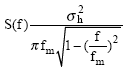 |
where, σh2 is a parameter describing the variance of a single channel coefficient and fm = vfc/c is the Doppler frequency that depends on the speed of the vehicle v and carrier frequency fc. The relative strength of the paths has exponential power delay profile. For simulation purpose, the complete channel is modeled as Finite Impulse Response (FIR) filter with delay between successive filter taps is assumed to be symbol period. The filter taps or coefficients, h(k), are time varying and generated as complex Gaussian according to the Jakes model for fading channel simulator[9]. We will evaluate the performance of the proposed algorithm for doppler frequencies of 6, 100 and 222 Hz, corresponding to the pedestrian speed of 3.5 km h-1 and vehicular channels with speeds of 54 and 120 km h-1, respectively.
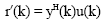
Assume that u (k) is the transmitted sequence (assumed stationary), h(k) is channel sampled impulse response, n (k) is the noise, r (k) is the received symbol, r'(k) is the estimate of the received symbol and y (k) is the estimate of the channel impulse response. All of the above quantities are measured at kT time instant, where, T is the sampling time. Thus:
 | (1) |
 | (2) |
 | (3) |
Adaptive digital filter can be used to estimate the sampled channel impulse response. It is a simple Finite Impulse Response (FIR) filter with variable tap weights. These tap weights are adjusted according to Least Mean Square (LMS) method of updating weights. The conventional LMS update of the estimated impulse response is as follows:
 | (4) |
During the past two decades, an enormous amount of research has been done to improve the performance of the conventional LMS especially in time-varying environments. A remarkable development in this direction is the use of variable step-size[10] to track time varying systems. However, the time-varyingness of mobile channels is smooth and the gain obtained by variable step-size algorithms is not significant. A significant improvement in the performance of conventional LMS to track mobile channels can be achieved by initial optimum step-size[11]. However, this performance gain is heavily dependent on the accurate estimation of optimum step-size. Some variations of the LMS algorithm have been developed to compensate for its deficiency in fading channel estimation. By modeling the non stationary target system as a second order Markov dynamics, Gazor proposed the second order LMS (SOLMS)[6] and showed that it can offer benefits over the conventional LMS in wireless channel tracking. Another approach to cater these problems is to incorporate the nature of time variations in the conventional LMS which is the subject of this study.
PLMS ALGORITHM
To improve the performance of LMS algorithm for tracking time varying channel a prediction scheme is used. So called degree-1 Least Square fading memory prediction was employed to take a priori information about the channel into the estimation scheme. The method of least square fading memory prediction is based on the fact that a better prediction of h(k+1) from the sequence of vectors y(k), y(k-1) ….. is obtained by determining the set of m+1 polynomials of given degree (0,1 or 2) each of which gives the LS fit to the components in the corresponding locations in the vectors y(k), y(k-1),…. and then using the values of the polynomial at time t = (I+1)T to determine the mth component of y(k+1). Thus, it behaves as a coefficient prediction filter. So, LMS with LS expanded fading memory prediction algorithm (PLMS)[8] which is used in this study to improve mobile channel estimation is given by:
 | (5) |
 | (6) |
 | (7) |
where, Δk is a measure of tap weight variation and is given by
 | (8) |
Both μ (step size) and θ (smoothing constant) are scalars (0 < θ < 1). θ is the smoothing constant that controls the forgetting amount of the past in a compromise with an accurate estimate. In this scheme both μ and θ have to be tuned depending on Signal to Noise Ratio (SNR) and channel behavior (speed of variation).
SIMULATION RESULTS
Extensive computer simulations were carried out to compare the performance of the conventional LMS, proposed predictive-LMS (PLMS) and Second Order LMS (SOLMS) proposed by Gazor for tracking mobile channels. The input to the channel is a pseudo random sequence of {+1,-1} and white Gaussian noise of different variances is used through out the test. In these simulations, pedestrian, slow and fast vehicular mobile channels with Doppler frequencies of 6, 100 and 222 Hz (corresponding to the mobile speed of 3.5, 54 and 120 km h-1 at 2 GHz carrier frequency and signal rate of 15 ksymbol/sec), respectively, are used. The Signal to Noise Ratio (SNR) used is 10log10 (1/σ2) where σ2 is the noise variance. Each transmission burst consists of 10000 symbols and the Mean Square Deviation (MSD) between the estimated channel taps and the actual ones is obtained as an average of 10 independent trials.
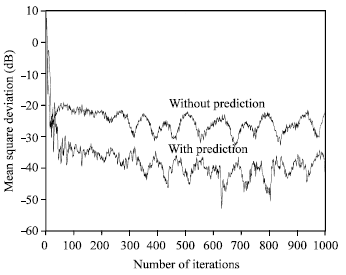 | |
| Fig. 1: | Tracking performance of channel estimators (Vehicular Channel, fm = 100 Hz, SNR =30 dB |
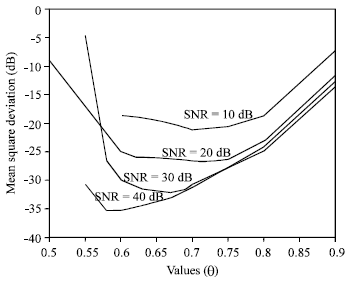 | |
| Fig. 2: | MSD vs θ with and without prediction (Vehicular Channel, fm = 100 Hz |
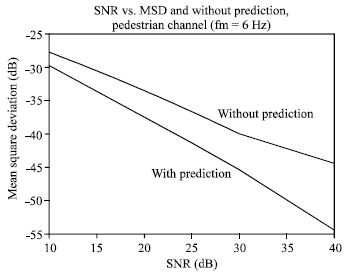 | |
| Fig. 3: | MSD vs SNR with and without prediction (Pedestrian Channel, fm = 6 Hz) |
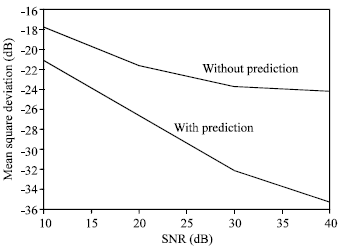 | |
| Fig. 4: | MSD vs SNR with and without prediction (Vehicular Channel, fm = 100 Hz) |
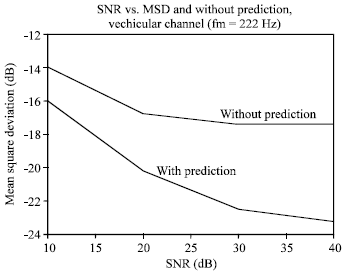 | |
| Fig. 5: | MSD vs SNR with and without prediction (Vehicular Channel, fm = 222 Hz) |
Figure 1 shows the convergence for a fading channel with vehicle speed of 54 km h-1 and SNR = 30 dB obtained by plotting MSD against time. It clearly shows that both algorithms converge but LMS without prediction is faster than that with prediction.
Figure 2 shows the MSD of estimated tap weights and the tuning of smoothing constant θ for different values of SNR. The optimum value of θ depends on the input SNR and the speed of the channel variations. The optimum value for μ (step size) and θ will be used for performance comparisons.
Figure 3-5 compare the performance of mobile channel estimation using conventional LMS and PLMS schemes for pedestrian and vehicular mobile channels. It can be seen that the steady state performance in terms of MSD of the proposed PLMS compared with the conventional LMS is improved by 3 dB for poor SNR (10 dB) while it gains around 11 dB for SNR of 40 dB.
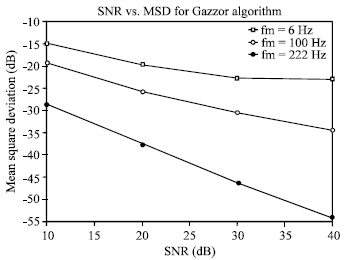 | |
| Fig. 6: | MSD vs SNR for SOLMS Algorithm |
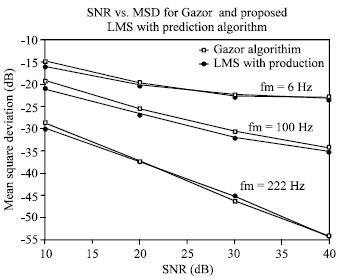 | |
| Fig. 7: | MSD vs SNR for SOLMS and LMS with prediction |
As expected, predictive system has superior performance than conventional LMS.
Figure 6 shows the steady state mobile channel estimation performance of SOLMS in different channel speed conditions. It shows that SOLMS depicts better performance compared to conventional LMS. Figure 7 compares the performance of the proposed PLMS with the Second Order LMS (SOLMS) method proposed by Gazor. The figure shows that proposed system offers minor benefit (about 1 to 2 dB) improvement compared to SOLMS.
CONCLUSION
Mobile Channel estimation based on LMS with degree-1 Least Square fading memory prediction (PLMS) has been explored. Based on a steady state mean performance PLMS offers a quite distinct benefit in comparison with the LMS-based method. Simulation results show that under the well accepted Jakes' fading channel model, the PLMS based algorithm offers about 3 to 11 dB benefit in pedestrian and vehicular mobile channel estimation over LMS based algorithm. It is shown that the algorithm has the capability of tracking slow, moderate and fast time varying mobile channels. Also PLMS does not add any substantial computation complexity. Moreover, this algorithm could be combined with a wide class of adaptive filters (e.g. normalized LMS and frequency domain LMS, variable step size LMS, RLS, FBLMS etc.) to improve their behaviour.
REFERENCES
- Haykin, S., 1996. Adaptive Filter Theory. 3rd Edn., Prentice Hall, New Jersey, ISBN: 0-13-322760-X.
Direct Link - Lindbom, L., A. Ahlen, M. Sternad and M. Falkenstrom, 2001. Tracking of time-varying mobile radio channels part I: The wiener LMS algorithm. IEEE Trans. Commun., 49: 2207-2217.
Direct Link - Clark, A.P. and McVerry, 1981. Channel estimation for an HF radio link. IEE Proc., 128: 33-42.
Direct Link