

Chou-Chan Yang
Department of Management Information System, National Chung Hsing University, 250 Kuo Kuang Road, Taichung County, Taiwan 402, Republic of China
Ya-Wen Yang
Graduate Institute of Networking and Communication Engineering, Chaoyang University of Technology, 168 Gifeng E. Rd. Wufeng,
Taichung County, Taiwan 413, Republic of China
Ting-Yi Chang
Department of Computer and Information Science,
National Chiao-Tung University, 1001 Ta Hsueh Road,
Hsinchu 300, Taiwan, Republic of China
Journal of Applied Sciences
Year: 2005 | Volume: 5 | Issue: 2 | Page No.: 281-283





ABSTRACT
An authenticated multiple-key agreement protocol uses a digital signature to sign the Diffie-Hellman public keys which can generate multiple session key in a single round of message exchange and achieve mutual authentication. Recently, Hwang et al. proposed an authentication key exchange protocol which takes less computation time than Harn and Lin;s protocol. However, this study, shows that Hwang et al.`s protocol is vulnerable to forgery attacks. An attacker can fool one communication part into believing the forged short-term public keys and share session keys with him.
PDF Abstract XML References Citation
How to cite this article
Chou-Chan Yang, Ya-Wen Yang and Ting-Yi Chang, 2005. Cryptanalysis of an Authentication Key Exchange Protocol. Journal of Applied Sciences, 5: 281-283.
DOI: 10.3923/jas.2005.281.283
URL: https://scialert.net/abstract/?doi=jas.2005.281.283
DOI: 10.3923/jas.2005.281.283
URL: https://scialert.net/abstract/?doi=jas.2005.281.283
INTRODUCTION
In 1976, the key agreement protocol was introduced by Diffie and Hellman[1]. The two parties were able to establish a secret session key over an insecure channel, such that the confidential information was transmitted securely. However, the Diffie and Hellman protocol could not provide authentication of the two parties. In other words, the two parties could not authenticate each other.
To solve this problem, there are two ways to integrate authentication into a key agreement protocol. One approach uses a pre-shared password[2]. With this pre-shared password, the session key can be established with user authentication. The other approach uses certificates (e.g. digital signatures), which provides authentication of the session key in key agreement protocols.
In 1995, the MQV key agreement protocol was proposed by Menezes et al.[3] The MQV key agreement protocol was the first key agreement protocol to use a digital signature to sign the Diffie-Hellman public keys without using one-way hash functions. Moreover, the MQV key agreement protocol was adopted as a standard by the IEEE P1363 committee[4].
In 1998, based on the MQV protocol, Harn and Lin[5] proposed an authenticated key agreement protocol without using one-way functions. Summarily, Harn and Lin’s protocol contain the authentication for the Diffie-Hellman protocol. The two communication entities can establish multiple session keys in one round of interaction and use simple key computations.
Unfortunately, Yen and Joye[6] pointed out that Harn and Lin’s protocol had a security flaw; it suffered from forgery attacks. If a valid short-term public key pair is given, an attacker can forge a new short-term public key pair and pass the verification procedure. In 2001, Harn and Lin[7] further proposed an improved protocol to avoid forgery attacks by modifying the signature signing equation. However, there was still a weakness in Harn and Lin’s improved protocol. The common session keys generated by two parties were limited to the use of if two parties send n Diffie-Hellman public keys at a time. The purpose of this limit was to prevent the known-key attacks.
Recently, Hwang et al.[8] modified Harn and Lin’s protocol using the XOR operation to decrease computational time and to use n2-1 to provide perfect forward secrecy. In this study, we will show that Hwang et al.’s protocol suffers from forgery attacks. An attacker can fool one communication part into believing the forged short-term public keys and share session keys with him.
Review of Hwang et al.’s protocol: In the Diffie-Hellman scheme, the system publishes two values p and g, where, p is a large prime and g is a generator with order p-1 in GF(p). Each user in the system selects a long-term secret key κ ∈ GF and computes a corresponding long-term public key y=gκ mod p. Assume the two communication parties are Alice and Bob. The long-term secret key and the long-term public key for Alice is (κA and yA) and for Bob, it is (κB and yB), respectively. The following are the steps needed to establish multiple common session keys.
Step 1: Alice privately selects two random integers kA1 and kA2 to be short-term secret keys and computes short-term public keys rA1= gkA1 mod p and rA2= gkA2mod p. The signature value sA can be obtained by computing the following equation:
 |
Alice then sends the authenticated message {rA1, rA2, sA, cert(yA)} where, cert(yA) is the certificate of YA to Bob.
Step 2: Bob follows the same procedure as Alice. He chooses two integers, kB1 and kB2 and computes {rB1, rB2, sB}. Then Bob sends {rB1, rB2, sB, cert(yB)} to Alice.
Step 3: After receiving the message {rB1, rB2, sB, cert(yB)} sent from Bob, Alice checks the following verification equation:
 |
Once the verification is valid, Alice uses rB1 and rB2 to compute four common session keys.
-pjas
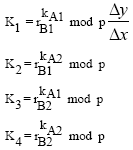 |
Step 4: Bob still uses the same procedure as Alice. After receiving the message{rA1, rA2, sA, cert(yA)}, he checks the following verification equation:
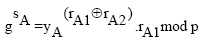 |
If the verification equation holds, Bob also uses rA1 and rA2 to compute four common session keys using the following equation:
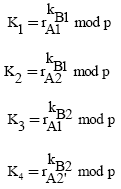 |
The four common session keys have been established successfully by Alice and Bob.
Forgery attack by an attacker
Step 1: An attacker intercepts the message {rA1,rA2, sA, cert(yA)} from Alice. The attacker chooses a random integer kC1 and the corresponding  and computes ‘rA2 as follows:
 |
Step 2: The attacker impersonates Alice in order to share keys with Bob. He/she sends {rA1, rA2', rC1, sA, cert(yA)} to Bob. When Bob receives the message, he thinks that Alice wants to share 9 keys with him and verifies {rA1, rA2', rC1} by checking 
In fact,
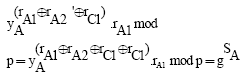 |
The attacker can then successfully share  with Bob.
With this attack, since Alice’s short term public key can be forged, the attacker can fool Bob into believing that he has shared 9 keys with Alice. However, Alice has actually only shared 4 keys with Bob. The attacker can therefore use forged short term public keys to compute 3 session keys and share them with Bob.
CONCLUSION
We have pointed out that Hwang et al.’s protocol is insecure, since an attacker can easily share some session keys with others only if he/she gets an old message from a legitimate user.
REFERENCES
- Diffie, W. and M.E. Hellman, 1976. New directions in cryptography. IEEE Trans. Inform. Theory, 22: 644-654.
CrossRefDirect Link - Seo, D.H. and P. Sweeney, 1999. Simple authenticated key agreement algorithm. Electr. Lett., 35: 1073-1074.
Direct Link - Harn, L. and H.Y. Lin, 2001. Authenticated key agreement protocol without using one-way function. IEE Electr. Lett., 37: 629-630.
CrossRef - Junn, H.S.R., S.H. Shiau and L.C. Hua, 2003. An enhanced authentication key exchange protocol. Proceedings of the 17th National Conference on Advanced Information Networking and Applications, Mar. 27-29, Tamkang University, Tamsui, Taiwan, pp: 202-205.
CrossRef