






He Chunmei
School of Information Engineering, ECJTU, Nanchang 330013, China
Information Technology Journal
Year: 2013 | Volume: 12 | Issue: 4 | Page No.: 852-856
ABSTRACT
Morphological Neural Network (MNN) is a novel and important neural network and it has many applications such as image processing and pattern recognition. It makes sense to research the learning algorithm of MNN and its application. A method based on genetic algorithm is presented to train and implement multi-layer morphological neural network in this study. The algorithm calculates the weights and biases of morphological neural network and the genetic algorithm automatically acquire the learning rate. After that, the trained morphological neural network is applied to image restoration. The image restoration simulation and a comparison with the median filter are shown in the end. It shows that the morphological neural network is a quite good method applied to image restoration.
PDF Abstract XML References Citation
Article History
Received: September 05, 2012;
Accepted: November 28, 2012;
Published: January 22, 2013
How to cite this article
He Chunmei, 2013. Evolutionary Learning Algorithm for Multi-layer Morphological Neural Networks. Information Technology Journal, 12: 852-856.
DOI: 10.3923/itj.2013.852.856
URL: https://scialert.net/abstract/?doi=itj.2013.852.856
DOI: 10.3923/itj.2013.852.856
URL: https://scialert.net/abstract/?doi=itj.2013.852.856
INTRODUCTION
Morphological Neural Network (MNN) is a kind of neural network combined artificial neural network and mathematical morphology. The MNN is a novel neural network and has been applied in many applications. Therefore it makes sense to research the MNN and its application. The algorithms of multi-layer MNN are paid close attention in this study in order to provide better algorithm in the training of MNN.
MNN was firstly presented by Ritter and Davidson (1991), Davidson and Ritter (1990) and Ritter (1991). An artificial neural network is said to be morphological if every neuron performs an elementary operation of Mathematical Morphology, that is, in MNN’s neurons, the classical operations of addition and multiply are replaced by addition and maximum or minimum operations. MNN use algebraic lattice operations structure: semi-Ring ( , ∨, ∧, +, +), while the Traditional Neural Networks (NN) are based on the Ring (
 , +, x).
There are different kinds of MNN such as Morphological Perceptron (MP) Ritter and Sussner (1996), multi-layer MNN (Zhang et al., 2003), morphological associative memories (He et al., 2011) and so on. The Fuzzy-morphology neural network are proposed for automatic target recognition by Yonggwan (1998). A doubly local Wiener filtering algorithm using elliptic direction and mathematical morphology is proposed to restore image (Zhou and Shui, 2008). Some algorithms for MP were presented by Ritter and Sussner (1996) and Sussner and Esmi (2011) in which the active functions are limited to hard limiter function. The active functions in multi-layer MNN aren’t limited to hard limiter function. The multi-layer MNN (Zhang et al., 2003) are trained by Least Mean Square algorithm and applied to color image restoration. In (Araujo, 2010; Araujo et al., 2011) the MNNs are trained by BP algorithm and applied in image processing and stock market prediction. The learning algorithms (Zhang et al., 2003; Araujo, 2010; Araujo et al., 2011) are mostly least squared error algorithm and the learning rate are fixed and manual set. The unsuitable learning rate often causes the learning algorithm oscillated and divergent. In this study, a new learning algorithm based on genetic algorithm is proposed for multi-layer MNN and the trained MNN are applied to image restoration.
MORPHOLOGICAL NEURAL NETWORK
Morphological Neural Network (MNN) is a kind of neural network combined neural network and morphology. In this section the architecture of MNN are introduced and a new learning algorithm for MNN is proposed.
Architecture of the MNN: MNN use algebraic lattice operations structure: semi-Ring (, ∨, ∧, +, +), the classical matrix operator including addition and multiply were replaced by the lattice algebra operator and caused a different nonlinear transformation in the systems. The architecture and learning algorithm of multi-layer MNN are simply introduced in this section.
The architecture of the erosion-based MNN is shown in Fig. 1 and in essence it is a multi-layer feed forward neural network with many inputs and single output.
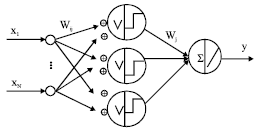 | |
| Fig. 1: | The architecture of the erosion-based MNN |
The erosion-based MNN model is given by the following equation:
 | (1) |
where:
 |
with:
 |
and
 |
where, xi = {xi1, xi2,..., xiN}, (i = 1, 2,..., K) denotes the ith input of the MNN. N is the dimension of a training pattern which is decided by the structure elements, ∨ denotes the maximum operator and ∧ is minimum operator. The output of the jth hidden neuron is uj (t) (j = 1, 2,..., H). K is the training pattern number and H is the neuron number in the hidden layer. The final output of the erosion-based MNN is y. Wij represents the connected weight between the ith node in the input layer and the jth node in the hidden layer, while Wj denotes the connected weight between the jth node in the hidden layer and the output layer.
Similarly, the dilation-based MNN is given by the following equation:
 | (2) |
where:
 |
with:
 |
and
 |
The architecture of the dilation-based MNNs is similar to erosion-based MNNs, but the operator in z is replaced by minimum operator ∧.
Learning algorithm for MNN: The connected weights Wij and Wj should been trained before the MNN used for image restoration. It is assumed that the dimension of every input training pattern is N and the training pattern number is K.
The training of the MNN is a processing of supervised learning, that is, the MNN is trained to make sure minimum the squared error between the desired outputs di and the actual outputs yi. The squared error function is defined by:
 | (3) |
The proposed conjugate gradient algorithm based on genetic algorithm is used to train the connected weights Wij and Wj of the MNN. In every iteration step, the optimized learning rate η is acquired by the genetic algorithm. The weights W of the MNNs are updated according to the iterative formulas:
 | (4) |
 | (5) |
where, η is the learning rate, α is the active factor, ∂E/∂Wij(t) and ∂E/∂Wj(t) are the partial derivative of the error function E. The iteration of Eq. 4-5 starts with an initial guess W(0) and stops when some desired conditions reached. ∂E/∂Wij(t) and ∂E/∂Wj(t) are given by the gradient of E with respect to W at the points where this gradient exists. Then, following the chain derivation rule, ∂E/∂Wij(t) and ∂E/∂Wj(t) are given as follows:
 | (6) |
 | (7) |
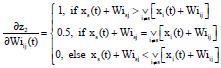
The existence of the gradient of E with respect to W only hinges on the existence of the gradients, ∂E/∂Wj(t) where at the discontinued points, by literature (Blanco et al., 1995), define that:
 |
The conjugate gradient algorithm based on genetic algorithm:
| Step 1: | Initialize: randomly initialize the weights Wij and Wj. Let iteration step n = 1 and error precision ε = 0.01. Acquire the input pattern x and the desired outputs d |
| Step 2: | Train the MNN first time and calculate the error function E |
| Step 3: | WHILE (E<ε? and t<MaxTime) Do |
| • | Compute the partial derivatives  and  according to Eq. 6-7 |
| • | Acquire the optimized learning rate η by genetic algorithm |
 | |
| • | Compute the weights Wij and Wj according to Eq. 4-5 |
| • | t = t+1 |
| • | Compute error function of the ith input training pattern xi of MNNs according to Eq. 3 |
ENDWHILE
| Step 4: | Save the weights Wij and Wj |
The GA (He and Ye, 2011) used to get the optimal n(t) is introduced as below:
| • | Initialization and coding: Randomly generate an initial population P(0) = {λ(0, 1),..., (0, n)}. Each individual λ(0, j) (j = 1,..., n) in the population maps to a string. Every string is an individual point in the search space. All the points compose of the solution space S0. Let t = 0 and max iteration step Max-gen = 140 |
| • | Fitness function: In this step, each string is decoded by an evaluator into an objective function value. For a Given λ(t, j)∈ P(t), compute Gλ(t, j), where P(t) means the ith generation population |
| • | Genetic selection: The roulette wheel selection is used, where the live probability of λ(t, j) is defined by: |
 | |
| • | Genetic operator: Randomly choose the individual pair (λ(t, j1), λ(t, j2)) from P(t) to match, where Cr is the one point crossover operator and the crossover probability is Pc |
To accelerate convergence to optimal solution, let the mutation probability be 0.005. Return to step 2 until the satisfying solution is achieved, or the iteration number is more than Max-gen. Otherwise the GA is terminated and proper parameters are obtained by encoding the best string into a set of parameters.
SIMULATION
The MNN is applied to image restoration in this section. The desired output d of the MNN is the original image shown in Fig. 2. Fuzz the original image to acquire the degraded images A shown in Fig. 2. Following the below steps, the input training sample generates.
The image A is scanned three rows every time during the training process, following a zigzag path from top to bottom. To define the local input vector xi of x at each pixel, a square window called as structure elementary is centered around it with size N = 9. Because the global sampling method is used, the marginal two rows and two columns are not scanned. If the size of A is m*n, then the acquired training sample number is K = (m-2)* (n-2). Every sample vector xi = {xi1,...,xiN}, where i = 1,..., K, N = 9.
The PSNR in the experiment is defined by:
 |
where, MSE is the mean square error between the original image and the restored image. The input training sample x is normalized and the structure elementary and the desired outputs are limited to be the range [0,1].
The experiment environment is MATLAB 2010. The hidden layer of MNN has 5 nodes. Figure 2 and 3 show the simulation results.
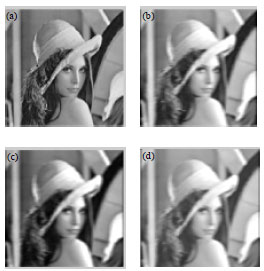 | |
| Fig. 2(a-d): | Restored results for (a) Original (b) Degraded (c) Restored by MNNs and (d) Restored by median filter fuzzy image |
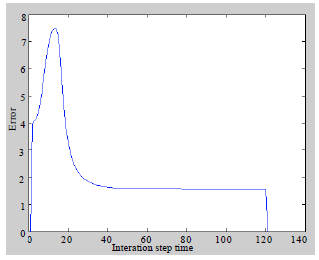 | |
| Fig. 3: | MNN’s error function E |
Figure 2 compares the fuzzy image restored by MNN with that restored by median filter. Figure 3 shows the variation trend of the MNN’s Error function E. The PSNR of the image restored by MNNs is 22.7253 and the PSNR of the image restored by median filter is 25.6842. It shows that the MNN is suitable to restore fuzzy image and is a good tool for image processing.
CONCLUSION
The multi-layer MNN is introduced and a new conjugate gradient algorithm based on genetic algorithm is proposed to train the multi-layer MNN in this study. Afterward the trained MNN is applied to restore fuzzy noise images. The simulation has good results and the comparison with median filter is presented in the end. However, the genetic algorithm is only one kind of evolutional algorithms, emerging some more evolutional algorithms such as quantum genetic algorithm, shuffled frog-leaping algorithms with MNN are our future research.
REFERENCES
- Ritter, G.X. and J.L. Davidson, 1991. Recursion and feedback in image Algebra. Proceedings of the Image Understanding in the 90s: Building Systems that Work, Volume 1406, October 17, 1990, McLean, VA., USA.
CrossRefDirect Link - Davidson, J.L. and G.X. Ritter, 1990. Theory of morphological neural networks. Proceedings of the Digital Optical Computing II, SPIE Volume 1215, July 1, 1990, Los Angeles, CA., pp: 378-336.
Direct Link - Ritter, G.X., 1991. Recent developments in image algebra. Adv. Electron. Electron Phys., 80: 243-308.
CrossRef - Ritter, G.X. and P. Sussner, 1996. An introduction to morphological neural networks. Proceedings of the 13th International Conference on Pattern Recognition, Volume 4, August 25-29, 1996, Vienna, Austria, pp: 709-717.
CrossRef - Sussner, P. and E.L. Esmi, 2011. Morphological perceptrons with competitive learning: Lattice-theoretical framework and constructive learning algorithm. Inform. Sci., 181: 1929-1950.
CrossRef - Zhang, L., Y. Zhang and Y.M. Yang, 2003. Color images restoration with Multi-Layer Morphological (MLM) neural network. Proceedings of the International Conference on Machine Learning and Cybernetics, Volume 5, November 2-5, 2003, IEEE Computer Society, Washington, DC., USA., pp: 2831-2834.
CrossRef - Araujo, R.A., 2010. Hybrid intelligent methodology to design translation invariant morphological operators for Brazilian stock market prediction. Neural Networks, 23: 1238-1251.
CrossRefPubMedDirect Link - Araujo, R.A., A. Oliveira, S. Soares and S. Meira, 2011. An evolutionary approach to design dilation-erosion perceptrons for stock market indices forecasting. Proceedings of the 13th Annual Conference on Genetic and Evolutionary Computation, July 12-16, 2011, ACM, New York, USA., pp: 1651-1658.
CrossRef - He, C.M. and Y.P. Ye, 2011. Evolution computation based learning algorithms of polygonal fuzzy neural networks. Int. J. Intell. Syst., 26: 340-352.
CrossRefDirect Link - Blanco, A., M. Delgado and I. Requena, 1995. Identification of fuzzy relational equations by fuzzy neural networks. Fuzzy Sets Syst., 71: 215-226.
CrossRef - He, C.M., Z.C. Ye, M. Han and Y.P. Ye, 2011. Perturbation robustness of morphological bidirectional associative memories networks. J. Nanjing Univ. Sci. Technol., 5: 664-669.
Direct Link - Yonggwan, W., 1998. Shift-invariant fuzzy-morphology neural network for automatic target recognition. IEICE Trans. Funda. Electron. Commun. Comput. Sci., E81-A: 1119-1127.
Direct Link - Zhou, Z.F. and P.L. Shui, 2008. Wavelet-based image denoising via double local wiener filtering using directional windows and mathematical morphology. J. Electron. Inform. Technol., 30: 885-888, (In Chinese).
Direct Link