

Yingxia Yu
School of Electronic and Information Engineering, Xi`an jiaotong University, People`s Republic of China
Information Technology Journal
Year: 2013 | Volume: 12 | Issue: 12 | Page No.: 2470-2472





ABSTRACT
In relaying networks, distributed resource allocation algorithms are preferable than the centralized ones due to implementation concerns. Using dual decomposition, we proposed a Distributed Power Allocation Algorithm (DPAA) for relaying net-works that employ Amplify-and-relaying (AF) protocol. Simulation results show the convergence of the algorithm with insignificant performance loss compared to the Centralized Power Allocation Algorithm (CPAA).
PDF Abstract XML References Citation
Article History
Received: April 09, 2013;
Accepted: June 14, 2013;
Published: August 02, 2013
How to cite this article
Yingxia Yu, 2013. Distributed Power Allocation Algorithm for Amplify-and-Forward Relaying Networks. Information Technology Journal, 12: 2470-2472.
DOI: 10.3923/itj.2013.2470.2472
URL: https://scialert.net/abstract/?doi=itj.2013.2470.2472
DOI: 10.3923/itj.2013.2470.2472
URL: https://scialert.net/abstract/?doi=itj.2013.2470.2472
INTRODUCTION
Recently, there has been tremendous research interest in relay-assisted cooperative communication. Conservation of transmit power can improve the communication reliability to some extent. Provided some statistical channel knowledge at the transmitter and relays(mean channel gain information). Annavajjala et al. (2007) derived the optimum transmit power allocation that minimizes the outage probability of the mutual information for wireless relaying protocols at high SNR for AF, DF and DSTC protocols operating over a Rayleigh fading channel. To optimally allocate the power, the algorithm Annavajjala et al. (2007) mentioned, however, requires centralized controller. In practical applications, due to the distributed characteristic of relays, it is more preferred to have a distributed alternative. Motivated by this, we transform the initial optimization problem into a dual one that consists of separable subproblems. The optimal power allocation then can be obtained by solving one subproblem at each relay at a globally iterative manner and information ows in a sequential manner from one relay to the adjacent relay except a single node broadcast by the source node. Annavajjala et al. (2007) considered three relaying protocols, while in this letter, for simplicity, we consider only the AF protocol. The distributed algorithm for other relaying protocols can be obtained similarly.
SYSTEM MODEL AND PROBLEM DESCRIPTION
Consider an AF relay network of Annavajjala et al. (2007), with a single source-destination pair and N relay nodes. The channels between all nodes are assumed to be quasi-static and at fading. For simplicity, we assume that there is no direct link between source and destination though the proposed algorithm can be easily adapted to the case with direct link. Half-duplex constraints are imposed on relay nodes as that of Annavajjala et al. (2007). The channel gain from the source to the relay j is with variance Ωj2 and the channel gain from the relay j to the destination is with variance Ωj3. With repetition-based AF protocol, the total bandwidth is divided into N+1 equi-width, disjoint channel, so that the bandwidth available for each relay in the second phase is W/(N+1). The single-sided power spectral density of additive Gaussian noise is assumed to be 1. Let Ps and Pr,j denote the transmit power of the source and the transmit power of relay j. The outage probability with information rate R is induced by Annavajjala et al. (2007) as:
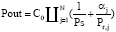 |
Where:
 |
is independent of power allocation and αj = Ωj2/Ωj3. Annavajjala et al. (2007) proved that the power allocation optimization problem can be described as:
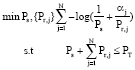 | (1) |
where, PT is the total transmit power. Compared with the results of Annavajjala et al. (2007), the product has been transformed into sum in Eq. 1. Because log (A) is concave, we multiply the cost function by -1 in (1) such that this transformation do not change the convex characteristics of the cost function. Thus, Eq. 1 is equivalent to results of Annavajjala et al. (2007).
While the centralized optimization algorithm is proposed by Annavajjala et al. (2007), we proposed a distributed alternative that does not require a central controller.
Distributed power allocation algorithm: The Lagrange cost function of Eq. 1 can be written as:
 | (2) |
where, λ>0 is the Lagrange parameter.
The dual optimization problem is:
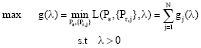 | (3) |
Where:
 | (4) |
An observation is that if Ps is given with some value, the evaluation of Eq. 3 is amenable to parallel computation with a separate relay calculating each component gi(λ) of g(λ) due to the separable structure of the problem. When given the initial value λ0 and Ps(0), the proposed distributed power allocation algorithm can be described as:
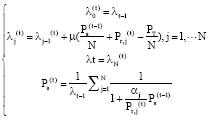 | (5) |
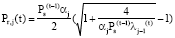
where, λj(t) denote a local estimate of λ, at relay k at time t, μ>0 is a step-size parameter, Ps is updated at source once in every iteration and the result is distributed to all relays by a single node broadcasting (Bertsekas and Tsitsiklis, 1989). P(t)r, j in Eq. 6 is computed as:
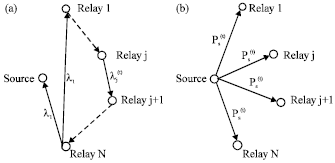 | |
| Fig. 1(a-b): | Data flow in the proposed distributed algorithm |
 | (6) |
Equation 6 and Ps(t) in Eq. 5 are obtained by noting that L(Ps, {Pr,j}, λ) is convex [1] and ∂gi(λ)/∂Pr,j and ∂g(λ)/∂Ps if the minimum in Eq. 3 is attained. In this proposed scheme, we define a cycle visiting each node over the network as that of (Lopes and Sayed (2007) such that relay j has access only to λ(t)j-1, which is an estimate of λ at its immediate neighbor in the defined cycle, except for Ps(t) that is broadcasted by the source. The algorithm is further illustrated Fig. 1: at time t we start with initial condition (6) at relay 1, iterate cyclicly across the relays and get λt at relay N. Ps is then updated and distributed to all relays. The algorithm ends if the difference between λt-1 and t is smaller than one certain threshold.
RESULTS
Different with the algorithm CPAA proposed by Annavajjala et al. (2007), the algorithm DPAA we propose does not require a central controller.
We now present some results illustrating the outage performance of the algorithm DPAA we studied compared with that of CPAA proposed in Fig. 2. As a popular and simple algorithm, the outage performance of the Equal Power Allocation Algorithm (EPAA) presented is also shown in Fig. 2.
The information rate is R = 1 bits/s/Hz . N= 4 relays is considered and αj are set as [α1α2α3α4] = [0.2 0.3 0.4 0.5]. We observe that the outage performance loss of DPAA compared to that of CPAA is insignificant, which shows the validity of the proposed algorithm. Moreover, 2.2 dB improvement can be obtained with DPAA compared to EPAA at an outage level of 10-3.
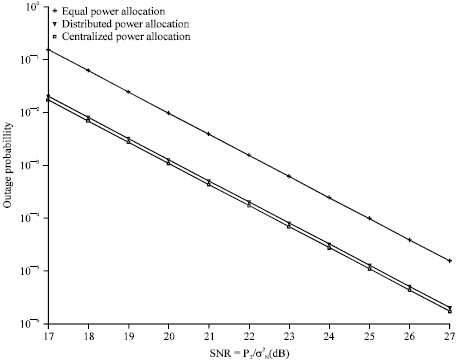 | |
| Fig. 2: | Outage probability of the AF protocol with equal, centralized and distributed power allocation |
CONCLUSION
The validity of the proposed distributed power allocation algorithm in the AF relaying networks have been demonstrated by the theory and simulation results.
REFERENCES
- Annavajjala, R., P.C. Cosman and L.B. Milstein, 2007. Statistical channel knowledge-based optimum power allocation for relaying protocols in the high SNR regime. IEEE J. Selected Areas Commun., 25: 292-305.
CrossRef - Lopes, C.G. and A.H. Sayed, 2007. Incremental adaptive strategies over distributed networks. IEEE Trans. Signal Process., 55: 4064-4077.
CrossRef