

Xiangmei Zhang
Hebei University of Technology, Tianjin City, 300401, P.R. China
Xianzhou Guo
Hebei University of Technology, Tianjin City, 300401, P.R. China
Anping Xu
Hebei University of Technology, Tianjin City, 300401, P.R. China
Information Technology Journal
Year: 2012 | Volume: 11 | Issue: 4 | Page No.: 557-559





ABSTRACT
With the high speed development of computer science and the increasing ability of calculation, the Fractional Calculus (FC) and Fractional Differential Equations (FDEs) appear more and more frequently in research areas and engineering applications. An easy-to-use and effective method for solving such equations is needed. Though some analytic solutions of FDEs can be resolved, most FDEs do not have exact analytic solutions. So approximation and numerical techniques must be used. In the study, given a set of grid points {xi}, i = 1, 2, …, n and corresponding function values, {f (xi)}, i = 1, 2, …, n, we use two methods to computer the fractional differentiation of function f (x)-Lagrange interpolation polynomial method and Chebyshev polynomial method.
PDF Abstract XML References Citation
Article History
Received: October 28, 2011;
Accepted: November 02, 2011;
Published: January 20, 2012
How to cite this article
Xiangmei Zhang, Xianzhou Guo and Anping Xu, 2012. Computations of Fractional Differentiation by Lagrange Interpolation Polynomial and Chebyshev Polynomial. Information Technology Journal, 11: 557-559.
DOI: 10.3923/itj.2012.557.559
URL: https://scialert.net/abstract/?doi=itj.2012.557.559
DOI: 10.3923/itj.2012.557.559
URL: https://scialert.net/abstract/?doi=itj.2012.557.559
INTRODUCTION
The Fractional Calculus (FC) is a generalization of the traditional calculus that leads to similar concepts and tools, but with a much wider applicability. It includes fractional derivatives and fractional integrals. FC means to generalize the differentiation and integration into fractional order and complex order. FC is a more than 300-year-old mathematics topic from the first raised by Leibniz and L’ Hospital in 1695. Because of the high computation complexity, FC was restricted in the theoretical research field by mathematicians. However, during the last ten years or so, with the high speed development of computer science and the increasing ability of calculation, the realization of FC becomes feasible and FC was noticed and researched by more and more engineers. FC is increasingly used to model problems in rheology, materials and mechanical systems identification, ANN, fractal and chaos and other areas of applications.
In recent years, the Fractional Differential Equations (FDE) appear more and more frequently in research areas and engineering applications. An easy-to-use and effective method for solving such equations is needed. Though some analytic solutions of fractional differential equations can be resolved, many solutions of them are expressed by some special functions. Generally, most FDEs do not have exact analytic solutions, so approximation and numerical techniques must be used (Khasawneh et al., 2011). Then a question is raised: How can we computer the fractional differentiation of function f (x)?
In practice, though we know that the function f (x) exists and is continuous, given a set of grid points {xi}, i = 1, 2, ..., n and corresponding function values, {f (xi)}, i = 1, 2, ..., n how can we use the data to computer approximately the fractional differentiation of function f (x)?
In the study, we use two methods to solve the former problem-Lagrange interpolation polynomial method and Chebyshev polynomial method.
LAGRANGE INTERPOLATION POLYNOMIAL METHOD
Lagrange interpolation polynomial method of degree n: Assume that function f (x) is continuous over the interval [a, b], by Weierstrass Theorem, then there exists a polynomial that approximates uniformly f (x) with any desired accuracy. By Chebyshev Theorem, the best approximation polynomial of f (x) in [a, b] is Lagrange interpolation polynomial (Berrut and Trefethen, 2004).
Given a set of grid points {xi}, i = 1, 2, ..., n a≤x1 <þ<xn ≤b and corresponding function values y1 = f (xi) i = 1, 2, ..., n.
Let L (x) be Lagrange interpolation polynomial of function y = f (x) over [a, b] satisfying L (xi) = yi, i = 1, 2, ..., n. Then:
 |
where:
 |
Therefore, the fractional differentiation of function y = f (x) can be approximated by one of L (x) over the interval [a, b]. Then:
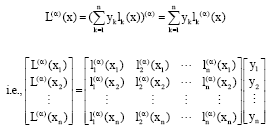 |
We denote the fractional differentiation of y = f (x) in point {xi} (I = 1, ..., n) by wi, then:
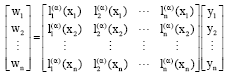 | (1) |
denoted by W = dLY.
Lagrange interpolation polynomial method of degree: For simplicity we divide the interval [a, b] uniformly with:
 |
and assume that the problem is periodic, i.e., y0 = yn, y1 = yn+1. For I = 1, ..., n:
| • | Let Li is the Lagrange interpolation polynomial of degree 2 with  |
| • | Set  |
Then for given I, we obtain easily the Lagrange interpolation polynomial of degree 2 as following:
 |
We denote:
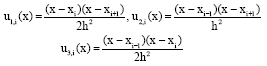 |
then we obtain that:
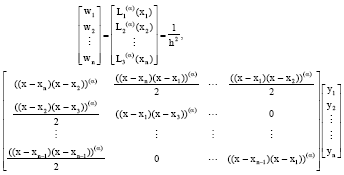 |
denoted by:
 | (2) |
CHEBYSHEV POLYNOMIAL METHOD
Under normal circumstances, it is very difficult that we find the best uniform approximation polynomial of y = f (x) ∈ C [a, b]. But it is feasible to find the approximate best uniform approximation polynomial of y = f (x) by using the good approximation properties of Chebyshev polynomial [3, 4, 5].
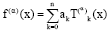
In the interval [-1,1] we have:
 | (3a) |
 | (3b) |
where the Chebyshev polynomial is denoted as following:
 |
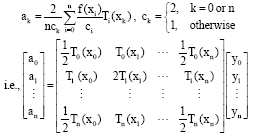
satisfying that T0 (x) = 1, T1 (x) = x and it has recurrence relationship Tn+1 (x) = 2xTn (x)-Tn-1 (x), ak (k = 0,1, ..., n)are coefficients as following:
 | (4) |
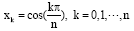
We interpolate at the Chebyshev collocation, or extreme points to minimizes the approximation error (Clenshaw, 1957). There collocation points are found from:
 | (5) |
| Table 1: | Error |
 | |
Exp. 2:  | |
| Table 2: | Error |
 | |
We take Eq. 4 and 5 into Eq. 3b, then:
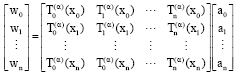 |
denoted by:
 | (6) |
NUMERICAL COMPUTATIONS
Now we verify the effectiveness and practicality of the former methods by two examples. Set:
 |
Using MATLAB, we obtain stability charts, frequency diagrams and errors of the following examples:
| Exp. 1: |  |
Now we analysis the pros and cons of the former methods by the following Table 1 and 2.
CONCLUSION
The results obtained by Lagrange interpolation polynomial method and Chebyshev polynomial method, considering two examples, are compared with experimental data provided by two methods and the true data. In the two methods we obtain a good convergence comparison.
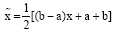
From the numerical results, we obtain that it is evident that the two methods in the paper are effect. Although, f (x) is assumed to take values in [-1, 1], the shifting to any arbitrary period  can be accomplished through the change of variables
  .
.
REFERENCES
- Khasawneh, F.A., B.P. Mann and E.A. Butcher, 2011. A multi-interval Chebyshev collocation approach for the stability of periodic delay systems with discontinuities. Common Nonlinear Sci. Number Simulat.
CrossRef - Berrut, J.P. and L.N. Trefethen, 2004. Barycentric lagrange interpolation. SIAM Rev., 46: 501-517.
CrossRefDirect Link