

Chunhong Cao
College of Information Science and Engineering, Northeastern University, Shenyang 110819, China
Tang Chuan
State Key Laboratory of Geohazard Prevention and Geoenvironment Protection, Chengdu University of Technology 610059, China
Dazhe Zhao
Key Laboratory of Medical Image Computing of Ministry of Education, Northeastern University, Shenyang, Lining 110819, China
Bin Zhang
College of Information Science and Engineering, Northeastern University, Shenyang 110819, China
Information Technology Journal
Year: 2012 | Volume: 11 | Issue: 4 | Page No.: 496-499





ABSTRACT
Geometric constraint problem is equivalent to the problem of solving a set of nonlinear equations substantially. The constraint problem can be transformed to an optimization n problem. We can solve the problem with cell membrane optimization. By studying the characteristics of cell membrane and the mode of material transfer, proposed a new global optimization algorithm: Cell Membrane Optimization (CMO), combined with global optimization algorithm. The experiment shows that it can improve the geometric constraint solving efficiency and possess better convergence property than the compared algorithms.
PDF Abstract XML References Citation
Article History
Received: October 28, 2011;
Accepted: October 31, 2011;
Published: January 20, 2012
How to cite this article
Chunhong Cao, Tang Chuan, Dazhe Zhao and Bin Zhang, 2012. Geometric Constraint Solving Based on Cell Membrane Optimization. Information Technology Journal, 11: 496-499.
DOI: 10.3923/itj.2012.496.499
URL: https://scialert.net/abstract/?doi=itj.2012.496.499
DOI: 10.3923/itj.2012.496.499
URL: https://scialert.net/abstract/?doi=itj.2012.496.499
INTRODUCTION
The parametric design is a geometric constraint-solving problem. Geometric constraint solving approaches are made of three approaches: algebraic-based solving approach based solving approach and graph-based solving approach (Bo, 1999). One constraint describes a relation that should be satisfied. Once a user defines a series of relations, the system will satisfy the constraints by selecting proper state after the parameters are modified. The idea is named model-based constraints. Constraint solver is a segment for the system to solve the constraints.
In the recent decades, it has seen many new optimization algorithms about the global optimization. For example, Genetic algorithms was put forward by simulating the natural selection of Darwin's biological evolution theory and the biological evolution of genetic mechanism (Holland, 1975). Ant colony optimization algorithm was inspired by ant foraging (Colorni et al., 1991). PSO was put forward by simulating the flight behavior of birds (Kennedy and Eberhart, 1995). In order to achieve optimization, the Artificial Fish School Algorithm constructed artificial fish to imitate the fish feeding, clusters, rear-end and random behaviors (Xiaolei, 2003). Leapfrog algorithm was proposed through the simulation of the frogs’ feeding characteristics (Eusuff and Lansey, 2003). Migration algorithm is simulated the migration mechanism-population is transferred with the economic center of gravity and is spread with the increasing population pressure to achieve global optimization (Zhou and Mao, 2003). Colony algorithm is proposed mainly based on the characteristics of bees seeking nectar (Karaboga, 2005).
This paper studies the characteristics of the cell membrane and its material transfer methods, from which construct optimization model. Combined with the basic idea of global optimization algorithms, we propose a new global optimization algorithm optimization as Cell Membrane Optimization (Tan and Yu, 2011).
CELL MEMBRANE OPTIMIZATION
According to the process of membrane transport material, the material is divided into three types: fat-soluble substances, high concentrations non-fat-soluble material (HS) and low concentrations non-fat-soluble material (LS) in this paper. In solving optimization problems, a material is corresponding to a solution of the optimization problem, the three different types material are corresponding to three solutions which of different characteristics.
This paper studies is for the unconstrained function optimization problem, as form (1) described.
 | (1) |
In it:
 |
Suppose form (1) always has solution, i.e., the global optimum exists. The overall process of Cell Membrane Optimization (CMO) is as follows.
Initial the material: In the solution space:
 |
Randomly generated m n-dimensional material, every material are randomly distributed in the solution space, calculate the value of their function and keep the best material in the Xbest.
Classified material type: First, the function value of each material sorted from small to large, material at the top Ps percentage is divided into fat-soluble substance, the material at the back is classified as non-fat-soluble substances; and then the non-fat-soluble material is further divided into two types: high concentration and low concentration. For a substance Y, the concentration of which is defined as the percentage of the material contained in the neighborhood for the total number of the material. As form (2) shows:
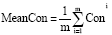 | (2) |
where, n means the number of the material of Xi (i=1, …, m) whose distance from the Y is less than rx(u - l) (it is for any k, with):
 |
The average of all concentration is MeanCon, as form (3) shows:
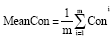 | (3) |
Free diffusion of fat-soluble substances: If f (newfsXi) is better than (fsXi), then use newfsXi to replace fsXi. Then shrink the search radius vector: Radius1 = Radius1xPb, repeat this process until max {Radius1k,∀k}>Pa. At the start, the calculate method of the search radius Radius1 is shown in form (4):
 | (4) |
The correct method of search range is that for k, if newfsXki>uk, then newfsXki = uk; if newfsXki<lk, then newfsXik= lk. The scope correction of the new material appeared below use the same method, no specific description.
High concentrations non-fat-soluble substances diffusion: Assuming that the probability that each high concentrations non-fat-soluble existences carrier is same, set the probability is Pc1, if the randomly generated number rand()≤Pc1, rand() is between 0 and 1; then the substance (such as hsXi) can help the movement to spread from high concentration to low concentration side and to make the new location as the local search center (denoted hsXCi); otherwise make the original place as the local search center. Then, the substance will do locn times local search campaign. Before this the search radius vector Radius2 need to be initialized. The method shown in form (5):
 | (5) |
Then made locn times random movement (that is generate locn material) in the search area where hsXCi as the center and Radius2 as radius and corrected their search area. Record the optimal material besthsXi of the locn material. If f (besthsXi)< f(hsXCi), then use besthsXi to replace hsXi, or use hsXCi to replace hsXi.
Low concentrations non-fat-soluble substances diffusion: Assuming that the probability that each low concentrations non-fat-soluble existences carrier is same, set the probability is Pc2. Every low concentrations non-fat-soluble owns energy and the energy value is in [0, 1]. First calculated the function value f (lsX i) (i = 1, ..., m3) for each low concentrations non-fat-soluble substances, then sort the function value from small to large. For the material that has the minimum function value, its energy Ei is Emin, For the material that has the largest function value, its energy Ei is Emax, the energy Ei of other substances is between Emin and Emax and is calculated with a linear order. Which, Emin and Emax is the constant in [0, 1], here, Emin is equal to 0, Emax is equal to 1.
If a substance (such as lsXi) carrier and there is enough energy, then it can be active transport, from the low concentration side to the high concentration side and to make a new location to be the center of the local search (denoted lsXCi), or the original place to be the local search center. After the active transport, the new location (lsXi) of the low concentrations non-fat-soluble substances (lsXCi) is shown in form (6):
 | (6) |
Then, initial the search radius vector Radius3, as is shown in form (7):
 | (7) |
Then made locn times random movement (that is generate locn material) in the search area where lsXCi as the center and Radius3 as radius and corrected their search area. Record the optimal material bestlsXi of the locn material. If f(bestlsXi)< f(lsXCi), then use bestlsXi to replace lsXi, or use lsXCi to replace lsXi.
Update the material: Use the new material group that composed by the fat-soluble substances, high concentration non- fat-soluble substances and low concentrations non-fat-soluble substances to replace the old material groups Xi (i=1, …, m).
GEOMETRIC CONSTRAINT SOLVING
The constraint problem can be formalized a7s (E, C) (Sheng-Li et al., 2003), here E = (e1, e2, ……, en), it can express geometric elements, such as point, line, circle, etc; C = (c1, c2, …, cm), ci is the constraint set in these geometric elements. Usually one constraint is represented by an algebraic equation, so the constraint can be expressed as follows:
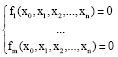 | (8) |
X = (x0, x1, …, xn), Xi are some parameters. Constraint solving is to get a solution x to satisfy formula (8):
 | (9) |
Apparently, if Xj can satisfy F (Xj) = 0, then Xj can satisfy formula (8). So the constraint problem can be transformed to an optimization problem and we only need to solve min (F ( Xj ) )<ε.ε is a threshold.
APPLICATION INSTANCE
In CMO, there are eight adjustable parameters: the maximum iteration generation G is generally in [10, 100]; the local search time locn of no-fat-soluble substance is generally in [10, 100]; Material total quantity m is generally in [10, 50]; the percentage in the colony of fat-soluble substances Ps is generally in [0.1, 0.3]; the threshold to stop thread of fat soluble substance Pa is generally in [1e-6, 1e-3]; the constringency rate of search radius is in [0.8, 0.99]; High and low concentration no-fat-soluble substance in a carrier Pc1, Pc2 is generally in [0.2, 0.8]. The radius r for substance concentration for an algorithm performance is less affected, can be set as a constant. It is not included in the programmable parameters, is generally in [0.2, 0.5].
The two graphs in Fig. 1 are drafts in engineering design. Figure 1b is an auto-produced graph after some sizes of the Fig. 1a are modified by CMO. In this instance, the parameters are set G = 20, locn = 10, m = 20, Ps = 0.2, Pa = 1e-5, Pb = 0.9, Pc1 = 0.8, Pc2 = 0.5, r = 0.4, respectively.
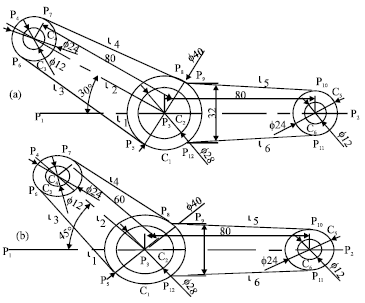 | |
| Fig. 1(a,b): | (a) A design instance (b) Solving result |
From the Fig. 1 we can realize from the above figures that once a user defines a series of relations, the system will satisfy the constraints by selecting proper state after the parameters are modified by CMO.
CONCLUSION
Geometric constraint solving is the core of parameterization design. Geometric Constraint Solving is the key of parameterization design system. In this paper the geometric constraint equation set will be transformed into an optimization model. The constraint problem can be transformed to an optimization n problem. We propose a new global optimization algorithm-Cell Membrane Optimization. The efficiency and practicality of the algorithm can be indicated by applying Cell Membrane Optimization. The future work is to prove the convergence from mathematics angle and the influence of related parameters.
ACKNOWLEDGMENT
This work is supported by “the Fundamental Research Funds for the Central Universities” (Project number: N100404002). This work is supported by “Opening fund of State Key Laboratory of Geohazard Prevention and Geoenvironment Protection (Chengdu University of Technology)(Project number: SKLGP2011K004).
REFERENCES
- Colorni, A., M. Dorigo and V. Maniezzo, 1991. Distributed optimization by ant colonies. Proceedings of the 1st European Conference on Artificial Life, December 11-13, 1991, Paris, France, pp: 134-142.
Direct Link - Kennedy, J. and R. Eberhart, 1995. Particle swarm optimization. Proc. IEEE Int. Conf. Neural Networks, 4: 1942-1948.
CrossRefDirect Link - Eusuff, M.M. and K.E. Lansey, 2003. Optimization of water distribution network design using the shuffled frog leaping algorithm. J. Water Resour. Plann. Manage., 129: 210-225.
Direct Link - Tan, S.H. and W.Y. Yu, 2011. New algorithm for global optimization: Cell membrane optimization. Appl. Res. Comput., 2011: 455-457.
Direct Link - Sheng-Li, L., M. Tang and J.X. Dong, 2003. Geometric constraint satisfaction using genetic simulated annealing algorithm. J. Image Graphics, 8: 938-945.
Direct Link