

Yu-long Bian
Faculty of Information Science and Technology, Ningbo University, Ningbo 315211, China
Zhen Liu
Faculty of Information Science and Technology, Ningbo University, Ningbo 315211, China
Information Technology Journal
Year: 2012 | Volume: 11 | Issue: 4 | Page No.: 471-475





ABSTRACT
Emotion is an important parameter of chasing between two virtual humans; a computational emotion model is an interesting topic. A mathematical model of virtual human’s chasing behaviour is set up, the model integrate physiological variables and emotion parameters, emotion synthesis is based on Ekman’s basic emotion, some formulas of emotion are constructed, a numerical simulation is realized on PC and the trend of speed, physical strength and emotion are illustrated in some figures.
PDF Abstract XML References Citation
Article History
Received: October 28, 2011;
Accepted: November 02, 2011;
Published: January 20, 2012
How to cite this article
Yu-long Bian and Zhen Liu, 2012. A Model Of Chasing Behavior For Two Virtual Humans. Information Technology Journal, 11: 471-475.
DOI: 10.3923/itj.2012.471.475
URL: https://scialert.net/abstract/?doi=itj.2012.471.475
DOI: 10.3923/itj.2012.471.475
URL: https://scialert.net/abstract/?doi=itj.2012.471.475
INTRODUCTION
The impact of humans’ emotion on their behavior has been a concerned subject for a long time and achieved some outstanding result. For example, Loomes and Sugden (1982) and Bell (1982) proposed r egret theory. Mellers et al. (1997) presented subjective expected happy theory. Loewenstein et al. (2001) introdeced risk immediate emotion model and this model is accepted by most people now. The simulation of mankind intelligent behavior is also an important issue too and large numbers of outstanding achievements have been registered (Tu and Terzopoulos, 1994; Funge et al., 1999; Blumberg et al., 2002; Liu and Pan, 2005).
We try to set up a new method that describes the chasing behavior, the model integrate physical strength, weight and the impact of emotion together. The simulation test shows that our method can well describe chasing behavior of two virtual human.
THE COGNITIVE STRUCTURE OF VIRTUAL HUMAN
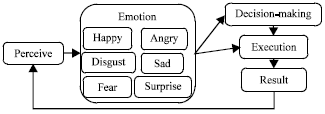
The cognitive structure of virtual human is shown in Fig. 1.
First, virtual human receives information via varieties of sensory organs. Second, the nervous system transports the information to the brain. Then the information is processed and the emotion changes.
 | |
| Fig. 1: | The cognitive structure on virtual human |
And then the change of emotion impacts the decision-making. The emotion can also impact humans’ behavior directly. Finely the result of human’s behavior is received by sensory organs and repeat this process.
Based on Darwin’s theory of evolution, Ekman proposes that there are six base emotions, they are happy, angry, sad, disgust, surprise and fear. Other emotions are synthesized by these six base emotions. So we use a six-dimensional vector to express the synthesized emotion. That is em = (em1, em2, em3, em4, em5, em6), em1, em2, em3, em4, em5, em6 express the strength of happy, angry, sad, disgust, surprise and fear. Let ev1 = (f1(i), f2(i), f3(i), f4(i), f5(i), f6(i)), it represents the impact of the event i on the emotion em. f1(i) is the strength of emj after the impact of event i. Different emotion has different stimulus intensity to the same event. So some weight must be set. Assume that the weight of the stimulus intensity emj of to the event x is aj, so the stimulus intensity of emotion em to the event x is:
 |
THE MATHEMATICAL MODEL DURING THE CHASING BEHAVIOR
The assumptions of chasing behavior: There are two people playing a chasing game in a yard, we name them Chaser and Escaper. Chaser pursues Escaper. There is a cylindrical object in the center of the yard. The radius of the cylindrical object is R. The rule of the game is that they run around the cylindrical object, they can’t climb the cylindrical object. If Chaser catches Escaper in the limited time, Chaser win, or Escaper win.
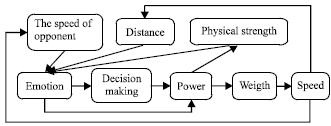
The factors that can impact the emotion should be taken in to consideration, such as physical strength, weight, speed etc.
 | |
| Fig. 2: | The relationship among related factors during the chasing game |
And the relationship among these factors is shown in the Fig. 2.
The emotion model of virtual human: First some stimulating events of them should be defined.
The stimulating events to Chaser: (1)the event that make Chaser happy: The distance between them is very small and he is likely to win; (2) the event that make Chaser fear: Time is running out, he is likely to lose the game; (3) the event that make Chaser surprise: The speed of Escaper is so fast; (4) the event that make Chaser angry: A long time has passed but he still cannot catch up with Escaper; (5) the event that make Chaser sad: His physical strength is running out, he want to be faster but failed; (6) the event that make Chaser disgust: he is very tired and don’t want to play the game anymore.
The stimulating events to Escaper: (1) the event that make Escaper happy: Time is running out and he is likely to win the game; (2) the event that make Escaper fear: The distance between them is very small, he is likely to lose the game; (3) the event that make Escaper surprise: The speed of Chaser is so fast; (4) the event that make Escaper angry: A long time has passed but Chaser still cannot give up; (5) the event that make Escaper sad: His physical strength is running out, he want to be faster but failed; (6) the event that make Escaper disgust: He is very tired and don’t want to play the game anymore.
Because the emotion of human is cyclical, so we use trigonometric function to describe the emotion of virtual human.
The emotion model of Chaser:
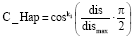
| • | The strength of happy: |
 | (1) |
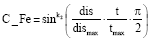
| • | The strength of fear: |
 | (2) |
| • | The strength of surprise: |
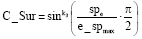 | (3) |
| • | The strength of angry: |
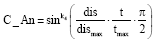 | (4) |
| • | The strength of sad: |
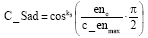 | (5) |
| • | The strength of disgust: |
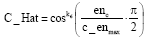 | (6) |
C_Hap, C_Fe, C_Sur, C_An, C_Sad, C_Hat are strength of happy, fear, surprise, angry, sad and disgust of Chaser. dis is the distance between them, Dismax is the max distance between them. spe Speis the speed of Escaper, e_spmax is the max speed of Escaper. tmax is the deadline time, t is the current time. enc is the current physical strength of Chaser, c_enmax is the max physical strength of Chaser. K1, k2, k3, k4, k5, k6, are control factors. Assume that the weight of Chaser’s emotions to the event of chasing are: l1, l2, l3, l4, l5, l6 and l1+l2+l3+l4+l5+l6. So the stimulus intensity of a chaser's emotion to the event of chasing is:
 | (7) |
The emotion model of Escaper:
| • | The strength of happy: |
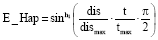 | (8) |
| • | The strength of fear: |
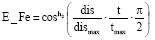 | (9) |
| • | The strength of surprise: |
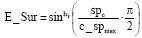 | (10) |
| • | The strength of angry: |
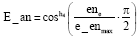 | (11) |
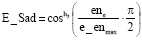
| • | The strength of sad: |
 | (12) |
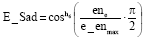
| • | The strength of disgust: |
 | (13) |
E_Hap, E_Fe, E_Sur, E_An, E_Sad, E_Hat are strength of happy, fear, surprise, angry, sad and disgust of Escaper. spc is the current speed of Chaser, c_spmax is the max speed of Chaser. ene is the current physical strength of Escaper, e_enmax is the max strength of Escaper. h1, h2, h3, h4, h5, h6 are control factors. Assume that the weight of Escaper’s emotions to the event of escaping are: n1, n2, n3, n4, n5, n6 and n1+n2+n3+n4+n5+n6. So the stimulus intensity of a escaper’s emotion to the event of escaping is:
 | (14) |
The speed model of virtual human: We compare the virtual human as a vehicle for simplicity. People have to overcome resistance when he is running, such as friction and gravity. The speed model is:
 | (15) |
F is the tractive force of virtual human, f is the resistance he have to overcome, m is the weight of the virtual human. So the acceleration of the human is:
 |
According to the theory of human biology, human will be tachypnea after running some distance. But he can get more oxygen and then some of his physical strength will be recovered. The model of tractive force is:
 | (16) |
Fmax is the max tractive force of virtual human, en is the current physical strength of virtual human, enmax is the max physical strength of virtual human, dir is the direction of virtual human’s movement. There are two directions: clockwise and counterclockwise. If dir = 1, the virtual human run along the clockwise direction; if dir= 0, the virtual human run along the counterclockwise direction. Run is the decision of whether to run or not. If rum = 1, the virtual human decide to run; if run = 0, the virtual human decide to stop; if o<run<1, the virtual human is hesitate. s1,s2 are control parameters. The resistance that the virtual human have to overcome is described by formula (17):
 | (17) |
where, s3, s4, s5 are control factors.
The physical strength of virtual human: The physical strength of virtual human is impacted by the speed, acceleration and weight. The physical strength model is described by formula (18) follows:
 | (18) |
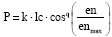
where, enmax is the max physical strength of virtual human, sp is the current speed of virtual human, P is the rate of physical strength recovery and it is impacted by his current physical strength and lung capacity. The model of physical strength recovery rate is described by formula (19):
 | (19) |
where, lc is the lung capacity of virtual human, k and q are control factors.
Experiment: The values of the parameters in the model are show in Table 1.
The weight of Chaser is 70, the weight of Escaper is 75, the max physical strength of Chaser is 10000 and the max physical strength of Escaper is 11000.
| Table 1: | The values of parameters |
 | |
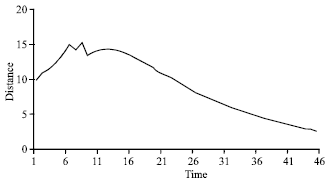 | |
| Fig. 3: | The distance between them |
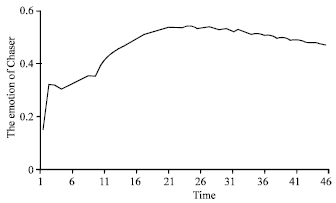 | |
| Fig. 4: | The emotion of Chaser |
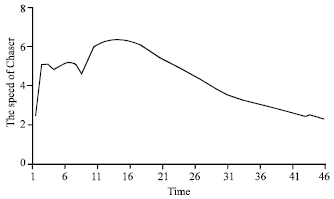 | |
| Fig. 5: | The speed of Chaser |
The radius of the cylindrical object is R = 5. The results of our experiment are shown in Fig. 3, 6.
From Fig. 3-6 we can see that this model can well describe the chasing behaviour of human.
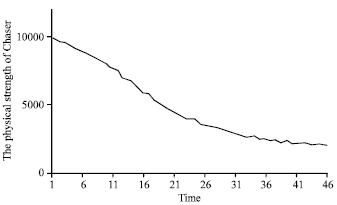 | |
| Fig. 6: | The physical strength of Chaser |
CONCLUSION
A mathematical model of virtual human’s chasing behaviour is built in this paper, in which the change of physiological and psychological is taken into consideration. Simulation is made on the computer and the result shows that our method can well describe the emotional game during the chasing behaviour.
ACKNOWLEDGMENTS
The work described in this paper was co-supported in part by the National Natural Science Foundation of China (Grant no: 60973099), the Natural Science Foundation of Zhejiang Province (grant no: Y1091158), Zhejiang Public Technology Application Project (2011C23027).
REFERENCES
- Loomes, G. and R. Sugden, 1982. Regret theory: An alternative theory of rational choice under uncertainty. Econ. J., 92: 805-824.
Direct Link - Bell, D.E., 1982. Regret in decision making under uncertainty. Operations Res., 30: 961-981.
CrossRef - Loewenstein, G.F., E.U. Weber, C.K. Hsee and N. Welch, 2001. Risk as feelings. Psychol. Bull., 127: 267-286.
Direct Link - Tu, X. and D. Terzopoulos, 1994. Artificial fishes: Physics, locomotion, perception, behavior. Proceedings of the 21st Annual Conference on Computer Graphics and Interactive Techniques, July 1994, Orlando, FL, USA., pp: 43-50.
CrossRef - Funge, J., X. Tu and D. Terzopoulos, 1999. Cognitive modeling: Knowledge, reasoning and planning for intelligent characters. Proceedings of the 26th Annual Conference on Computer Graphics and Interactive Techniques, August 8-13, 1999, Los Angeles, CA, USA., pp: 29-38.
CrossRef - Blumberg B., M. Downie, Y. Ivanov, M. Berlin, M. Johnson and B. Tomlinson, 2002. Integrated learning for interactive synthetic characters. ACM Trans. Graphics, 21: 417-426.
CrossRef - Liu, Z. and Z.G. Pan, 2005. An emotion model of 3D virtual characters in intelligent virtual environment. Affective Comput. Intell. Interaction, 3784: 629-636.
CrossRef