

Xin Li
Lanzhou Jiaotong University, Lanzhou, People Republic of China
Hai-Ying Dong
Lanzhou Jiaotong University, Lanzhou, People Republic of China
Information Technology Journal
Year: 2012 | Volume: 11 | Issue: 4 | Page No.: 436-440





ABSTRACT
In this study, a modeling method is presented for networked traction control systems by introducing Networked Control Systems (NCSs) into the asynchronous traction motor driving system. The NCSs of EMUs is base on the Train Communication Network (TCN). It is assumed that the time delay is less than the sampling period T, when the network time delay occurs in the transport medium of network data. A feedback linearization method is used to achieve input-output linearization and decoupling of the asynchronous traction motor driving system based on a fifth-order model of an asynchronous traction motor which includes both electrical and mechanical dynamics under the assumptions of linear magnetic circuits. Using the dynamic output feedback control method, a networked control model of an asynchronous traction motor is established.
PDF Abstract XML References Citation
Article History
Received: October 28, 2011;
Accepted: October 31, 2011;
Published: January 20, 2012
How to cite this article
Xin Li and Hai-Ying Dong, 2012. Modeling of High-Speed Traction Motors Control System Based on Train Communication Network. Information Technology Journal, 11: 436-440.
DOI: 10.3923/itj.2012.436.440
URL: https://scialert.net/abstract/?doi=itj.2012.436.440
DOI: 10.3923/itj.2012.436.440
URL: https://scialert.net/abstract/?doi=itj.2012.436.440
INTRODUCTION
Due to the technology developments in high speed railway area, the AC drive traction motor have been widely utilized in many high-speed Electric Multiple Unit (EMUs). At the same time, there is a NCSs both for the interconnection of equipment located inside a EMUs vehicle and for communication and control between different vehicles. How to introducing NCSs of EMUs into the asynchronous traction motor driving system and getting the networked model of an asynchronous traction motor driving system has become a essential technology in high-speed EMUs.
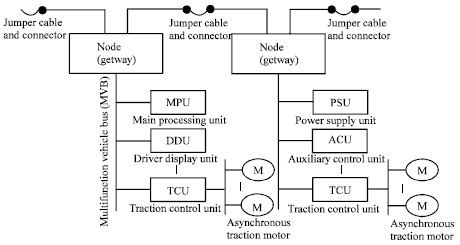
The NCSs of EMUs is base on the international standard IEC 61375-1 (Electric railway equipment-Train bus-Train communication network) which can complete descriptions of TCN techniques. The TCN has a hierarchical structure with two levels of busses, a Train Bus and a Vehicle Bus, as shown in Fig. 1. The TCN interconnects programmable equipment onboard rail vehicles for the support of: traction, vehicle control (remote control, doors control, lights control etc.,) remote diagnostics, maintenance, passenger information and comfort. However, the introduction of network into the traction motor driving system also brings many uncertain factors, such as networked time delay, loss and disorder of data packages, etc. (Dan and Nguang, 2009; Zhu et al., 2008; Shanbin et al., 2006), which makes it more intricate to analyze and design the control system.
The asynchronous traction motor is a system with nonlinearities and cross couplings, which is complicated in respect to achieving high-dynamic control. In the literature, some important methodologies are proposed to analyze and design the networked dc motor system. (Chow and Tipsuwan, 2003; Almutairi et al., 2001) designed a networked DC motor controller and made an analytical comparison between the performance of traditional motor control system and that of NCSs. Zhao et al. (2011) and Li et al. (2009) presents a new controller design method for networked DC motor system in the presence of time delays and packet losses. However, most of the aforementioned research results are not takes nonlinearity problem into account. Nonlinearity is the major barrier in implementing a networked control scheme on an induction motor. Asynchronous traction motors have more complexities in control characteristics than DC traction motors because of their coupled and nonlinear dynamics. In recent years, significant advances have been made in the theory of nonlinear state feedback control ,in particular feedback linearization technique have proved useful in applications. Feedback linear method is a effective method in linearization of the induction motor model.
This study proposes a novel model for networked traction control systems. A networked control model of an asynchronous traction motor is established by introducing Networked Control Systems (NCSs) into the asynchronous traction motor driving system.
 | |
| Fig. 1: | Structure of the train communication network |
The nonlinear model of traction motor is linearized and decoupled in the asynchronous motor driving system using the direct feedback linear method. A networked control system model of an asynchronous traction motor driving system with networked time delay is obtained.
THE MODEL OF ASYNCHRONOUS TRACTION MOTOR
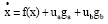
The two-phase equivalent nonlinear model under the assumptions of linear magnetic circuit for an asynchronous traction motor in the stationary reference frame is given by Marino et al. (1993), Chiasson (1998), Novotny and Lipo (1998) and Taylor (1994).
 | (1) |
where the vector fields f(x), ga, gb are:
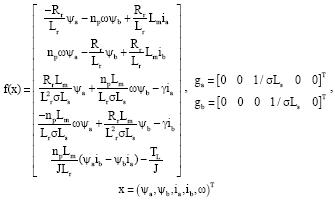 |
where the rotor motor speed is given by ω; the rotor fluxes are ψa and ψb; ia and ib are the corresponding stator currents; np denotes the number of pole pairs of the asynchronous traction motor; J is the moment of inertia of the rotor and of any tool attached to it and TL is the load torque. Rs, Rr are the stator and rotor resistances; Ls, Lr are the stator and rotor autoinductances and Lm is the stator-rotor mutual inductance. Let σ denote an angle such that dσ/dt = npω, σ(0) = 0, γ = (L2m Rr/σLs L2r)+(Rs /σLs).
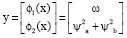
The outputs to be controlled are ω and ψ2a+ψ2b, Let φ1(x) and φ2(x) be the output variables:
 | (2) |
TRACTION MOTOR DRIVING SYSTEM BASED ON FEEDBACK LINEARIZATION
As shown in Boukas and Habetler (2004) and Wai and Chang (2002), the field oriented control of asynchronous traction motor can be improved by input-output decoupling and linearization via a feedback linearization control. The following notation is used for the directional (or Lie) derivative of state function φ(x): Rn→R along a vector field f(x) = (f1(x) ,..., fn(x)):
 | (3) |
The feedback linearization transformation is given by defining the change of coordinates (Kim et al., 1990). The dynamics of the traction motor with nominal parameters are given in new coordinates by:
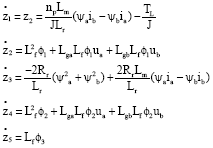 | (4) |
The input-output linearizing feedback for system is given by rewriting the first four Equations in Eq. 4:
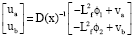 | (5) |
where, v = [va, vb]T is the new input vector and D(x) is the decoupling matrix defined as:
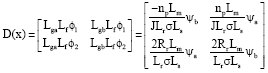 |
where, L2fφ1 and L2fφ2 are given by:
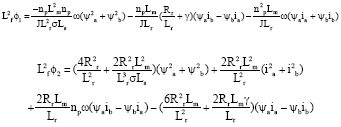 |
The resulting linear and controllable system is described by the state space Equations:
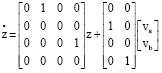 | (6) |
where, z = [z1, z2, z3, z4]T. In this section is to make clear that the decoupling control makes the angle φ3 unobservable from the outputs.
NETWORKED CONTROL SYSTEM MODEL OF AN ASYNCHRONOUS TRACTION MOTOR
As shown in Fig. 2, the networked asynchronous traction motor driving system considered in this paper can be divided into three modules: (1) the traction motor driving system; (2) the Train communication network with time delay; (3) the networked controller.
The NCSs with T time delay: In practice, the NCSs usually suffer time delays during network transmissions. The network delay, including sensor-to-controller delay and controller-to-actuator delay, that happens when data exchange happens among devices connected by the communication network. Time delay in NCSs is a major cause for system performance deterioration and potential system instability.
Let τsc denotes the sensor-to-controller delays and τca denotes the controller-to-actuator delays. A networked control system model of an asynchronous traction motor in EMUs will be presented. Before proceeding to the modeling procedure, the following assumptions will be used through out this paper:
| • | The sensor is time-driven: the states of the plant are sampled periodically |
| • | The controller is event-driven, which can be implemented by an external event interrupt mechanism; the control signal is calculated as soon as a new sensor data arrives at the controller |
| • | The actuator is event-driven: the control signal is applied to the plant as soon as a new controller data arrives at the actuator |
| • | The computational delay can be absorbed into either τsc or τca without loss of generality. For fixed control law, the sensor-to-controller delay and controller-to-actuator delay can be lumped together as τk = τsc+τca for analysis purposes. 0≤τmin≤τk≤τmax≤T, where τmin and τmax are constant and T is sampling period. |
With the above assumptions, it is known that within the kT sampling period, the output signal vectors of controller can be depicted as:
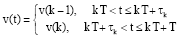 | (7) |
Networked controller system model: The networked controller of NCSs in EMUs is a highly sophisticated controller that requires lots of computing power and memory. The networked controller can provide advanced real-time control laws to all remote traction motor, including fault diagnosis and accommodation control and network traffic condition monitoring. The networked controller will provide the control signals va and vb to the networked asynchronous traction motor driving system, where va is the rotor speed control signal and vb is the rotor flux control signal.
According to Eq. 6, the networked asynchronous traction motor driving system can be described by the following state-space description:
 | (8) |
Where:
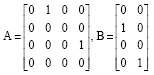 |
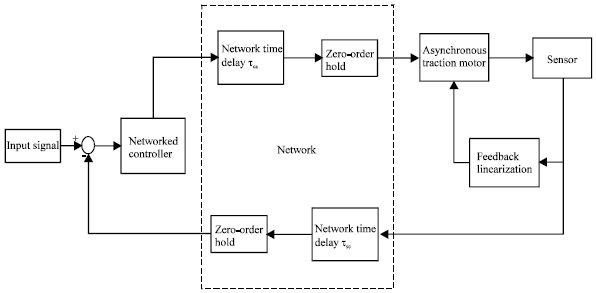 | |
| Fig. 2: | Structure of the networked traction motor control system |
Matrices C is known matrices of appropriate dimensions.
When the sampling period is specified to T, the networked asynchronous traction motor driving system can be discretized as:
 | (9) |
Where:
 |
Using the dynamic output feedback control method and design a dynamic output feedback controller as follows:
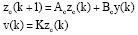 | (10) |
where, xc(k), Rp denotes the state of controller. v(k), Rr denotes the output of controller. matrices Ac, Bc and K are known matrices of appropriate dimensions. When the network delay is 0≤τk = T, consider Eq. 9 and 10, we can obtain the close-loop system model:
 | (11) |
Let augmented vector, Γ(k) = [z(k) zc(k)]T, Eq. 11 can be rewritten as:
 | (12) |
CONCLUSIONS
In this study, for a detailed nonlinear model of an asynchronous traction motor, a networked control method has been used in an asynchronous traction motor based on TCN, which is a main advantage when compared with other similar control model. The asynchronous traction motor speed and flux regulation are exact decoupled into two independent linear subsystems completely based on direct feedback linearization method, which involve a large amount of computation to cancel out the nonlinearities. After the linearization of the traction motor model, the existing achievements on NCSs can be employed by considering the network time delay and then a networked control model of an asynchronous traction motor is obtained by using the dynamic output feedback control method.
REFERENCES
- Zhu, X.M., C.C. Hua and S. Wang, 2008. State feedback controller design of networked control systems with time delay in the plant. Int. J. Innovative Comput. Inform. Control, 4: 283-290.
Direct Link - Chow, M.Y. and Y. Tipsuwan, 2003. Gain adaptation of networked DC motor controllers based on QOS variations. IEEE Trans. Ind. Electron., 50: 936-943.
CrossRefDirect Link - Almutairi, N.B., M.Y. Chow and Y. Tipsuwan, 2001. Network-based controlled DC motor with fuzzy compensation. Proc. Annu. Conf. IEEE Ind. Electron. Soc., 3: 1844-1849.
CrossRefDirect Link - Zhao, D.Z., C. Li and J. Ren, 2011. Fuzzy speed control and stability analysis of a networked induction motor system with time delays and packet dropouts. Nonlinear Anal.: Real World Appl., 12: 273-287.
CrossRefDirect Link - Li, H.B., M.Y. Chow and Z.Q. Sun, 2009. EDA-based speed control of a networked DC motor system with time delaysand packet losses. IEEE Trans. Ind. Electron., 56: 1727-1735.
CrossRef - Marino, R., S. Peresada and P. Valigi, 1993. Adaptive input-output linearizing control of induction motors. IEEE Trans. Automatic Control, 38: 208-221.
CrossRefDirect Link - Chiasson, J., 1998. A new approach to dynamic feedback linearization control of an induction motor. IEEE Trans. Autom. Control, 43: 391-397.
CrossRefDirect Link - Boukas, T.K. and T.G. Habetler, 2004. High-performance induction motor speed control using exact feedback linearization with state and state derivative feedback. IEEE Trans. Power Electron., 19: 1022-1028.
CrossRef - Wai, R.J. and L.J. Chang, 2002. Decoupling and tracking control of induction motor drive. Trans. Aerospace Electron. Syst., 38: 1357-1369.
CrossRefDirect Link - Kim, D.I., I.J. Ha and M.S. Ko, 1990. Control of induction motors via feedback linearization with input-output decoupling. Int. J. Control, 51: 863-883.
CrossRefDirect Link