

Caixia Luo
Institute of Chemical and Biological Technology, Taiyuan University of Science and Technology, Taiyuan 030021, China
Sufang Song
Institute of Chemical and Biological Technology, Taiyuan University of Science and Technology, Taiyuan 030021, China
Information Technology Journal
Year: 2012 | Volume: 11 | Issue: 4 | Page No.: 426-430





ABSTRACT
In order to study the influence of round transition on stress distribution at the nozzle junction of a spherical shell, finite element model is built in the light of large opening spherical shell with flatting nozzle and inside-stretching nozzle differently. It is carried on finite element analysis through capturing stress nephogram and path-linearization. The study shows there is higher stress concentration at the nozzle junction. Sharp-angled transition can produce higher stress than round transition, Round transition can reduce stress compared with sharp-angled transition in any case it is a flatting nozzle or an inside-stretching nozzle. Maximum stress value can reduce 8% approximately. Besides maximum stress, other stresses all have some decline. So, we can adopt round transition for reducing stress and increases strength. The study provides an important foundation for building finite element model in future.
Key words: Spherical shell, opening nozzle, finite element, maximum stress
PDF Abstract XML References Citation
Article History
Received: October 28, 2011;
Accepted: October 31, 2011;
Published: January 20, 2012
How to cite this article
Caixia Luo and Sufang Song, 2012. Finite Element Analysis of Spherical Shell with Opening Nozzle. Information Technology Journal, 11: 426-430.
DOI: 10.3923/itj.2012.426.430
URL: https://scialert.net/abstract/?doi=itj.2012.426.430
DOI: 10.3923/itj.2012.426.430
URL: https://scialert.net/abstract/?doi=itj.2012.426.430
INTRODUCTION
The spherical shell is widely used in chemical industry production. Openings and nozzles on spherical shells are ineviTable for installation, process and inspection (Dekker and Brink, 2000). They will not only weaken the strength of spherical shells but also generate boundary stress on the joint of vessels and nozzles, leading to severe stress concentration (Schindler and Zeman, 2003; Liu et al., 2001). So, the joint is the most vulnerable part to failure. It’s of great importance to study the influence of various parameters on the stress distribution of the openings and nozzles. Many experts and scholars have done a lot of research with finite element technique (Weib and Rudolph, 1995; Jayaraman and Rao, 1978; Chao and Sutton, 1985). Moffat took over a detailed study of the nozzles on a cylindrical shell with 20 nodes isoperimetric element and concluded the graphs of the maximum stress concentration coefficient on different geometry parameters in internal pressure and six moments function (Moffat et al., 1991; Lu and Li, 2002) got the stress concentration coefficient on nozzle area on a cylindrical shell due to internal pressure using finite element analysis (Lu and Li, 2002). Usually, it’s not round but sharp-angled transition that was adopted in joint when a finite element model was built in all of the above papers for simplification. At present, there is no enough data to show influences of the two treatments on the real stress distribution.
In this study, the stress distribution of sharp-angled and round transition is studied on the condition of large opening spherical shell with flatting nozzle and inside-stretching nozzle differently, using the finite element ANSYS. The necessity of round transition in finite element analysis is discussed which will provide theoretical basis on model building.
FINITE ELEMENT ANALYSIS OF LARGE OPENING SPHERICAL SHELL WITH FLATTING NOZZLE
A spherical shell, inner diameter Di = 1000 mm, thickness T = 10 mm and external diameter of the nozzle d0 = 530 mm, thickness of the nozzle t = 12 mm, overhanging length should be far outweigh the relaxation length of the boundary stress in the joint, h = 240 mm. Sharp-angled transition and rounded transition were adopted in the joint of nozzle and spherical shell, inner wall round radius ri = 12 mm, outside wall round radius r0 = 10 mm. The geometric model was shown in Fig. 1, under normal temperature, design pressure p = 4 MPa, the material of spherical shell and nozzle is 16 MnR. Elastic modulus E = 2x10⁵ MPa, Poisson’s ratio mu = 0.3.
The model is simplified into an axial symmetry one to analyze due to both the geometric shape and the loading are axial symmetry. It is meshed in PLANE82, then applied load and boundary conditions. The inner wall of the spherical and nozzle is applied pressure 4MPa while the upper nozzle is applied tensile load -41.20MPa (5), boundary conditions are symmetry plane applying on the lower of the spherical shell. The stress distribution of the two models is shown in Fig. 2 and 3.
There are two high stress areas in both Fig. 2 and 3. One exists in the external surface of spherical shell near the joint; the other appears in the inner surface of the spherical shell. The difference is the position of the maximum stress. The maximum stress value is 504.088MPa on node 2 in Fig. 2 and 4 60.871 MPa on node 2277 in Fig. 3. Compared with Fig. 2, the maximum stress is reduced by 8.6% in Fig. 3.
Path 1-1 is defined through the spherical shell thickness at the point of maximum stress value. Path 2-2 is also defined from the inner angular point to the external angular point.
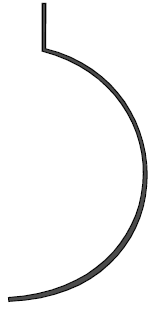 | |
| Fig. 1: | Geometric model |
Stress linearization along the path and classification achieves the results in Table 1.
Each kind of stress is almost same in both two conditions along path 1-1 from Table 1. The peak stress and total stress varies a lot along path 2-2. The main characteristic of peak stress is high localization that won't cause significant deformation. So, the peak stress can be neglected usually except in fatigue analysis. Membrane stress and membrane stress plus bending stress vary little. That is, the maximum stress can be reduced by round transition in the joint.
FINITE ELEMENT ANALYSIS OF LARGE OPENING SPHERICAL SHELL WITH INSIDE-STRETCHING NOZZLE
There is an inside-stretching nozzle in spherical shell. The inside-stretching length h = 100 mm, other parameters of shell and nozzle are the same as above definition. Sharp-angled transition and round transition are adopted, respectively. Finite element model is built, meshed, loaded and solved. The stress nephogram is shown in Fig. 4 and 5.
The number and position of high stress area are the same in Fig. 4 and 5, as is the position of maximum stress point. The difference is that the maximum stress value is 7.5% lower in Fig. 5 than that in Fig. 4, whose scale is almost same compared with that of flatting nozzle.
Comparing Fig. 4 with Fig. 2, the maximum stress value falls from 504.1 to 443.3 MPa, falling 12.1%, comparing Fig. 5 with Fig. 3, the maximum stress value falls from 460.9 to 410.2 MPa, falling 11%. It is clearly that maximum stress can be reduced with round transition while it is an inside-stretching nozzle.
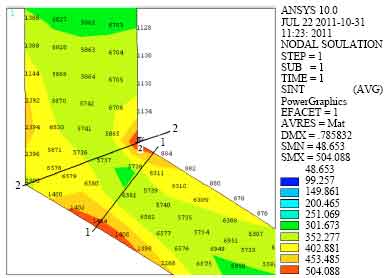 | |
| Fig. 2: | Stress nephogram of sharp |
| Table 1: | Stress on the path of flatting nozzle |
 | |
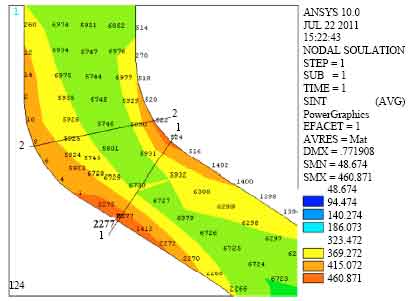 | |
| Fig. 3: | Stress nephogram of round of the structure angled transition with flatting nozzle transition with flatting nozzle |
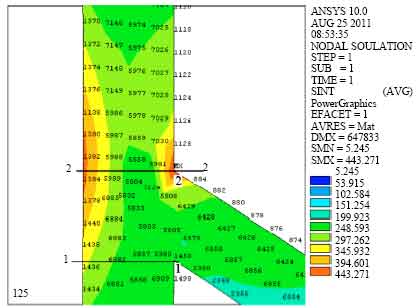 | |
| Fig. 4: | Stress nephogram of sharp-angled |
Path 1-1 is defined through the spherical shell thickness from the inner angular point. Path 2-2 is also defined from the maximum stress point to the inside along the nozzle thickness. Stress linearization along the path and classification achieves the results in Table 2.
From Table 2, it can be seen that each kind of stress varies a lot in sharp-angled transition and round transition along path 1-1.
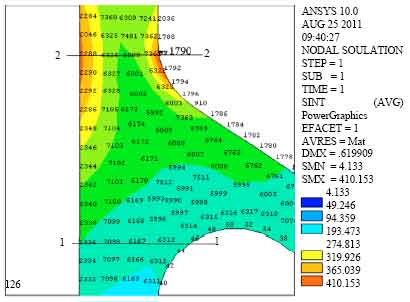 | |
| Fig. 5: | Stress nephogram of round transition with inside-stretching nozzle with inside-stretching nozzle |
| Table 2: | Stress on the path of inside-stretching nozzle |
 | |
Compared with sharp-angled transition, the decline of stress along path 1-1 is about 71% for membrane stress, 30% for membrane stress plus bending stress, 25% for peak stress and 35% for the total stress in round transition. It is also remarkably reduced for all sorts of stress except for membrane stress along path 2-2 in round transition. As a result, the maximum stress can be reduced by round transition in the joint.
CONCLUSION
This study studies the influence of sharp-angled transition and round transition on the stress distribution in conditions of large opening spherical shell with flatting nozzle and inside-stretching nozzle. The conclusions are summarized as follows:
| • | The stress echogram of every condition is achieved after finite element analysis of spherical shell with opening nozzle. It shows that there is higher stress concentration at the nozzle junction. The maximum stress often appears in the internal and external wall of the joint |
| • | Sharp-angled transition can produce higher stress than round transition. Round transition can reduce stress compared with sharp-angled transition in any case it is a flatting nozzle or an inside-stretching nozzle. Maximum stress value can reduce 8% approximately. Besides maximum stress, other stresses all have some decline |
| • | Under the same condition, maximum stress can be reduced while it is an inside-stretching nozzle. So, when spherical shell needs large opening and nozzle, inside-stretching nozzle with round transition is adopted for increasing the strength as far as possible |
REFERENCES
- Dekker, C.J. and H.J. Brink, 2000. Nozzles on spheres with outward weld area under internal pressure analyzed by FEM and thin shell theory. Int. J. Pressure Vessels Pip., 77: 399-415.
CrossRef - Schindler, S. and J.L. Zeman, 2003. Stress concentration factors of nozzle-sphere connections. Int. J. Pressure Vessels Pip., 80: 87-95.
CrossRef - Liu, J.S., G.T. Parks and P.J. Clarkson, 2001. Shape optimisation of axisymmetric cylindrical nozzles in spherical pressure vessels subject to stress constraints. Int. J. Pressure Vessels Pip., 78: 1-9.
CrossRef - Weib, E. and J. Rudolph, 1995. Finite element analyses concerning the fatigue strength of nozzle-to-spherical shell intersections. Int. J. Pressure Vessels Pip., 64: 101-109.
CrossRef - Jayaraman, J. and K.P. Rao, 1978. Thermal stresses in a spherical shell with a conical nozzle. Nucl. Eng. Des., 48: 367-375.
Direct Link - Chao, Y.J. and M.A. Sutton, 1985. Stress concentration factors for nozzles in ellipsoidal pressure vessel heads due to thrust loads. Int. J. Pressure Vessels Pip., 19: 69-81.
CrossRefDirect Link - Moffat, D.G., J.A.M. Mwenifumbo, S.H. Xu and J. Mistry, 1991. Effective stress factors for piping branch junctions due to internal pressure and external moment loads. J. Strain Anal. Eng. Des., 26: 85-101.
Direct Link