

Vu Dung
Institute of Psychology, Vietnam Academy of Social Sciences, No. 37 Kim Ma Thuong, Ba Dinh Street, Hanoi, Vietnam
Luong Thu Thuy
Academy of Finance, No. 58 Le Van Hien Street, Duc Thang Ward, Tu Liem District, Hanoi 100000, Vietnam
Pham Quynh Mai
Academy of Finance, No. 58 Le Van Hien Street, Duc Thang Ward, Tu Liem District, Hanoi 100000, Vietnam
LiveDNA: 84.23305
Nguyen Van Dan
Academy of Finance, No. 58 Le Van Hien Street, Duc Thang Ward, Tu Liem District, Hanoi 100000, Vietnam
Nguyen Thi Mai Lan
Graduate Academy of Social Sciences, Vietnam Academy of Social Sciences, No. 477 Nguyen Trai street, Hanoi, Vietnam
Asian Journal of Scientific Research
Year: 2018 | Volume: 11 | Issue: 3 | Page No.: 434-440





ABSTRACT
Background and Objective: Personnel selection is one of the most critical strategies for companies to enhance the input quality of human resource their competitive strength in knowledge economy environment. Interval neutrosophic set (INS) is an adequate way for modeling uncertainty in decision making problems. Although numerous TOPSIS methods have been developed for personnel selection, none of them have used INS in their calculation. Therefore, this study integrated the Technique for Order of Preference by Similarity to Ideal Solution (TOPSIS) and INS to support for personnel selection. Materials and Methods: The proposed TOPSIS method is applied for selecting academic staffs at Academy of Finance. In the proposed TOPSIS approach, the ratings of alternatives and importance weights of criteria for personnel selection are represented by the INS. Results: Four academic staffs have been selected under six criteria including number of publications, quality of publications, personality factors, activity in professional society, classroom teaching experience and fluency in a foreign language. The results indicate that the best staff is A2 which has highest closeness coefficient value. Conclusion: This study has developed the TOPSIS method using the information-centric network (ICN) in order to solve the personnel selection problem. The proposed method may also be applied to solve other multi-criteria decision making (MCDM) problems such as supplier selection, market segment selection and investor selection.
PDF Abstract XML References Citation
Article History
Received: February 12, 2018;
Accepted: May 08, 2018;
Published: June 15, 2018
Copyright: © 2018. This is an open access article distributed under the terms of the Creative Commons Attribution License , which permits unrestricted use, distribution and reproduction in any medium, provided the original author and source are credited.
How to cite this article
Vu Dung, Luong Thu Thuy, Pham Quynh Mai, Nguyen Van Dan and Nguyen Thi Mai Lan, 2018. TOPSIS Approach Using Interval Neutrosophic Sets for Personnel Selection. Asian Journal of Scientific Research, 11: 434-440.
DOI: 10.3923/ajsr.2018.434.440
URL: https://scialert.net/abstract/?doi=ajsr.2018.434.440
DOI: 10.3923/ajsr.2018.434.440
URL: https://scialert.net/abstract/?doi=ajsr.2018.434.440
INTRODUCTION
Personnel selection plays a decisive role for finding the sufficient input quality for an organization. In the organization, the personnel defined as capability, knowledge, skill and other abilities1. Personnel selection is the process of choosing individuals who match the qualifications required to perform a defined job in the best possible way2. To select the most suitable personnel, many individual attributes, i.e., organizing ability, creativity, personality and leadership, must be considered in selection process3. Therefore, personnel selection can be viewed as a multi-criteria decision making problem (MCDM). The MCDM approaches for personnel selection is able to incorporate qualitative as well as quantitative data2.
Personnel selection is a highly complex and messy problem in real life. It is complex problem because there is uncertainty regarding the outcomes of any choice. It is messy problem because it requires systematic integration of multiple evaluation criteria of the various decision makers involved in the personnel selection process. In addition, several issues need to identify in the personnel selection process including: (1) Identify the importance weights of criteria, (2) Evaluate the applicants under multiple criteria using linguistic values and (3) Aggregate the evaluation results and then rank the applicants4.
In many situations, individuals mostly prefer to express their feelings with verbal expression and they may make accurate guesses in qualitative forecasting5. The fuzzy set theory appears as an essential tool to provide a decision framework that incorporates imprecise judgments inherent in the personnel selection process. Because of the imprecise expressions, a fuzzy multi-criteria approach is commonly used in decision problems. However, the disadvantage of fuzzy set theory is that it only has a membership and is unable to express non-membership. On the basis of fuzzy set, Atanassov6,7 proposed the intuitionistic fuzzy set (IFS) by adding a non-membership function. However, in practice, the decision information is often incomplete, indeterminate and inconsistent information. In order to process this kind of information, Smarandache8 further proposed the neutrosophic set (NS) by adding an independent indeterminacy-membership on the basis of IFS, which is a generalization of fuzzy set, interval valued fuzzy set, intuitionistic fuzzy set and so on.
Recently, NSs have become an interesting research topic and attracted widely attentions9-19. Since the NS is difficult to be directly used in real-life applications, Wang et al.18 proposed a single valued neutrosophic set (SVNS) from scientific or engineering point of view, which is an instance of the neutrosophic set. Wang et al.19 proposed INSs in which the truth-membership, indeterminacy-membership and false-membership were extended to interval numbers and discussed some properties and comparing method of INSs.
Numerous studies in the literature have applied MCDM techniques for personal selection. Kundakci20 proposed grey relational analysis for employee selection to overcome the drawbacks of the traditional methods in the case of a technology firm. The Hamming distance method was presented by Saad et al.21 to solve personnel selection problem. Interval valued fuzzy numbers and triangular fuzzy numbers were used to express the performance rating values as well as the weight of the criteria. Khorami and Ehsani22 reviewed recent advances on the application of MCDM methods for personnel selection problem. The authors have indicated that the literature on the application of MCDM techniques for personnel selection problems has been growing increasingly and it also seems that usage of fuzzy decision making and hybrid approaches would increase within next future years. Kabak et al.23 adapted a fuzzy hybrid MCDM including fuzzy analytic network process (FANP), a TOPSIS and ELECTRE, to personnel selection, i.e., sniper selection problem. An intuitionistic fuzzy multi-criteria group decision making method with grey relational analysis (GRA) is proposed for personnel selection24. Dursun and Karsak2 developed a fuzzy MCDM algorithm for personnel selection using the principles of fusion of fuzzy information, 2-tuple linguistic representation model and TOPSIS is developed. Kelemenis and Askounis25 proposed a new TOPSIS-based multi-criteria approach to personnel selection. Gungor et al.5 employed fuzzy Analytic Hierarchy Process (AHP) to evaluate the best adequate personnel dealing with the rating of both qualitative and quantitative criteria. Although several fuzzy MCDM methods have been developed for personnel selection, most of them used fuzzy numbers in their calculation26.
In recent years, TOPSIS (technique for order performance by similarity to ideal solution)27 has been one of the well-known methods for solving MCDM problems. The fundamental idea of TOPSIS is that the chosen alternative should have the shortest distance from the positive-ideal solution and the farthest distance from the negative-ideal solution. Some recent applications can be found in Nadaban et al.28, Alizadeh et al.29, Kutlu and Ekmekcioglu30, Roszkowska and Wachowicz31, Mohammadi et al.32 and Sengul et al.33. To the best of our knowledge, till now no one has used INSs for solving the personnel selection problems. Therefore, this study proposed a TOPSIS approach using INS was developed to support for personnel selection process.
PRELIMINARIES
Definition 1
Neutrosophic set (NS)8: Let X be a space of points and let x∈X. A neutrosophic set  in X is characterized by a truth membership function
  an indeterminacy membership function
  and a falsehood membership function
  and are real standard or non-standard subsets of ]0‾ , 1+[. To use neutrosophic set in some real-life applications, such as engineering and scientific problems, it is necessary to consider the interval [0, 1] instead of ]0‾ , 1+[, for technical applications. The neutrosophic set can be represented as:

where, one has that  and and are subsets of the unit interval [0, 1].
Definition 2
Single valued neutrosophic set19: Let X be a universe of discourse, with a generic element in X denoted by x. A single valued neutrosophic set A in X is A = [x{TA(x), IA(x), FA(x)}|x∈X], where, TA(x), IA(x) and FA(x) are the truth-membership function, indeterminacy-membership function and the falsity-membership function, respectively. For each point x in X, we have TA(x), IA(x), FA(x)∈[0, 1] and 0<TA(x)+IA(x)+FA(x)<3.
Definition 3
Interval neutrosophic set19: Let X be a universe of discourse, with a generic element in X denoted by x. A interval neutrosophic set A in X is A = [x {TA(x), IA(x), FA(x)}|x∈X], where, TA(x), IA(x) and FA(x) are the truth-membership function, indeterminacy-membership function and the falsity-membership function, respectively. For each point x in X, we have TA(x), IA(x), FA (x)⊆[0,1] and 0<sup TA(x)+sup IA(x)+sup FA(x)<3. For convenience, we can use x = ([TL, TU], [IL, IU], [FL, FU]) to represent a value in INS and call interval neutrosophic value (INV).
Definition 4
Operational rules of the INV19: Let:

and:

be two INVs. The operational rules are then defined as follows:
The complement of x is:
 | (1) |
 | (2) |
 | (3) |
 | (4) |
 | (5) |
Definition 5
Distance between two neutrosophic values19: Let:

and:

be two INVs.
| • | The Hamming distance between x and y is defined as follows: | |
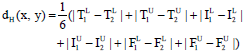 | (6) |
| • | The Euclidian distance between x and y is defined as follows: | |
 | (7) |
PROPOSED TOPSIS APPROACH USING INTERVAL NEUTROSOPHIC SET
In this section, the TOPSIS method using INS is developed for personnel selection. Let us assume that a committee of k decision-makers (Dt, t = 1,…, k) is responsible for evaluating n alternatives (Ai, i = 1,…, n) under m selection criteria (Ch, h = 1,…, m), where the suitability ratings of alternatives under each criterion, as well as the weights of all criteria are assessed in INS. The steps of the proposed TOPSIS method are as follows.
Aggregate ratings of alternatives versus criteria: Let  be the suitability rating assigned to alternative Ai by decision-maker Dt for criterion Ch i = 1,…, n; t = 1,…, k; h = 1,…, m. Using the operational rules of the INS, the averaged suitability rating
  can be evaluated as:
 | (8) |
Where:
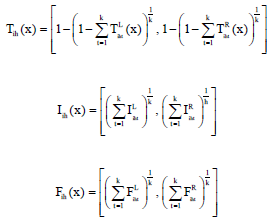
Aggregate the importance weights: Let  be the weight assigned by decision-maker Dt to criterion Ch, t = 1,…, k; h = 1,…, m. Using the operational rules of the INS, the average weight
  can be evaluated as:
 | (9) |
Where:
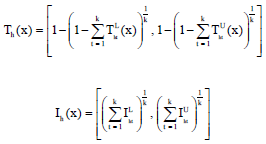
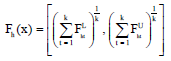
Aggregate the weighted ratings of alternatives versus criteria: The weighted ratings of alternatives can be developed via the operations of INS as follows:
 | (10) |
Calculation of A+, A‾,  and
and  : The positive-ideal solution (FPIS, A+) and fuzzy negative ideal solution (FNIS, A‾) are obtained as:
A+ = ([1, 1], [0, 0], [0, 0]) | (11) |
A‾ = ([0, 0], [1, 1], [1, 1]) | (12) |
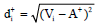
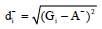
The distances of each alternative Ai, i = 1,…, n from A+ and A‾ are calculated as:
 | (13) |
 | (14) |
where,  represent the shortest distances of alternative Ai and
  represents the farthest distance of alternative Ai.
Obtain the closeness coefficient: The closeness coefficient of each alternative, which is defined to determine the ranking order of all alternatives, is calculated as:
 | (15) |
A higher value of the closeness coefficient indicates that an alternative is closer to PIS and farther from NIS simultaneously. The closeness coefficient of each alternative is used to determine the ranking order of all alternatives and identify the best one among a set of given feasible alternatives.
APPLICATION OF THE PROPOSED TOPSIS METHOD
In this section, the proposed TOPSIS approach is applied to select the academic staffs at Academy of Finance (AOF). Recently, AOF has 13 administrative divisions, 14 academic faculties and 02 research institutes.
Suppose that AOF needs to select a candidate for the teaching position. After preliminary screening, four candidates, namely A1,…, A3 and A4 are chosen for further selection. A committee of four decision makers from AOF’s Board of management, office of human resources and department head, i.e., D1, D2, D3 and D4, conducts the selection of the four candidates. Based on the discussion with the committee members, six selection criteria are considered including number of publications (C1), quality of publications (C2), personality factors (C3), activity in professional society (C4), classroom teaching experience (C5) and fluency in a foreign language (C6). The computational procedure is summarized as follows:
Aggregation of the ratings of candidates versus the criteria: Four decision makers determine the suitability ratings of four potential candidates versus the criteria using the INS S = {VP, P, M, G, VG} where, VP = Very poor = ([0.1, 0.2], [0.6, 0.7], [0.7, 0.8]), P = Poor = ([0.2, 0.3], [0.5, 0.6], [0.6, 0.7]), M = Medium = ([0.3, 0.5], [0.4, 0.6], [0.4, 0.5]), G = Good = ([0.5, 0.6], [0.4, 0.5], [0.3, 0.4]) and VG = Very good = ([0.6, 0.7], [0.2, 0.3], [0.2, 0.3]), to evaluate the suitability of the candidates under six criteria. Using Eq. 8, the aggregated ratings of four candidates (A1, A2, A3, A4) versus six criteria (C1,…, C6) from four decision-makers (D1, D2, D3, D4) are shown in Table 1.
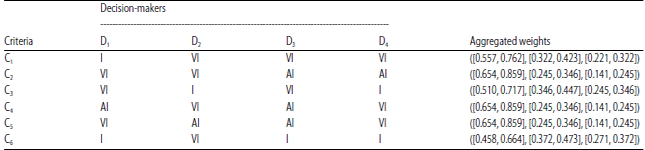
Aggregate the importance weights: After determining the lecturer selection criteria, the committee members are asked to determine the level of importance of each criterion using the INS, V = {UI, OI, I, VI and AI}, where UI = Unimportant = ([0.1, 0.2], [0.5, 0.6], [0.7, 0.8]), OI = Ordinary important = ([0.2, 0.4], [0.5, 0.6], [0.5, 0.6]), I = Important = ([0.4, 0.6], [0.4, 0.5], [0.3, 0.4]), VI = Very important = ([0.6, 0.8], [0.3, 0.4], [0.2, 0.3]) and AI = Absolutely Important = ([0.7, 0.9], [0.2, 0.3], [0.1, 0.2]). Table 2 displayed the importance weights of the six criteria from the four decision-makers. The aggregated weights of criteria obtained by Eq. 9 are shown in the last column of Table 2.
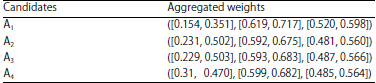
Aggregate the weighted ratings of alternatives versus criteria: Table 3 presented the weighted ratings of alternatives of each candidate using Eq. 10.
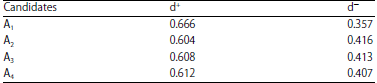
Calculation of A+, A‾, and : As shown in Table 4, the distance of each candidate from A+ and A‾ can be calculated using Eq. 11-14.
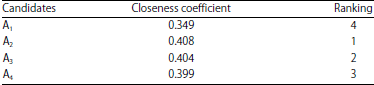
Obtain the closeness coefficient: The closeness coefficient of each candidate can be calculated by Eq. 15, as shown in Table 5. Therefore, the ranking order of the four candidates was A2›A3›A4›A1 Consequently, the best candidate is A2.
| Table 1: | Aggregated ratings of alternatives versus the criteria |
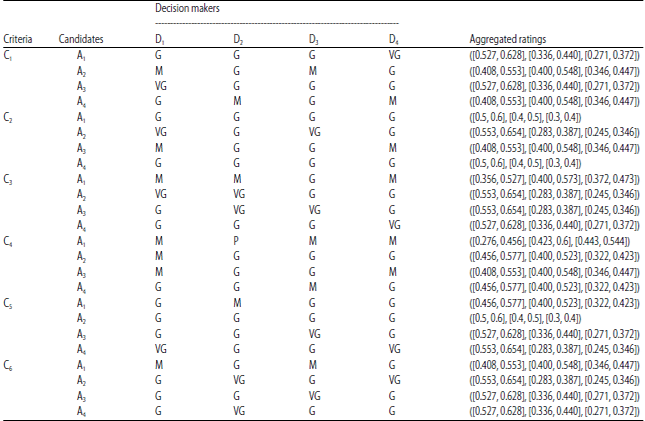 | |
| G: Good, M: Medium, VG: Very good, P: Poor | |
| Table 2: | Importance and aggregated weights of the criteria |
 | |
| Table 3: | Weighted ratings of each candidate |
 | |
| Table 4: | Distance of each candidate from A+ and A‾ |
 | |
| Table 5: | Closeness coefficients of candidates |
 | |
DISCUSSION
Personnel selection plays an importance role for all organizations. Several decision makers and criteria should be involved in the decision process to select the appropriate personnel. Consistent with past studies2,3,5, several quantitative and qualitative criteria such as organizing ability, creativity, personality and leadership, are considered in the personnel selection process. This study proposed the new TOPSIS approach using INSs to solve personnel selection problem which can extend and overcome the shortcomings of the existing TOPSIS method21-23,25. The proposed model allows the ratings of personnel and the importance weight of criteria to be expressed in INSs. The proposed TOPSIS method could be extend by integrating with AHP technique5,29,30 in order to determine the importance weight of evaluation criteria. In addition, different MCDM methods could be used to compare the ranking result with the proposed method.
The proposed approach and application of this study should be of interest to both companies’ managers and researchers. The results show that the proposed method is effective in personnel selection for organizations. The proposed method may also be applied to solve other MCDM problems with similar settings in various industries such as investor selection, market segment selection, supplier selection vv.
CONCLUSION
This study proposed new TOPSIS decision making procedures to solve the lecturer selection in the case study of Academy of Finance (AOF) with four decision makers and six selection criteria. In the proposed method the importance weights of all criteria and the ratings of various personnel under different criteria are assessed in linguistic values represented by INSs. It has been demonstrated throughout the detailed calculation in the application that the proposed TOPSIS approach is efficient and more general as compared to the relevant studies.
SIGNIFICANCE STATEMENT
This study proposes a new TOPSIS approach using INS to solve the personnel selection problem, where the importance weights of all criteria and the ratings of various personals under different criteria are assessed in linguistic values represented by the INS. This study will help companies to find the right people for the right jobs in order to optimize production costs and achieve corporative goals. The proposed TOPSIS approach can also be applied to other areas of management decision problems.
ACKNOWLEDGMENT
The author is very grateful to the anonymous reviewers for their insightful and constructive comments and suggestions, which have been very helpful in improving the paper.
REFERENCES
- Aksakal, E., M. Dagdeviren, E. Eraslan and I. Yuksel, 2013. Personel selection based on talent management. Procedia-Social Behav. Sci., 73: 68-72.
CrossRefDirect Link - Dursun, M. and E.E. Karsak, 2010. A fuzzy MCDM approach for personnel selection. Expert Syst. Applic., 37: 4324-4330.
CrossRefDirect Link - Chien, C.F. and L.F. Chen, 2008. Data mining to improve personnel selection and enhance human capital: A case study in high-technology industry. Expert Syst. Applic., 34: 280-290.
CrossRefDirect Link - Lin, H.T., 2010. Personnel selection using analytic network process and fuzzy data envelopment analysis approaches. Comput. Ind. Eng., 59: 937-944.
CrossRefDirect Link - Gungor, Z., G. Serhadlioglu and S.E. Kesen, 2009. A fuzzy AHP approach to personnel selection problem. Applied Soft Comput., 9: 641-646.
CrossRefDirect Link - Atanassov, K.T., 1989. More on intuitionistic fuzzy sets. Fuzzy Sets Syst., 33: 37-45.
CrossRefDirect Link - Atanassov, K. and G. Gargov, 1989. Interval valued intuitionistic fuzzy sets. Fuzzy Sets Syst., 31: 343-349.
CrossRefDirect Link - Biswas, P., S. Pramanik and B.C. Giri, 2016. TOPSIS method for multi-attribute group decision-making under single-valued neutrosophic environment. Neural Comput. Applic., 27: 727-737.
CrossRefDirect Link - Li, Y., P. Liu and Y. Chen, 2016. Some single valued neutrosophic number heronian mean operators and their application in multiple attribute group decision making. Informatica, 27: 85-110.
CrossRefDirect Link - Liu P. and G. Tang, 2016. Multi-criteria group decision-making based on interval neutrosophic uncertain linguistic variables and Choquet integral. Cognitive Comput., 8: 1036-1056.
CrossRefDirect Link - Liu, P., L. Zhang, X. Liu and P. Wang, 2016. Multi-valued neutrosophic number Bonferroni mean operators with their applications in multiple attribute group decision making. Int. J. Inform. Technol. Decis. Mak., 15: 1181-1210.
CrossRefDirect Link - Sahin, R. and P. Liu, 2016. Maximizing deviation method for neutrosophic multiple attribute decision making with incomplete weight information. Neural Comput. Applic., 27: 2017-2029.
CrossRefDirect Link - Tian, Z.P., H.Y. Zhang, J. Wang, J.Q. Wang and X.H. Chen, 2016. Multi-criteria decision-making method based on a cross-entropy with interval neutrosophic sets. Int. J. Syst. Sci., 47: 3598-3608.
CrossRefDirect Link - Ye, J., 2014. Single valued neutrosophic cross-entropy for multicriteria decision making problems. Applied Math. Modell., 38: 1170-1175.
CrossRefDirect Link - Ye, J., 2016. Interval neutrosophic multiple attribute decision-making method with credibility information. Int. J. Fuzzy Syst., 18: 914-923.
CrossRefDirect Link - Zhang, M., P. Liu and L. Shi, 2016. An extended multiple attribute group decision-making TODIM method based on the neutrosophic numbers. J. Intell. Fuzzy Syst., 30: 1773-1781.
CrossRefDirect Link - Kundakci, N., 2016. Personnel selection with grey relational analysis. Manage. Sci. Lett., 6: 351-360.
CrossRefDirect Link - Saad, R.M., M.Z. Ahmad, M.S. Abu and M.S. Jusoh, 2014. Hamming distance method with subjective and objective weights for personnel selection. Scient. World J., Vol. 2014.
CrossRefDirect Link - Khorami, M. and R. Ehsani, 2015. Application of multi criteria decision making approaches for personnel selection problem: A survey. Int. J. Eng. Res. Applic., 5: 14-29.
Direct Link - Kabak, M., S. Burmaoglu and Y. Kazancoglu, 2012. A fuzzy hybrid MCDM approach for professional selection. Expert Syst. Applic., 39: 3516-3525.
CrossRefDirect Link - Zhang, S.F. and S.Y. Liu, 2011. A GRA-based intuitionistic fuzzy multi-criteria group decision making method for personnel selection. Expert Syst. Applic., 38: 11401-11405.
CrossRefDirect Link - Kelemenis, A. and D. Askounis, 2010. A new TOPSIS-based multi-criteria approach to personnel selection. Expert Syst. Applic., 37: 4999-5008.
CrossRefDirect Link - Hatami-Marbini, A. and F. Kangi, 2017. An extension of fuzzy TOPSIS for a group decision making with an application to tehran stock exchange. Applied Soft Comput., 52: 1084-1097.
CrossRefDirect Link - Nadaban, S., S. Dzitac and I. Dzitac, 2016. Fuzzy topsis: A general view. Procedia Comput. Sci., 91: 823-831.
CrossRefDirect Link - Alizadeh, S., M.M.S. Rad and A.A. Bazzazi, 2016. Alunite processing method selection using the AHP and TOPSIS approaches under fuzzy environment. Int. J. Mining Sci. Technol., 26: 1017-1023.
CrossRefDirect Link - Kutlu, A.C. and M. Ekmekcioglu, 2012. Fuzzy failure modes and effects analysis by using fuzzy TOPSIS-based fuzzy AHP. Exp. Syst. Applic., 39: 61-67.
CrossRefDirect Link - Roszkowska, E. and T. Wachowicz, 2015. Application of fuzzy TOPSIS to scoring the negotiation offers in ill-structured negotiation problems. Eur. J. Operat. Res., 242: 920-932.
CrossRefDirect Link - Mohammadi, A., A. Mohammadi and H. Aryaeefar, 2011. Introducing a new method to expand TOPSIS decision making model to fuzzy TOPSIS. J. Math. Comput. Sci., 2: 150-159.
Direct Link - Sengul, U., M. Eren, S.E. Shiraz, V. Gezder and A.B. Sengul, 2015. Fuzzy TOPSIS method for ranking renewable energy supply systems in Turkey. Renewable Energy, 75: 617-625.
CrossRefDirect Link